
(Image stolen from TaylorTomlinsonComedy.com)
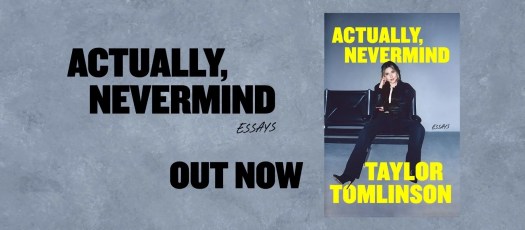
Last week, I went on about a different book, Frivolity: A Defense, by Jehanne Dubrow. Once that was done, I picked up my impulse buy at Northshire Books: Actually, Nevermind, by Taylor Tomlinson. And what I hadn’t expected was that the existence of the second was an excellent demonstration of the argument of the first.
I’ve always been a huge fan of standup comedy. When I was a kid, every variety show had an array of men (almost always men, almost always in tuxes) who stood on their own with a mic in their hand. America’s eyes were on them, and they told stories. They had no backup, they had no bunker to duck down in when things went bad. They just stood there and made us laugh.
I liked comedy of all sorts, of course. Sketch comedy was wonderful: nobody could make us laugh like Carol Burnett and her crew. Sitcoms were terrific (and if you’re my age, you’ll appreciate the role of Charles Douglass’ “Laff Box” in amplifying the home audience’s reaction). But there was something pure and raw about the people who could just face us and do the work of helping us laugh.
I still watch a lot of comics on YouTube, and my favorite is Taylor Tomlinson. Her writing is terrific, her delivery is spot on, and her crowd work is attentive and jet-fast. She does the work of frivolity — of making something that doesn’t need to exist, because it’s generous. Because it gives us the luxury of laughing with someone in pleasure instead of laughing at someone in cruelty.
Lots of famous people’s books are boring because they got famous for doing something other than writing. Tomlinson’s book pays off because it comes from the same skills she’s honed as a professional for fifteen years. She knows how to tell a story, in a very particular way — she makes fun of herself, and somehow does it in a way that makes us want to give her a hug and tell her how terrific she is.
Actually, Nevermind, without actually saying exactly those words, is a book about that strategy and about its origins. About needing to be hugged and told how terrific she is. I don’t want to tell you about it, I want you to go read it yourself. But I will share one passage, seemingly a throwaway that actually landed hard for me after reading last week’s book.
She and her friends went, on a bachelorette weekend, to a psychic to have their auras read. “…as she worked her way through our group, it became clear that she could not read auras. Or at least, not our auras. She kept telling us we were giving her “philanthropist” vibes, which made it embarrassing to reveal that we were a bunch of corporate lawyers and a comedian. (p.217)
Taylor, I can’t speak about your friends, but you are exactly a philanthropist. You give from your experiences, in a way that offers us relief from toil, that provides the unnecessary pleasure of laughing together. Making people laugh is one of the greatest gifts anyone can offer. I’m grateful that you didn’t end up doing something “useful” and “productive,” that you just trusted yourself to offer the unnecessary joy that lifts us all. Thank you.

