Jean-Pierre Dalbéra – originally posted to Flickr as La statue de Quan Am dans la pagode But Thap,
Watching the Democratic debate tonight. I’m not going to talk about the politics or the demeanor, but rather about Gayle King’s last question: What are the words you live by?
I would like to live by these words. I aspire and fail to live by all these words all the time, which is why they matter.
Be kind whenever possible. It is always possible.
the Dalai Lama
The Dalai Lama is thought to be the current incarnation of the spirit of the bodhisattva Avalokiteśvara or Quan Am. Bodhisattva is kind of a cool job title—it describes a person on the road toward enlightenment not merely for himself or herself, but on behalf of a community. A Bodhisattva regularly sets aside his or her own progress in favor of the support of others.
Quan Am, the Vietnamese referent for Avalokiteśvara, is often shown as having a thousand hands to lift all those who need, a thousand eyes to see all suffering, a thousand ears to hear all cries. It’s hard work, but needed.
There are lots of Bodhisattvas, people who could be enormously recognized for their talents as individuals but who instead choose to lift those around them. We see them not often in full sun, but rather in glimpses, as the others around them shine.
Say thanks to the bodhisattva closest to you. You know who they are.
You work really hard to understand your characters. To make sure that their flaws are understood, that their current condition makes sense from prior conditions, that they have a coherent and whole personality.
But sometimes, you just get to write a bad guy. And it’s so much fun!!
I’m writing, of all things, an architectural novel. Really, it’s a novel about a building, and the people who occupy the different spaces for different reasons. And there are three people who showed up today who are just awful. Just. Awful.
They exist, of course, as obstacles and hazards for the well-meaning people around them. And I could give them some kind of nonsense backstory that explains their wounded psyche, that somehow justifies their bad behavior, like the recent Joker movie. But I don’t want to.
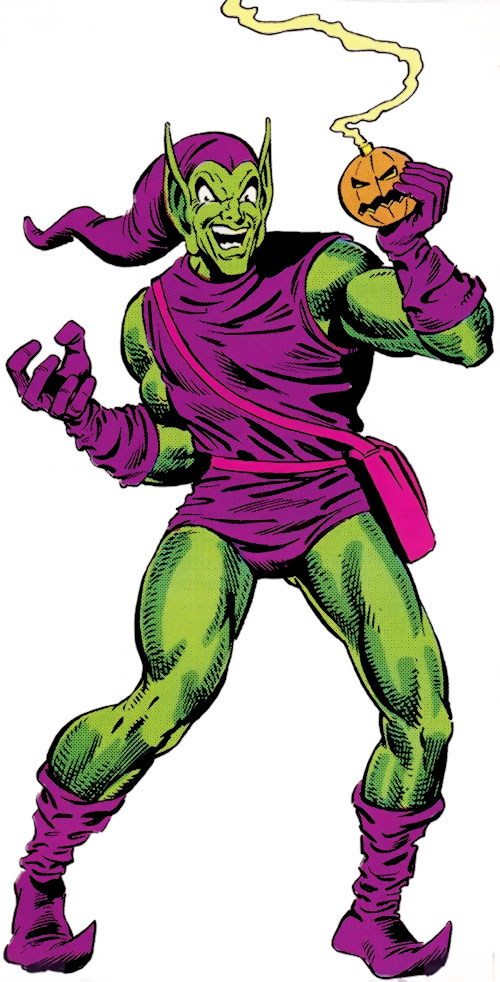
Comic books have so much fun with supervillains. The Wikipedia page for “comics supervillains” shows the following numbers of supervillains by publisher:
Amalgam Comics (18)
DC Comics (625)
Fawcett Comics (11)
Image Comics (26)
Marvel Comics (994)
Wildstorm Universe (15)
That’s one thousand six hundred and seventy four bad guys! If I ever got to work for Marvel, I’d volunteer for the bad-guy division, just for the fun of having someone with a singular motivation. James Bond, too. Sign me up for sidekicks and villains, please.
Some writers use villains like bakers use pie crust, as a fully-warranted counterpoint to the superhero filling. I use them more like cayenne pepper, a small quantity, but enough to make our hero spicy as he has to deal with the problem. They appear for a chapter or two, not as the central opponent that our hero has to address—that would be himself, as he tries to overcome his own flaws and fears—but as a particular moment, usually as someone that our hero would once have avoided but now realizes needs to be confronted after all.
Anyway, I hadn’t expected the bro-triumvirate of Cameron and Chandler and Raines to show up today, but they were exactly who I needed to see. Man, they’re just terrible!
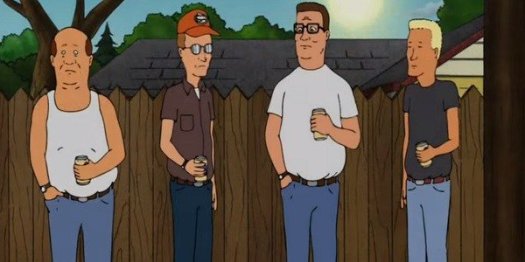
Men make. We make houses, machine parts, clever boxes. We make decisions, pronouncements. We make mistakes.
Men fix. We fix cars, tractors, snowblowers. We fix potholes, sewers, power lines. We fix public policy, international relations. We fix mistakes, sometimes, when we’re not making another.
Men know. We know the right way to baste ribs, the right way to plow driveways, the right way to mow the lawn. We know what the shortstop should have done, what the coach should have called, what the umpire should have seen. We know that the policy is stupid, that the legislators are on the take, that the strategy defies “common sense.” Which only we know.
Men love. We love mutely. We love in spite of knowing that we are fundamentally unlovable. We love by demonstrating that we are unlovable, daring our partners and friends to leave and thus prove us right.
Men take. We take charge, take up space, take the bull by the horns. We take the reins, take over, take what’s ours. And we don’t take any shit.
Men defend. We defend nation and family and position. We defend pride and honor. We build our shell to defend our hollow center.
Men enforce. We enforce laws and standards. We enforce borders, treaties, agreements, each other.
Men man up. Which is to say, we shut up. We man up about embarrassing things we’ve done, about our frailties, about our resentments. We come together, if at all, over the combat of other men. We look outward, not inward. We don’t fucking whine about it.
Men die. We die flamboyantly, in racing crashes and drunken boating accidents. We die of stupid habits—smoking, eating Buffalo wings, fucking around with guns. We die on the job, crushed by a tree or dismembered by the saw, lungs blackened, ears deafened. We die at each other’s hands, the sudden flaring argument or the lifelong grudge. We die from disappointment, from stress, from confusion, from stubbornness. We die from what we do.
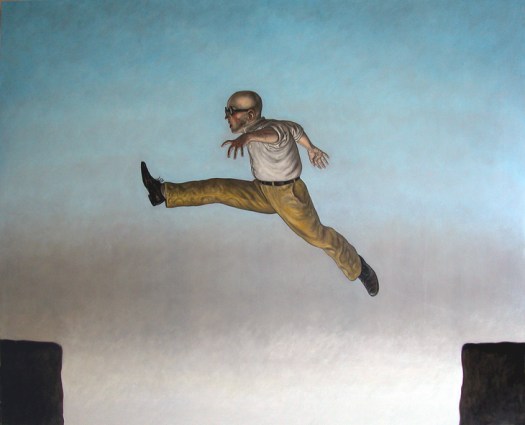
Leaping Man, by David Dalla Venizia, the print I brought home with me from my trip to Venice. It’s framed and hanging in my pool room.
We tell ourselves stories in order to live.
Joan Didion
I believe that we organize our lives around narrative principles. That is, we are the protagonists of our own stories, defining ourselves through the roles we fulfill and the roles we’re remanded to by others, defining ourselves by our goals and our settings, and encountering others as we go along. Our “stages of life” are the periods in which the story is more or less coherent.
Every so often, though, the story stops making sense. Stops being readable. Stops being satisfying. The old story is broken, and we haven’t crafted a new one yet. That narrative gap is normal, more regular than we think, and yet wrenching every time we have to go through one. Although journalist Gail Sheehy laid out some of these in her 1976 book Passages: Predictable Crises of Adult Life, I think she oversimplifies in an effort to make everything fit into decades—The Trying 20s, the Catch 30s, the Forlorn 40s, and so on. Let me try a different take at it.[1]
Here are some of the common wrenches that we’ll have tossed into our gears during our lives, in kind of a common chronological sequence. School, sexuality, college/work, legal independence, serious relationship(s), breakup(s), work failure, children, menopause, first serious health scare, retirement, major physical/intellectual limitation. Add your own. At every point, the easy prior self-definition can no longer be taken for granted, and some new self has to be constructed.
The Adjunct Underclass is, at its heart, about the psychic destruction of a formerly understood story. For decades, we were told that we were smart. We were given harder things to do, and we did those. We got accepted to new schools, thrived there, met new challenges at every step and were acknowledged to have mastered every one. We had a story, we had an identity, we had a path. We knew how to behave, how to be rewarded.
And then one day, the rewards just stopped. Not through any failure of our own, but simply because the treat bag was now empty. There were no more tests, no next committee to satisfy, no next semester to enroll in, and no next career step to take.
This is a particular instance of a common occurrence. The factory closes, the kids leave home, the heart lurches, the ovaries close up shop with only the occasional clearance sale.
Mom used to pack my lunch, but now I have to go to the grocery store myself and understand how to cook and not just eat Cheerios and Bud Light.
I’m good at my job, but it isn’t fun any more, and I haven’t learned anything new in five years.
It takes a while to learn how to construct a reliable new self when the old one breaks down. And it takes a while to fully acknowledge that the old self can’t be salvaged… we often hang onto it for too long. We can’t rush that, even though we’d like to.
We build the new life by feel rather than by plan. We fix some pieces to an understood foundation, even when we don’t know what the upper floor might look like yet, or where the stairs are. Sometimes that means we have to take stuff apart, because it doesn’t get us to the right place.
I feel like I’m there, in that space between, building without a plan.
I’m pretty much done with higher ed; I’ve got nothing left to say, and increasingly no credence left upon which to say it. It’s been at least six years since I led an accreditation, wrote an assessment plan, led undergraduates through a curriculum, sat on a dissertation committee, created a new course. I’ve written three books, and don’t have anything left in that tank, by current experience and by interest. That divorce is more or less finalized, only seven years since I walked away from a daily identity in higher ed.
I’m trying to construct a new identity as a fiction writer, and I’m doing some of the things that I can understand. Mainly, I’m writing. A lot. That feels like the right thing to do. I’ve taken on different forms of formal and informal coaching, from writers’ groups to conferences to the endless reading of writers’ guides and website advice. I show up and do the work.
But there are steps yet to go. I’m working, more or less blindly, to find readers. Maybe, in order to do that, I’ll have to take some things apart that feel secure, because the stairs aren’t where I expected. Maybe there aren’t stairs at all. There’s no way to know. I’ll just keep building, and occasionally raise my eyes and look around.
[1] I refer you, for the best treatment I’ve seen of “stages of life,” to Hugh Klein, “Adolescence, Youth, and Young Adulthood: Rethinking Current Conceptualizations of Life Stage,” Youth and Society 21:4, 1990. If you can get this through interlibrary loan, you absolutely should.
Please note that there will be some crudeness in today’s post. Please leave now if you don’t want to know what John Irving did to some people…
Okay, so every so often, there are scenes so tightly wound that they clearly illuminate everything that’s come before as mere clockworks, components that enable the core metaphor of the book or movie. Tarantino is full of them, as is Paul Thomas Anderson, Jennifer Egan, Steven Holl. It’s a common high-culture malady, as true in modern architecture and modern music as it is in modern literature. We’re supposed to admire the creator’s ingenuity more than the actual sounds or images or words or people.
Basta.
The example that first made me think of this, almost thirty years ago, is the moment when I quit The World According to Garp in full disgust, recognizing all at once that each and every character existed only to play out the author’s cleverness. The hinge of the book comes in the few pages when all of the foreshadowing is triggered at once, like a game of Mousetrap, to implement the whole Rube Goldberg device.
There’s Garp himself, the product of multiple sexual traumas, who is little more than broken, ambulatory libido.
There’s his wife Helen, an English teacher driven to affairs of her own by Garp’s inattention and infidelity.
There’s their son, ignored by both of his ruined parents.
There’s the repeated theme of physical mutilation as a symbol or outcome of sexual abuse.
There’s the car with the gearshift lever that they’ve never repaired, its bare metal shaft a symbol of their acceptance of decay.
There’s the steep driveway, which Garp regularly uses as a test of masculine capability, gauging his speed so that he can coast the last bit uphill and let the car come gently to rest in the garage bay.
Can you guess what dish Irving concocts from this recipe?
(Don’t read this next paragraph if you’re worried about spoilers or naughty words or authorial human decency.)
Helen feels guilty about the affair she’s carried on with a student, has him over to break it off, but agrees to give him a farewell blowjob in his car. Garp is coming home with their toddler son, no seatbelt or carseat, himself uncertain about their marriage and family. He rolls up the hill in the fog, and runs into the back of the student’s car in the garage. In the impact, Helen bites off her lover’s dick, and Garp’s son is thrown onto the gearshift and loses an eye.
Oh HELL no! You didn’t just do that! Oh, fuck you, dude, I’m out!
You do NOT bring me two hundred pages into a book just to reveal that you think of your characters as nothing more than a vaudeville setup. You do NOT ask me to care about real people and then make them artifice again. No. I will not have it.
And I had that experience again this afternoon at about 3:30, while reading the 2015 novel Hausfrau, by Jill Alexander Essbaum. It’s a book of metaphors. The Swiss German language as a metaphor for action and inaction, for the consideration of tense and gender. The work with a Freudian therapist, Freudian analysis being nothing but the investigation of metaphor. The endless affairs as a metaphor for disillusion and passivity. The notion of Swiss emotional reserve as a metaphor for all of male inattentiveness to women’s inner lives. The mixed-parentage baby as a metaphor for all of the secrets Anna can never reveal. Her inner life, enormously detailed in its protective inertia, kept at its own emotional distance from us (and from Anna herself).
But then, at the stereotypical moment of two-thirds-of-the-way-through-the-book, Anna finally tries to do “the right thing,” fails at it, and is immediately punished in the most garish, cruel way that her allies (us, the readers) could ever have imagined. And we suddenly realize that Essbaum wasn’t employing metaphors to help us understand Anna’s life, but rather that Anna’s life, and the lives of those around her, were nothing but authorial metaphors in the first place. The World One is shredded to reveal the World Two author, grinning like Harley Quinn as she reveals her presence behind the levers.
And looking back from that moment of reveal, I can now see that Anna’s therapist Doktor Messerli had all the best lines. She’s actually been the only person in this story with insight or agency, her Freudian metaphoric analysis being the Greek chorus that offers interpretive commentary. Here’s one of the very best things in the book, right up front on p. 6:
“Shame is psychic extortion,” Doktor Messerli answered. “Shame lies. Shame a woman and she will believe she is fundamentally wrong, organically delinquent. The only confidence she will have will be in her failures. You will never convince her otherwise.”
(There’s an entirely different blog essay coming in the next week or so about incorrectly gendering the work of shame, spawned by an article from a couple of weeks ago by Jennifer Weiner. We’ll get back to that at some point, after I get through this afternoon’s trauma.)
This is full authorial malpractice. This is an abuse of trust, asking me to believe in the virtual reality of World One and then ripping it open to see the Matrix beneath, shimmering with its manipulative algorithms. It is a fully Modernist abuse, all head and no heart.
If I were still teaching, I would teach this novel beside Jennifer Tseng’s outstanding book Mayumi and the Sea of Happiness. We could explore the parallels:
The authors, both celebrated poets embarking on their first novels
The protagonists, women of similar age (38 and 41), women in marriages that are “good enough” but not at all good
Both women with children whom they love but do not begin to understand
Both women in landscapes that they only partially inhabit, different from those around them in some fundamental ways
Women who embark on secret affairs, and equally secret wandering just to be alone
Both stories culminating in an unexpected death that the protagonist and others must collectively come to terms with
And even with all of those parallels, one story is generous and the other meager. One is wise, the other merely intelligent. One is kind, the other cold. One uses metaphor inductively, to love, to explore, to illuminate the detailed contours of precious lives. The other uses metaphor deductively, to delimit, to burn away, to incinerate everything outside its own concerns.
Essbaum’s book has done one good thing for me. It has given me the desire to go back and re-read Tseng’s.
Will you tell this author that there are glittering prizes ahead for those who can write as she does?
Robert Hale, British publisher, 1948
Eleanor Alice (Burford) Hibbert was a novelist who wrote steadily and proficiently from the 1930s through the mid-1990s. In her long career, she published over 200 novels. And almost no one had ever heard of her.
They had probably heard of some of the thirty novels she published under her birth name, Eleanor Burford. In England, many readers had probably known of her remarkable career as a historical novelist, the ninety novels published as Jean Plaidy. Americans would more likely have known the thirty books she wrote beginning in the 1960s as Victoria Holt. There were books by Elbur Ford and Kathleen Kellow, books by Anna Percival and Philippa Carr and Ellalice Tate. In the end, it’s estimated that her books collectively sold over 100 million copies in twenty different languages.
She wrote five hours a day, even though that much typing was a physical strain. “I love my work so much that nothing would stop me writing,” she said. “When I finish one book I start on the next. If I take even a week’s break I just feel miserable. It’s like a drug.”
When I feel good about my own work, when it flows without conscious effort on my part, when the high is in full flower, I’m good for an average of eleven or twelve hundred words in a day. More often, it’s in the mid-600s, and even that’s good enough for two books a year. But when Ms. Hibbert was all-in, she averaged over five thousand words a day, seven days a week. At that pace, even a February outside a leap year could be good for a book and a half. Even assuming a few days off for illness or outside responsibilities, that’s 1,750,000 words a year.
I love prolific writers, and aspire to be one. The San Francisco Chronicle daily columnist Jon Carroll quoted William Saroyan as saying, “I can write better than anybody who can write faster, and I can write faster than anybody who can write better.” It’s like kitchen work; you can make brilliant meals for two hundred diners every night once you know your practice. Every restaurant is fast paced, whether it’s Red Lobster or Blue Hill. Being a prolific writer does not imply that one is a hack. I think it’s the mark of a craftsperson who just does the work, every day.
Over the course of his thirty year career, Carroll published about six million words in the Chronicle, and he became a beloved newsprint philosopher in the Bay Area. In the seven years I’ve been writing steadily, I’m barely at 900,000 (plus another 150,000 or so on the two blogs I’ve run).
Go up to the place in the bookstore where your books will go… Walk right up and find your place on the shelf. Put your finger there, and then go every time.
Annie Dillard, as reported by her former student Alexander Chee
The first fiction cove in Northshire Books, Manchester VT, where today’s story is set…
My shelf was knee high in the first cubby of fiction, the wing that ran from A through Cr, like homeroom. I had to sit on the footstool to read it.
Most were there as single copies, alone at the cocktail reception and hoping to find a conversation. Nine were twinned with an identical partner, only one in triplet—the featured book of the row, the only one faced out rather than spinewise, and the only hardback.
Only three writers represented by more than a single book. Chabon, Chevalier, Choi. All the rest: only their most recent, or their most famous, or their only.
In class, the idea seemed ridiculous. But at some point after the class ended, I did it. I walked up to the shelf. Chabon. Cheever. I put my finger between them and made a space. Soon, I did it every time I went to a bookstore.
Alexander Chee
By luck of the draw, Chee and Childress would have been shelfmates. I would’ve said hi, but he wasn’t there. But I do know that his bookstore is far smaller than mine, if he could have merely put a finger between Chabon and Cheever. I could have fit my whole forearm in there, shoving aside Mai-Lee Chai and Patrick Chamoiseau and Eileen Chang and Dan Chaon and Kate Chapin and Sasha Chapin and Ryan Chapman and Jerome Charyn and Eve Chase and Maunta Chaudhry and Amit Chaudhury and Chip Cheek. We all know those partygoers who only talk with us for a few minutes until they spot someone important, and immediately leave us forgotten. I fear that Alexander Chee would do that to me, based on the name-dropping in his collection of personal essays that I bought a couple of weeks ago from a different neighborhood in the bookstore altogether. We’re all climbers, even though we inhabit different levels at any moment.
At any rate, my own finger landed, with more precision, between Jennifer Chiaverini’s Resistance Women and Richard Chizmar’s Gwendy’s Magic Feather. Fine neighbors, though not previously known to me. I said hi to them both, and they wished me good luck but let me know that it was lonely sometimes, and that they wrote their asses off: Chizmar as a twenty-year horror writer with books and stories and screenplays galore, Chiaverini with thirty-eight books that I might classify as “cozy history,” originating in her experience as a quiltmaker and quilting teacher. Get busy, they said to me, and then went silent.
I felt like I should make an offering, in gratitude for letting me hang out and pretend to be a colleague. So, because I’ve been at work on a book about extraordinarily talented teenagers, I bought one of the three hardback copies of Susan Choi’s Trust Exercise, since it also evokes the experience of talent, and confusion, and high school.
The only bookstore I ever had was the paperback rack at the drugstore.
Larry McMurtry
I’ve never known what level my brow is. To use the standard definitions, I’ve been all three, and remain a sort of tossed salad. There’s lowbrow, relating to or suitable for a person with little taste or intellectual interest. There’s highbrow, related to things that are sophisticated, elite or high culture. And perhaps worst of all is middlebrow: easily accessible art and literature, and the people who use the arts to acquire culture and social prestige.
Bingo! Filled the card!
The only hardcover books that ever came into our home were a) the World Book Encyclopedia of 1963, b) my school books, and c) the Readers’ Digest Condensed Books, one bound edition containing anywhere from four to six mildly abridged full novels, released four times a year. (THERE’s a self-publishing idea…)
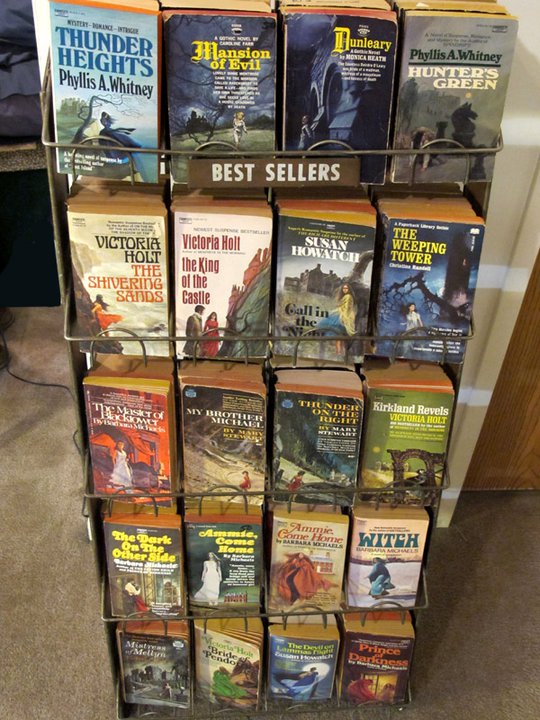
My house was filled with books, though, like the Avon paperbacks shown above. They were tiny books: an Etsy listing for one of these (Avon S216) shows it as 4.25″ x 7″, half an inch thick, at 224 pages. That thickness was only due to the crap paper they printed on (hence “pulp” fiction), but really, for sixty cents, you could have a full novel that would fit in your back pocket.
I love that. I love everything about it. I love that it was cheap. I love that it was small. I love that it was unobtrusive. I love that there weren’t author photos, or the words “A Novel” on the front. I love that they fell apart, that they weren’t precious, that no one thought of them as collectibles.
I don’t have many left myself. But they were real books, anywhere from 60,000 to 80,000 words, with small text and small margins and single spacing. One of the reasons modern books cost more is that the text is more generous, the spacing more open, the typefaces carefully chosen. The graphic arts departments are doing more beautiful, elegant covers, the page layout designs are equally elegant, and the marketing group is busy harvesting reviews and blurbs and commendations. By contrast, the pulp guys didn’t pay anybody much in the production world, and the “marketing department” was a loose array of rack jobbers, wholesalers who paid a small amount to put wire racks of paperbacks and comics and eight-tracks and greeting cards into drugstores and neighborhood groceries.
The rack jobbers were in a symbiotic relationship with their host stores: they paid for space and inventory, and usually a small percentage of sales; they bore all the risk of shoplifting and wear; and they kept whatever they sold after that. They’d drop by once or twice a month, see what had sold, and re-fill the racks with either high-demand or new titles. I love that too. The word “job” is derived from gob, or a pile of work. So a jobber is a merchant who sells piles of work, always with a ruthless eye toward what is and isn’t selling.
And let’s be honest. That’s what the highbrows do, too.
It’s a dirty story of a dirty man, and his clinging wife doesn’t understand His son is working for the Daily Mail It’s a steady job, but he wants to be a paperback writer
In this morning’s e-mail, from the increasingly accurately named Random House
I was trained in social science research methods, and one of the things hammered into us is that if you’re going to give someone a multiple choice question, the answers need to be meaningfully different from one another. The question “what’s your favorite dinner?” can’t include the options for both fried chicken and Brad Pitt, because one is a food and the other a dinner partner. (At least, we hope…)
Categories matter, dammit. And it’s not as though there’s a single category system that should always pertain regardless of circumstance; categories are situational, related to what we hope to accomplish more than to the thing itself. The thing is a thing; the category into which we place it says more about us than about the object. It’s an end-based sorting mechanism, and we determine the ends toward which we sort.
The thing that got me started this morning was an e-mail from Random House, entitled “The YA Heating Up This Winter.” YA, for those of you outside the book world, is short for Young Adult, the middle of three age-defined book categories:
“MG”—Middle Grade, ages 8-12
“YA”—Young Adult, ages 13-17
“NA”—New Adult, ages 18-24
So these are fine categories for educators, I suppose, perhaps indicating the range of vocabulary that a reader would need. (Green Eggs and Ham was famously the outcome of a bet Dr. Seuss made with his editor Bennett Cerf, that he could write a successful and engaging kids’ book with fifty or fewer distinct words.) But it’s a dumb category for a bookstore, or for its readers. Let’s look at the books in this morning’s YA e-mail:
Karen McManus: One of Us Is Next
Melissa de la Cruz: The Queen’s Assassin
Astrid Scholte: The Vanishing Deep
Holly Jackson: A Good Girl’s Guide to Murder
Ransom Riggs: The Conference of the Birds
Natasha Preston: The Twin
Marie Lu: The Kingdom of Back
Jennifer Niven: All the Bright Places
If these weren’t segregated by age, they’d have little enough to do with one another. They are, in order, a contemporary murder mystery, a historical fantasy, a speculative-future fantasy, a cosy mystery, the fifth book in a Harry Potter knock-off series, a psychological thriller, a historical bio (think Amadeus), and a Nicholas Sparks-derived limp romance. They’d be all over the bookstore if they were aimed at adults, but here dumped into a single age-defined box. Kids who are into dragons and magic are different from kids who like murderous high school cliques, but “kids” is the ruling category from the publisher. (In our local bookstore, the books for kids from birth through 16 or so are on an upper floor, surrounded by plush toys and board games… not exactly the landscape for a disaffected Goth kid who just wants to read.)
Within adult books, the distinction between “literary fiction” and “commercial fiction” makes me nuts. Where does Ursula LeGuin belong: in the science fiction genre pool, or in literary fiction because her work is so remarkably elegant and inventive? Bookstores, and the publishing community, have to have a single, stable shelf location for whatever unit comes through the door. The fact that it may not match the author’s conception of it is irrelevant; the book has become a marketing decision, no longer a writer’s story.
A few years ago, I heard the poet Carl Philips tell a story. His early poetry was more overtly political, focusing on his sexual and ethnic identities; his later poetry doesn’t abandon those concerns by any means, but adds other issues to his array. After a reading, a young man came up to him and said “I liked you better when you were a gay poet.” Gay poet is the reader’s box, not the poet’s box. The poet’s just writing stuff.
My friend Aimee tells me that the paper arts community is currently embroiled in a controversy over the definition of paper. American carmakers increasingly don’t make cars, but rather SUVs (don’t you DARE call them a station wagon, even though they are) and trucks (having shed the earlier prefix word “pickup” to become more manly). And “books” are all over the map, from paper objects to audio and .mobi files. In a few years, it won’t be possible to buy audiobook CDs, because CDs won’t exist as a useful category any more, either.
I don’t know… I mean, you know, who cares what you call it, right? But the issue is that categories do the work of including and excluding, perhaps the most basic functions of both social and intellectual life. The publishing industry has built an entire acquisition and sale structure around these inept categories, so they’ve taken on a weight for both readers and writers that they don’t deserve. I’ll quote Brooke Warner, publisher of She Writes Press, on what the categories “literary” and “commercial” do:
Consider Elizabeth Gilbert’s Eat, Pray, Love, a memoir that’s as formulaic as it gets. Her concept is in her title: eating in Italy, praying in India, and loving in Indonesia. And the names of all the countries she visited start with an I. This was a highly commercial and highly acclaimed memoir, and its easy summarization is part of what defines it as commercial.
The writer Neal Stephenson uses the categories somewhat more literally, implying that authors of commercial fiction are expected to support themselves through commerce, whereas authors of literary fiction are expected to support themselves through patronage, like university jobs. Again, this is not a distinction useful to readers just looking for a good story, nor to writers just trying to write one.
Building a book is hard enough. Building the category adds an extra burden, more uncertainty.
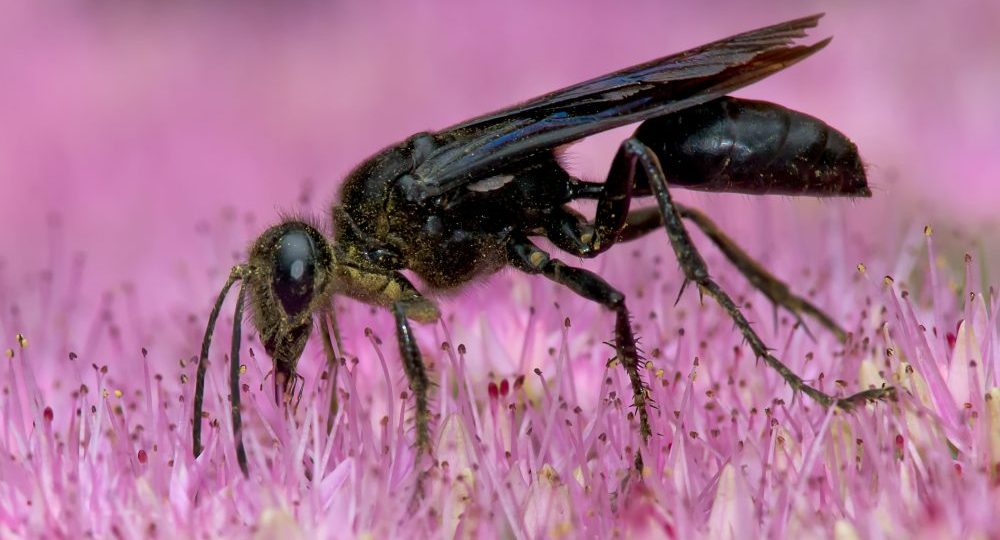
Our house has been beset by black wasps for the past couple of weeks. They’re digging wasps, and seem to have nested in the soil of a giant potted rosemary that we keep on the porch in nice weather and in the living room in the winter. They aren’t really a hazard—they’re kind of sluggish and not aggressive, so mostly we’ve been able to trap them under a glass and take them outdoors.
I looked them up, and found the following:
Adult females of S. pensylvanicus build an underground nest which they provision with various orthopteran insects… Prey are stung three times, once in the neck and twice in the thorax, and are paralyzed by the wasp’s sting, although they can survive for weeks. The prey are then carried to the nest. While collecting their prey, the females are vulnerable to kleptoparasitism, in which birds, including the house sparrow and the grey catbird , steal the prey that the wasp has collected… The eggs of S. pensylvanicus are 5–6 mm (0.20–0.24 in) long and 1 mm (0.04 in) wide; they are glued to the underside of the prey insect between the first and second pairs of legs. Each of the several chambers in the nest houses a single larva, which consumes 2–6 katydids or grasshoppers.
Well, there’s a pretty specific ecological tale, eh? These wasps take down katydids and grasshoppers like a mob hit (once in the neck and twice in the thorax), and have to get back to the hideout before another gang can hijack their victims. Then they glue eggs onto the victim’s belly so that their kids can cannibalize their way to adulthood.
(There’s a Jared Kushner or USC Admissions joke waiting in there somewhere, but it’s too early in the morning, and not my primary task today.)
And the sparrows and catbirds in their own role, waiting on the trail like bandits to steal the already misbegotten goods. And the katydids, innocently chowing on some leaves with a side of aphids when the hit man busts into the diner. The whole thing is a nested tale of ecological functions.
I’ve been thinking about this lately for a few related reasons. First, I’m doing a talk next week at Trinity College in Connecticut, and I’ll be talking about my ecological framing of the adjunct crisis. Second, I’ve been thinking about all of my worry in the past week about honoring both characters and readers, and wondering if I haven’t been really more worried about me. I’m the writer, after all, so it’s no surprise that I’m concerned about my own culpability and capabilities. But a productive way out of this dilemma might be to understand what ecological niche my stories might fulfill. To quit worrying about my own survival as a wasp or a katydid or a sparrow, and to imagine what happens out there because of these stories.
And it’s clear that stories accomplish work, for good and for ill. One of the members of my writing group, homesick for his MFA cohort that he’s now graduated from, has assembled a local reading group to go through the novels of William Faulkner. He said that one of the members asked at some point, “When will something good happen to these characters?” And my friend laughed and said, “You might be in the wrong reading group. Nothing good will ever happen for anyone in a Faulkner novel.”
And I thought to myself, well, Faulk that! Contemporary literature is so oversaturated with misery, it’s like an algae bloom that chokes off all of the oxygen of hope from the biblioscape. Why would I want to provide more misery to a world already suffused with it?
Brandon Taylor describes the first time one of his stories was on the table at the Iowa Writer’s Workshop:
Another thing about that first workshop was that I heard something about myself that I had never heard before: that my story story was protective and civilized and carefully managed. These to me seemed the primary virtues of fiction that I loved and that I wanted to write. There’s nothing I want more than peace and order. I had a difficult life. A strange life. And so in turning to fiction, I wanted to create for my characters a space where the urgent material of their lives would not contain the question of whether or not they would live or die. I wanted to write about people moving through the world who could count on more time, who didn’t have to confront the ugliness of violence and harm and malevolence. I wanted only to make for my characters a space where they could be. I left the workshop that night feeling like I had been struck by lightning. I was angry and ashamed.
The thing I have been thinking about for the last year—every moment of every day almost, and certainly every time I sit down to write, or think about writing—is this question of protectiveness, of orderliness. These traits were presented to me in the way a doctor describes some malformation of the inner ear or bad nerve in the lower spine: not a catastrophe, but not quite as it should be, either. Like I’d have to spend the rest of my life compensating in ways minor and major, making myself slightly more brutal, slightly crueler.
That’s exactly my experience of any review in any fiction workshop, whether in a classroom or at a conference or informally with people trained in one of those realms. It’s like Christopher Walken and “More Cowbell!!” More Misery!!! More Trauma!!! More Suffering!!!
Yeah, that’s a hard no.
I count hospitality as one of my primary ecological functions, the fact that people can come to my home and relax and laugh and have a good time with one another, no matter what other crap is going on in the rest of their lives.
The insistence on cruelty feels to me to be oddly gendered: that serious literature is written by men, and for women to gain entry to the serious camp, they have to be just as cruel as men can be. Every few days, I get an ad in my e-mail from Random House, a regular scrolling feed through mystery and thriller and romance and young adult. And when the “women’s fiction” comes around, I can count on seeing the word heartwarming in more than one of the book descriptions.
Guys don’t get to be heartwarming, nor do serious writers. “Real literature” bears exactly the field markings that Susan Faludi identified for contemporary American masculinity: stoicism, self-sufficiency, competition, and vanity. No one will help you, the world is against you, you’re on your own, and you’ll suffer through it. It’s every bad father ever.
So the ecological function of my stories, regardless of their specifics, is to work against that tide of cruelty, to help re-oxygenate the lake. To say: We can do this. There’s a way through. You’ve got abilities you never imagined.
Every creature, from bacteria to aphid to wasp, is doing something. The difference between us and the lower orders is that we get to decide what role we want to play.







 Herb Childress