Proudly DNF

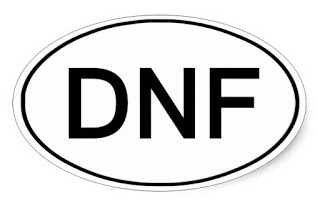
The last three books I’ve started to read have been DNFsโ€”Did Not Finish. I don’t need to tell you what they were: other people liked them just fine, and I prefer to talk about books that I love instead of those that didn’t catch me. But I can tell you why they didn’t catch me: I didn’t want to spend time with the characters. There was nobody there who was both intelligent and good-natured. If I went to a party where there was nobody intelligent and good-natured, I’d go home from that, too.

It used to be that I would have kept those books. I would have either bulled my way through them, determined to cross some irrelevant finish line, or I would have left them on my nightstand with a bookmark in them, nagging at me to fulfill my responsibility and gathering dust. Now, I don’t feel bad for even a minute; I set them into a pile for a friend who runs a used bookstore and would be happy to sell a nearly-new copy of some otherwise well-regarded book. Maybe I’ll get a couple of bucks from her if they sell, and maybe those books will land with a reader who appreciates them in a way that I couldn’t.

Back when I was a runner, a DNF was a sign of defeat or disaster. I dropped out of my first marathon at mile 23, from hypothermia on a gray and drizzly Northern California March day. But for more elite runners, a DNF can be a strategic decision. If you’re having a bad day, there’s no reason to finish 26 miles just as a poorly-framed training run. Let it go, plan for your next race, and don’t hurt yourself. I later finished two other marathons, under better conditions.

I think of DNF’s with books the same way. I don’t need to prove to myself or anyone else that I have the gumption to finish a whole book: I’ve done that thousands and thousands of times already. I’m an elite reader, I don’t need to finish a bad novel just for the training. I can drop it and get myself ready for the next one.

A couple of days ago, a friend asked Nora and I for recommendations for novels she should read during this moment of isolation. And the ones on that list were the happy ones, the ones where finishing them was never in doubt. Allow me to introduce you to some of my friends:

  • The Fortunes: Peter Ho Davies
  • The Queen’s Gambit: Walter Tevis
  • Miyami and the Sea of Happiness: Jennifer Tseng
  • A Pocketful of Names: Joe Coomer
  • Erotic Stories for Punjabi Widows: Balli Kaur Jaswal
  • Dancer: Colum McCann
  • The Calligrapher’s Daughter: Eugenia Kim
  • The Kiss Quotient: Helen Hoang
  • Fingersmith: Sarah Waters
  • Our Souls at Night: Kenth Haruf
  • Play It As It Lays: Joan Didion

I hope they’ll bring you as much joy as they did me. But if not… DNF them and go on to another. Read what you want.

Some years ago, the writer Daniel Pennac devised what he called the Reader’s Bill of Rights. The right to not read… to skip pages… to not finish… to reread… to read anything… to escapism… to read anywhere… to browse… to read out loud… and to not defend your tastes. These are not the rules that Sister Edna Marie would have led us to respect, but she’d have marked me down for the DNF’s, too. I’ve gotten over it.

Material Ontology

By all means, we should preserve our historic… PSYCH! (The Cardiff Gas Light and Coke Building being crushed beneath the Altolusso Tower, in Cardiff, Wales. Photo from the Guardian, 2014)

Nora’s been occasionally helping the local museum community identify the spinning wheels they own: their likely origins, the kinds of fibers they would have been meant to spin, and the things to look for when identifying a new acquisition. And as is true in all museum work, there’s some degree of debate about what constitutes “appropriate” preservation. How much of something can you change before it’s no longer the same thing?

Sure, you can clean a piece of art… unless the acquisition of detritus was one of the artist’s original intentions. You maybe can change a painting’s frame, but you can’t just grab one from Michael’s. If the varnish is cracked on a piece of furniture, you can probably try to clean it, but you can’t sand it down and throw some polyurethane on it, even though it’s a more durable material and the table would be better protected.

A lot of historic preservation in architecture is what I think of as taxidermy: we save the skin, fill it with a modern building, and stick a pair of glass eyeballs in it. What part of a building deserves to be preserved? Just the facade? Or the plumbing? Or the original interior walls? Should we put an elevator into a building that never had one? Should we keep storing hay for the police-wagon horses on the second floor? It’s easy to chase questions of preservation down to silly extremes, but the underlying question is always the same impossible, ontological dilemma: What, exactly, is the nature of the thing? What parts of the thing must remain part of the thing if it’s going to continue to be the thing? At what moment in the thing’s development must it be locked into place and not further changed?

Sometimes that question doesn’t matter at all. There are some car restorers who want to verify the exact original part of every element of their restoration, building a sort of archaeological record of what came off the assembly line. On the other end, I’ve long been a fan of car customization, in which whatever Detroit provided is merely inspiration for what could be.

This is NOT what a 1952 Chevrolet Styleline looked like in 1952. Photo by Mike Basso for Car Kulture DeLuxe magazine.

This car was completely reimagined by the brothers Yoshi and Kyohei Sakuragi and bodyworker Gene Winfield, to capture a love of curvature and solidity, and to hearken back to the late 50’s and early 60’s origins of “kustom kulture.” You could put it into one kind of museum as an exemplar of creativity and craft, but you couldn’t put it into another kind of museum as an historical record of auto production. So what do you want the thing to be?

One of the few books I’ve kept from my former academic interests is Preserving Cultural Landscapes in America, a book of essays that were edited together by Arnold Alanen and Robert Melnick. One essay by Richard Francaviglia offers a classification system for understanding what he calls “heritage landscapes,” but which we can use to think about any kind of historic object.

  • There are the passively preserved, “preserved unintentionally through continued traditions of use, ownership, and design.”
  • There are the actively preserved, “consciously preserved to retain their historic heritage or charm.”
  • There are the restored, “in which significant historic features have been reconstructed or replaced (or later intrusions removed) to enable them to regain their original character.”
  • There are the assembled, “in which historic designs and historical features are constructed to achieve a look of antiquity.”
  • There are the imagineered, “designed to appear historic but reconstructed to convey essence rather than re-create particular locale.”
  • There are the imagically preserved, “images, models, or dioramas that recreate vanished landscapes for viewing rather than entry.”

Most of Nora’s wheels are either passively preserved, rescued intact from someone’s mom’s house, or restored, with broken parts rebuilt from materials similar to the originals (like using cow or deer bone to make the bearings rather than nylon). There’s no pressure to modernize, to install stainless steel parts for increased production, so it’s easy to keep them more or less original. But sometimes, in order to get the machine to run at all, you make do: building a spindle harness from a leather belt instead of braided corn husks, for instance. It’s a little thing, but in some circumstances, little things matter.

In re-enactor culture, the question of material authenticity is a constant. Coming to a Civil War re-enactment with your contemporary Browning rifle wouldn’t do: the Browning company didn’t even exist until the 1880s, much less that particular instrument. Participants would be discouraged from bringing a polystyrene cooler filled with machine-made ice and canned beer. But lots and lots of re-enactors go beyond that. They make their own woolen underwear, forego their contact lenses in favor of glasses appropriate to the 1860s. But even that is about visual authenticity. Do they leave their Lipitor at home? Do they no longer get to participate once they’ve had a knee replacement or a composite-resin tooth filling? How about if they’ve studied contemporary sociology, and simply know things that wouldn’t have been known at Appomattox? Where do we quit?

It’s all about intentions. Do we intend to recreate an 1810 object in its precise detail? Or do we want to use it every day, and thus accept some improvements? And what level of imprecision becomes immediately noticeable and regrettable, like the photo at the top of today’s post? I mean, SOMEBODY approved that. A whole bunch of them, actually, the developer and the design firm and the local building council. So what were their intentions, and who are we to judge them?

And Two by Two They Came

So THAT’s why writing feels that way…

I love the heuristic value of a simple two-by-two matrix. I discovered its power when I was trying to understand why some of the teenagers I hung out with twenty five years ago during my dissertation were brilliant and funny and didn’t have a lot of interest in school, while others who were equally smart were teacher’s pets, somewhat dull and always dutiful. And it occurred to me that we were actually seeing two simultaneous variables. The first was whether or not they had families with sort of normal white-collar resources. And the second was whether they were engaged in testing the boundaries of what they and others knew, or were satisfied to follow the tracks laid out by others. And once I had that, once I could put it into a named model, I could suddenly see dozens of other ways that it played out.

The kids who had resources and were comfortable in how life played out were simply believers, those who knew that compliance brought rewards. But those who were both protected and wanted to know more took on the role of theologians, constantly questioning why some practice was in place, always looking for alternatives. The same contrast played out for those students with fewer resources. The ones who let it all wash over them because they knew it didn’t matter were agnostics, but the ones who felt personally threatened or demeaned and that the situation required resistance were the infidels.

I’m pretty convinced that you could take almost any two social variables, place them orthogonally to one another, and learn something interesting and meaningful about social relations and where individuals stand within them. And that’s where the uppermost graphic came from.

One of the benefits of social isolation is that you have time to a) clean out all the old articles you’ve clipped from magazines, and b) read them before recycling. So Nora had kept an article from the Chronicle of Higher Education, November 21, 2003, by Alice Weaver Flaherty, called “Writing Like Crazy: a Word on the Brain.” This essay was a pre-publication excerpt from her 2004 book The Midnight Disease: The Drive to Write, Writer’s Block, and the Creative Brain. (Thank god for the Chronicle’s pre-publication excerpts…)

Anyway, it’s a really interesting article, and the book’s probably pretty good, too. But the thing that stopped me dead was this:

Most researchers agree that a useful definition of creative work is that it includes a combination of novelty and value. Creativity requires novelty because tried-and-true solutions are not creative, even if they are ingenious and useful. And creative works must be valuable (useful or illuminating to at least some members of the population) because a work that is merely odd is not creative. This two-factor definition of creativity also provides an explanation of why the creative can be close to the crazy (unusual but valueless behavior).

And that explains so much of the travails of the early author. The attribution of whether our work is valuable is inevitably external; someone else must value it. Without that external validation, all we can know is that we’re doing work that hasn’t been done before. And the question of whether we’re creative or crazy becomes a daily (or hourly) dilemma. Steven King and Margaret Atwood don’t have to live quite so closely to that question, because the world has provided tons of validation for their work. For the rest of us, struggling to find readers… I think it’s natural that at least once in a while, we imagine ourselves to be fully insane. By definition, the writer of an unpublished work has created novelty without value; that status may change at some point, but we have no empirical grounds upon which to say that. We have no control over the value, and can’t fully trust our self-assessment.

We all know plenty of people who imagine themselves clever, but are merely annoying. The possibility of the Dunning-Kruger Effect always has to be recognized. One of the other quotes from Flaherty’s article was this simple laugh line:

As Eyler Coates put it, “We’ve all heard that a million monkeys banging on a million typewriters will eventually produce a masterpiece. Now, thanks to the Internet, we know this is not true.”

This was late 2003, remember. The exponential growth of the Internet since then has introduced us to an explosion of wonders, and an even greater explosion of idiocy. Sturgeon’s Law, introduced in 1957, still holds: Ninety percent of everything is crap. How can we imagine ourselves immune?

Trolling

At least it’s spelled right…

A group of peopleย in the United States took to social media on Tuesday to express shock at receiving a pornographic video while dialing in to a virtual social event held on Zoom, a California-based video conferencing platform… โ€œParticipants screamed and cringed while the hosts rushed to kick the troll out of the call. But they just re-entered under a new name and blasted the audience with more disgusting imagery.โ€

Reuters news story, https://www.reuters.com/article/us-women-rights-cyberflashing-trfn/risk-of-online-sex-trolling-rises-as-coronavirus-prompts-home-working-idUSKBN2153HG

There’s a whole subculture devoted to shock and destruction. Of people who bring nothing to the table but a desire to disrupt, to disturb, to provoke.

Social workers Kim Abraham and Marney Studaker-Cordner have identified a few of the underlying causes of trolling in children, where it’s kind of normal:

  • Children are generally known for having a low tolerance for frustration. They want things to go their way.
  • They are unable to cope with their frustrations and extreme feelings, and destructiveness is a release of sorts.
  • Sometimes a child may learn that by breaking things or behaving in a violent manner, he will effectively frighten a parent into doing what he wants.
  • Intimidation may also give a child whoโ€™s feeling powerless a sense of control.

How is it that we’ve created an entire culture of these man-boys who have no other strategy than defiance and destruction? How is it that millions of people got stuck at eleven years old?

How is it that we elect them?

This nonsense about the “Chinese virus” has two goals. One is to encourage fear of the other, making us compliant with the hero who might save us. The other is to deflect attention from our own amazingly bad planning. (A century ago, we’d have probably called it the “Italian virus,” since Italy has been hit so badly, and we didn’t like Italians so much back then.)

Listen. Viruses don’t have nationalities or ethnicities. They don’t carry passports, don’t have allegiances to a homeland. They aren’t “attacking” us, since they lack motivation. They aren’t “aggressive,” since they lack emotion. They grow somewhat normally among animals, then at some point a human host is infected successfully, and then it’s just people all the way down after that. If people travel, viruses can come from far away. If people don’t travel, then once in a while, a virus takes down everybody in our little insignificant holler, and no one else ever hears about it.

The “Spanish flu” of a hundred years ago was originally from Kansas, then France, before discovered in significant numbers in soldiers returning to the US from Spain in World War 1. There was nothing any more Spanish about the Spanish flu than there was about the “Spanish rice” my mother made from Uncle Ben’s and paprika. There’s nothing any more Chinese about the “Chinese virus” than there is about the holiday cookies I make every year from melted chocolate and bagged chow mein noodles.

Viruses don’t come from bad sanitation. They don’t come from “dirty cultures.” They don’t follow family lines. They come from breathing on or sneezing on or coughing on or exchanging bodily fluids with somebody else. It’s as simple as that.

As Susan Sontag wrote forty years ago in Illness as Metaphor, our need to anthropomorphize everything gets in the way of understanding diseases on their own terms. The sick become flawed, the well become virtuous. And neither are true. It’s all just respiratory droplets, in the end. Bleach and alcohol and physical distance have positive effects, fear and blame do not.

There’s a common line in internet protocols: Don’t feed the trolls. To mean, ignore them and they’ll go away. Well, we ignored them for a long time, and they elected their king to be ours. We need to step up and do better. Trolls are vicious and dangerous, far more so than viruses. In the end, they can’t be ignored, or else we cede the ground altogether.

…When it comes to how we respond to them, our tactics can and will vary, and they may involve anger, humor, love, tolerance, blocking, or maybe even some productive discussion. But ultimately, if we care about abuse, we cannot care most about whether we have comforted, converted, or even fed them. We have to care more about the people they hurt.

https://www.theverge.com/2018/7/12/17561768/dont-feed-the-trolls-online-harassment-abuse

New Depths

So you say there’s a race of men in the trees

You’re for tough legislation…

Thanks for calling.

I wait all night for calls like these.

Donald Fagen, “The Nightfly”

I’m acting as the Town’s emergency management director, which means I’m getting tons of info from the state department of health and the state emergency management office. I try to put out daily updates on our town website, so as to help people sort through what they can trust.

I know, at this moment, there’s a lot of misinformation out there about COVID-19 and how we might respond. Some of that is just mistaken, the flurry that comes when things change rapidly. Some of it is purposeful scamming and profiteering, the anti-coronavirus toothpaste or the Silver Solution. But sometimes…

Here’s a near-verbatim transcript of a conversation I had today at the grocery store, getting a few things before practicing shelter-in-place for a while. (First off, there was no toilet paper, paper towels, disinfectant anything, any kind of cold & flu. No meat, no chicken, no dairy, no bottled water. No pasta, no rice, no tomato sauce products, no beans. It was pretty apocalyptic, unnecessarily so.)

So I’m in the checkout line, working to sustain a respectful distance between me and the fellow ahead of me. But before I get to the conveyor, this person comes up behind me. Close behind me. Like she-could-choke-me-out-with-both-hands close behind me.

I turned over my shoulder and said, “Could I ask you to give me just a little more space?”

“Why? What happened?”

I didn’t quite know how to answer that. “Nothing happened. I’d just like to have a little more personal distance between us… as recommended by public health.”

I’m not sick!”

“Well, you don’t think you’re sick…”

“I know I’m not sick. And I don’t want to argue.”

And just as I gave up and turned forward to go about my business, she added…

“You need to look up 5G and chemtrails. The storm is coming…”

O! M! F! G!

It used to be hard to publish things. It used to be hard to spread lunacy. You used to have to stand on the subway platform and harangue the passers-by. But now there’s a whole alternate universe out there, where the like-minded can convince one another that “they” are out to get us. Depending on where you live online, COVID-19 is:

  • a way to digitally disable the organs of those who are non-compliant in the face of the New World Order, using 5G wireless technology and chemtrail-diffused “smart dust.”
  • the means of righteous execution of those responsible for the global pedophilia ring, which somehow includes Tom Hanks and the NBA because why not.
  • a tool of Big Pharma to scare us into accepting high-profit vaccines.
  • biological warfare by the U.S. (in China), or biological warfare by China (in the U.S.).

I’m sure there are a dozen others.

Public discourse relies on a public. And we no longer have a public, we have hundreds of thousands of specifically curated worlds that bear almost no relationship to one another.

Viruses are dangerous. But viral stupidity is what will kill us.

Oh, no, baby…

Golly… thanks so much… it’s really… ummm… special.

I’m a big fan of the Graham Norton talk show (or as they call them in England, “chat shows”). He brings all his guests on together, gives them drinks, and they make each other funnier and wittier as they tell stories, mostly having to do with some stupid or embarrassing thing they themselves have done. Here’s a part of one story from the American comedian Kevin Hart, about one of his early-career stand-up gigs:

I remember hearing a womanโ€™s voice, an older lady, I tell a joke, and the joke doesnโ€™t work. And I remember this lady just going, โ€œOh, noโ€ฆโ€ And I would much rather be booed than hear the disappointment from her voice. I remember, she said, โ€œOh, no, babyโ€ฆโ€ Like I had made a mistake with my whole choice of life.

Nora and I spent the day yesterday out of town at a craft centerโ€”I won’t tell you where, so as to not cast aspersions on perfectly lovely people doing their best. But…

You know how you can just tell when it’s not right? How you can spot the hobbyist acrylic painting, the church-supper poem, the crocheted pillow cover that won’t ever be displayed? How you can hear the tin ear, the stiff piano player, the story that might never end?

What do you say when you see the bad taxidermy, the tuna-noodle casserole, the birch branch jigsawed into a rough crucifix? What do you say to the rock polishers, the potholder-makers, the person who makes refrigerator magnets of tiny photos inside bottle caps?

And what if they’re me?

I live in perpetual fear that my work is just… precious, a nice hobby, like an endless series of knitted baby caps foisted upon every distant relative.

There’s an internet meme that says, “Being stupid is like being dead… you’ll never know it, but everyone around you will.” And that’s the fate of the artist, putting our work out in public, and having the public walk past, trying not to notice you… or having them pick it up, consider it silently for a few seconds, and set it back down.

Short of the National Book Award, the glowing review in the London Review of Books, the Booker or the Grand Prix… anything less than that leaves us to wonder, really, whether the work has mattered. The doing of the work matters, and matters enormously. To us. But the work itself, and its worth to others… it’s impossible to say.

And sometimes, when I’m in the galleries of ill-proportioned still life drawings, or undrinkable home-brewed beer, or yet another lumpy ceramic pot… the question feels awfully close to home.

My Favoritest Book in the Whole Wide World!

It’s been a wild couple of weeks, what with being the town’s emergency management director and getting three or four updates a day from the Vermont Department of Health and Vermont Emergency Management about current status and instructions re: COVID-19. I was going to do a workshop at a conference in DC on April 1-3; that got cancelled. The 50th anniversary event for my graduate program’s department got cancelled. The freakin’ NBA season got stopped. Everyone’s practicing self-quarantine and social distancing.

So stay home and read a book. I’ve got one for you.

As I promised a couple of weeks ago, I’ve finally gotten a drizzly day to read, and I re-read Mayumi and the Sea of Happiness, by Jennifer Tseng. I came across it a little over three years ago, when it was a relatively young book. And, like Mayumi herself, I was smitten with its freshness and youth. Now it’s a mature book, and I love it all the more.

Years ago, when Kenzaburo Oe won the Nobel Prize in Literature, I decided that I should expand my horizons a bit, and I picked up A Personal Matter. And from there, I discovered a body of fiction that didn’t move as much as it churned. The plot is secondary, physical and social details are shared only sparingly (and all the more remarkable for their rare appearance, like catching sight of a deer or a porcupine during a forest hike). The real work is to explore what goes on inside one’s mind. What we think, and the absurdity of our thinking that way, and the other plausible ways we might think about the same circumstance. What we imagine others are thinking, about us and about themselves and about our secrets if only they knew. 

This book is firmly within this tradition. Mayumi, the narrator of this story, is a Japanese-British-American librarian who lets us completely, unguardedly, inside her mind as she navigates a web of relationshipsโ€”family, work, and (most especially) otherwise. She is disgusted and at peace with her husband, loving and exhausted with her daughter, at home and alienated from her work. And she is ashamed and impatient and delighted and brazen with her lover.

It’s easy to see that Ms. Tseng started her literary career as a poet; Mayumi thinks almost entirely in metaphor, always seeing one thing in the language and form of another, part of what gives the book such a surreal, shimmering light. I could point to hundreds of examples, but here’s one:

Transgression has a scent. One wears it like a perfume and there are those who smell it immediately. During the course of my affair with the young man, countless patrons confessed to me their crimes. Thierry Lambert’s wife was the nanny for whom he had left his first wife, Joe Fischer had been banished from the priesthood for his love affair with an altar boy, and Linda Cardo continued to meet with her childhood sweetheart in an off-island hotel where they drank Chianti and floated in the indoor pool. Why tell me? Why not any of the other librarians? I’m convinced I wore the perfume of transgression and that transgressors were drawn to it, perhaps even comforted by it. I was their kind.

p.123

There are several books that I’ve come back to several times, with years of life between readings that have made me into a different reader. Sometimes the book doesn’t stand up to that new examination; flaws that were once overlooked now seem to shout their presence, the only thing visible. But sometimes, the new reader simply finds new perfections, patterns unseen by the first viewer and waiting patiently for other selves to come. Mayumi and the Sea of Happinessย is one of that second group. It’s a treasure, a powerful and humbly honest story that defies summarization. I can’t recommend it highly enough.

A Momentary Lapse of Reason

Well, I guess I’d better fix it… (Rabbit, from Disney’s version of Winnie the Pooh)

I start at the first sentence of a novel and I finish at the last. It would never occur to me to choose among three different endings because I havenโ€™t the slightest idea of the ending until I get to it, a fact that will surprise no one who has read my novels. Macro Planners have their houses largely built from day one, and so their obsession is internalโ€”theyโ€™re forever moving the furniture. Theyโ€™ll put a chair in the bedroom, the lounge, the kitchen and then back in the bedroom again. Micro Managers build a house floor by floor, discretely and in its entirety. Each floor needs to be sturdy and fully decorated with all the furniture in place before the next is built on top of it. Thereโ€™s wallpaper in the hall even if the stairs lead nowhere at all.

Zadie Smith, “That Crafty Feeling”

Revision is a funny thing. I revise at every second at the desk. Sometimes that’s sitting silently for thirty seconds while the next word arrives. Sometimes it’s going backward to the beginning of that paragraph and thinking about a better way to merge into the traffic stream I’m in. And sometimes it’s just leaning on the delete key for ten or twenty characters, digging out the decay until I get back to bone.

I’m one of the class of writers that Zadie Smith has identified as a Micro Manager. I wait for weeks at a time until someone shows up and makes a compelling enough case that his or her story needs to be heard. And then I tell it.

The most fundamental decision is to figure out where to start. Everyone’s story extends back to that first slap on the butt in the delivery room, but my interest in their story inevitably begins somewhat later than that. Mostly, I want to start with a scene that shows a character simultaneously successful and stuck, doing well enough but not at all well. That’s the tension I most often want to explore in my stories, so I listen for that point of weakness, where the grain is starting to separate, where the crotch in the wood will inevitably fail.

Once I have that, I don’t need to stopโ€”except for meals, sleep, and emailโ€”until I get to “The End,” a few months later. The story just falls onto me like a giant wave, and I count myself lucky to not be lost in the curl.

When the wave spits me out, I rarely conduct major structural revisions. It would be like trying to find the same wave over again so that I could experiment with a new route. That ride is done, and all I can do is paddle out and wait my turn in the lineup until a new wave makes itself evident.

However.

There are almost always one or two spots in a story that are false. Many come from me being willful, from having some version of “Oh, I’ve got a terrific idea!” instead of just shutting up, paying attention, and letting my characters drive. And because they’re good ideasโ€”MY good ideasโ€”I don’t want to let them go, but I have an awful time fitting them into the organic story. They aren’t part of the story at all, they’re my cleverness intruding like some boorish drunk who wants to tell his tale to all his newfound pals, each of whom is scouting around for an exit.

Those are relatively easy to fix, because they’re so lightly attached to the whole. I can pluck them off after a few months of admiring them, and only the finest scar remains to be healed.

The more difficult ones come from having been tired, and just wanting some scene or another to end so I can go to bed, or get on to the next scene that’s already making itself evident. A five-page scene that takes three minutes to read takes two days to write. And after two days, I’m sometimes not patient enough to stick with it, and I’m enthused about what’s so obviously coming next, and so I come to some clumsy, “good enough” resolution or transition and move on.

I dealt with one of those today. I’d written a story some months ago, and the end of the story came too fast. The major, though quiet, drama had already gone by, and we just fell into the denouement. I wanted the resolution of her crisis to occur off-stage, because so much of what had mattered in her life had gone unseen and un-noted. But the move from her decision to the story’s off-ramp was just too abrupt, since the easy answer of the resolving action wasn’t there to provide its natural buffer.

I was about to send this story out to my writing group, and I didn’t want to be embarrassed by it. It was an obvious error, though its solution was anything but. And as I was reading it again, almost ready to send it out to my friends even with its misshapen joint, I saw a solution. Svetlana’s resolving action didn’t need to be seen, but her decision to do it needed to be more fully tied back into decisions we’ve already seen her make. If, as David Mamet has it, character is merely habitual action, then I needed to show this surprising decision as not surprising at all. So by slightly building up scene nโ€“1, scene n didn’t need to change at all to feel far more natural, inevitable, true.

These are the things you can’t see when you work, the momentary lapse of reason that feels okay when you do it and subsequently just nags and worries and pesters. A solution is always possible. Just wait it out, and the answer will emerge.

In the Zone

We talked a little yesterday about the three common levels of professional development: apprentice, journeyman, and master. The apprentice has skills, but requires supervision; the journeyman has enough breadth of professional experience to operate independently; and the master sets the strategic direction for others.

I feel like that’s been my path as a writer as well. For a long time, I had plenty of skill. In high school and college, and then as a freelance architecture and planning writer for local news magazines, I was given writing tasks, completed them, and turned them in. It’s an outstanding way to learn the trade: tons of work with tons of feedback.

Most writers stay there, because most writers write under the guise of some other job title. As a professional in higher education. I wrote accreditation reports and annual assessment reports, policy proposals and grant proposals. My president or provost would ask for something, and I’d deliver it. And of course, I probably wrote a million words a year just in e-mail. I got my hours in.

My shift to journeyman came in grad school, with the dissertation. “This is what I want to do,” I said, “and this is how I’d like to do it.” And my committee approved, and I went off on my own for two years, and came back with a book. And then I found a publisher and the book entered the world.

I did that twice more. I wrote another book and sold it to the University of Chicago Press. Then my UCP editor, the miraculous Elizabeth Branch Dyson, came to me with what she now calls “a vague hand-wavy idea” that I again went off for two years and made manifest. I have the demonstrated capability of writing book-length nonfiction without oversight.

The first steps toward mastery came when I decided to leave the industry of writing about academia and shift my work toward fiction. That was a strategic decision, not merely a craft decision. I wanted something different: different stories, different voice, different readers. And I made that shift. I already knew how to write a book; I just had to figure out how to write different kinds of books.

That started seven years ago, when I left my job in the summer of 2013. Since then, I’ve written ten books: eight novels, one collection of short stories, and one non-fiction book about fiction. There’s another one on the bench right now. That’s kind of the easy part, the independent making of books. I’ve done that for a long time, that’s now just normal work.

It’s also the safe work.

The less safe work is the next step on the mastery trail: making all of that work public. To go back to the example of a law firm, a principal in the firm has full autonomy to work with clients, manage a case, supervise other lawyers and paralegals. But all of that independent work is facilitated by the protective shell of the law firm: the senior partners who make the deals, set the strategy, grease the gears of commerce.

The University of Chicago Press has been that protective shell for my past two nonfiction books. They have a marketing department. They have a graphic design department. They manage fulfillment of orders, from Amazon to a tiny neighborhood bookshop. They take books to book fairs and conferences and set up tables and talk with passers-by. I have none of those things. But if I want to set my own strategic direction, then those are all tasks that I need to take on.

The graphic up at the top is a visual representation of the work of child psychologist Lev Vygotsky, and what he termed the Zone of Proximal Development. Basically, there are tasks we can take on for which their challenges are equal to our capabilities. If we try to do something that’s miles above us, not only can’t we do it, we freak out while we’re trying. It’s the zone of high anxiety, of frustration, of stress. On the other end, there are tasks that are way below our capabilities, things we can do with almost no effort or attention. That way lies boredom.

The goal, according to Zygotsky, is to give people tasks that are just a little above their current competency, and help people do them. That increases competency in a safe way, cements a new learning and a higher level of capability for future tasks that are even more demanding.

So that’s where I’m at. I have to reach a little above my comfort, into the mysterious lands of marketing and distribution, and try to find help in learning those new skills. The Zone of Proximal Development isn’t a safe place. But it’s a necessary part of the trip.

Mastery

Emile Adan, Apprentice (1914). Library of Congress.

There seems to be some kind of magic around the number three. Learning is often structured in three phases, roughly related to beginning, intermediate, and advanced.

  • For K-12 education, we have elementary school, middle school, and high school.
  • For higher education, we have bachelor’s, masters, and doctoral degrees.
  • For college faculty, we have assistant, associate, and full professors.
  • In lots of professions, we have associate, principal, and partner.
  • In culinary work, we have cook, sous-chef, and chef de cuisine.
  • And in traditional trades, we have apprentice, journeyman, and master.

The interesting level to me in all of these cases is the middle one, at least in part because it’s the only one with an accomplishment on both ends. For the apprenticeship, we come in knowing nothing whatsoever. At the end of mastery comes either retirement or death. But we have to test out of apprenticeship to become a journeyman, and then test out of that to become a master.

The term journeyman comes from an era in which the skilled trades were exclusively practiced by men. So, of course, does master, from magistrate, or the guy in charge. Gender-neutral alternatives for journeyman have been proposed: journey-level, or journeyperson (ick), or trade worker. But let’s think about what the three levels entail with regards to working life before we start to mess with the language.

At the lowest levelโ€”cook, or apprentice, or associateโ€”we’re talking about someone who works under supervision, someone with a senior eye on their efforts. We trust that they can get the job done (they won’t work here long if they can’t), but their agendas are set by others. As an associate at Jay Farbstein and Associates 20 years ago, I was given specific tasks to do by my superiors, and checked in on a regular basis about how things were going and what I ought to be doing next. I was 40 years old and had a PhD, I wasn’t a total beginner, but I wasn’t at a position where I was leading my own projects; I was fulfilling project components for others.

The middle level connotes a position of trust and independence. A principal in a big architecture or law firm has project-level authority. They work directly with clients, supervise other workers, run day-to-day contact with subcontractors. They know enough to coordinate a pretty good sized project, and are entrusted by their business as managers. In the kitchen, the sous-chef drives the daily operation, manages inventory and ordering, does some training, steps in whenever one of the line or prep cooks (or even sometimes the dishwasher) is in the weeds. Whether lawyer or electrician or restaurateur, that middle level is crucially important, and a person at that point is a fully vetted professional.

The “journey” of journeyman has three competing meanings. The term originally seems to be a bastardization of the french journee, or day, and it meant an employee paid by the day (as opposed to the apprentice, who got paid with a bowl of gruel and a straw mat in the corner). But once the word became anglicized, it took on the connotation of the independent professional able to journey out onto a work site by himself to get things done. The journey was often more literal: the journeyman was an apprentice ready to leave the nest, deemed worthy by another shop of being employed (and paid). In some guilds, the journeyman was expected to really journey, to go on a grand tour for a few years and work as an employee for multiple masters of the same guild, so as to learn different approaches to the work.

Entry to the master level was a matter of professional consensus, in which the other masters of the guild approved the new member, often after the journeyman had produced a master piece (a material version of a qualifying exam). Here’s one, from France in the mid-19th Century:

From the collection of the Cooper Hewett, Smithsonian Design Museum. Photographer: Ali Elai

Once anointed, a master could own his (or her) own shop. Could make decisions about the kinds of projects and clients to take on, the kinds of equipment and facilities to invest in, the kinds and numbers of apprentices to accept. Law and architecture firms use partner to denote the same level, someone with a financial and strategic interest in the business as a whole rather than merely managerial responsibility for a project. The chef de cuisine or executive chef is most often the restaurant’s owner as well, making decisions about exactly what goes on the menu, about the culinary and hospitality principles of the whole endeavor.


All of this meandering is my way of thinking through what it would mean for me to move from journeyman to master writer. What does it mean to demonstrate mastery? And the historical answer is the shift from capability to strategy.

Hmm… more soon.