My Favoritest Book in the Whole Wide World!

It’s been a wild couple of weeks, what with being the town’s emergency management director and getting three or four updates a day from the Vermont Department of Health and Vermont Emergency Management about current status and instructions re: COVID-19. I was going to do a workshop at a conference in DC on April 1-3; that got cancelled. The 50th anniversary event for my graduate program’s department got cancelled. The freakin’ NBA season got stopped. Everyone’s practicing self-quarantine and social distancing.

So stay home and read a book. I’ve got one for you.

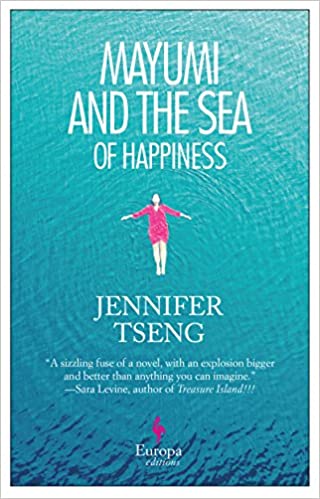
As I promised a couple of weeks ago, I’ve finally gotten a drizzly day to read, and I re-read Mayumi and the Sea of Happiness, by Jennifer Tseng. I came across it a little over three years ago, when it was a relatively young book. And, like Mayumi herself, I was smitten with its freshness and youth. Now it’s a mature book, and I love it all the more.

Years ago, when Kenzaburo Oe won the Nobel Prize in Literature, I decided that I should expand my horizons a bit, and I picked up A Personal Matter. And from there, I discovered a body of fiction that didn’t move as much as it churned. The plot is secondary, physical and social details are shared only sparingly (and all the more remarkable for their rare appearance, like catching sight of a deer or a porcupine during a forest hike). The real work is to explore what goes on inside one’s mind. What we think, and the absurdity of our thinking that way, and the other plausible ways we might think about the same circumstance. What we imagine others are thinking, about us and about themselves and about our secrets if only they knew. 

This book is firmly within this tradition. Mayumi, the narrator of this story, is a Japanese-British-American librarian who lets us completely, unguardedly, inside her mind as she navigates a web of relationshipsโ€”family, work, and (most especially) otherwise. She is disgusted and at peace with her husband, loving and exhausted with her daughter, at home and alienated from her work. And she is ashamed and impatient and delighted and brazen with her lover.

It’s easy to see that Ms. Tseng started her literary career as a poet; Mayumi thinks almost entirely in metaphor, always seeing one thing in the language and form of another, part of what gives the book such a surreal, shimmering light. I could point to hundreds of examples, but here’s one:

Transgression has a scent. One wears it like a perfume and there are those who smell it immediately. During the course of my affair with the young man, countless patrons confessed to me their crimes. Thierry Lambert’s wife was the nanny for whom he had left his first wife, Joe Fischer had been banished from the priesthood for his love affair with an altar boy, and Linda Cardo continued to meet with her childhood sweetheart in an off-island hotel where they drank Chianti and floated in the indoor pool. Why tell me? Why not any of the other librarians? I’m convinced I wore the perfume of transgression and that transgressors were drawn to it, perhaps even comforted by it. I was their kind.

p.123

There are several books that I’ve come back to several times, with years of life between readings that have made me into a different reader. Sometimes the book doesn’t stand up to that new examination; flaws that were once overlooked now seem to shout their presence, the only thing visible. But sometimes, the new reader simply finds new perfections, patterns unseen by the first viewer and waiting patiently for other selves to come. Mayumi and the Sea of Happinessย is one of that second group. It’s a treasure, a powerful and humbly honest story that defies summarization. I can’t recommend it highly enough.

A Momentary Lapse of Reason

Well, I guess I’d better fix it… (Rabbit, from Disney’s version of Winnie the Pooh)

I start at the first sentence of a novel and I finish at the last. It would never occur to me to choose among three different endings because I havenโ€™t the slightest idea of the ending until I get to it, a fact that will surprise no one who has read my novels. Macro Planners have their houses largely built from day one, and so their obsession is internalโ€”theyโ€™re forever moving the furniture. Theyโ€™ll put a chair in the bedroom, the lounge, the kitchen and then back in the bedroom again. Micro Managers build a house floor by floor, discretely and in its entirety. Each floor needs to be sturdy and fully decorated with all the furniture in place before the next is built on top of it. Thereโ€™s wallpaper in the hall even if the stairs lead nowhere at all.

Zadie Smith, “That Crafty Feeling”

Revision is a funny thing. I revise at every second at the desk. Sometimes that’s sitting silently for thirty seconds while the next word arrives. Sometimes it’s going backward to the beginning of that paragraph and thinking about a better way to merge into the traffic stream I’m in. And sometimes it’s just leaning on the delete key for ten or twenty characters, digging out the decay until I get back to bone.

I’m one of the class of writers that Zadie Smith has identified as a Micro Manager. I wait for weeks at a time until someone shows up and makes a compelling enough case that his or her story needs to be heard. And then I tell it.

The most fundamental decision is to figure out where to start. Everyone’s story extends back to that first slap on the butt in the delivery room, but my interest in their story inevitably begins somewhat later than that. Mostly, I want to start with a scene that shows a character simultaneously successful and stuck, doing well enough but not at all well. That’s the tension I most often want to explore in my stories, so I listen for that point of weakness, where the grain is starting to separate, where the crotch in the wood will inevitably fail.

Once I have that, I don’t need to stopโ€”except for meals, sleep, and emailโ€”until I get to “The End,” a few months later. The story just falls onto me like a giant wave, and I count myself lucky to not be lost in the curl.

When the wave spits me out, I rarely conduct major structural revisions. It would be like trying to find the same wave over again so that I could experiment with a new route. That ride is done, and all I can do is paddle out and wait my turn in the lineup until a new wave makes itself evident.

However.

There are almost always one or two spots in a story that are false. Many come from me being willful, from having some version of “Oh, I’ve got a terrific idea!” instead of just shutting up, paying attention, and letting my characters drive. And because they’re good ideasโ€”MY good ideasโ€”I don’t want to let them go, but I have an awful time fitting them into the organic story. They aren’t part of the story at all, they’re my cleverness intruding like some boorish drunk who wants to tell his tale to all his newfound pals, each of whom is scouting around for an exit.

Those are relatively easy to fix, because they’re so lightly attached to the whole. I can pluck them off after a few months of admiring them, and only the finest scar remains to be healed.

The more difficult ones come from having been tired, and just wanting some scene or another to end so I can go to bed, or get on to the next scene that’s already making itself evident. A five-page scene that takes three minutes to read takes two days to write. And after two days, I’m sometimes not patient enough to stick with it, and I’m enthused about what’s so obviously coming next, and so I come to some clumsy, “good enough” resolution or transition and move on.

I dealt with one of those today. I’d written a story some months ago, and the end of the story came too fast. The major, though quiet, drama had already gone by, and we just fell into the denouement. I wanted the resolution of her crisis to occur off-stage, because so much of what had mattered in her life had gone unseen and un-noted. But the move from her decision to the story’s off-ramp was just too abrupt, since the easy answer of the resolving action wasn’t there to provide its natural buffer.

I was about to send this story out to my writing group, and I didn’t want to be embarrassed by it. It was an obvious error, though its solution was anything but. And as I was reading it again, almost ready to send it out to my friends even with its misshapen joint, I saw a solution. Svetlana’s resolving action didn’t need to be seen, but her decision to do it needed to be more fully tied back into decisions we’ve already seen her make. If, as David Mamet has it, character is merely habitual action, then I needed to show this surprising decision as not surprising at all. So by slightly building up scene nโ€“1, scene n didn’t need to change at all to feel far more natural, inevitable, true.

These are the things you can’t see when you work, the momentary lapse of reason that feels okay when you do it and subsequently just nags and worries and pesters. A solution is always possible. Just wait it out, and the answer will emerge.

In the Zone

We talked a little yesterday about the three common levels of professional development: apprentice, journeyman, and master. The apprentice has skills, but requires supervision; the journeyman has enough breadth of professional experience to operate independently; and the master sets the strategic direction for others.

I feel like that’s been my path as a writer as well. For a long time, I had plenty of skill. In high school and college, and then as a freelance architecture and planning writer for local news magazines, I was given writing tasks, completed them, and turned them in. It’s an outstanding way to learn the trade: tons of work with tons of feedback.

Most writers stay there, because most writers write under the guise of some other job title. As a professional in higher education. I wrote accreditation reports and annual assessment reports, policy proposals and grant proposals. My president or provost would ask for something, and I’d deliver it. And of course, I probably wrote a million words a year just in e-mail. I got my hours in.

My shift to journeyman came in grad school, with the dissertation. “This is what I want to do,” I said, “and this is how I’d like to do it.” And my committee approved, and I went off on my own for two years, and came back with a book. And then I found a publisher and the book entered the world.

I did that twice more. I wrote another book and sold it to the University of Chicago Press. Then my UCP editor, the miraculous Elizabeth Branch Dyson, came to me with what she now calls “a vague hand-wavy idea” that I again went off for two years and made manifest. I have the demonstrated capability of writing book-length nonfiction without oversight.

The first steps toward mastery came when I decided to leave the industry of writing about academia and shift my work toward fiction. That was a strategic decision, not merely a craft decision. I wanted something different: different stories, different voice, different readers. And I made that shift. I already knew how to write a book; I just had to figure out how to write different kinds of books.

That started seven years ago, when I left my job in the summer of 2013. Since then, I’ve written ten books: eight novels, one collection of short stories, and one non-fiction book about fiction. There’s another one on the bench right now. That’s kind of the easy part, the independent making of books. I’ve done that for a long time, that’s now just normal work.

It’s also the safe work.

The less safe work is the next step on the mastery trail: making all of that work public. To go back to the example of a law firm, a principal in the firm has full autonomy to work with clients, manage a case, supervise other lawyers and paralegals. But all of that independent work is facilitated by the protective shell of the law firm: the senior partners who make the deals, set the strategy, grease the gears of commerce.

The University of Chicago Press has been that protective shell for my past two nonfiction books. They have a marketing department. They have a graphic design department. They manage fulfillment of orders, from Amazon to a tiny neighborhood bookshop. They take books to book fairs and conferences and set up tables and talk with passers-by. I have none of those things. But if I want to set my own strategic direction, then those are all tasks that I need to take on.

The graphic up at the top is a visual representation of the work of child psychologist Lev Vygotsky, and what he termed the Zone of Proximal Development. Basically, there are tasks we can take on for which their challenges are equal to our capabilities. If we try to do something that’s miles above us, not only can’t we do it, we freak out while we’re trying. It’s the zone of high anxiety, of frustration, of stress. On the other end, there are tasks that are way below our capabilities, things we can do with almost no effort or attention. That way lies boredom.

The goal, according to Zygotsky, is to give people tasks that are just a little above their current competency, and help people do them. That increases competency in a safe way, cements a new learning and a higher level of capability for future tasks that are even more demanding.

So that’s where I’m at. I have to reach a little above my comfort, into the mysterious lands of marketing and distribution, and try to find help in learning those new skills. The Zone of Proximal Development isn’t a safe place. But it’s a necessary part of the trip.

Mastery

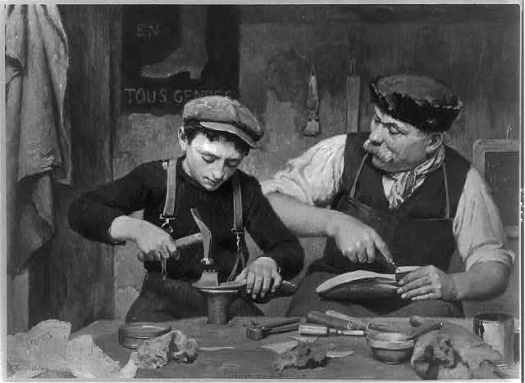
Emile Adan, Apprentice (1914). Library of Congress.

There seems to be some kind of magic around the number three. Learning is often structured in three phases, roughly related to beginning, intermediate, and advanced.

  • For K-12 education, we have elementary school, middle school, and high school.
  • For higher education, we have bachelor’s, masters, and doctoral degrees.
  • For college faculty, we have assistant, associate, and full professors.
  • In lots of professions, we have associate, principal, and partner.
  • In culinary work, we have cook, sous-chef, and chef de cuisine.
  • And in traditional trades, we have apprentice, journeyman, and master.

The interesting level to me in all of these cases is the middle one, at least in part because it’s the only one with an accomplishment on both ends. For the apprenticeship, we come in knowing nothing whatsoever. At the end of mastery comes either retirement or death. But we have to test out of apprenticeship to become a journeyman, and then test out of that to become a master.

The term journeyman comes from an era in which the skilled trades were exclusively practiced by men. So, of course, does master, from magistrate, or the guy in charge. Gender-neutral alternatives for journeyman have been proposed: journey-level, or journeyperson (ick), or trade worker. But let’s think about what the three levels entail with regards to working life before we start to mess with the language.

At the lowest levelโ€”cook, or apprentice, or associateโ€”we’re talking about someone who works under supervision, someone with a senior eye on their efforts. We trust that they can get the job done (they won’t work here long if they can’t), but their agendas are set by others. As an associate at Jay Farbstein and Associates 20 years ago, I was given specific tasks to do by my superiors, and checked in on a regular basis about how things were going and what I ought to be doing next. I was 40 years old and had a PhD, I wasn’t a total beginner, but I wasn’t at a position where I was leading my own projects; I was fulfilling project components for others.

The middle level connotes a position of trust and independence. A principal in a big architecture or law firm has project-level authority. They work directly with clients, supervise other workers, run day-to-day contact with subcontractors. They know enough to coordinate a pretty good sized project, and are entrusted by their business as managers. In the kitchen, the sous-chef drives the daily operation, manages inventory and ordering, does some training, steps in whenever one of the line or prep cooks (or even sometimes the dishwasher) is in the weeds. Whether lawyer or electrician or restaurateur, that middle level is crucially important, and a person at that point is a fully vetted professional.

The “journey” of journeyman has three competing meanings. The term originally seems to be a bastardization of the french journee, or day, and it meant an employee paid by the day (as opposed to the apprentice, who got paid with a bowl of gruel and a straw mat in the corner). But once the word became anglicized, it took on the connotation of the independent professional able to journey out onto a work site by himself to get things done. The journey was often more literal: the journeyman was an apprentice ready to leave the nest, deemed worthy by another shop of being employed (and paid). In some guilds, the journeyman was expected to really journey, to go on a grand tour for a few years and work as an employee for multiple masters of the same guild, so as to learn different approaches to the work.

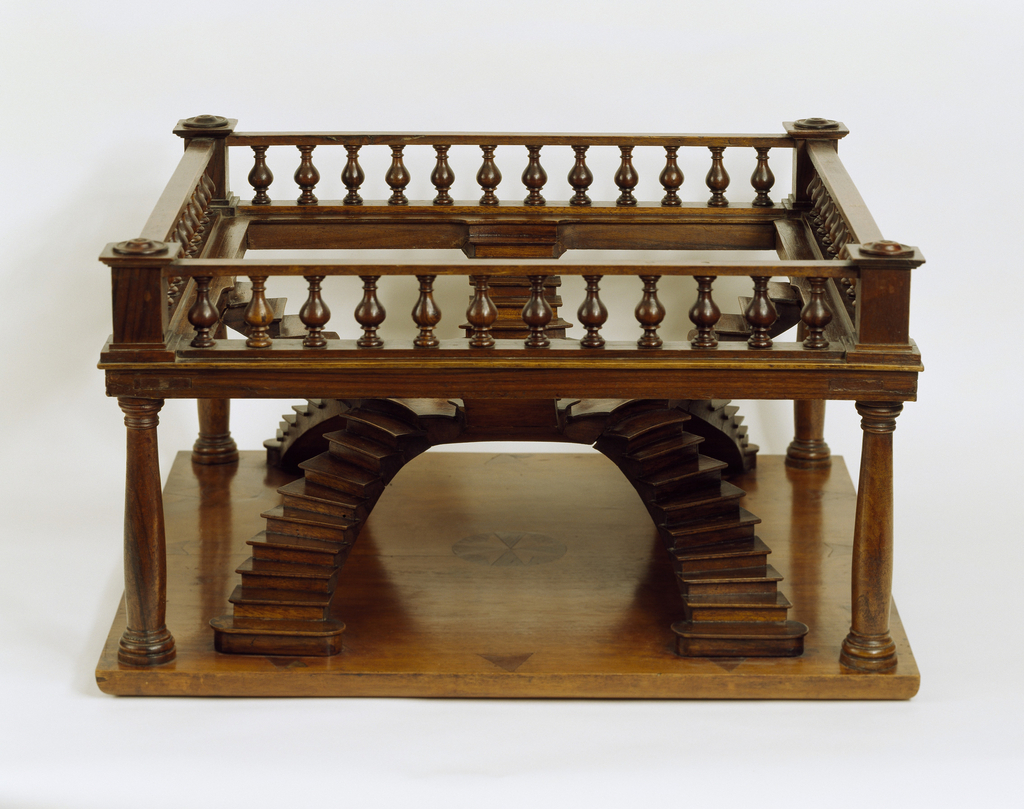
Entry to the master level was a matter of professional consensus, in which the other masters of the guild approved the new member, often after the journeyman had produced a master piece (a material version of a qualifying exam). Here’s one, from France in the mid-19th Century:

From the collection of the Cooper Hewett, Smithsonian Design Museum. Photographer: Ali Elai

Once anointed, a master could own his (or her) own shop. Could make decisions about the kinds of projects and clients to take on, the kinds of equipment and facilities to invest in, the kinds and numbers of apprentices to accept. Law and architecture firms use partner to denote the same level, someone with a financial and strategic interest in the business as a whole rather than merely managerial responsibility for a project. The chef de cuisine or executive chef is most often the restaurant’s owner as well, making decisions about exactly what goes on the menu, about the culinary and hospitality principles of the whole endeavor.


All of this meandering is my way of thinking through what it would mean for me to move from journeyman to master writer. What does it mean to demonstrate mastery? And the historical answer is the shift from capability to strategy.

Hmm… more soon.

Invisible Shame

Don’t ever for a moment think that men don’t receive crazy body-image messages… and that both men and women don’t reinforce them.

Women watch a 15-minute show featuring elite entertainers and, in some cases, end up feeling bad about ourselves. Men, meanwhile, watch a three-hour game, played by elite athletes with single-digit body fat, and most wonโ€™t feel a single twinge of self-doubt, or miss a single chip from the nacho platter… I donโ€™t even think it would occur to them to feel bad, or try to emulate what they saw.

Jennifer Weiner, New York Times, February 4 2020

You think? Really, you imagine that “most” of us won’t have even “a single twinge” of self-doubt? Well, that’s because we won’t show you. It’s because we don’t trust you to not use our weaknesses against us.

And our weaknesses have always been used against us.

Remember “tall, dark and handsome?” We all know who is and isn’t. And we all know which is and is not acceptable. We know the lack-of-height penalty in men’s wages and career advancement. We know who goes on the cover. We know why George Costanza was a buffoonโ€”it’s because he had the hubris to imagine that he mattered. If he’d been six feet tall with those same mannerisms, he’d be Alec Baldwin on 30 Rock: a boor, not a buffoon.

We know the appropriate roles for Brad Pitt and Jonah Hill in Moneyball; we know the appropriate roles for Michael Keaton and Danny DeVito in Batman Returns; we know the appropriate roles for Mark Wahlberg and Philip Seymour Hoffman in Boogie Nights. We know what it means when the audience on Ellen all scream when she persuades Chris Hemsworth to take his shirt off. You think those things don’t hurt. You think we’re oblivious. And you’re wrong.

We were in gym class or neighborhood hockey with ten thousand Donald Trumps. “Liddle Adam Schiff.” “Crazy Bernie.” “Get Mikey a footstool.” And the other boys in the Senate, on the sidelines, laughing along with their alpha. We know we won’t be alphas. We pick a different field upon which to perform, because that one’s already been claimed.

We were raised by men who told us to get up and stop whining, who told us that visible weakness was the unforgivable flaw, who taught us to be stoic and silent, to “man up.” To doubt oneself is merely to fail a second time. To reveal fear is to have already lost. And to lose, for whatever reason, is unforgivable.

If you believe that a lot of men aren’t hurt, it’s because we’ve done our jobs right, at least as those jobs were explained to us. If you believe that we don’t see hipster guys in skinny jeans, or underwear models, or elite athletes as a dagger in the ribs, it’s because we don’t trust anyone enough to tell you.

I want to come back to a line from the book I mentioned a few days ago:

Shame is psychic extortion… Shame lies. Shame a woman and she will believe she is fundamentally wrong, organically delinquent. The only confidence she will have will be in her failures. You will never convince her otherwise.

Jill Alexander Essbaum

There is no reason to have any reference to gender in that passage. Shame does what shame does. We take our revenge on ourselves, in the dark, and you’ll never know.

And I will never write about this again.

Non-Starter

If you’re not going to work, don’t pretend to work…

Every so often you just have a day. Today was one of them.

I slept a little late, after having had a late night from my final Selectboard meeting ever. Then I answered e-mail, read the news. Corresponded with the Secretary of State’s office over an election-management question for next week, communicated that information with my colleagues on the Board of Civil Authority. Constructed, reviewed, and revised an instructional sheet to help voters understand a couple of complicated ballot items.

Took three long-ish phone calls, all having to do with some unresolved Town business.

Brought in firewood. Re-read a stream of wonderful correspondence with a friend. Conferred with Nora on the computer to buy as she replaces her failing machine.

Played some solitaire, in different versions.

Talked with our contractor over his thoughts on window and plaster repair.

Made lunch. Made dinner.

I’m starting to trust that days like today can be productive, even when they feel anything but. It’s like sleeping, you wish you had that extra seven or eight hours to be busy, but it’s really time well spent for our larger health, focus and creativity. The occasional day of woolgathering (a lovely word) or idling may be a form of screen-refresh, a line break, a breath between phrases.

The word idle, we learn from the Oxford Online Dictionary, is drawn from “Old Englishย ฤซdelย โ€˜empty, uselessโ€™, of West Germanic origin; related to Dutchย ijdelย โ€˜vain, frivolous, uselessโ€™ and Germanย eitelย โ€˜bare, worthlessโ€™.” And indeed, I put nothing into the bare cupboard today. But I know from experience that something’s about here. It’s like the old timers who can predict rain from their knuckles aching; I can predict story from the days of idle.

Words to Live By

Jean-Pierre Dalbรฉra – originally posted to Flickr as La statue de Quan Am dans la pagode But Thap,

Watching the Democratic debate tonight. I’m not going to talk about the politics or the demeanor, but rather about Gayle King’s last question: What are the words you live by?

I would like to live by these words. I aspire and fail to live by all these words all the time, which is why they matter.

Be kind whenever possible. It is always possible.

the Dalai Lama

The Dalai Lama is thought to be the current incarnation of the spirit of the bodhisattva Avalokiteล›vara or Quan Am. Bodhisattva is kind of a cool job titleโ€”it describes a person on the road toward enlightenment not merely for himself or herself, but on behalf of a community. A Bodhisattva regularly sets aside his or her own progress in favor of the support of others.

Quan Am, the Vietnamese referent for Avalokiteล›vara, is often shown as having a thousand hands to lift all those who need, a thousand eyes to see all suffering, a thousand ears to hear all cries. It’s hard work, but needed.

There are lots of Bodhisattvas, people who could be enormously recognized for their talents as individuals but who instead choose to lift those around them. We see them not often in full sun, but rather in glimpses, as the others around them shine.

Say thanks to the bodhisattva closest to you. You know who they are.

Writing the Villain

No Redeeming Qualities

You work really hard to understand your characters. To make sure that their flaws are understood, that their current condition makes sense from prior conditions, that they have a coherent and whole personality.

But sometimes, you just get to write a bad guy. And it’s so much fun!!

I’m writing, of all things, an architectural novel. Really, it’s a novel about a building, and the people who occupy the different spaces for different reasons. And there are three people who showed up today who are just awful. Just. Awful.

They exist, of course, as obstacles and hazards for the well-meaning people around them. And I could give them some kind of nonsense backstory that explains their wounded psyche, that somehow justifies their bad behavior, like the recent Joker movie. But I don’t want to.

Comic books have so much fun with supervillains. The Wikipedia page for “comics supervillains” shows the following numbers of supervillains by publisher:

  • Amalgam Comics (18)
  • DC Comics (625)
  • Fawcett Comics (11)
  • Image Comics (26)
  • Marvel Comics (994)
  • Wildstorm Universe (15)

That’s one thousand six hundred and seventy four bad guys! If I ever got to work for Marvel, I’d volunteer for the bad-guy division, just for the fun of having someone with a singular motivation. James Bond, too. Sign me up for sidekicks and villains, please.

Some writers use villains like bakers use pie crust, as a fully-warranted counterpoint to the superhero filling. I use them more like cayenne pepper, a small quantity, but enough to make our hero spicy as he has to deal with the problem. They appear for a chapter or two, not as the central opponent that our hero has to addressโ€”that would be himself, as he tries to overcome his own flaws and fearsโ€”but as a particular moment, usually as someone that our hero would once have avoided but now realizes needs to be confronted after all.

Anyway, I hadn’t expected the bro-triumvirate of Cameron and Chandler and Raines to show up today, but they were exactly who I needed to see. Man, they’re just terrible!

What Men Do

Men make. We make houses, machine parts, clever boxes. We make decisions, pronouncements. We make mistakes.

Men fix. We fix cars, tractors, snowblowers. We fix potholes, sewers, power lines. We fix public policy, international relations. We fix mistakes, sometimes, when weโ€™re not making another.

Men know. We know the right way to baste ribs, the right way to plow driveways, the right way to mow the lawn. We know what the shortstop should have done, what the coach should have called, what the umpire should have seen. We know that the policy is stupid, that the legislators are on the take, that the strategy defies โ€œcommon sense.โ€ Which only we know.

Men love. We love mutely. We love in spite of knowing that we are fundamentally unlovable. We love by demonstrating that we are unlovable, daring our partners and friends to leave and thus prove us right.

Men take. We take charge, take up space, take the bull by the horns. We take the reins, take over, take whatโ€™s ours. And we donโ€™t take any shit.

Men defend. We defend nation and family and position. We defend pride and honor. We build our shell to defend our hollow center.

Men enforce. We enforce laws and standards. We enforce borders, treaties, agreements, each other.

Men man up. Which is to say, we shut up. We man up about embarrassing things we’ve done, about our frailties, about our resentments. We come together, if at all, over the combat of other men. We look outward, not inward. We donโ€™t fucking whine about it.

Men die. We die flamboyantly, in racing crashes and drunken boating accidents. We die of stupid habitsโ€”smoking, eating Buffalo wings, fucking around with guns. We die on the job, crushed by a tree or dismembered by the saw, lungs blackened, ears deafened. We die at each otherโ€™s hands, the sudden flaring argument or the lifelong grudge. We die from disappointment, from stress, from confusion, from stubbornness. We die from what we do.

Liminal

Leaping Man, by David Dalla Venizia, the print I brought home with me from my trip to Venice. It’s framed and hanging in my pool room.

We tell ourselves stories in order to live.

Joan Didion

I believe that we organize our lives around narrative principles. That is, we are the protagonists of our own stories, defining ourselves through the roles we fulfill and the roles weโ€™re remanded to by others, defining ourselves by our goals and our settings, and encountering others as we go along. Our โ€œstages of lifeโ€ are the periods in which the story is more or less coherent.

Every so often, though, the story stops making sense. Stops being readable. Stops being satisfying. The old story is broken, and we havenโ€™t crafted a new one yet. That narrative gap is normal, more regular than we think, and yet wrenching every time we have to go through one. Although journalist Gail Sheehy laid out some of these in her 1976 book Passages: Predictable Crises of Adult Life, I think she oversimplifies in an effort to make everything fit into decadesโ€”The Trying 20s, the Catch 30s, the Forlorn 40s, and so on. Let me try a different take at it.[1]

Here are some of the common wrenches that weโ€™ll have tossed into our gears during our lives, in kind of a common chronological sequence. School, sexuality, college/work, legal independence, serious relationship(s), breakup(s), work failure, children, menopause, first serious health scare, retirement, major physical/intellectual limitation. Add your own. At every point, the easy prior self-definition can no longer be taken for granted, and some new self has to be constructed.

The Adjunct Underclass is, at its heart, about the psychic destruction of a formerly understood story. For decades, we were told that we were smart. We were given harder things to do, and we did those. We got accepted to new schools, thrived there, met new challenges at every step and were acknowledged to have mastered every one. We had a story, we had an identity, we had a path. We knew how to behave, how to be rewarded.

And then one day, the rewards just stopped. Not through any failure of our own, but simply because the treat bag was now empty. There were no more tests, no next committee to satisfy, no next semester to enroll in, and no next career step to take.

This is a particular instance of a common occurrence. The factory closes, the kids leave home, the heart lurches, the ovaries close up shop with only the occasional clearance sale.

Mom used to pack my lunch, but now I have to go to the grocery store myself and understand how to cook and not just eat Cheerios and Bud Light.

Iโ€™m good at my job, but it isnโ€™t fun any more, and I havenโ€™t learned anything new in five years.

It takes a while to learn how to construct a reliable new self when the old one breaks down. And it takes a while to fully acknowledge that the old self can’t be salvaged… we often hang onto it for too long. We canโ€™t rush that, even though weโ€™d like to.

We build the new life by feel rather than by plan. We fix some pieces to an understood foundation, even when we donโ€™t know what the upper floor might look like yet, or where the stairs are. Sometimes that means we have to take stuff apart, because it doesnโ€™t get us to the right place.

I feel like Iโ€™m there, in that space between, building without a plan.

Iโ€™m pretty much done with higher ed; Iโ€™ve got nothing left to say, and increasingly no credence left upon which to say it. Itโ€™s been at least six years since I led an accreditation, wrote an assessment plan, led undergraduates through a curriculum, sat on a dissertation committee, created a new course. Iโ€™ve written three books, and donโ€™t have anything left in that tank, by current experience and by interest. That divorce is more or less finalized, only seven years since I walked away from a daily identity in higher ed.

Iโ€™m trying to construct a new identity as a fiction writer, and Iโ€™m doing some of the things that I can understand. Mainly, Iโ€™m writing. A lot. That feels like the right thing to do. Iโ€™ve taken on different forms of formal and informal coaching, from writersโ€™ groups to conferences to the endless reading of writersโ€™ guides and website advice. I show up and do the work.

But there are steps yet to go. Iโ€™m working, more or less blindly, to find readers. Maybe, in order to do that, Iโ€™ll have to take some things apart that feel secure, because the stairs arenโ€™t where I expected. Maybe there aren’t stairs at all. There’s no way to know. I’ll just keep building, and occasionally raise my eyes and look around.


[1] I refer you, for the best treatment Iโ€™ve seen of โ€œstages of life,โ€ to Hugh Klein, โ€œAdolescence, Youth, and Young Adulthood: Rethinking Current Conceptualizations of Life Stage,โ€ Youth and Society 21:4, 1990. If you can get this through interlibrary loan, you absolutely should.