I was working on the new book yesterday, which has been a lumpy road so far. My lead character Cassie was real to me, a character I understood in a place I understood, but my understanding of her was like reading the psychiatrist’s notes after the session, thin and summarized. I shifted it all about three weeks ago from third person to first person narration, and that helped her speak in ways that she hadn’t been able to when I was acting as her narrative interpreter. Better, but still not fully present.
Yesterday, though… yesterday was the first day that I actually heard her. I heard her frustration at having worked so hard and so well and achieving so little. Heard her embarrassment at going home to yet another family dinner and having her parents and sister treat her as a failure. She told me about her first boyfriend—not the dopey Mike she was with at the beginning of this story, but Tracy, the boy who’d made her feel special for the first three semesters of college and then dumped her as he was about to graduate, for a girl back home who was at his own economic and social level.
There are days when writing feels like a spiritualist exercise. You spend days and days setting the scene, laying out the candles and asking the spirits to arrive. And they don’t. And they don’t. And then, as you’ve just about given it up, they do.
There’s a paranormal tradition in many cultures that is sometimes called fuji or fu chi, planchettewriting, or in English most often, spirit writing. As with any other form of seance, one pledges respect to those not present, and makes room for them to speak. In spirit writing, the visitor appears not through voice or through a Ouija board or knocking over a bottle, but through text. The medium, having made himself present, merely takes dictation from the other side. William Burroughs claims to have written Naked Lunch that way, and said that it was a miserable experience, his subconscious taken over by a “hostile entity.”
Psychology researchers have said that spirit writing may be a product of what they call “dissociative states,” in which our perception of the world is unlinked from our identity. But that just strikes me as a pejorative term for perhaps the best experiences of our lives, the moments that Csikszentmihalyi calls flow. When we are in a flow state, we are not emotionally present or involved; the work does us, in a way. If we worry about our outcomes or our capability or our status or embarrassment, we can’t reach flow at all; flow only comes in those dissociative moments when we can leave ourselves aside and let the work itself take primacy.
That’s what yesterday was, finally. I stepped aside and let Cassie use my keyboard.
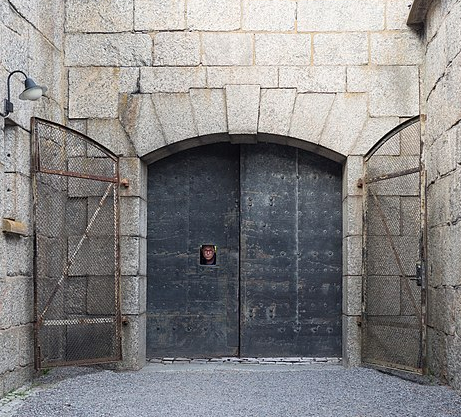
Image of Vaxholm Fortress gate, by “Rhododendrites.” Creative Commons License.
Readers of a certain age will remember the experience of going to a professor’s office after an exam to find their grade, the list of doom or celebration taped to the office door. At best, individuals were identified by their student ID number, but more often, it was just last name-first initial-grade. Childress, H. ………. B+, there for everyone to see in the alphabetical list of forty other kids. We don’t do that any more, and we’d be appalled to see it, but in the 1970s, that was normal.
By the time I was professionally involved in higher ed, our daily work was governed by FERPA, the Family Educational Rights and Privacy Act. Without a student’s individual and direct permission, we couldn’t say anything about a student at all except that they were or were not enrolled. FERPA can be overridden by a subpoena, of course, or by law enforcement if they declare an immediate public-safety concern, but in general, we didn’t say nothin’ to nobody.
Medical records are governed by a similar law, HIPAA, or the Health Insurance Portability and Access Act. The premise is the same: your health is your business and no one else’s. (The Insurance part of that is important, though, because it means you don’t really have privacy control over your medical records at all. Your health insurance providers can read the whole thing.)
The notion of privacy is that our information is an extension of our selves, and that we deserve the same autonomy over that information as we do over our bodies. We decide who knows what about us: we “let someone in” or “shut someone out,” opening and closing doors differentially depending on who’s asking.
Sometimes the door is literal; physical barriers are one of the strategies of privacy protection. Others include distance and isolation; reserve and non-engagement; intimacy with selected others that makes it clear the rest of the world isn’t welcome to our small, shared circle; and anonymity, in which things about us might be known but nobody knows or cares who we are (e.g., what happens in Vegas stays in Vegas).
Privacy has always been less than absolute, just as every individual right is less than absolute. Hester Prynne’s scarlet letter was the 17th-century version of contemporary sex-offender registries, a legal claim that one’s sins should be visible to all. In our “big data” age, we surrender privacy every minute, mostly in ways we haven’t considered. But epidemics raise privacy concerns in different ways, and some people feel that their safety is compromised if the infected aren’t wearing a big red C.
The fact that the virus can be spread without symptoms, and that a quarter of people with COVID never develop symptoms, is a few steps too far for some people to track. Easier to decide that some people are unsafe and call it enough. Let “them” change their behavior; I need a haircut.
Now, as our Town’s emergency management director, I know some things and hear some other things that I don’t share. Unlike my statistics class at Michigan Tech in Winter 1977, I’m not going to be posting people’s grades on the door, or the town website. It’s neither my business nor anyone else’s. Those who are sick—with ANY illness, from measles to cancer—deserve to manage their own information, as would be true in any other circumstance. We aren’t shunning or excommunicating anybody. We’re in this together, as we always are.
I was a flask-shaped man in a velour shirt sitting at long lunchroom tables in business schools, cosmetology schools, junior colleges, community colleges. My business was buying used textbooks and crating them off too a distributor.
Gary Lutz, as quoted in Ange Mlinko’s London Review of Books essay, May 7 2020
That’s just a delicious specificity, none of which is descriptive in the usual demographic ways. We don’t know his age or ethnicity, don’t know height or religion. We don’t usually get asked on multiple choice forms to describe ourselves as “flask-shaped,” but what an outstanding portrayal of a body and its freighted life.
We are collective, demographic. We are gender, ethnicity, age. We can all be reduced to some combination of items by the US Census or by Survey Monkey or by a market-research call center. At a questioner’s request, we can eliminate enough of ourselves to climb within one container or another, even though that packaging doesn’t exactly fit.
But we oughtn’t to do that blurring to ourselves or the people around us. We are specific, marked by innumerable choices, made by ourselves and by others. At every moment, we shed many opportunities in order to pursue one, and each of those paths has led further to who we are. There’s no singular branch point that “made all the difference,” because they all do.
I’m putting together a free class to teach short story writing to a small group. It’ll be based almost entirely on discovering the specificity of our protagonists, the ways in which tiny details and insignificant choices lead to whole, unmistakeable, unforgettable people. If you’re interested in being part of this pilot group, get in touch. It won’t be easy work, but you’ll never forget it, and you’ll be amazed at what you can create.
Photo from Cisco, and I can name three dozen ways in which I know this is a staged image that has nothing to do with what a real prison visitation would be like. About the only thing they got right is the slip-on shoes.
It may be possible to be brave with others, but in fear, as in illness, each of us is alone.
Masha Gessen, “The Political Consequences of Loneliness and Isolation During the Pandemic,” The New Yorker
Nora and I get out as much as we can. Every Tuesday and Saturday, we go to the Historical Society to deliver the meals that our neighbors have requested. I go in to town most weekdays to pick up the mail. It’s been about two weeks since I’ve been into Rutland for a supermarket visit, and I miss it enormously, the simple fact of people-watching now revealed to be one of the most crucial commodities a supermarket provides.
On Sunday evening, we held our distancing picnic, the second time we’ve done it. I put out our patio chairs on the lawn, each chair seven feet from its nearest neighbor. Our friends from up the road stopped by with their own picnic baskets and their own beverages, and the ten of us sat and talked in our giant circle like some demented New Age ceremony. Normal conversations don’t happen in groups of ten; ten people naturally subdivide into two or three or four simultaneous groups, each with its conversational gravity drawing its participants close. Now we’re all engaged in a public-speaking club, like Toastmasters, our conversations turned into sequential pronouncements.
Zoom is worse. The practices of turn-taking are subtle, watching someone lean forward as they’re about to speak, watching someone turn their eyes down and shake their head in subtle disagreement that ought to be surfaced. None of that is available in our low-res, un-edited, poorly framed meeting space. People just don’t understand the amount of professional support required to make video look good. (I guess we do now, after a month of watching late-night TV shows shot on a single rigid-mount camera in the host’s rec room.)
It’s been about sixty years since the anthropologist Edward T. Hall developed his ideas on what he called proxemics, or the study of the social uses of distance. In his 1963 book The Hidden Dimension, Hall posited that there were four zones that we used for different kinds of interactions:
Intimate (touching to 18 inches), for those with whom we’re “closest”
Personal (18 inches to 4 feet), for interactions among “close” friends
Social (4 to 12 feet), for interactions among “more distant” acquaintances
Public (12 feet and beyond), used for addressing those who are “remote” from us, like theater or political audiences or a lecture hall
The way we describe our relations with the people in our lives, as close or distant or remote, is directly drawn from millennia of human relations. We find it hard to replicate those emotional relationships when we can’t manage physical relationships that match. Our circle of 7′ chairs was over twenty feet in diameter: I was sitting on the porch, and Sarah directly across from me was all the way out at the edge of the road. That’s no way to sustain a friendship, though it’s better than the phone.
Political commentator Masha Gessen had a smart essay in The New Yorker yesterday, from which the quote at the top is taken. She writes about how the work of meaningful thought is powered by the cyclical engine that spins between the intake of social engagement and the compressive chamber of solitude. Without both, solitude becomes loneliness, deprived of fuel. She writes:
I am much more worried about lonely educators and lonely politicians, lonely writers and lonely economists, lonely architects and lonely filmmakers, lonely organizers and lonely artists, and all the other lonely people whose job it is to imagine the future.
I know that I’m finding it a lot harder right now to work on my fiction, on unearthing the communication between me and another complex and not entirely predictable human. It’s a lot easier to write in essay form, responding to a delimited condition, trimming away the extraneous to focus on a unified theme. Even my writing is lonely.
I was awfully good at essays. At the precise identification of a phenomenon, at naming its salient characteristics, on specifying the relationships between them. I made a career, from grade school onward, of writing in response to the essays of others. The world of essays is a closed circle of automatons, artificial intelligence in bounded communication with its peers.
The dissertation was a liberation from that. I lived for a full year with a high school full of kids and teachers who surprised me every day, who broke my carefully framed understandings over and over through the simple fact of being unclassifiable. And then I spent a second year writing about them, in a mode of storytelling that I hoped gave them the latitude to speak on their own behalves as I chased behind them and highlighted some particulars that I thought were interesting. The writing of that book was a continuation of the dialogue, in which their actions caused me to think about some new thing on the fly.
But I soon found that professions aren’t usually dialogic. We write not about what people are doing, but about policies, about procedures, about projections, about categories and constructions that have been fixed and cannot be questioned. The professions are mostly conducted in essay form, efforts to reduce risk and ambiguity, to declare certainty. I was once told by a good friend that he watched me lose a job in the final interview. “They wanted answers,” he said, “and you gave them stories.”
The dissertation itself was contentious. My committee, who were in on the game from the start, thought it was revelatory; one colleague who ran the sponsored research office said “I had a lot of problems with it as the culmination of an academic study. If you wanted to write fiction, you should have said so.” Even then, I was mistaken about what academic life was for. I wanted to open possibilities, and the profession wanted to construct precision. A simple, fundamental conflict of purpose that could never be resolved, and was never actually named.
But people who can’t surprise us aren’t really people at all. That’s why the work of fiction has been such a blessing. My characters surprise me every time I sit down. If they don’t, then I’m writing an essay, and I know that it’s become a bad day at the desk, an artifice all of my own creation.
I like essays. I’m good at them. But they aren’t enough, not any more. In the fourteen months I’ve been writing the little essays on this website, I’ve simultaneously written two novels. They’re the leavening that allows the writing to rise. But for the past couple of months now, it’s all been hardtack, all matzo—the intellectualized ritual sacrifices that once were set apart to remind us of our good fortune, now become our daily lives.
Lots of religious traditions have some version of the concept of axis mundi, the point where heaven meets earth, and God is most present. Or the point at which the underworld has an exit to the surface, from which our earliest ancestors emerged. No matter the history or the explanation, the axis mundi is the point deemed to be at the spiritual center of the spinning world.
I’d like to propose a paired concept, the personales borealis, our own individual North that sets our course. I think that all of us have some magnetic pole that draws us perpetually toward our own home. We already have words for that, of course: obsession, or mania, or idée fixe, or mission, or passion. But I think none of those quite hit their mark, because they feel like either decisions or afflictions. I’d like to use personales borealis to designate something more neutral, more basic: our own individual polarization that pulls us perpetually in a single direction, toward the destination we never reach.
The axis mundi is settled and stable. The personales borealis makes us move.
The axis mundi is a point of reassurance. The personales borealis is the question perpetually unanswered.
The most identifying mantra for the axis mundi is Ram Dass’ simple be here now. But I think the best expression of the personales borealis comes from Martha Graham, who said to one of her friends, the choreographer Agnes de Mille, “No artist is pleased… There is only a queer divine dissatisfaction, a blessed unrest that keeps us marching and makes us more alive than the others.”
Although too much of what we call education is intended to instill our own borealis into other minds, it’ll never take. The one we’re born with can never be supplanted by one that’s grafted on. At best, the artifice will be rejected. At worst, and far too often, the imposed purpose is loud enough that it muffles the authentic one, and we spend too many years not being able to hear our true call.
This is the 200th of these little essays since I started this website in February 2019, a full book’s worth of writing that will never be a book. It’ll never be anything—except what it is, a chance two or three times a week to think about whatever comes to mind. Some people pursue their personales borealis through their hands, drawn forward into paper, or yarn, or a fine restaurant meal. Some people pursue their personales borealis through music, or through dance, or through athletic endeavor. Mine seems to draw me through language, through writing and erasing and writing again, drawing closer but never quite reaching.
I hope that you give yourself some time today to sit with that question, to identify the magnetic charge of your own borealis. Let’s leave Martha Graham with today’s last word:
There is a vitality, a life force, an energy, a quickening that is translated through you into action, and because there is only one of you in all of time, this expression is unique. And if you block it, it will never exist through any other medium and it will be lost. The world will not have it. It is not your business to determine how good it is nor how valuable nor how it compares with other expressions. It is your business to keep it yours clearly and directly, to keep the channel open. You do not even have to believe in yourself or your work. You have to keep yourself open and aware to the urges that motivate you. Keep the channel open.
How tenth grade explained the academic and arts job markets.
I’m struck by how many of my cohort thought they were headed for junior faculty, who’ve become data managers or advocates for women in science or some non-teaching role. There were a few of my colleagues who wound up running academic programs, like a travel study program. An associated thing that wasn’t what they’d set out to do
“Paul,” ten year adjunct faculty quoted in The Adjunct Underclass
Sixty-eight years ago, the renowned sociologist Erving Goffman wrote an ingenious essay called “On Cooling the Mark Out,” a study of how con men kept their “marks” from losing confidence and calling the cops. I’ve written before about how precisely Goffman’s language mirrors that of Damon Runyon and Guys and Dolls:
A mark’s participation in a play, and his investment in it, clearly commit him in his own eyes to the proposition that he is a smart man. The process by which he comes to believe that he cannot lose is also the process by which he drops the defenses and compensations that previously protected him from defeats. When the blowoff comes, the mark finds that he has no defense for not being a shrewd man. He has defined himself as a shrewd man and must face the fact that he is only another easy mark. He has defined himself as possessing a certain set of qualities and then proven to himself that he is miserably lacking in them… It is no wonder that the mark needs to be cooled out and that it is good business policy for one of the operators to stay with the mark in order to talk him into a point of view from which it is possible to accept a loss. In essence, then, the cooler has the job of handling persons who have been caught out on a limb—persons whose expectations and self‐conceptions have been built up and then shattered. The mark is a person who has compromised himself, in his own eyes if not in the eyes of others.
Goffman notes, in fact, that it’s more important for institutional cons to cool the mark than it is for street-corner hustlers: “One may note that a service organization does not operate in an anonymous world, as does a con mob, and is therefore strongly obliged to make some effort to cool the mark out. An institution, after all, cannot take it on the lam; it must pacify its marks.” That unproductive PhD program can’t just beat it and catch a bus to Poughkeepsie; it has to stay put and drag more people into the net, and so must calm its losers.
In Goffman’s analysis, there are two primary modes of cooling the mark. The first is to “offer him a status which differs from the one he has lost or failed to gain but which provides at least a something or a somebody for him to become.”
How many hundreds of thousands of former mid-level athletes now coach in pee-wees and high school and community college and independent leagues? How many lapsed high-school jocks are now in college, majoring in sports administration or athletic training?
How many artists run galleries, or write grant proposals for nonprofits, or teach life drawing and intro to watercolor at the local community college? How many poets teach freshman comp?
How many fully qualified scholars teach as adjuncts for three or four grand per course? How many become academic advisors, run the tutoring center, direct the women’s center?
How many novelists park their work on the hard drive in order to write news copy, or edit the work of others? Become a corporate media director, a book reviewer, a pop-culture writer?
The Washington Post reported a few years ago that the Washington Nationals baseball team employed about 200 players at all levels of major and minor leagues, and over 1,100 other employees, from business operations to travel management to chefs and trainers. Rob McDonald, the Vice President of Clubhouse Operations and Team Travel, was a perfect example of a former athlete who used a quasi-athletic job to stay close to the action:
McDonald grew up outside St. Louis, went to Northern Illinois to play quarterback, moved to wide receiver, then suffered a back injury that ended his football career. He transferred to the University of Arizona, studied pre-law, and decided he preferred the pursuit of a career in pro sports over law school. So he worked in Tucson rec leagues, then for a sports radio station in Phoenix, then for the Arizona Diamondbacks in spring training before landing in the Arizona Fall League, where baseball’s best prospects go each year.
Barry Svrluga, “The Glue,” Washington Post, September 22, 2014
Colleges especially are full of ways to cool the academic mark. Student services, IT, co-curricular offices, assessment and institutional research, grants offices, financial aid, registrar, admissions—so many functions that welcome those who are fluent in the language and practices of higher education, but who will not themselves get to participate in the life of teaching and scholarship. I used to describe being a college administrator as like living next door to your old girlfriend—you got to see her every day, but you’d always be reminded of the life you’d never, ever have. It’s a way of life that’s similar, but not congruent, to the work you’d dreamed of doing. You get paid, sometimes pretty well, to endure a very specific form of cruelty.
The second strategy Goffman lays out for cooling the mark is to “offer him another chance to qualify for the role at which he has failed.” The arts are terrific at this: there’s always another fellowship to write for, another residency, another group show. Every Starbucks needs something on the walls. The writers’ magazines are laden with short story competitions, the prize for which almost always includes having your work actually read by someone important. Maybe only televangelists exceed the arts in their demands to be sucked up to without giving anything back except promises. Con men always promise. Twenty dollar entry fee, please; tithing as our shared act of contrition and fealty.
We publish in the little magazines, paid in two contributor’s copies, read by an audience in the high dozens. But it’s printed, after all, with our names on it and everything. Unless it isn’t, unless it’s an online journal, in which case we just put the URL into our CV and hope they keep paying the registration fees for that domain name.
Parafaculty life is the same. Every year brings its new job market, new possibilities to which we rise like trout to the fly. And mostly, we find that the colleges practice catch-and-release; we’re taken up for a semester and returned to the hungry stream. But because we aren’t as smart as trout, we hang around, hoping to be caught again. We hear the murmurs of affection, from our students and our department chair, and believe that we’re accomplishing… something. Something unnamed but clearly positive, clearly productive, demonstrating our qualifications and our goodwill and our capability of being a good permanent partner if only, if only.
To return to Hans Abbing’s book that we discussed yesterday, he makes several comparisons between life in the arts and life in religious vocations. “According to an early US census report, only employees of the church faced larger income penalties than artists; it again suggests that there is a parallel between art and religion. Both invite employees to make sacrifices.” We imagine ourselves participating in something sacred, and are willing to forego earthly comforts to attain a larger reward.
The salespeople know it’s a business. Salespeople always do. But what they sell is a prosperity gospel in which our poverty is merely evidence of our insufficient faith. They tell us that our dedication and talent are similar, but not congruent, to those more righteous who have attained their promised seat in heaven. But they hold out hope, so that we persist.
Guess what, friends? This is the 199th little essay in the fourteen-month run of this website. Tomorrow will be posting #200. I’ll throw us a party.
It’d just look less compelling with a keyboard or paint brush instead of a wrench, wouldn’t it?
Given that today is May 1, I thought it would be a good day to talk about work and money. Happy Workers’ Day, and thank you to all who work in hidden backstage ways to make our lives better.
It’s interesting that the two professions I write most about, writers and college faculty members, are both winner-takes-all markets, in which a handful of practitioners are handsomely rewarded and economically secure, and most scuffle together what they can on the freelance market. My friend Aimee pointed me to a wonderful book by Hans Abbing, called Why Are Artists Poor? The Exceptional Economy of the Arts (Amsterdam University Press, 2002). Abbing wrote this book from a nearly unique standpoint: he’s an academically trained economist who is also a recognized painter and photographer. The book is an attempt for Abbing to reconcile the cognitive dissonance created by living simultaneously within those two logic systems. Lots of sections of the book contain a construction that shows him actively comparing his two mutually exclusive beliefs, such as this one:
Although I actually earn a substantial portion of my income through the market, as an artist I am convinced that aesthetic value is independent of market value. But as an economist, I disagree with this. As an economist I believe that quality in general corresponds with success in the market. (54)
Must be exhausting to live inside that head. To his great credit, rather than trying to gloss or elide these contradictions, Abbing has spent much of his academic career trying to understand exactly why they diverge and how they might cohere. His conclusion frames the subtitle of this book: the arts represents an exceptional economy, which behaves in specific and knowable ways that are dissimilar to the economies of manufacture or service.
The book is full of takeaway quotes, and is totally worth your time. (You can read and download the entire book at oapen.org, the European academic open-access consortium.) But given that it’s May Day, I want to focus on one particular aspect, the notion of the winner-take-all market.
There exists a number of markets where a large and often increasing part of consumer spending ends up in the pockets of a small number of producers, while the majority of the producers earn little or nothing. Those near the top secure a disproportionate share of the particular market’s income. . . For instance, professional tennis players operate in a ‘winner-takes-all’ market. There are thousands of tennis players all over the world offering high quality performances, but only a select few earns the big incomes, while the vast majority cannot even earn a basic living from playing tennis. (54)
I’ve long been interested in people who are nearly but not quite at the pinnacle of their chosen fields, and who because of that can’t practice them at all. As an example, pick any college baseball player at random: that person would be the best baseball player you’ve ever met, an elite athlete with rarified skills, truly praiseworthy. Maybe one percent of those will go on to make a living (for a brief while) playing baseball, if even for the Lowell Spinners or the El Paso Chihuahuas or the Richmond Flying Squirrels. A tiny percentage of those minor league players will make a major league roster somewhere. So much remarkable talent goes unrecognized and unutilized.
But I think Abbing leads us down a side road by using athletes as his example. Tennis players are engaged in a knowable, objective competition in which one will empirically be better than the other. A career of those empirical outcomes leads some players to be Serena Williams, and others to be Haley Giavara, the world’s #732 ranked women’s player who has made $12,724 in her career. Haley is a starter on the UC Berkeley tennis team, a brilliant player. But the current world #1, Ashleigh Barty of Australia, has already made $17,594,569 at the age of 24. It would be like if the 700th-best carpenter in the US made about thirty cents an hour.
Most professions don’t have an empirical mechanism for determining relative quality, or perhaps for defining quality at all. Those markets are externally influenced: by credentialling systems (passing the bar exam, for instance, or getting a barber’s license), or by a community of gatekeepers. Both of those serve to maximize income for those deemed to be “inside the professions,” and to eliminate the possibility of meaningful competition by those outside.
I absolutely don’t mean to suggest that those restrictions are a bad idea. In law and cosmetology, we want some certification that our practitioner knows what she’s doing, isn’t just making an unwarranted claim to competency. In the arts, in writing… well, we’ve all been to the local craft show, and the world of electronic self-publishing will tell you an awful lot about the gradients of storytelling capability. Nobody has time to winnow through all of that.
And frankly, the gatekeepers don’t, either. There are too many of us who are trying to enter the market, and we can’t all be judged on the merits of our work. So proxies and personalities come into play:
Gatekeepers have an information advantage that allows them to monopolize the discourse, which in turn enables them to easily exclude both artists and experts who do not understand the discourse well enough. (269) Gatekeepers decide on who to let in (to attain a certain reputation) and those who are to be kept out. In fact, participants in the discourse occasionally let artists in by granting them a favorable reputation, while others are rejected or are stripped of their favorable reputations. This way the favorable reputation of the insider artists can be protected. (272)
That “reputation” is generated by facts that lie outside any specific piece of work. Aspiring artists and academics alike are notorious CV polishers. Every award, every show, every mention in the media—all part of our permanent record. We present it to the gatekeepers, to edge our new work to the front of the line; we gaze at it in the mirror, to convince ourselves that our work has mattered.
And every one of those gatekeepers relies on gatekeepers before them. An MFA from Columbia weighs more than an MFA from across the river at St. Francis College in Brooklyn. A distance far greater than the nominal hundred miles separates the MFAs from the University of Michigan and Western Michigan University; the two equivalent degrees are tickets to entirely different kinds of conversations. Literary editors are loathe to read unagented work, and the agentry community itself uses the word “slush” to designate the writing (and by extension, the writers) who must be cleared from the porch before the real workday can actually start. Each of those offers a simple binary of consideration: do you have the reputation that makes you worthy of scarce attention, or are you safely ignored?
The value of reputation is what economists would refer to as a market distortion, in which some external factors prevent product A for price $A from being set directly against product B offered at price $B. Most products, from prospective faculty and prospective artists and prospective writers, have no access to a meaningful marketplace at all.
As you might have seen with the most recent two posts, I’ve had a fraught couple of days. So Nora and I had a long talk last night, a lot of which had to do with the functions that writing accomplishes in the world. It was pretty wonderful, and made me realize all over again just how lucky I am.
She’s described a lot of my work in the wake of The Adjunct Underclass as “academic chaplaincy,” talking with people by phone or by email to help them know that they’re not alone. Even the book itself did that work, letting readers of all stripes know that the emotional dislocation and disrespect they experienced was normal, should be expected, wasn’t shameful, wasn’t a weakness. I said to Nora that my fiction was intended to have that same effect. All of my stories, no matter when or where they’re set, are about someone who has done all the right things, looks successful enough from the outside, and feels as though they haven’t reached what they’d hoped for. Or had quit hoping altogether. And my stories are there to say to readers, It’s normal to feel stuck. It’s normal to feel like your success doesn’t look like it showed in the catalog. But you have the capabilities already within you to reinvent yourself. You don’t have to accept who and where you are. There’s more possible. It’s an attempt to offer a different mode of chaplaincy, through fiction.
And Nora said something really interesting, which I’ll paraphrase since I wasn’t taking notes and it was eleven o’clock at night. She said, “I’ve never looked to fictional characters for role models or life lessons. I’ve never looked at a character, no matter how much I’ve identified with them, and thought that I could take lessons for my own progress.” And I think that’s not surprising; she’s an ethnographer down to the bone, learning about others, constantly focused on the experiences and the welfare of those around her. She reads with empathy, learning what it must be like to inhabit those circumstances, that time and place, that culture, that body. She focuses outward.
I guess I’m more selfish. I read lots of things both to imagine those lives and to re-imagine my own. We can go through all kinds of dollar-store psychology about what our reading says about our personalities, our ego stability or fragility. Whatever. I do think, though, that neither Nora’s nor my style of reading are idiosyncratic. Both modes exist in the world.
I’ve written extensively about my desire to write hopeful books, to act as a countervailing force against a literary landscape that seems daily to become more lurid, more hopeless. That would, in the classic distinction, make me a writer of comedy (books with an upward arc) rather than tragedy (books with a downward arc). Comedy isn’t necessarily funny; it’s just about ascent rather than decline.
And just today, Katy Waldman in The New Yorker wrote about the work that comic novels do. I’ll leave aside her extended discussion of P. G. Wodehouse’s Jeeves and Wooster books, and Richard Russo’s novel Straight Man, as well as her recommendations for comic novels worth reading during the quarantine. Instead, I’d like to highlight an important distinction between two different functions of comedy, a distinction that pretty closely mirrors Nora’s and my conversation of last night.
Waldman differentiates between stories intended to lighten our load and those intended to help us adjust and reshoulder our load:
Russo, whose protagonist often wavers between sorrow and hilarity, wants to emphasize that applying a comic framework to life is a choice. Hank refuses to play the straight man in his routine with the universe. Seriousness poses danger; better to make the cracks than to endure them. In this sense, Hank’s clowning illuminates his character, even invests it with tragedy, and Russo offers an alternative to the Wodehouse novels. Bertie is an innocent portrayed ironically; Hank is an ironist portrayed sincerely. One path leads to escapist distraction, whereas the other leads to a set of implied instructions: This is how humor might help—or fail to help—a person cope…. What is our disposition toward a fickle universe? Do we claim agency through humor? Or strive for a jolly and wide-eyed surrender?
Katy Waldman, “Two Paths for the Comic Novel (and the Funniest Books to Read in Quarantine), New Yorker, April 27, 2020
This is absolutely my experience. Some novels are about agency, about recognizing our absurdity and taking action nonetheless. And others are just fun, page-turners that help us get through a hard day. As Waldman says:
From an aesthetic perspective, one vision—pessimistic or optimistic, active or passive—isn’t better, or funnier, than another. But there’s a larger truth here. Before the shelter-in-place orders, I was not seeking out the books that made me laugh as a kid. Now I am. This fact somehow seems to get at the essence of comedy—an art that becomes more real, more fully itself, within a shared, tragic frame.
And that’s the work of comedy as chaplaincy, the recognition that things really ARE fucked up and that we have a responsibility to be honorable anyway.
A couple of years ago, I was at a writers’ conference held at the Vermont College of Fine Arts. One of the staples of those events is some venue where each participant, no matter how far along they might be in their career, is given the opportunity to do a brief public reading. At Bread Loaf, there’s the Blue Parlor; at VCFA, there were pre-dinner readings in which the members of each cohort got their time at the lectern. You get three minutes, or five minutes, to show what you can do.
As a college teacher, I’d done public speaking for a long time, and I know something about how to honor a circumstance like this. So at VCFA, I read an excerpt of my very first novel, a roughly three-minute piece that I knew would hang together without backstory, a piece that had some degree of sonic music to it.
Afterward, I interacted with several of the faculty at the event who said how much they’d appreciated my piece. But one in particular stuck with me, a poet who said, “When you started, I thought, ‘this isn’t going to be a subject I’m interested in.’ But you made it interesting, you made it matter to me.” She paused for the briefest moment, and said, “Where can I read more of your work? Are you published?”
“Not in fiction, no. I’ve sent it out quite a lot, but it hasn’t gotten any traction.”
“Well, people are just stupid.”
Well, yes. Yes, they are. And that’s the Chautauqua for today.
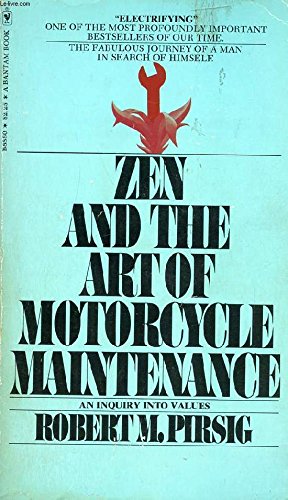
In Zen and the Art of Motorcycle Maintenance, Robert Pirsig lays out a number of what he calls “gumption traps,” circumstances that can dispel one’s attempts toward Quality. He divides them into two kinds:
The first type are those in which you’re thrown off the Quality track by conditions that arise from external circumstances, and I call these “set-backs.” The second type are traps in which you’re thrown off the Quality track by conditions that are primarily within yourself. These I don’t have any generic name for—”hang-ups,” I suppose. (299)
Pirsig lays out several set-backs. There’s the out-of-sequence assembly, in which you’ve got the thing almost back together before you discover some step you should have done long before, an oversight that requires disassembling all the work you’ve done. There’s the intermittent failure, the thing that works fine when you go to examine it on the bench, so you put it to use again and discover the same problem. There’s the parts set-back, in which the part you need either isn’t available, or you forgot to get it when you went to the shop, or it wasn’t manufactured right and doesn’t actually fit where it’s supposed to go.
The hang-ups (or “traps”) also come in a three-pack, and Pirsig claims that the traps are far more damaging, and common, than the set-backs. First, there are value traps, in which your preconceived diagnosis of a problem prevents you from actually looking at what’s in front of you. Your preconceived diagnosis of the problem may also be about yourself as a problem-solver. About your ego, or your anxiety, or your impatience, or your boredom. The problem itself doesn’t change because of your anxiety or impatience, but your ability to understand it and address it absolutely does.
There are truth traps, in which we presume that we’ve framed a question in which all of the possible answers can be named, but by its very framing, leads us toward unhelpful answers. Pirsig uses the Japanese Zen teaching of mu as a useful response to that framing. The answer may be neither yes nor no, but mu, which can best be translated as “unask the question.” The best way I can explain truth traps is through the conversation we had a couple of days ago about metaphor. It may be that the very metaphor we hold for what a phenomenon is, is exactly what prevents us from asking better questions about it.
Finally, there are muscle traps. Bad tools, uncomfortable working conditions, and insufficient feel or tactile memory. The things that cause us to make physical mistakes, break parts, burn ourselves or rack our knuckles.
Pirsig drew both the setbacks and the hangups from his own long experience of mechanical work, the “motorcycle maintenance” part of his title. But I think they all apply to writers as well. The external setbacks certainly exist. We put things together in the wrong order, and have to go back and disassemble. Every writer in a workshop knows the experience of having ten radically different reactions to a story, and ten different diagnoses about the location of the flaw and the prescribed remedy.
And, as with mechanical life, the hangups are even more serious. We stop ourselves by our anxiety, we press forward with a bad idea out of ego, we truncate a scene through impatience. We use the wrong metaphor to contain our ideas, and imagine we’re writing a book about some theme instead of letting the characters tell us what themes they’re living. We write in awkward places, at bad times. (Joyce Carol Oates says that the nemesis of the writer isn’t lack of talent, it’s interruption.)
But although writers face the same array of gumption traps as motorcycle mechanics, we have our own special array to add on. As the poet Philip Larkin has it, They fill you with the faults they had / And add some extra, just for you.
So there’s a literary agent who has a blog. It was recommended in an article I once read, and as someone always on the search for the key to the castle, I went there and read it for a while, even participated in the discussions for a few months.
It was miserable. The agent herself, with decades of experience, used the blog mostly to complain about writers’ misguided aspirations, or about whatever injustices she felt burdened by that day. It was a cynical stew. And several of her regular comment participants were abrasive, confrontational, mean-spirited. (That blog, in fact, is why I decided not to enable the comments on this one. There’s always someone who wants nothing more than to pee in the pool.) So after about four months, I let it go, stopped visiting.
But here we are in Covidland, all sitting at home without even random errands to run or a restaurant to visit. We need some things to do. So I made the mistake of going back to see what this agent had been up to recently. Her most recent post began:
Lately, lots of off-the-wall submissions. Definitely feels like end of days. And as always they evoke a spectrum of feelings and reactions in me. First, self-pity. Why me? Why do I get these letters and why do I feel I have to answer. Next, annoyance. Can you not be bothered to do a a simple Google search and discover that I’m not interested in self-help, how-to, sci-fi, fantasy, new age and books on spirituality? Books on spirituality in particular enrage me. Then there’s the writing thing. Most people who get published work at their writing for YEARS. These query letters generally come from people who just turned on an Apple for the first time and believe that whatever comes out deserves to be published.
I had my own “spectrum of feelings and emotions” about this, which I’ll spare you. But all that reactive fizz settled quickly, of no more consequence than the bitters that foamed it up in the first place. And the residue that separated out was a third form of gumption trap, perhaps unique to the creative fields, which we might call the misdirection trap. In creative fields, we’re told to work on our craft, to seek out opportunities for growth, to demonstrate our individual capability. Talent and effort, talent and effort, we om to ourselves, like dwarves off to the mines.
And then we find that the seats we’d earned through our craft and labor are already filled by the Harvard kids and the NYU kids who had enough parental money to run their own magazines for a few years without getting paid, who got into the right parties and had the right people mention their names in conversations. We discovered that our PhD or MFA from the wrong school was a counterfeit currency that couldn’t be spent, no matter how much the salespeople had touted it, no matter how much we’d learned and been published.
That’s what literary agents get paid for. To insert your name into the right conversations, to sell you a card or two from their Rolodex, to overcome your social shortcomings with outboard connections that they’ll lease to you if they feel like it. But the world of agentry is opaque. We send our materials, after hours of research, to an agent who never responds. Or who responds with a form letter about how “it’s not right for my list,” but that writing is a subjective business and someone else might LOVE your deformed offering. We have no feedback from which to learn, merely silence.
So then to discover occasionally that those people don’t merely ignore us but actively demean us—well, that just a hard fact of the world to encounter. In Pirsig’s words, it knocks you off the Quality track, it makes it difficult to find the gumption to face the story again. All of us gullible, naive children who learned the word meritocracy early on and then discovered that its definition was entirely wrong… that sad shantytown of the poorly born, discovering that we are not merely blocked from the mansion but mocked by those inside… it makes you believe bad things about yourself. Beliefs that aren’t warranted, but that have to stand in the absence of other evidence. Beliefs that make trying again just seem wrong-headed and feeble.
I’ll write again, soon, because the writing is always worth it. In the novel I’ve been working on for the past three months, Cassie is just now starting to trust me enough to show me who she is, and the growth of her story will be its own reward. But the thought of putting that story and all the others on the table for sale again is gruesome. I can’t even think about it, or it wipes all of my good will away for hours. For me, it is the biggest gumption trap of them all.
I’ll close where I began, with my colleague the poet and her elegant refrain, “Well, people are just stupid.” The question is: who among us does that best describe?
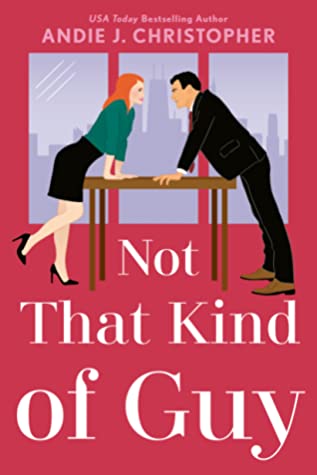
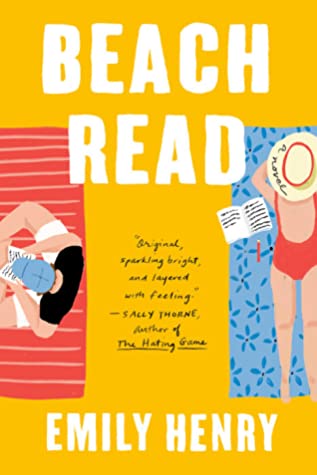
I’ve mentioned before that I get updates every couple of days from Random House, with new entries in some category or another. Yesterday, I was asked to Fall In Love with This April’s Romances.
It doesn’t take a decade of architecture school to notice that there’s some kind of graphic-design collusion going on here. (And not all of these are from Random House; I browsed in Goodreads and found these and dozens of others just like them.) Whether the romance in question is straight or gay, whether the couple are white or multiracial, romance books this season are cartoons. Solid, saturated colors edge to edge. Big, blocky text with no borders or shading. The couple in question portrayed by drawn figures, barely more than silhouettes, their clothing and hair also only blocks of solid saturated colors.
Publishing, which we wish were more about individual stories, is really about product, as is true of most industries. (Certainly it’s true of colleges, which have to make their own products uniform enough to be transferred across schools and adhere to disciplinary-society standards.) These books are being sold as just nine different flavors of Doritos, the same chip with different powder, the same bag with different colors, the same general experience with a little twist.
So the literary agent community—just salespeople in the end, like Realtors who have to make each unique home into a commodity—start to ask for these categories, with all of the expectations that they entail. Fads abound, rocketing and exploding and fading into the night. Here’s a bet; romance covers won’t look like this in three years. Some other flavor profile will have taken the fore.
And in closing, let me say this. If one of my fiction books is ever published, they can do whatever they want with the graphic design of the cover; that’s product design, not storytelling. But I promise you that I will fight every last step to ensure that the words “A Novel” do not appear anywhere. What the hell is that even about? I mean, they’re not cookbooks. They don’t look like SAT prep guides, or nonfiction history, or religious tracts. We’d find them in the fiction section of the bookstore. Of course they’re novels! Are we so afraid of collections of short stories that we have to have some kind of safety seal on the book cover? Bah.
I’ll write more tomorrow about why I’ve been so crabby the past couple of days. It’ll help me get over it.












 Herb Childress