It’s All Metaphor

Illustration from PC World Magazine

The greatest thing by far is to be a master of metaphor. It is the one thing that cannot be learnt from others; and it is also a sign of genius, since a good metaphor implies an intuitive perception of the similarity in the dissimilar.

Aristotle

Well, thanks, dude!

When Nora and I started Teleidoscope Group seven years ago, we gave ourselves the job titles we wanted, instead of the normal CEO or President or such nonsense. I became the Director of Metaphor, and Nora, who has an innate capability of luring anybody into a rich conversation, became the Director of Dialogue.

Aristotle’s attribution of genius aside, I don’t know why I’ve always been drawn to see things in terms of other things. We all do this, of course, but we don’t always know that we’re doing it, and so we don’t think about alternatives. And metaphors always have alternatives.

A simile or other comparison is a simple affair. X is like Y, because they share some common feature. It’s a tool for noticing. A metaphor, on the other hand, is an ontological claim about what a thing is. When we wrestle or grapple with ideas, we mean that those ideas are dangerous opponents that we need to master. When we come to terms with ideas, we mean that truth is a bargain that we need to negotiate. When we interrogate an idea, we mean that it’s concealing its truth from us and we need to get past its superficial alibi. The way we define and approach any problem is based on what we think the problem is.

Twenty years ago, I spent some time in all four of California’s state mental hospitals. (As a consultant, not an inhabitant, thank you very much.) Those hospitals had become mostly populated by people who had arrived due to some form of court sentence: not competent to stand trial, not guilty by reason of insanity, and a special population that the Legislature had invented in 1995, the sexually violent predator who had served his prison term but was deemed unsafe for general release.

Those hospitals were governed simultaneously by two opposing metaphors. The security perimeter, the entry protocols, the restrictions against contraband, all of that came from seeing those institutions as prisons. And they were. They were guarded and set apart from the civilian world by the California Department of Corrections. But once you got through the sallyport and into the units, you were in a hospital, governed by the California Department of Mental Health. And those two communities despised each other, because they each saw everything about the place through their own governing metaphor. The prison guards saw the mental health staff as naive coddlers, and the residents as inmates; the mental health staff saw the prison guards as punitive and draconian, and the residents as patients. One institution was being simultaneously overseen by two communities with two fundamentally different definitions of what the institution was. You can guess how well that worked.

I think it’s far easier to change someone’s mind than to change their metaphor. Once someone has decided that social life is a Darwinian competition over scarce resources, no argument based on collaboration stands a chance. Once someone brings out the word “liberty,” it’s difficult to ask that they temper their behavior in favor of responsibility. If metaphors are fluid, then reality itself becomes fluid, and that’s just scary. It places lots more responsibility on us if we have to choose the metaphor we want to employ; safer to pretend that it just is what it is.

We think of language as a post hoc means of describing reality: the thing is there, sitting immaculate and innocent, and we decide how to talk about it. But I think it makes just as much sense to say that we create reality through language, that what we see and hear can only be known through the metaphors we’ve created to hold it. Your plans to pass a pleasant evening listening to Killswitch Engage can easily be disrupted by your dad hollering down the stairs, “Turn off that noise!” Same song, two definitions.

More tomorrow.

Some Excerpts from Pirsig

Not what the book “is about.” Merely some of the many things that it is.

The school was what could euphemistically be called a “teaching college.” At a teaching college you teach and you teach and you teach with no time for research, no time for contemplation, no time for participation in outside affairs. Just teach and teach and teach until your mind grows dull and your creativity vanishes and you become an automaton saying the same dull things over and over to endless waves of innocent students who cannot understand why you are so dull, lose respect and fan this disrespect out into the community, The reason you teach and you teach and you teach is that this is a very clever way of running a college on the cheap while giving a false appearance of genuine education. (140)

When you’ve got a Chautauqua in your head, it’s extremely hard not to inflict it on innocent people. (161)

[on teaching writing…] A student would always ask how the rule would apply in a certain special circumstance. Phaedrus would then have the choice of trying to fake through a made-up explanation of how it worked, or follow the selfless route and say what he really thought. And what he really thought was that the rule was pasted on to the writing after the writing was all done. It was post hoc, after the fact, instead of prior to the fact. And he became convinced that all the writers the students were supposed to mimic wrote without rules, putting down whatever sounded right, then going back to see if it still sounded right and changing it if it didn’t. There were some who apparently wrote with calculating premeditation because that’s the way their product looked. But that seemed to him to be a very poor way to look. It had a certain syrup, as Gertude Stein once said, but it didn’t pour. But how’re you to teach something that isn’t premeditated? (170)

Quality… you know what it is, yet you don’t know what it is. But that’s self-contradictory. But some things are better than others, that is, they have more quality. But when you try to say what the quality is, apart from, the things that have it, it all goes poof! There’s nothing to talk about. But if you can’t say what Quality is, how do you know what it is, or how do you know that it even exists? If no one knows what it is, then for all practical purposes it doesn’t exist at all. But for all practical purposes it really does exist. What else are the grades based on? Why else would people pay fortunes for some things and throw others in the trash pile? Obviously some things are better than others… but what’s the “betterness”? (178)

It’s nice to start journeys pleasantly, even when you know they won’t end that way. (184)

I think metaphysics is good if it improves everyday life; otherwise forget it.
(240)

…it’s the student’s choice of Quality that defines him. People differ about Quality, not because Quality is different, but because people are different in terms of experiences. (244)

…getting stuck is the commonest trouble of all… your mind gets stuck when you’re trying to do too many things at once. What you have to do is try not to force words to come. That just gets you more stuck. (271)

Traditional scientific method has always been at the very best, 20-20 hindsight. It’s good for seeing where you’ve been. it’s good for testing the truth of what you think you know, but it can’t tell you where you ought to go, unless where you ought to go is a continuation of where you were going in the past. Creativity, originality, inventiveness, intuition, imagination—”unstuckness,” in other words—are completely outside its domain. (273)

The solutions all are simple—after you have arrived at them. But they’re simple only when you know already what they are. (281)

Coronamoments

So since I can’t concentrate, why not subject all of you to low attention span as well? Here are a few things I’ve discovered in the past few days as I’ve tried to not make myself crazy.

  1. I went from my newspaper website to the King Features syndicated page to do a crossword puzzle. Along with puzzles, King Features also owns the rights to a bunch of daily comics: Beetle Bailey, Zits, Baby Blues… that kind of stuff. But the thing I hadn’t expected is that each of those comics has a comments section, with sometimes dozens of comments! I mean, in what universe do people have an urgent need to make comments about Beetle Bailey?
  2. I was contacted this morning by the person who’ll be doing the translation of my book into Chinese. That person has a difficult task ahead, since the book’s written in a pretty colloquial voice, and they asked if they could reach out for guidance. The example they used was my reference to the fictional Wassupwich U. I spent a long paragraph to try to explain working-class constructions and Bullwinkle and the fact that lots of kids go to colleges that just aren’t very good, and I’m 100% sure that I wasn’t helpful. I feel really awful for this person as she or he takes on an impossible task.
  3. The underground yellowjacket nest in my front yard is now vacated, leaving a basketball-sized hole. My friend Derrick thinks that mice may have burrowed into it over the winter and eaten all the larvae. Thanks, mice! Good job.
  4. Nora and I have engaged in lengthy discussions about whether a piece of fiber has been twisted clockwise or counterclockwise; whether it matters which end of the yarn you look at when you say that; and whether the correct jargon for clockwise is “Z-twist” and counterclockwise is “S-twist,” or whether we’ve got it backward. It’s simultaneously testing my spatial-orientation skills, my language skills, my memory skills, and my patience.
  5. No matter what you try to do, other people will interpret it differently than you meant it. I’ve been asked this morning by one person to limit the number of people I send my daily emergency-management updates to, and asked by another person to be on them. And they’re both right. It’s a question without a correct answer, even though several people imagine that they’re correct.
  6. The world is awash in conspiracy theories, mostly generated from fear and anger in the midst of confusion. They give us power when we feel powerless. Everyone’s looking for some kind of master narrative that helps disparate phenomena make sense; the fact that a lot of those constructions are pretty rickety doesn’t matter as much as the comfort they provide.
  7. I was watching a YouTube video of a former literary agent talking about the seven reasons why the first page of your manuscript will get it rejected. And one of them was that the core conflict of the book isn’t contained on page 1. She said that back in the ’90s, books could take fifty or sixty pages to lay out the back story, but nowadays, readers want immediate action. And I thought four things, almost simultaneously. A) Nonsense. B) We’ve Twittered ourselves into intellectual submission. C) I love that “back in the ’90s” is unimaginably distant. and D) many of today’s readers were also readers in the 1990s, and the 1970s. It’s not like software, there aren’t reverse-compatibility issues that limit the use of legacy systems.

That, times about eighty-three, is the state of my head today. And I know, from talking with friends, that I’m not alone in that. So give yourself permission to be scattered and disjointed and not at your intellectual best today. It’s not reasonable to expect ourselves to be normal when nothing else is. Be gentle with yourselves and others.

Three Cheers for Crappy Printing!

The used-car lot of ideas. They’ll still get you where you want to go.

I had a conversation with a friend yesterday in which I said that I was half considering just taking all my novels, converting them to pdf or mobi or epub formats and just giving them away. And she said that she hated to read on screen, never owned an e-reader.

Well, that was a smack in the head. Duh! Neither do I!

I got a Kindle as a gift seven or eight years ago, downloaded one or two books, and hated every bit of it. It’s just an unappealing way of reading. I love holding a paper book. I like the clutter of having paper books around me, of seeing my reading history in a bookcase.

One of the obvious things that gets in the way of creating real paper books is the cost of production. I’ve had the experience of working with an Espresso print-on-demand publisher; after the original set-up costs, the unit cost per book was about eight dollars. Those books cost way more than they needed to. And part of the cost is due to our contemporary expectations about how words sit on pages.

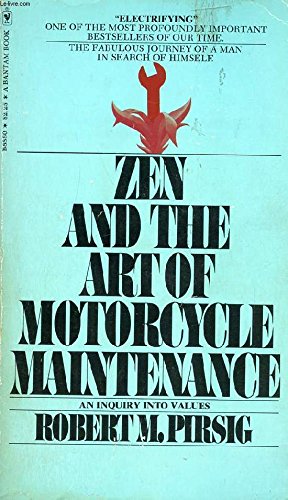
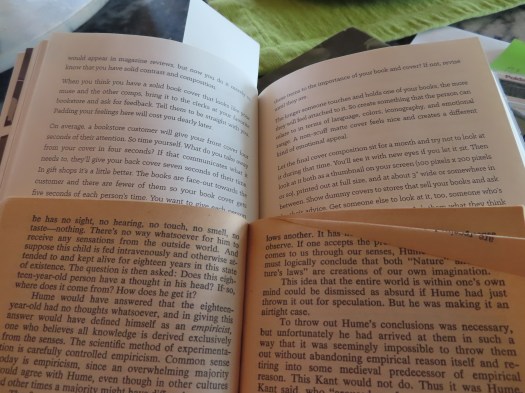
Here’s an image of the innards of two paperback books on my kitchen table, both just over 400 pages. The upper one was printed in 2018, the lower one in 1976. Let’s do a comparison:

  • Size 1976: 7 x 4.12 x 0.9. Size 2018: 7 x 5 x 0.9.
  • Layout 1976: Single spaced, 10pt type, paragraphs marked only with indentation. Layout 2018: 1.5 spaced, 11pt type, paragraphs marked with extra line break.
  • Words per page 1976: about 400, or about 14 words per square inch. The book totals about 150,000 total words. Words per page 2018: about 270, or about 8 words per square inch. That book totals about 110,000 total words.
  • List price 1976: $2.50. List price 2018: $19.95

Writer friends, we’ve been sold a lie! White space! Leave the readers some white space! Giant blocks of text are just so… intimidating! Well, bullshit. We LIKE words. We make words and organize words and sell words. Words are what we make people out of. Why are we trying to sell blank paper on behalf of somebody else?

Look at that brick of a book from 1976, the yellowing chintzy paper disappearing under the ideas. That book—Zen and the Art of Motorcycle Maintenance, 19th reprinting of the Bantam paperback—wasn’t influential because of the elegance of its page layout. It was influential because of the elegance of its thought.

The book itself, the object… it’s a hooptie, a beater, a third-hand ride with its warranty long behind it. The body panels aren’t aligned, it doesn’t close right, there’s a lot of paint missing and a 75-cent sticker crooked on the hood. And it doesn’t matter. The ideas haven’t deteriorated. It’s still a reliable mode of transportation to another world.

As Kazuo Ishiguro (author of Remains of the Day, among others, and the 2017 Nobel laureate in literature) said, “I think of my pile of old paperbacks, their pages gone wobbly, like they’d once belonged to the sea.” Nobody’s ever going to say that about their Kindle…

The only file format that matters to the writer is FTP. Fill. The. Page. It’s time to reclaim the power of the crappy print job. To reclaim the unbleached paper, still true to its piney origins, covered with words. It’s time to reject the upscaling of our books, to return to line after line after line of beauty.

Hollow Honor

Us against them.

An old joke—Ever hear of Boston Alzheimer’s? You forget everything except your grudges.

There’s been decades of research on what are known as “honor cultures,” in which every perceived slight must be met instantly and harshly. Any insult, whether against individual or clan, is cause for retribution. As Dov Cohen of the University of Illinois and his colleagues put it:

Approximately 20,000-25,000 Americans will die in homicides this year, and tens of thousands more will be injured in stabbings or gunfights that could have ended in death. In about half of the homicides for which police can find a cause, the triggering incident seems argument- or conflict-related; and, in many of these cases, this triggering incident might be classified as “trivial” in origin, arising from a dispute over a small amount of money, an offensive comment, or a petty argument. Such incidents, however, are not trivial to the participants in them. Rather, the participants behave as if something important is at stake. They act as if they were members of what anthropologists call a culture of honorin which even small disputes become contests for reputation and social status.

These honor cultures tend to have several historical commonalities:

  • They come from places whose origins were in herding rather than crop farming, so poaching and violent defense were common activities. We see the same things now in gangs and organized crime and vulture capitalism: when most of one’s wealth can be taken away at once by hand (in cash or drugs or hostile stock raids), poaching and violent defense are again common economic and political strategies.
  • They come from places where political stability was rare, and clans were the dominant form of control. Loyalty to tribe was a matter of life and death.
  • They come from places where law enforcement is scarce or non-existent or corrupt, and every man was responsible for his own and his own family’s welfare.

Where cultures of honor persist, we see these attitudes carry over into even small elements of social life. People from honor cultures “stigmatize men, described in brief scenarios, who did not respond with violence, criticizing them for being ‘not much of a man’ if they failed to fight or shoot the person who challenged or affronted them.” The old cliche from Western films still holds true in a lot of places: Them’s fightin’ words!

So we have a condition in which the social norms of precarious masculinity that we described yesterday are amplified by cultural patterns of perceived threats to honor, and the perceived necessity of immediate response.  

We can productively apply this understanding to any number of social or political phenomena, from party politics to sports rivalries. Will Blythe wrote a book about how the UNC-Duke basketball rivalry was more about loathing them than loving us. He called it To Hate Like This Is to Be Happy Forever.

And I find the whole thing exhausting, and tragic. When the universe is defined as us versus them, we have lost the capacity for generosity, the capacity for empathy, the capacity for good will. We leave innumerable people crushed, helpless, as we bulldoze our way toward our own benefit. It leaves us all as our own bargain-sized Ozymandias, our own less-than-cinematic Citizen Kane, surrounded by the debris and carnage of our hollow honor.

We can stand our ground, and see who’s left standing. Or we can stand for others, and make ourselves greater.

Article referred to: Cohen, Dov, Nisbett, Richard E., Bowdle, Brian F., and Schwarz, Norbert. “Insult, Aggression, and the Southern Culture of Honor: An ‘Experimental Ethnography’.” Journal of Personality and Social Psychology, May 1996 Vol. 70, No. 5, 945-960.

Precarious

Step right up, sir… let’s see if you’re a REAL man!

I was at our local general store the other day, standing on the porch, wearing my face mask and waiting for Kathye to hand my bag through the take-out window. I could hear from up the road a motorcycle with a loud radio on. (Between the wind noise, the engine noise, and the helmet, motorcycle music systems are kind of a dumb idea. But other people get to hear it, which seems to be the point.) Sure enough, ten seconds or so later, two guys coasted past the shop up to the four corners. I was just about to turn away from the window when they blasted off from their stop, pipes wide open as they accelerated up and over the hill.

There’s a common trope having to do with sports cars and loud bikes and big trucks and lots of guns all having to do with threatened masculinity. But it’s not just folk wisdom; there’s a significant body of social science behind it as well. Researchers Joseph Vandello and Jennifer Bosson of the University of South Florida have developed the concept of precarious manhood, that being seen as a man requires “continuous social proof and validation.” A woman can be seen as a “good” woman or a “bad” woman or somewhere along that gradient, but a man is more likely to be seen as either a “real” man or “a pussy” or “a faggot” or “a wimp” or “a boy” or some status other than a virile, heterosexual male. It’s a simple, binary, yes/no condition: are you a real man, or something else?

To quote the title of their most important theoretical paper—pulling together 130 prior works across psychology, sociology, and anthropology—manhood is “hard won and easily lost.” And along with three other colleagues (Rochelle Burnaford, Jonathan Weaver, and Dov Cohen), they set out to propose a few tests. In their article “Precarious Masculinity,” they discussed the outcome of several experiments:

  • Male and female participants were asked to agree or disagree with statements like “Manhood (Womanhood) is hard won and easily lost,” or “Manhood (Womanhood) is not a permanent state, because a man (woman) might do something that suggests that he (she) is really just a ‘boy’ (‘girl’).” Both men and women participants agreed in significant majority that manhood was precarious, disagreed that womanhood was. Men were even more likely than women to believe that manhood could be lost.
  • Participants were asked to read a somewhat ambiguous life story, concluding with the statement “My life isn’t what I expected it would be. I used to be a man (woman). Now, I’m not a man (woman) anymore.” For the stories about men, the favored interpretation was that the loss of man-status was a social condition: that he felt shamed, felt like a failure. For the stories about women, the favored interpretation was that the loss of woman-status was a physical condition, the result of an operation or menopause or aging.
  • Participants were given a set of “psychological portraits,” generic drawings intended to express some larger condition rather than to be a verbatim image. For a story having to do with men, the portraits were of an attractive man, an unattractive man, and a boy; for stories having to do with women, it was attractive woman, unattractive woman, girl. The story went that the person involved was emotionally troubled, conflicted by spiritual doubts, and had recently discovered that they were infertile. For the story about a woman, the most common image chosen to represent the story was of the unattractive woman; for the same story about a man, the most common image chosen was of the boy.
  • Participants were given a set of questions about stereotypically gendered tasks and roles: sports and mechanical and automotive questions for male participants, cooking and children and fashion questions for female participants. They were told that they were going to be scored on how far toward the “masculine” or “feminine ” ends of the scale they performed. The results were fake: both half the women and half the guys were told that they’d scored normal for their gender, the other half told they’d scored normal for the opposite gender. Then they were given a second test, a series of words with missing letters, and told to complete the word. Guys who’d just been told that they’d scored low on masculinity were more likely to complete _IGHT as fight than night or right or sight, more likely to complete SHA_E as shame than shade or shale or share. Male participants were far more likely to complete the words in an anxious or violent form if they’d just been told they weren’t very manly. For female participants, there was no meaningful difference.
  • As a follow-on to that last study, participants were asked a) if they’d be comfortable if their friends and family members knew their results of the gendered-knowledge test, and b) if they thought the results would be different if they could take another shot at it. For male participants, guys with “masculine” results were fine with the results being known, and figured that the outcomes would be the same if they did it a second time; guys with “feminine” results didn’t want the results known, and believed strongly that they’d score better if given a second chance. For women, there was no difference between the participants who’d been given “feminine” or “masculine” results.

The upshot of all of these studies suggests that people believe that “manhood” is an absolute status rather than a gradient, that it’s a fragile condition that can be easily lost, and that threats to one’s manliness are shameful and needed to be repaired, by force if necessary.

More tomorrow.

The papers referred to today are (1) Vandello, Joseph A. and Bosson, Jennifer K., “Hard Won and Easily Lost: A Review and Synthesis of Theory and Research on Precarious Manhood.” Psychology of Men & Masculinity, 2013, Vol. 14, No. 2, 101–113. (2) Vandello, Joseph A. Bosson, Jennifer K., Cohen, Dov, Burnaford, Rochelle M., and Weaver, Jonathan R., “Precarious Manhood,” Journal of Personality and Social Psychology, 2008, Vol. 95, No. 6, 1325–1339.

Content Management

Why, you could put ANYTHING in here!

Imagine that bucket as a bookstore, or a gallery, or a magazine, or a college curriculum, or a grocery store. Any desirable space of limited capacity. The more of us there are who can provide the appropriate content for that bucket, the more we’ll be in competition with one another, and that competition will come mostly in the form of price.

I’ll teach that class for two thousand dollars.

Well, I’ll teach it for eighteen hundred.

Being a content provider in any field is like a reverse auction, in which the lowest bidder wins.

The journalist Ben Fong-Torres maintained a strictly freelance career for forty years, because he wanted the freedom to pursue his own topics at his own depth. He knew that as a daily newspaper reporter, he’d be assigned stories that weren’t in his area, and that he’d be under pressure to turn them around quickly, glancing off the surface rather than really penetrating. When he started in the 1960s, he could write a feature story and be paid about $500. But he finally gave up and accepted a newspaper job. The end came when he was offered a cover story for a big magazine in 2006, and they told him it would pay… $500.

One of the things I described in The Adjunct Underclass was our increasing understanding of college education as “content,” and college teachers as “content providers,” leading toward what economists call commodity pricing, in which a gallon of crude oil or milk is a uniform commodity to be sold at uniform price.

The fungibility of the commodity places downward pressure on price, and cannot consider the unique practices of the producer. If a particular dairy farmer thinks he needs $18.50 per hundredweight to break even, but the going market rate from the co-op is $16.50, then $16.50 it’s going to be, and the individual farmer gets to choose to either (a) lose two bucks per hundred pounds, (b) reduce the quality costs of his work, or (c) stop selling milk altogether. So too for adjunct faculty. Intro Sociology can be bought by colleges in the Boston Metro teaching market for about three thousand dollars per three credits, so an individual teacher—no matter how well credentialed, no matter how excellent—gets to choose to (a) teach for an embarrassingly small hourly rate, (b) try to make their teaching something simpler and less time-intensive, or (c) not teach at all. In the eyes of the college-as-aggregator, as long as any specific provider is above the floor of competency, it doesn’t really matter if they’re any better.

I was put in mind of this over the past couple of days while reading the really smart blog of the writer Madeleine Morris, PhD in creative writing from Roehampton University. She’s had some success commercially publishing her work—she writes erotica, a small enough bucket in the best of times, and one with an enormous number of content suppliers—but most of her work has been given away, published in bits and pieces on various websites, including her own. She’s part of the vast fiction community who, even when published in “the little magazines,” are paid only in contributor’s copies. But she lays blame at the feet of not merely the publishers, but also us readers.

Content has become an incredibly cheap commodity. I’ve watched readers whine over paying $2.00 for an ebook novel. I know of readers who buy an ebook, read it, and then return it for a refund. Think about it: a novel for less than the price of a coffee you consume in 5 minutes and piss out 5 minutes later. A novel that takes, if you’re any more than an abject hack, at least 3 months to write.  So, it’s readers too, who feel entitled to something close to free entertainment. 

The internet has made us all freeloaders. We expect our music and our reporting and our images and our ideas and our stories for free. We are offended by paywalls. So content providers are all reduced to buskers, playing our tune on the corner with a hat on the ground, asking Kickstarter or GoFundMe or Patreon for a few bucks.

And here’s another dilemma. I’ve had my career, I don’t need to be paid to write. So are these very essays contributing to the expectation of good, free content? Am I taking up reading time that someone else might be paid to claim? Am I contributing to our cultural diminishment of intellectual life by offering intellectual life for free?

So let me say this. All writers need readers. Some writers need readers and money, because it’s their livelihood. Pay those people. Please.

Systemic Internality

The inside of my head for the last few stories…

I’ve been working on a new book lately, and the first few chapters have been sort of slow going. They make sense, they’re smart, they’re setting up later work, but they feel weary. I attributed my malaise to a broader and more general malaise all around us.

But then last week, I wrote a scene with five friends in a bar on a Friday night. And it levitated, it wrote itself. It was just people talking. And I love that.

The last couple of stories I’ve shared with my writing group have been about people who have found themselves isolated, cast adrift from a community that they thought they’d once been a part of. And those are harder for me to write, and less fun to write, because there’s no dialogue. I mean, that’s kind of the existential state of exile, right? It’s not merely the identity fact that you’re not a member of the club any more, it’s also the social fact that you’ve got nobody to talk to who understands your native language. When you’re cut adrift, you lose the possibility of dialogue. You start talking to your cat, or your volleyball, just to convince yourself that you matter.

I thought back on the fiction I started to write once I first left higher ed. And the first six novels were all told mostly in scene, filled with dialogue and social connection. The one I wrote just before Christmas was all in scene, filled with dialogue. Those books just poured out of me, I couldn’t wait to get back to the desk the next morning and see what those people would do next. The stories of individuals adrift, though… I have to pull myself back to those. I have to figure out how they’ll dig themselves out of their isolation, which was a project I spent far too long on in my own life. It doesn’t appeal to me to go back there.

I grew up with television. And television is, paradoxically, an innately auditory medium. Whether it’s Hogan’s Heroes or Voyage to the Bottom of the Sea, The West Wing or Home Improvement, television lives and dies on the quality of its dialogue. The scenes and clothing and actions and music exist only to lend visual context to the conversations. Watch a TV show sometime—I don’t care what show, your choice—and count the longest time spent between anyone speaking. If it’s even ten seconds, I’d be amazed. Whether drama or comedy, whether medical or detective or family or Western, the fundamental unit of analysis is the ensemble, building itself every week through words.

I’ve made my writing career in essays, in the sound of my own isolated voice. The dialogue with other thinkers is implied, not present. And I’ve got a pretty good voice for essays, because I try to write the way I’d say it. But I don’t have to write novels that are actually just essays in drag, as so many are. I can write ensembles. If I’m going to write for pleasure, I should include my own pleasure as a worthy goal.

The Importance of Being Earnest

We see things not as they are, but as we are.

Anais Nin, Seduction of the Minotaur, 1961

In every morning’s e-mail, I receive a briefing digest from the New York Times (sick tigers at the Bronx Zoo, Anthony Fauci blocked from taking a reporter’s question about hydroxychloroquine) and another from the Chronicle of Higher Education (will colleges reopen this fall? will this mark the end of tenure?). I read some of the highlights (well, maybe the wrong word) from each location this morning, and then got drawn into an article from the Chronicle’s archives, called “The Birth, Death, and Rebirth of Postmodernism.” And from there, hyperlinked quickly to an adjacent article, “What’s Wrong with Library Studies?” which was a 2016 pushback against “the paranoid project” of literary studies configured as exclusively political critique. And that hyperlinked me back one more year, to December 2015, and Lisa Ruddick’s essay “When Nothing Is Cool.”

Ruddick is doing some interesting things here, about the ways in which cultural criticism can be alienating for even those who practice it, that it promotes a form of “intellectual sadism… norms that make ruthlessness look like sophistication.” I think that our relentless pursuit of irony has been a force for cultural diminishment. When we begin every analysis with the presumption of others’ ill-will, the presumption of hidden agendas, the presumption of threat, we diminish ourselves in a pre-emptive act, lest others diminish us instead. As John Cougar* set forth in 1980, “Nothin’ Matters and What If It Did.”

Irony is a cynical response to cynicism. We saw the growth of the ironic form in the 1950s as a rebellion against consumerism, its maturation in the 1960s as a rebellion against Vietnam, and its full blossoming in the 1970s against the betrayals of Watergate, the full collapse of whatever faith in common purpose we might have once ever had. It’s no coincidence that Saturday Night Live, a television show created specifically to show us how stupid other people are, was launched in October 1975, only a year after Nixon was forced from office and we really started to learn just how extensive his criminal enterprise had been, only six months after we fully gave up on twenty years of baseless involvement in Vietnam. We’d been lied to, we were angry about it, and that anger became rootless, free-spraying across the landscape, taking down everything around us.

I’ve never been able to sit through even a single full episode of Seinfeld, a show based on the premise that every single person is debased and motivated only by vanity. I cannot watch a Will Ferrell movie, all of which are motivated by the cheap shot of setting up and then mocking a lead character who is both inept and narcissistic. If even our entertainments are populated by people with no redeeming characteristics, we are culturally lost, engaged in a “ruthlessness that looks like sophistication.”

Tell me what you want. Tell me what you believe. Tell me what you think is noble and good. Even if I disagree, I won’t mock you for your dreams. We owe it to ourselves to create some hesitant islands of fully stated aspiration, in the midst of a culture that can only honestly express its mistrust.

*In 1980, he’d moved on from Johnny Cougar, but hadn’t yet become John Cougar Mellencamp, nor his current plain ol’ John Mellencamp. He was still caught up in his own (externally driven) self-negation, wearing a name chosen by his record label.

Nothing Is Neutral

Useful sometimes, less so other times

Sometimes things have to hit me several times in quick succession before I think about what they mean.

  1. This morning, I had a new colleague ask how to find reliable data on adjuncts. I told him that I didn’t think there was any, because all the data that IS collected is collected to serve a question that I’m not asking. The IPEDS differentiation between “full-time” and “part-time” faculty actually conceals what I’m trying to learn. Their question is about calculating student-teacher ratio, and my question is about the insecurity of intellectual life. It’s like using a kitchen thermometer to measure how many potatoes I have left; they’re both kind of about food, but they’re not mutual or interchangeable.
  2. Yesterday, my friend Aimee was talking about which of two gallery spaces was preferable for her fall show. And she was talking about the art world’s preference for the plain white wall, so that “the space wouldn’t compete with the art.” That, of course, privileges art that lives nowhere in particular, eliminates the notion that art could cooperate with a space rather than compete with it. (She actually used the term white box artist, which I think is its own wonderfully revelatory category.)
  3. Nora is trying to put a group of local food providers together with local people or families who are in need of that food during our time of home isolation. And we quickly realized that we don’t have a great way of doing that. The school knows the families that qualify for free or reduced-price lunches, but that only includes families with kids between 4 and 18 years old. The local social service agencies know the people they care for, but there are a fair number of families who have done everything they can to stay below the observation of social services, knowing that their lifestyle would draw scrutiny and possible intervention if it were exposed. Or we can just put out the call to say that food assistance is available, and run the risk of freeloaders (its own contextually defined category)
  4. I was pointed to the category of “under-recognized artist,” which the Harpo Foundation defines as an artist who hasn’t presented in major museums or events, hasn’t received multiple awards or grants, and isn’t represented by a prominent gallery. (Note the subsumed categories of “major” museums and “prominent” galleries.) Likewise, Bread Loaf divides its participants between Contributors, Scholars, or Fellows, based on number and scope of prior publications.

Every category we make serves some purpose, draws attention to some characteristics and ignores others. Think even about the photo at the top of this post. Having those four cards would be terrific in poker or in rummy, would be okay but not outstanding in cribbage (unless the cut card was an ace or an eight), and would be disastrous in a game of spades. Categories support rules, and don’t easily transport across rule systems.

If we accept data laid out in the categories provided by others, we’re kind of like the drunk looking for his lost car keys under a street lamp because that’s the only place he can see well enough to search. We’re often forced to rely on data that’s carefully illuminated but not helpful for our specific need. I’ve been published (and paid for my writing) for over thirty years, with three books, but not published specifically in fiction. So am I a contributor, a scholar, or a fellow? Am I an emerging artist, or a mid-career artist, or an established artist? Is my research part of the humanities, or the social sciences?

You want to play the game, you need to know the rules. The rules will determine the categories. And the categories, far too often, define who we are.