Finding Community

Well, I keep tryin’…
(Image by Carl Heyerdahl, via Unsplash)

A friend wrote me a question that her sister raised: why is art so competitive? I mean, just make stuff, right? Do more. Anybody can make art, that’s an infinite resource. But money, and recognition, and awards, and visibility… those are finite. And thus we have to fight over them.

Another friend does dog behavior and tracking trials, and her dog has done pretty well in her first two years. So every couple of weekends, we’ll get a photo like this one:

And that’s another reason we have competitions. How would I ever know if I was any good if I couldn’t be shown to be better than someone else?

Of course, once we’ve entered the world of art, “better” is no longer quantifiable, but rather a matter of judgment. We hope that the judges are connoisseurs, with long experience at critical evaluation of the appropriate work, but even with that, judgments would rarely be uniform even within a panel, much less if we replaced those panelists with a whole other cohort, even less if we replaced the dog-show reviewers with fine-arts reviewers or restaurant reviewers or car reviewers.

We aspire to approval from those whose judgment we trust.


In my final undergraduate semester, I took a Journalism class called “The Critical Review” from the truly phenomenal David Littlejohn, a broadly-interested arts critic and fine, fine teacher (1985 UCBerkeley faculty of the year). He started the semester with a question to his (competitively selected) studentsโ€””what is criticism for?” We gave the first stereotypical answer, which is consumer advice: you’ll enjoy this movie-restaurant-car-whatever. He waited us out, and then said, “Then why should we read a review of Paul Simon playing the Oakland Coliseum for one night last week? Why do people read reviews of museum shows in New York that they’ll never go see?” Well, we stumbled all over that one for a while, before he let us in on his secret, which I’ll paraphrase for you: It doesn’t matter what you’re reviewing. People will read you for the same reason they read anybody about anythingโ€”because there’s a smart, engaging voice that they trust.

A good critic has broad experience with, and enthusiasm for, whatever art form they’re writing about. A good critic has developed some vocabulary and some criteria that they can communicate about their tastes, even better when they can demonstrate where their tastes lie within some broader discourse. A good critic can describe a particular phenomenon accurately and carefully and joyfully, and understand something about what traditions or practices it lives within.

So when my friend writes of her experience of having her work reviewed by a state arts council, made up of people she doesn’t know, who don’t know her work nor the tradition it lives within, who are asked to pass judgment on it in an accelerated moment because they’ve got dozens or hundreds more to get to that day… well, really, she has no need to care about what they think, because they haven’t exercised any of the duties of a good critic. But, alas, they have the money and the certificates of recognition, so she’s forced to plead her case before the illiterate.

I’m part of a writers’ group that I assembled from folks I’d met five years ago at Bread Loaf. It’s a small group, just four of us total. And we’re all good writers, but more importantly, we all read a ton, and we’re able to make connections between the story on the table on any given day and other things we’ve read, and to talk about why they might be useful points of comparison. Increasingly, now that we’ve been together for years, we’re able to make connections between the story on the table on any given day and all of the other things we’ve seen before from that same group member, able to put one piece of work into context with others. We have different interests, of course, and by nature would take a story different directions; but these people have all become smart, engaging voices that I trust.


I’m part of some other communities of writers and artists whose judgment I trust less. And I think that one important difference is that they have no interest in a broader discourse within which their work lies. They have no widely educated judgment or vocabulary to fall back upon, just a reflex that “it’s pretty” or “I liked it” (or not).

One of my colleagues at an architecture program I worked for used to ask prospective students to name their favorite architect. And most often, they couldn’t name one at all. (If they could, it was usually Frank Lloyd Wright, the only household name the industry has ever produced.) Imagine asking that same question of prospective musicians, to name their favorite musician. There’d be immediate answers, probably more than one, and some reasons why. Imagine asking that same question of prospective actors, or directors; they’d know bunches of heroes, and be equally likely to talk about their reasons for naming them.

It’s hard to find community as an artist, and it’s not just because some people are better and others are worse, or because we work in different media. It’s because, in part, we’re entering a specific body of interests and knowledge; because we’re speaking among friends who share our enthusiasms. And the more eccentric and specific our enthusiasms are, the fewer are those with whom we can share them most fully.

Add the problems of competition into that mix, in which we have to show ourselves to be “superior” even to our friends in order to get into a magazine or a gallery or a fellowship or a faculty position, and building and sustaining creative community becomes even harder.


For the subtitle of his his wonderful 1989 book The Great Good Place, the sociologist Ray Oldenburg wrote “Cafes, Coffee Shops, Community Centers, General Stores, Bars, Hangouts, and How They Get You through the Day.” I won’t get much into his theoretical description of the idea of the third place; for our purposes, I’ll talk about the ways that one becomes a “regular” at one of these places. Frequency of attendance is only one of the factors that makes someone a regular. Two other factors are more important: that one is vouched for by someone who is already established, and thus is trustworthy; and that one adds something of value to the conversations already underway. So community is built both by the residents and by the newcomers. The residents welcome newcomers into their midst; the newcomers contribute something that the established members value. The responsibility lies in both halves.

So for those already within a community of practice… look around you and invite others whom you think would be welcome. Build your cohort purposefully. For those hoping to enter a community of practice… shut up and listen for a while, and figure out the conversations that matter to those already present before you insert your own agenda. Think about how to use your interests to enhance what already exists.

The world provides no native holes that are shaped exactly like us. Each of us has to carve out our own place among others. And the work of shaping best fit inevitably changes both the mortise and the tenon.

Stepping Aside

Such a nice phrasing
(Image by Will H. McMahan, via Unsplash)

I think that the universe has sent me many messages over the past few weeks, and perhaps I should attend to them.

First, we had a contentious and enormously important election two weeks ago, which meant that much of my August through October was spent helping to volunteer with one candidate’s campaign and work on behalf of a state constitutional amendment. (And I’m proud to say that the adoption of Article 22 of the Vermont Constitution, known as the Reproductive Liberty Amendment, passed by more than a three-to-one margin statewide, and was approved by a majority of voters in every one of the State’s 283 voting precincts.)

Second, I injured my knee while working with a friend to section up a huge fallen tree in the yard. He was chainsawing the trunk into 16″ lengths to prepare for splitting, and I was pulling away the three-foot diameter disks and rolling them out of the way so he had a clear workspace. And as I pulled one section away, I felt a POP that seemed as thought it must have been audible, a blinding pain, and I was unable to lift my right foot. Now, four weeks later (yay for rural medicine…) I know that it was a strained lateral collateral ligament, clearly not fully torn because it’s responded well to physical therapy. Today’s the first day that, if I didn’t know intellectually I’d been injured, I’d have no empirical evidence to support the statement. But it was a climb to get here.

Third, we’ve been social. It just feels like we have a lot of friends going through things right now, plus those friends have introduced us to new friends, and we end up either having folks over or spending an evening away three or four times a week.

And fourth, a number of other smaller projects have sprung upโ€”writing and rehearsals and production of a play, a friend needing an external review for his students’ final project, the possibility of a grant proposal for substantial Town road work.

All of that means that I haven’t written much in the novel over the past month. And the quiet part is that I’m relieved.


This is the second novel in three years that I’ve set aside partway through. The first one, Story Box, remains a terrific idea that I may yet come back to. And this one, Shopkeeper, is also a terrific idea that I may yet come back to. But ideas aren’t stories.

A friend wrote me yesterday to let me know that one of her short stories had been nominated by its journal for the Pushcart Prize, America’s annual award for material published by small presses. She’d been part of the short-fiction group I lead last spring, and in her note, she wrote: “your class taught me so much about writing short stories. It slowed me down, way down, and my other stories are benefiting from that as well. If I don’t know what my character is carrying in her pocket, I haven’t done my job.”

And that’s where we are. In both Story Box and Shopkeeper, I don’t yet know what’s in their pockets.


I’d be worried, except for two things. One is that I’ve got plenty to do. But the more important encouragement is that setting aside Story Box in late 2020 paved the way for the arrival of & Sons in 2021. I just read that book again over the past couple of days, to convince me that I really did know how to do this stuff. And, all modesty aside, it’s a fantastic story. I know everything anyone could ever need to know about Cale and Sammi and Ray, and it’s just a blessing to have their stories in my life. The book is simultaneously lively and smart, whereas the two that have been shelved are merely smart. I once critiqued Modernism as being all head and no heart, the intentional setting-aside of emotion and culture for a supposedly pure rationality (which in fact was just as cultural and historically specific as the Baroque). I’m a neo-Romantic at heart, a maximalist, depressed but filled with hope. Click below for a story that feels right to me, which I wrote a couple of months ago. And shoot me a message if you want a copy of & Sons.

What I Know after Five Weeks

So THAT’s what’s behind there!
(Image by Jazmin Quaynor, via Unsplash)

I’ve really struggled with the opening of this novel. People talk blandly about “writers’ block,” which I think has innumerable varieties. For me, my difficulties have come because I didn’t know what events would matter most to this high school boy I’m writing about, would be likely to persist into his adulthood.

Now I do. It’s a story of divided allegiances, and Jim will be called upon (over and over and over) to negotiate competing forces.

The conflict that matters most to me in fiction is internal. I lose patience with the grand narratives of protagonist versus antagonist; I’m much more drawn to the person who simultaneously wants two or more opposed things. And that’s what this story now has.


But I also want to talk a little today about my perpetual irritation with how clueless important people can be about why they’re important. One of them is a literary agent crowing on her blog about how two of her clients are on the NYT bestseller list. Well, if your clients are Temple Grandin and Neil DeGrasse Tyson, you didn’t have to do a whole hell of a lot to get them noticed.

The whole business model of literary agentry can be traced back to Morton Janklow, a lawyer who got a better contract for his client William Safire’s book about Richard Nixon. Right from the beginning, agentry has been about making powerful people even more powerful. According to Janklow’s obituary in Variety last May, his client list included Pope John Paul II, Barbara Walters, John Glenn, Al Gore, Thomas Harris,ย Judith Krantz, John Erhlichman, David McCullough,ย Ronald Reagan, Michael Moore, Pat Riley and Carl Sagan. The rest of us… not so much.

But as bad as that is, something else pissed me off even worse today. A friend dropped off a copy of a book for us, a cookbook based on another intellectual property. (I’m being vague because I don’t want my friend to suffer consequences for my impolitic statements.) Our friend been hired to develop all the recipes for dishes that these characters would have consumed, according to the roles and cultures that had been devised within the lore of this world. The three credited authors of the book are the movie directors and writers of the intellectual property; my friend the chef is listed nineteenth among the 26 credited contributors of the book, behind the photo stylist and colorist and photo retoucher, but ahead of the indexer and the publicist. Dude, it’s a fucking cookbook! The guy who wrote, prepared, tested, sampled, and revised every single recipe in the book should not be three-quarters of the way down the list!

A third bit of irritation comes from a recent study published in Nature Human Behavior showing that almost a quarter of tenure-line faculty in eight major intellectual fields in American research universities have at least one parent with a PhD. (I’d found an even stronger proportion among my postdoctoral colleagues at Duke twenty years ago. The higher you climb, the more important the foundation becomes.)

And all of that leads us to today’s sociological principle, known as “the Matthew Effect,” a reframing of Jesus’ words in the gospel of Matthew: “to every one who has will more be given, and he will have abundance; but from him who has not, even what he has will be taken away.” We can be technical and talk about this as “cumulative advantage,” or colloquial, as in “the rich get richer,” or echo Molly Ivins’ assertion about George Bush the Elder that “he was born on third base and thinks he hit a triple.” Powerful people are often in denial about the sources of their power, and imagine that they are somehow especially talented or virtuous. I suppose humility isn’t a productive virtue for those who want more power, but it’s not a good look to be quite so arrogant when an awful lot of their success has been showered upon them rather than pulled from the ground through raw effort.

What I Know After Four Weeks

Well, we must be going somewhere…
(image by chmyphotography, via Unsplash)

(First off: yes, I know it’s been five weeks. But since I’ve only done one week of writing in the two weeks since week three, it’s week four.)

I’ve been enormously distractible in the past couple of weeks, one hyperlink after another. We hosted a huge political gathering here on Sunday, I wrote a brief play, I’ve stacked some firewood, but it feels like I haven’t done much of anything at all.

I have, of course. Jim’s family has become clearer, and his love of working in the store is more grounded. I know how his mind works, I know what he notices when he watches other people, I know how he thinks about a simple algebra problem.

This, of course, is not a story. It’s ethnography, the rich description of a person within a culture. For it to become a story, I think it needs a little more uncertainty. To fulfill the work of the novel as Peter Ho Davies puts itโ€”a machine to make us keep readingโ€”we need the fundamental attitude of “I hope he makes it okay.” And that requires more difficulty than we’ve seen so far. I think there’s some backfitting to be done in the next couple of weeks.


Every so often, you come across a framing of a problem that clarifies the nature of that problem. For me this past week, it came in the New Yorker’s post-award profile of the work of this year’s Nobel laureate in literature, the French memoirist Annie Ernaux. The reviewer Adam Gopnik, a fantastic writer himself, had this construction early on:

The news of a new Nobel Prize in Literature tends to divide amateur readers into two camps: those who have never heard of the author and those who have, vaguely… Annie Ernaux [is] on her way to becoming a permanent writer to those who read for the love of it, not the game of it. [emphasis mine]

What a fantastic distinction! People who read for the love of it, because they want to be immersed in the lives and circumstances of others, and people who read for the game of it, for the formal exercise of narrative structures and the novelty of exploring some intellectual frontier. I recognize this divide in my writer friends, and lived it very closely during my years in architectural education, as I struggled to see anything interesting and humane in the high design of the various moments. It’s a common enough distinction that we see it even in bartending, where people who make good drinks stand on a somewhat different shore than those who make interesting drinks. The beverage writer Jim Meehan says that mixologists serve drinks, bartenders serve patrons.

A year or so ago, the New Yorker’s art critic Peter Schjeldahl talked about his difficulty feeling anything for the clearly expert work of Paul Cรฉzanne. He wrote, in a construction remarkably similar to that of Gopnik, “I tire of being made to feel smart rather than pleased.”

I read, and write, for the love of it. I stand with the bartenders, and proudly so.

What I Know After Three Weeks

They’re only anonymous if we don’t ask
(Image by Gleb Lucky, via Unsplash)

I had a slow week with the book, doing the necessary work of going backward to earlier scenes to ask myself why people were doing what they were doing. Or, more accurately, what kind of a person would do these things. It really is ethnographic, in which we have to watch people do stuff before we try to guess the meanings behind it.

I know some big structural things about the story. I know my protagonist. I know that the book will see him at four different stages of his life: in his middle-school years, in his early 20s, in his late 30s or early 40s, and again in the present day in his mid-50s. I know that the four novelettes will be called Novice, Apprentice, Journeyman, and Master.

I know that the streetscapes will be characters themselves. No retail store stands on its own, it lives on an urban block, shoulder to shoulder with taverns and markets and bowling alleys and bookstores and florists and diners.

And within that frame, I have no idea what the painting will look like yet. I have to let them tell me.


The big work of this past week has been to learn more about the second tier of characters, the ones who’d be supporting actors. In the case of middle-school Jimmy, that’s his dad, his mom, his mom’s new boyfriend, his brother and sister, and the other people who work in the store. I’ve learned things about each of them this week that I absolutely didn’t know last weekend.

I have to do some work to imagine the array of businesses that would be on a middle-class Milwaukee shopping street in 1980. No Starbucks yet, too small a neighborhood to warrant a vest-pocket Burger King. The neighborhood grocery is now bigger than a corner store, not yet a supermarket. No one drives to the shopping center to Staples or Bed Bath & Beyond yet, so small family versions of housewares and office supplies and bookstores still exist. But exactly what’s on that block of Oakland Avenue in Shorewood… that’s crucial work still to be done.

And what I don’t know yet… can’t know yet… are the early disruptions of Jimmy’s young path. There’s been one, the revelation of his mother’s affair and his parents’ divorce. But there will be a reckoning with his siblings, and with his mother’s new partner, and those I can’t yet describe. They’ll come into view as I sketch, and then pen, and then color those scenes.

Well, THAT Explains a Lot

Nail it to the seminary door
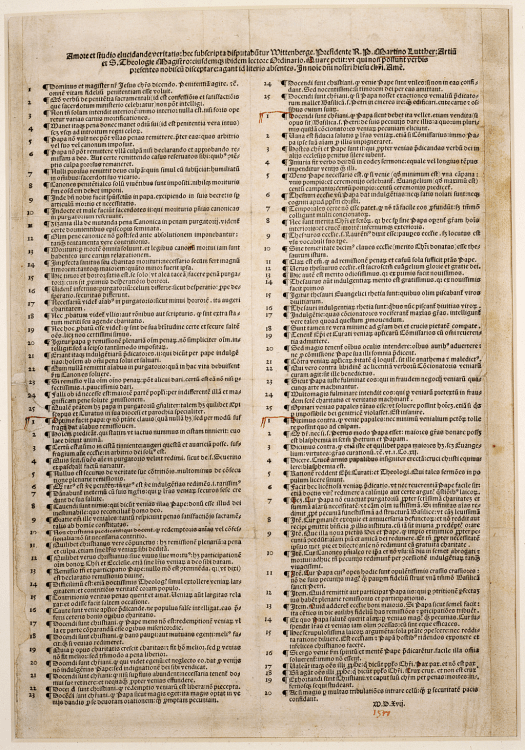
(Martin Luther’s 95 Theses, image in the public domain, via Wikimedia Commons)

Nora’s been clearing out old papers yesterday, and came across a few things I’d sent her ages ago. One of them was the proposal for a day-long conference session I hosted in 2000 at the Environmental Design Research Association meeting. The session was called “Environment-Behavior Research as a Field of the Humanities,” in which I invited lots of other folks to come deliberate on the idea that maybe EBS (as we called it) was misplaced by being categorized within the social sciences. Maybe instead we’d be productively housed with the other branches of the humanities: literature, philosophy, history. I didn’t use this language at that moment, but my argument was that EBS could be fundamentally hermeneutic rather than analytical, even while retaining a shared interest in the careful, empirical study of real people in real places. Novelists do that, too, without any expectation of coming to some immutable laws of behavior. We watch people, and report back on what it looks like and what we think it might mean.

I can tell you that attitude did me no favors in my academic job search. Architecture departments are variously housed in larger institutional structures alongside the fine arts, or engineering, or “applied sciences,” or in independent units they share with urban planning and interior design and landscape architecture. Every time I was making my case about why architecture mattered, I was making it not merely to my prospective colleagues, but also within an institutional structure and set of values that I almost never considered.

Anyway, Nora found another thing this morning that also did me no favors. It came from work I did as part of a team that was trying to redevelop the first two years of a college design curriculum. That process taught me a lot of things. It taught me that all of the experimentation and suspension of assumptions we teach in studio get left aside almost immediately when designers have logistical problems to solveโ€”Oh, we could NEVER do that, because… Rather than attempting what we believed in, we reverted immediately to managerial expediency, house-trained to follow the channels pre-cut for us. And as Audre Lorde reminded us, the master’s tools will never dismantle the master’s house.

Anyway, as an early process in our team’s work, I started by asking all the team members to put our foundational values on the table. None of the rest of them did, just me. I still believe all of it, but it never found traction. And now that I’m safely out of the game, I can offer them to you, the sixteen things I believe about education in environmental design.

  1. Environmental design is primarily a civic and political activity rather than an artistic expression. We are fundamentally in the business of creating the stage sets on which people will live out the dramas of their individual and communal lives.
  2. The criteria for successful environments are that they are helpful, dependable, satisfying and fair. Every place is owned by some person or organization with goals, and inhabited by other people with other goals. We have to understand and value the entire range of goals, create for future fluidity, and ensure that our work enhances the lives of all who come into contact.
  3. All problems of citizenship, including environmental design, are wicked problems, impossible to even fully define much less correctly answer. This implies that realistic process management and facilitation are core skills of citizenship in any of its forms.
  4. The photograph has drastically changed both design and design education, to the loss of context, sequence and experience. Buildings are taught in isolation, but can only be experienced as part of a larger landscape. Design students need to be trained in careful, naturalistic observation and study of real places.
  5. The vast majority of the built landscape is created by people who are not trained designers; thus, design guidelines and strong performance criteria are more influential than objects. We need to help students define and understand desired outcomes.
  6. The education that designers need is more similar to that of other professions than it is different. Our students may not remain in the design professions for their entire lives, but they will always be family members and citizens. We want students prepared to engage the world from whatever position they might find themselves.
  7. The academic curriculum of design programs should be heavily weighted toward general education, with the expectation that those interests have a role in their design work. We need a strong focus on strategic thinking, the “why” that lies behind the “what” and the “how.”
  8. Design education should cover the entire building sequence, from conception of need through habitation, revision, and ultimate demolition. The weight of design education currently falls within conceptual design, with successively less attention in the curriculum as one moves away from that five weeks of initial excitement about a new problem. Students need to understand their role in the hundred-year cycle of the work, not just the moments of blinding creativity.
  9. Every student can be a successful designer, if we think more broadly about success. Students will differ in their capabilities across content areas. What does design look like for the talented graphic artist who writes poorly, or a skilled writer with a math phobia, or a brilliant design historian with poor graphic control? It takes a broad community to make powerful contributions to the built world, and we need to be equally diverse in our thinking about how to help all students be their best selves.
  10. Any educational setting needs strong and clearly stated outcome criteria, combined with great freedom in achieving those criteria. What we hope students will be able to do is more important than the paths they each follow to arrive there.
  11. The most vulnerable people deserve the greatest amount and highest quality of our resources. We need to offer our least experienced students our most experienced and proven instructors, the best physical resources, and the most curricular attention.
  12. Collaboration is a core educational value; students should work together far more often than they work individually. For the rest of our professional, civic, and family lives, we work as team members, and projects are achieved through the quality of our collaboration.
  13. We must devise ways in which students can do fewer hours for greater impact rather than simply asking for more hours. The charette and the all-nighter may be great social experiences (for extroverts), but students deserve to go home, be with their families and friends, get sufficient rest, and still do good work.
  14. Mentorship and advising are everyone’s business. Every student should have one or two allies among the permanent staff who know them, check in with them about their progress and their happiness, act as a sounding board, offer counsel. We are all complex wholes, and need to be considered and mentored with that awareness in mind.
  15. Leadership is everyone’s business. The best definition of leadership I know is “taking responsibility for something that matters to you.” We should be fostering that attitude among students and faculty from their first moments in the program, knowing that it will raise contentious and messy issues. We can teach mediation and negotiation better through working with live issues than with the canned and bland.
  16. We do not have to replicate the ways we were educated.

Yeah, all this would be hard to do. Yeah, we might get it wrong once in a while. But we are not proposing to abandon some perfect present condition; the costs of continuing as we have are also real, and substantial. Alas, though, inertia is powerful, and things in motion continue in motion. As one of my characters put it in considering his own academic life, universities are simultaneously dedicated to advancing the furthest frontiers of human knowledge, and to ensuring that nothing about their own operation must ever change.

I didn’t know any of that, so I was perpetually working against the current. If you choose to pursue any of these, you need to recognize that you also will face significant headwinds. Be prepared.

What I Know After Two Weeks

Don’t be in such a rush, hot rod (Image by Logan Weaver, via Unsplash)

When I did my dissertation research 28 years ago (!!!), I knew that it would take me a while to be recognized and considered trustworthy within the high school community I was studying. It turned out to be somewhere between a month and three months for most of the kids, some never; between a week and a month for most of the teachers and administrators, some never.

Nora put me in mind of that this evening. I came downstairs after a day of writing, and said, “I just feel like there’s a distance between me and these people.” And she said, wisely, “They don’t trust you yet.”

Part of it is the structure of the story. The story that presented itself was of the later-adult James facing a major life change. But I wanted to see how he’d gotten to that place, which meant writing about the nine-year-old Jimmy, and the high school and young-adult Jim, as well as the older James. Plus Jimmy’s dad, and his mom, and his little brother and sister, and his mom’s lover. None of those people volunteered for this, and I could make them look bad if I wanted to. So I have to earn their trust before they’ll really tell me what they value. And that takes time.

And even with that, I’m a fair ways in, and I think it’s a viable story. I’ll tell you more next week.

What Stories Are For, and How to Read Them

Let yourself come into the world of the story
(Image by notquitemax, via Unsplash)

When we encounter a spirituality that differs from our own and seems alien, [Islamic scholar Louis] Massignon explained, instead of simply dismissing it, we must ask ourselves how the writer came to have these ideas. We must acquaint ourselves in a scholarly fashion with the social, political, geographical, historical and philosophical context in which he lived and worked. And we must not leave this text, Massignon insisted, until we can honestly say that, in such circumstances, we would feel the same. In this way, he explained, we can broaden our horizons and make a place for the other in our minds and hearts. It is anย ekstasis, a disciplined โ€œstepping outsideโ€ of the self in a sensitive but informed identification with another โ€” not an exalted trance, but an intellectual process that enables you to open your mind and heart to something that seemed initially alien.

Interview with Karen Armstrong, New York Times

I came across this interview yesterday because of its lovely title, “The Novel That Made Karen Armstrong Quit Her Reading Group.” I knew nothing about Karen Armstrong, but there’s a story imbedded in that title that I wanted to know about. And as with any good browsing, what you find is different than what you came for.

Toward the end of the interview, Armstrong loops back to this opening idea of imaginative entry into the world of another:

Novels can serve a moral function by enabling us to enter the lives of others imaginatively. It is anย ekstasisย in which we step outside the self, leaving it behind, and embrace a different perspective โ€” realizing, for example, the attractions of evil at the same time as we are made to recoil from it. Novels force us not only to face but to experience the terror of illness, sorrow, poverty and infirmity. They enhance our compassion by compelling us to feel with others, taking us out of the comforts of solipsism.

The questions that a writer is interested in addressing have to be met by a reader intrigued and open to addressing them as well. When we put a book down and don’t finish, the flaw may lie with the writer, who hasn’t done the work of putting a life fully enough on exhibit to capture our imagination or intellect. But the flaw may also lie with the reader, in not setting aside their own assumptions and expectations to fully enter the world of the story.

I had that experience this morning, sitting down to review a short story opener by one of the members of my writing group. When I first opened it, I read the first paragraph too rapidly, it didn’t slow me down enough to really comprehend what I was about to engage. That flaw, I think, was mutual: the tone of the story was a little flat and didn’t invite slowness, but more importantly, I didn’t come to it in the spirit of full engagement. It took me ten minutes or so to slow down enough to really read it, to sit inside the narrator’s experience for the next hour.

I think that maybe we need to go through the equivalent of warm-ups before we sit to read fiction. To fully prepare ourselves to leave the passive TikTok feed and pinging texts of the swirling days, and to embark on the quiet, rigorous investigation of another’s life.

What I Know After a Week

A novel about customer service? Sure, why not.

A year ago, I live-blogged my last novel, & Sons, keeping you (and myself) apprised of progress. That was fun, let’s do it again.

Last Tuesday, my new story appeared. Young Jimmy first presents himself in 1978 as a nine-year-old, riding his bike on a Saturday for his flanรชurโ€™s afternoon on Lincoln Street in Milwaukee.

The glass storm door sounded its usual welcome, a leather strap with jingle bells hanging from its inner handbar to alert the Johnsons to new arrivals. Jimmy knew every aisle and corner of the store, had spent innumerable hours there as a free agent, loosely overseen, able to let his mind and body wander. Mrs. Johnson, as always behind the register in her little retail island just inside the door, nodded at him in recognition but nothing further. Jimmy walked back into the store, through the aisle of Comet and Reynolds Wrap, brooms and Playtex dishwashing gloves, toward the curved-glass butcher counter behind which Mr. Johnson was stationed. Mr. Johnson would either be talking with a customer and putting cuts of meat or scoops of ground hamburger onto butcher paper on the scale, or cutting huge slabs of red-and-white-streaked meat on his bandsaw, ribs and hip joints cruelly bared from their formerly quiet lives within a cow or a pig. Jimmy imagined that Mr. Johnson had never actually seen him; the man was in constant work, fully intent on customer or display or carcass.

Even though he’s only in fourth grade, Jimmy has always been far more attuned to the everyday adult world than the kids around him, whom he mostly finds bewildering.

One of the things he liked about being with adults was that they didnโ€™t need to be mean just for fun. The only problem with school was the other kids. Grown-ups sent kids to school to learn how to be adults, and then defeated their own purposes by surrounding them with the savage culture of children. Every kid had to decide for themselves which team would have their allegiance, and Jimmy, by virtue of having chosen wrong, earned the complete and total disdain of the other kids.

We’ll see Jimmy, then Jim, then James, at four different phases of his life through the course of the book, I think, as he grows into full expression of his nature. And I increasingly see that the book will serve as a love poem to the very idea of the sidewalk, the most urban of spaces.

I can’t imagine anything more fun than this.

Today’s Best Book in the World!

In his book Craft in the Real World, writing teacher Matthew Salesses talks about the ways that traditional writing workshops can be places of hostility, even when (almost always) unintentional. The pitfalls come when some kinds of stories and narrative structures and characters seem so taken for granted that stories of other cultures or structures are deemed to be incorrect or out of bounds. There’s no “conflict,” no “arc of change,” and so therefore the story is faulty. Some stories are within the community’s unspoken expectations, and those that aren’t will be met with resistance.

The first writer I read that truly challenged those expectations was Kenzaburo Oe, the Nobel Prize winner in literature in 1994, who once said that his work was about “the dignity of human beings.” Oe’s stories don’t move us along as much as they ask us to sit, quietly, with the facts of a person and her or his circumstances. There is a story, a sequence, but it’s in the background, a simple chronological organization of a series of states of mind. When I teach fiction writing, I say that the basic logic of fiction is that there’s a pre-BOOM, a BOOM, and a post-BOOM; that is, that there’s one or more disruptive events that change the angle of the story. And Oe’s work helps me to see how cultural that expectation is, and how Western of me that I’d never imagined stories created otherwise.

My own work has some of that non-BOOM character, though, based on the fact that I was trained as an ethnographer rather than a fiction writer. I’ve always felt at home watching people in the everyday, trying to understand the unspoken cultural guidelines that shape the visible behaviors. And because of that, I’ve been told occasionally that it’s problematic that my stories don’t hit their point of conflict early enough. In response to reading the first page of one of my stories, one reader said, “So does anything happen to your boy Tim? If so, start there.” That expectation that we’re tossed immediately into tumult is a particularly cultural belief, and could be otherwise. But different stories rely on different readers, who are willing to sit and watch.


The most recent, wonderful example of a BOOM-less book I’ve read is Convenience Store Woman, by Sayaka Murata. Originally published in 2016, the book sold a million and a half copies in Japan, likely substantially less in its 2018 English translation by Ginny Tapley Takemori. The story is told through the person of Keiko, a woman in her mid-30s who has found a seemingly destined life through her work in a convenience store (“Smile Mart”). Others around her, her family most centrally, can’t quite understand why she hasn’t fulfilled one of the two culturally acceptable roles of womanhoodโ€”wife/mother or career woman. They acknowledge that she’s stable and capable, but not in a way that they deem “successful.” They’ve always tried to repair what they see as her faults.

The success of the book is in its deep ethnography. For readers willing to sit, we’re shown the inner workings of a mind untroubled by being “other.” Keiko has never been able to read the emotions of others, but she’s learned to mimic their expressions well enough to be adjacent to people, even as she’s never fully one of them. She’s learned to read the labels on others’ clothing so that she knows the “right brands” to buy, so that people will see her as acceptable. She’s learned what can and cannot be saidโ€”mostly the things that cannot, as when examining her sister’s baby: “Maybe this particular baby should be more important to me than the others, but so far as I could see, aside from a few minor differences they were all just an animal called a baby and looked much the same, just like stray cats all looked much the same.”

At eighteen years in the Smile Mart, she’s outlasted eight managers, every coworker, every individual product that’s ever been sold. In one of the most brilliant passages of the book, she talks about the underlying change that feels to casual observers like stability:

As she fished out her purse to pay, she again muttered, “This place really doesn’t ever change, does it?”

Actually, someone was eliminated from here today, I thought. But I merely told her “thank you” and started scanning her purchases.

Her figure overlapped with that of the old lady who had been the very first customer when the store opened eighteen years ago. She too had come daily, walking with a stick, until one day I realized she wasn’t coming anymore. Maybe her health had deteriorated, or maybe she’d moved. We had no way of knowing.

But here I was repeating the same scene of that first day. Since then we had greeted the same morning 6,607 times.

I gently placed the eggs in a plastic bag. The same eggs sold yesterday, only different. The customer put the same chopsticks into the same plastic bag as yesterday, took the same change, and gave the same morning smile.

There is a BOOM in the book, sort of, coming late, but its narrative function is to convince Keiko that she’s been on the right path all along, and wants nothing more than to sustain it. The work of the reader is not to be swept along in the flow of eventsโ€”it’s to sit quietly with Keiko and experience those events with her and through her.


Western reviewers of the book often turned to a handful of terms to describe the book, or to describe Keiko. Words like “oddball,” “strange,” “weird,” “eccentric,” “quirky.” And that’s an example of the problem that Salesses tries to show us in his book. Even the most positive reviews of the book often described it in words that showed us that it was exotic, that it was outside the norms of the canon. If we came to literature knowing that there are a body of people who are asexual, then Keiko’s revulsion at sexuality wouldn’t be quirky, it’d just be who she is. If we came to literature expecting occasionally to read about people who are neurodivergent, then Keiko’s regular confusion at the norms of the world wouldn’t be oddball, it’d just be the story of someone navigating a culture. Praising a book for its “nutty deadpan prose and even more nuttily likable narrator” means that we’re treating it like a pet, a TikTok-able novelty, rather than a meaningful contribution to literature

Convenience Store Woman is one of the very best things I’ve read in ages, exactly because it makes a way of living and thinking so completely visible.