Earthquake

The aftermath of what we hadn’t seen.
(Image by Dave Goodreau, via Unsplash)

Example One. Iโ€™m having some jaw pain this week. Iโ€™m pretty sure that I can track it back to dental work I had done about eight months ago. Other dentists have wanted to take out that oddly placed eyetooth since I was about twelve years old. It was never really in the way, wasnโ€™t doing anything, but my new dentist thought that its absence would help me clean in a less crowded location.

Well, of course, all the other teeth around it had been held apart for fifty years, leaning against that harmless little canine wedge. So now that itโ€™s gone, everything else is moving a little bit. (Thatโ€™s the principle behind orthodontics, of course, that your teeth can be moved at glacial pace.) It hurt a lot about three or four weeks after the removal, was fine all summer and fall, but now weโ€™ve hit a new moment where those subterranean forces have reached a tipping point and need to find a new resolution. Invisible and unnoticed for six months, and then all at once, an uncomfortable week of motion. 

Example Two. One of our neighbors attempted suicide last week. He wasnโ€™t successful, for which weโ€™re grateful, but it took all of us by surprise. But now that weโ€™re hearing from his family about whatโ€™s gone on over recent years, it shouldnโ€™t have surprised anyone at all.

He always seemed pretty close to his animal nature, doing the same thing day after day, week after week, season after season. He worked around town, mowed lawns, plowed driveways, unchanged for the dozen or more years Iโ€™ve known him. But on Thursday, he hit a new moment where his subterranean forces reached a tipping point and needed to find a new resolution. Invisible and unnoticed for a decade, and then all at once, an uncomfortable night of truth.

Example Three.ย On December 20 and then four days later on Christmas Eve 1940, two earthquakes occurred beneath Ossipee, New Hampshire. There was a lot going on underground, of courseโ€”anywhere there are mountains, thereโ€™s been some kind of geological thrust. But it seems also that there had been:ย 

  • a collapsed volcano 120 million years ago which made vertical breaks in the stone; 
  • the perimeter of the former St. Lawrence Sea or Mer de Champlain, which would have borne the weight of trillions of gallons of water but has been relaxing since the seaโ€™s recession ten thousand years ago; and 
  • a likely meteor strike in Charlevoix, Quebec about 45 million years ago, which formed permanent shear fractures in the rock structure for hundreds of miles.

But in December 1940, all of those subterranean forces reached a tipping point and needed to find a new resolution. All of it invisible and unnoticed for millennia, and then all at once, an uncomfortable week of shuddering.

Why Are We Talking About This? Everything that happens has precursor events. Some we know about, some we donโ€™t. But as narrative writersโ€”whether fictional or memoirโ€”we have the difficult task of making moments of great change simultaneously surprising and inevitable. 

โ€œForeshadowingโ€ is a technical term that makes it seem like weโ€™re winding up a music box thatโ€™ll play some tinny tune when we lift the lid. John Irvingโ€™sย The World According to Garpย has always struck me that way, cleverly designed but devoid of lived care. What weโ€™re really doing, I think, is following our charactersโ€™ concernsโ€”within the social context around themโ€”to their logical conclusion. The work of narration is selecting from the details weโ€™ve found to highlight the ruptures that will ultimately fail, the subterranean forces that reach a tipping point and need to find a new resolution. All of it invisible and unnoticed, and then all at once, an uncomfortable moment that reveals what everyone had hoped would be unseen. Or maybe never knew at all.

Of course, the event of rupture is followed by something. There is an aftermath of an earthquake, both collectively and individually. We rebuild the way it was, or we remodel from whatโ€™s left, or we leave town altogether for some place where the land seems more stable. 

Think of how much stress we can bear, right up until the moment we canโ€™t. And then think about all the work it takes to move forward from the collapse. Thatโ€™s where the emotional weight of the story lies.

What Must We Write?

There are things that weigh on us. Write that.
(Image by Christopher Catbagan, via Unsplash)

In her essay โ€œIn Praise of Panic,[1]โ€ novelist Stephanie Danler writes about the necessity of staying close to your own core emotions. In one jokey passage, she writes:

Writing can be taught. Itโ€™s not magic. Itโ€™s a technology for communication, and one can only hope it is our most enduring one. The best way to become a better writer is to read as widely as possible and then find a subject that keeps you up at night. There, I just saved you two years and fifty thousand dollars on an MFA.

But jokes aside, I think we can only write well about things that keep us up at night. We talk about a writersโ€™ themes, but I think those are only externally applied names for the writerโ€™s barely-identified inner obsessions, the itch they just have to scratch over and over again.

Joan Didion wrote five novels and ten books of nonfiction between 1963 and 2021. Theyโ€™re all different. Theyโ€™re all about different places and times and characters. But at the root of all of them, I think, is the question of what we do when we discover weโ€™ve been lied to. So many of her stories are about someone whoโ€™s been betrayed: by their culture, by their men, by political forces that emerge from across the horizon, by their belief that theyโ€™ll be protected by beauty or money. To use a sports analogy, she writes about people who learned the rules and played the game, had some early successesโ€”and then all their points were taken off the scoreboard and the rules changed, never again to be explained at all. 

Thatโ€™s a reasonable thing to write about for a girl born to Sacramento wealth and political power in the 1930s and โ€˜40s, who saw everything about Californiaโ€™s social structures come apart in the 1950s through 1980s. Someone took her silver spoon away, and she never recovered. (And I say that as someone who deeply admires her work. Joan Didion taught me how paragraphs work.)

Walter Tevis wrote six novels, all of which are about someone with an early sense of mission and mastery, a clear arc toward success, derailed by oneโ€™s own distractions and vices, but later (usually, not always) to recover a more mature version of that first mission. 

  • Eddie Felson, the pool player distracted by gambling and gamblers, who remembers in the end why he plays.
  • Thomas Jerome Newton, the alien who comes to take Earthโ€™s water for his dying planet, and discovers alcoholism instead.
  • Beth Harmon, the chess prodigy who loses her drive to drinking and uppers and anger, but who emerges with a purer respect for the game and her talents. 

Thatโ€™s a reasonable thing to write about for a boy with rheumatic fever who lived in a childrenโ€™s convalescent hospital for a couple of years, a boy who became a man who lost a prodigious writing talent to two decades of gambling and drinking and teaching college. A man who finally quit it all, moved to Manhattan and wrote for four brilliant, scorching years before dying way too young. 

Every writer has only one tale to tell, and he has to find a way of telling it until the meaning becomes clearer and clearer, until the story becomes at once more narrow and larger, more and more precise, more and more reverberating.

James Baldwin

Kenzaburo Oeโ€™s work is inescapably linked to his life as father to a disabled son. Nevada Barrโ€™s mysteries are all about a person who deeply loves the innumerable forces and expressions of nature, but whose National Parks job inevitably brings her into disappointing contact with mere humans.

Write what you know, they say. I know nothing of being a championship-level athlete at the end of high school, or of raising an adoptive daughter. I know nothing of driving a plow truck or raising field corn, of running a tavern or being a structural engineer. But I do know what it means to look like Iโ€™m doing okay from the outside, and know that Iโ€™m collapsing inside. I know what it means to have my work not pay off, and have to build a new life from old skills. I know what it means to have to choose between a good thing and another good thing.

Write what you know. Find a subject that keeps you up at night. Every writer has only one tale to tell.

And you may not recognize what that is for a long, long time.


[1] In The Sewanee Review, Fall 2023.

Controlling the Pace

They’re all there for a reason, bud.
(Image by Unervi Gonzรกlez, via Unsplash)ย 

The worst writing advice ever isย Show, donโ€™t tell. Itโ€™s like sayingย Gas, not brakes. You need both, and you need to be able to manage how you choose which pedal to emphasize.ย 

There are books that are chewy and dense, filled with ideas. Novels about social change, novels about questions of justice, novels about great historical trends that continue to play out. And there are books that are mile-a-minute, that suck you in and just wonโ€™t let go. โ€œI couldnโ€™t put it down,โ€ we say. And even within either kind of book, there are moments that move more quickly, and moments that draw back.

Thereโ€™s no โ€œright pace,โ€ thereโ€™s only decisions about how we control pace. There will be times when we want to be quick and immersive, and times when we want to be more deliberative and abstract. There will be some genres, like mysteries and romances, where weโ€™ll skew toward speed more often than not; there will be other genres, like novels of social criticism, where weโ€™ll skew toward deliberation.

If our craft is up to the task, our readers will be doing what the characters are doing. When our characters are arguing, our readers are tense. When are characters are doing something, our readers are feeling it. When our characters are observing, our readers are observing. When our characters are pondering, our readers are pondering along with them. Thinking is always slower than feeling; ideas take us out of scene and make us do more work.

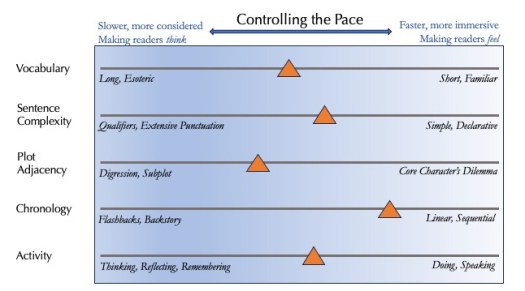
Here’s a quick thought about the kinds of tools we have at our disposal to make a passage faster and slower.

Mine, (c) 2023. Make your own.

Imagine this as a series of sliders. If you mash them all the way to the right, it feels faster. If you push them all the way to the left, it feels slower.

Vocabularyโ€”short and simple words read quickly. Long and specialized and unfamiliar and esoteric words read more slowly.

Syntaxโ€”Simple declarative sentences read quickly. Longer and more qualified sentences, especially those with lots of internal punctuation (like this one) that require you to remember a root structure, read more slowly.

Plot Adjacencyโ€”scenes that are about the core character and their primary dilemma move faster; digressions and secondary/tertiary characters and subplots require us to keep track of more things.

Chronologyโ€”linear and relatively close-sequenced chronology is familiar. Chronological jumps, flashbacks, long absences, a narrator from the future commenting on the narrative present: all of those slow a passage down.

Activityโ€”if the scene is about people doing or talking, it’ll go quick. If it’s about people thinking, making connections, remembering, taking stock… so will we as readers.

I was at a talk recently in which the author spoke unambiguously about the importance of pace and tension. All good, but he’s an extrovert author of political thrillers, and he wasn’t able to reflect on the importance of different paces for different needs. It’s like a drag racing driver on a Formula 1 courseโ€”he’s just gonna go through a wall in pretty short order if he doesn’t do work that’s in a straight line.

All of this is like drivers’ training. It’s not enough on its own to know where the pedals are and what they do, it takes a lot of practice to be able to use them without lurching. But it’s a starting point, and I think that it makes something that a lot of writers do by feel into something maybe more learnable and controllable.

The Editor’s Early Roles

Gimme a minute… We’ll figure it out.

Nora and I were at the membersโ€™-exhibition open house last night at Stone Valley Arts, here in Poultney. We knew about a third of the artists, including two of the folks in our current writing group (Thanks, Melissa! Thanks, Burnham!). We snacked, we chatted, we looked at the work.

The organization of the show was interesting on its own terms. Itโ€™s different from a craft fair, in which every vendor is geographically segregated from every otherโ€”Daveโ€™s turnings over here, Nicโ€™s stonework over there, and so on. At this show, each participating artist had work in three or four different locations around the two rooms, commingled with the others. But it wasnโ€™t just a dumping ground. There was a logic to the organization. 

The first thing that drew my attention to that decisionmaking was a painting in one corner that had an oval-pear form at the lower left which closely mirrored the oval-pear form of a woodturning below it. The exhibition designers had clearly seen that formal connection and emphasized it through adjacency. We viewers then saw something more than weโ€™d have seen without that decision.

The editor plays a lot of roles over the development of a project, but the work of critique lies somewhere in the second half of the project. The work of the first half includes:ย 

  • Encouragement and identification of whatโ€™s going well
  • Deadlines and check-ins
  • Expansion of opportunities
  • Negotiating the writerโ€™s intentions and the readersโ€™ desires
  • Identification of themes and organization of the work to amplify/reinforce those themes
  • Preliminary thoughts on formโ€”what kind of a thing IS this, and how is it arranged?

Just as the writerโ€™s work changes over the duration of a project, so does the editorโ€™s.


Just so you know, Iโ€™m about to nerd out a little bit here. Stick with me.

Music is the space between the notes.

Claude Debussy

Iโ€™m just had the first rehearsal of the play I submitted to this yearโ€™sย Theater in the Woodsโ€™ Ten-Minute Play event, in which local writers come up with very short plays that are then performed together in a pair of single-evening shows: half on Friday night, half on Saturday.ย (Mark your calendars for Friday November 10 and Saturday November 11, with an additional Sunday matinee of three new kids plays, too.) Iโ€™ve done that a couple of times in recent years, and itโ€™s a fascinating experience to hand your work over to other readers in live-time.

One of the most common pieces of advice given to writers is to read your work aloud as you revise, to hear the lumpy spots. And you doโ€”boy, do you ever. Thatโ€™s kind of a normal part of my revision process. Where do I hear the emphasis within the sentence? Where do I hear vowel sounds align? Where do I place the hard-stop consonants that break long phrases into haiku?

So as I hear my plays performed for the first time, Iโ€™m not often surprised by how the actors read the words. Iโ€™ve done most of the work to let the text read itself. What I wasnโ€™t prepared for, what was really revelatory, was hearing the silences. Hearing how long someone paused between lines. Or within a line. Silences in a conversation, or even a monologue, are the moments where weโ€™re thinkingโ€ฆ and I could hear these characters thinking. 


One of the reasons I love typography (like that little separator we just passed, or the parentheses around this comment) are that they guide the reader to think in spaces and not just in sounds. We steer your thinking with all that stuff that isnโ€™t actually words. We help you slow down, help you hit words harder, help you hear repetition. Just read the score of a piece of classical music sometimeโ€ฆ composers offer instructions with the pace and density of an air traffic controller. Every note is guided not merely by pitch and by duration, the stuff on the staff, but also from above, a voice from God to guide us into right thinking about volume, cadence, connection or disconnection with the neighbors. He even offers little endearing Italian murmurs like affettuoso or sospirando, telling us what attitude toward life we should embrace as we play.

Text is filled with breathing instructions. The little channel between the period and the next capital letter (a gulf thatโ€™s narrowed over the past decades from two spaces to one as the pace of our lives has increased). The different tools we use to separate non-restrictive clausesโ€”commas, parentheses, brackets, em-dashes, even footnotesโ€”each of which signals a different kind of side trail from the main path of the sentence. One of the tools I rely on far too often: the ellipsisโ€ฆ a foot on the clutch to more gently shift gears, the three little dots that ease our pace as we enter the curve.

We have the word, the phrase, the clause, the sentence, the paragraph. The scene and the act. The novel and the three-novel trilogy and the whole Nancy Drew / Harry Potter / Jack Reacher oeuvre. We are taught to read by a broad taxonomy of spaces, given a chance to breathe and to think and to prepare for whatโ€™s next. Even when we binge-watch The Crown, we get to go to the bathroom once every 55 minutes, and use that moment to reflect on the collective tragedies of the last episode before we get into the next one. 

I know better than to even start Lucy Ellmannโ€™s 2019 novel Ducks, Newburyport, its single sentence stretching in a uniform-bordered carpet across literally a thousand pages. (One reviewer said โ€œthis book loves itself very much.โ€) I donโ€™t know how to read that. I donโ€™t know where I would stop by choice and where I would stop by exhaustion and where I would stop from impatience, but I know I canโ€™t stay awake long enough to read a thousand pages. Itโ€™s been called an โ€œambitiousโ€ novel, but I donโ€™t feel the need to be caught up in her ambition. The weakness may be mine, probably is. Thatโ€™s okay. Iโ€™ll own that. Iโ€™ll opt for the comfort of textual convention that allows readers to THINK theyโ€™re ignoring the road signs, even as those signs influence every driving decision. I mean, if I gave you a test to remember every single road sign between here and Rutland, no way could you do that. But you see them, and you use them, even as they (mostly) donโ€™t enter your conscious thought. 

When youโ€™re a reader, ignore all that, the man-behind-the-curtain stuff. Pretend you didnโ€™t see it, let it be invisible. It ought to be. But when youโ€™re a writer, start to look at something other than the 26 letters of the language. Start to seeโ€”and to hearโ€”the spaces.

Motives for Reading

What is she hoping for?
(Image by Marga Santoso, via Unsplash)

Architecture professor William Hubbard once claimed that buildings were always part of at least three different sets of discourses.ย 

  • Thereโ€™s theย discourse of order: has this building been rigorous about the way that it solves formal problems? Has it set interesting problems in the first place? This is anย intellectualย conversation, having to do with the buildingโ€™s contributions to the theory and practice of the discipline.
  • Thereโ€™s theย discourse of worth: Is this building efficient? Does it promote the goals of the organization that bought it? Has it helped its clients teach better, heal better, work better? Has it made the client more profitable? This is anย instrumentalย conversation, having to do with the business goals that the building advances.
  • And then thereโ€™s theย discourse of values: Does it promote the community? Does it โ€œfit inโ€ with the surroundings? Does it help bring us together and make us proud of our place? This is a community conversation, having to do with the way that a building does or does not promote collective ideals.

Different viewers of any building will not only have different opinions about it, but those opinions will be based in entirely different conversations. Itโ€™s no surprise that we donโ€™t always like the same things.

I think that writing also responds to these same three discourses, and probably other ones as well

Literary critic Wendy Lesser reads for intellectual pleasure. She writes, โ€œI live with, and through, literature. That, I suppose, is what I am hoping to transmitโ€”that sense of connection with something other than oneself and oneโ€™s friends and oneโ€™s life in this time. Reading literature is a way of reaching back to something bigger and older and different. It can give you the feeling that you belong to the past as agent well as the present, and it can help you realize that your present will someday be someone elseโ€™s past. This may be disheartening, but it can also be strangely consoling at times.โ€

The literary agent Janet Reid reads for economic value. โ€œWhat I’m looking for isn’t a checklist. If I read something and like it (a lot!) I will consider whether I think I can sell it. I will consider how much I can sell it for. I will consider whether the author appears to be someone I can work with or if they are giving off Nutso Vibes. I’ll look at other books on my list and consider if this fits or overlaps with my current clients. A lot of those specific “things I’m looking for” are in fact responses to what we think will sell. There’s been a surge in demand for books that specifically reflect diversity in race and ethnicity, rather than the characters simply being default white.ย  Some of the requests reflect our knowledge of holes in the market. And some of it is just us yapping about what we like to read.โ€

The novelist Jennifer Weiner reads, and writes, for emotional support. During a conference talk, Weiner said thereโ€™s a โ€œpolitical impact of escapism. I wrote my first book almost as a life raft to the girl I had once been. I wanted girls like meโ€”who felt ugly, or fat, or lonely, or like it was never going to get betterโ€”to be able to read something and think maybe it will. Why do we read? Yes, to understand the world, and, of course, to meet characters that are alive and visceral. But, at least to me, sometimes we do read to make friends. Sometimes we do read to escape, or find comfort, or to spend time in a world that is a little more fair and a little more kind than the world that we inhabit.โ€

Spend some time thinking about the things youโ€™ve read in the last year that you really loved. And then try to write down the reasons why it was so wonderful. Those are the reasons that should motivate us, as well. We should be writing what we love to read.

Literary Research

This specimen, my friends, is what our protagonist experienced on that fateful day in January. (Image by the National Cancer Center, via Unsplash)

We were talking with a friend this evening, whose partner was off for the second week of her bowling league. Every Tuesday night for thirty weeks. Nora said, “that’s why your writing course is going from fall through spring, right? Old habits die hard.”


We talk a lot about โ€œdoing the research for a book,โ€ but I think we mean several different things when we say that. Iโ€™ll give you some examples.

My most recent book was set in the contemporary world, so I didnโ€™t have to go back in time and try to figure out who was President or what might have been on the radio. I didnโ€™t have to recreate world affairs or natural disasters.

The story was, however, set in a different place. Specifically, the Upper Peninsula of Michigan, commonly known as the U. P. I went to college in the U. P. between 1976 and 1978, driving through that remarkably unpopulated landscape four times a year. The U. P. is about twice the size of Vermont, and has fewer than half as many people. The biggest city, Marquette, is just barely larger than Rutland. The U. P. has a mythological place in my mind, a colony of Detroit and Boston that shipped out all of its raw materials (iron ore, copper ore, timber, and smart children) only to get nearly nothing in return. 

I donโ€™t live in the U. P., and I havenโ€™t been there for decades. So I had some work to do: driving around Alger County on Google Maps Street View, for instance, or looking up the Countyโ€™s governmental structure. Finding out whether the former prominence of Finnish and Welsh family names still held, finding out how far one would have to drive to buy a new car or a new snowmobile. Learning where the hospital would be, learning where the schools would be, learning how long it would take to drive to Shingleton, or to Marquette, or to the Mackinac Bridge. Learning how to pronounce cudighi, the U. P.โ€™s unofficial official sandwich. Those are all examples of one kind of research, the sort of factual things that make a place or a job feel realistic. They are necessaryโ€”weโ€™re not allowed to get those wrong. But theyโ€™re far from sufficient.

Thereโ€™s other research that we do all day every day; we live around people and see how they dress, listen to how they talk. The imaginary town of Cornwall, Michigan is the same size as the real-world town of Middletown Springs. That means some things for everyday life: about gossip at the general store and the dump, about grudges held and about alliances strengthened. Rural life everywhere is filled with second-guessing, because rural people all have to do a lot of things well enough rather than a few things really well. So lots of guys have built a garage or graveled their driveway, and they think they know how to do it. That means everybody else is wrong. (Nora and I joke that the Vermont state motto should be โ€œHuhโ€ฆ donโ€™t know that Iโ€™d have done it THAT wayโ€ฆโ€) Same is true for pie crusts, quilts, engine repair, gardeningโ€ฆ thereโ€™s just endless commentary about other people and their errors. Because really, in a town of 800 people, what else is there to talk about?

All of that is important, but still falls a little shy of the kind of research that I love most.

I was about to write a scene in which our protagonist Angie was asked to look over a crime siteโ€”her boyfriendโ€™s summer cabin that had been taken over for winter use as a combination of meth lab and housing. Iโ€™ve never been in a meth lab. I donโ€™t know what that looks like. I know itโ€™s not clean science, like a hospital lab; itโ€™s poor people, poorly educated, who are trying to make a dangerous product without much infrastructure. So I googled โ€œmeth lab,โ€ and chose โ€œimages,โ€ and saw this.ย 

Image from AEI Decon

What a remarkably rich portrait of shattered lives. The clutter, the trash. The stained walls. The plastic tubing running into and out of plastic bottles, the propane tank and the cooler. The scale. The single rubber glove draped over the edge of the sink. The deer rifle propped against the counter. The fucking teddy bear, and the same colors on the onesie on the chair next to it.

Thatโ€™s what the research was for. To let me live in it. To let me understand not merely the technical facts but the despair. The research was all about experiential understanding. And it became this.

Once Sunday came, Angie met Kate at the shop, then drove out to meet the State Police at Grantโ€™s cabin. Given that the house was a crime scene, they had to come to agreement out in the snow about what they could and couldnโ€™t touch, where they could and couldnโ€™t walk. 

As they were about to go up the stairs to the deck, Kate said, โ€œYou ready for this? Itโ€™s probably going to feel pretty ugly.โ€

โ€œNo, I ainโ€™t ready, but weโ€™re gonna do it anyway. Letโ€™s go.โ€ The trooper slid the patio door open, and Kate walked in, Angie right behind.

The curtains were all torn down and had been used as blankets, draped all over the couch and wadded into the arms of chairs. Bed pillows and couch pillows and stuffed animals alike had been pressed into dormitory service. The toolbox and chainsaw from the truck were up against the kitchen counter, the handgun and radio next to the sink. 

The breakfast table had been pushed up against the wall. On it, a Blue Rhino propane tank, an ice chest, and plastic tubing running back and forth between them, the wallpaper and ceiling above it scorched and smoke-stained. A deer rifle propped against the counter. A plastic bale of Walmart house-brand diapers, sized for six- to twelve-month-olds, on the floor next to it.

Trash everywhere. On the floors, on the furniture, on the counters, spilling out of the lower cupboards. Empty cans for soup and beer alike. Dirty clothes, infant through adult, a Goodwill dumpster of ragged clothes and boots and sneakers and slippers.

All of this, where Angie and Grant had had their fill of one another every day and night for the past few summers. 

She hadnโ€™t walked ten feet, but couldnโ€™t bear any more, turned and walked back outdoors. She felt colder than she had after her rescue, but a different kind, the cold that comes from a familiar story replaced by something obscene. Kate came out to join her. โ€œCome on, letโ€™s go.โ€ She walked Angie out to the one-ton, put her into the passenger seat and drove away.

And then, what Angie had seen haunted her through the rest of the day:

Angie and the crew went about their workdays, prepping for the afternoon snow, clearing a couple of frozen culverts to clear an ice wash over a back road, and then out with all three plow trucks until about eight in the evening. But the normal shop banter didnโ€™t lift her mood for more than a few seconds. Her usual ability to be present, to see every leaf and every reflector and every visitor in a driveway, was hampered by the visual aura of that cabin. Of the lives that it represented. Which one of those young men had been the captain of the football team, the lead of the school play? Which one of those young women had been aiming to be a high school science teacher like Betsy? And what would become of a baby born to that home? How could any child climb from that hole, a hole that it had no responsibility for digging? A hole that was its only birthright?

We care about our characters, so itโ€™s crucial that we really understand what itโ€™s like to live that way. So an awful lot of my research is on the fly, scene by scene and day by day. What do I need to know in order to understand this moment? Itโ€™s research about the way people live, far more than about the nature of the fabrics they wore or the members of their favorite TV show. The research isnโ€™t done to show OUR authority as writers; itโ€™s to give us a better sense of the inner lives of our characters, to give THEM the density and authority that readers need in order to care about them. 

Gatekeepers

Here. Just show them this, and they’ll let you backstage.
(Image by Van Tay Media, via Unsplash)

“Everybody is trying to sell the project to the next person in line.”

Jenna Johnson, Executive Editor, Farrar, Straus andย Giroux

Nora and I and our friend went down to the Southern Vermont Arts Center yesterday, to see the Red Dress exhibition. Highly recommended.

But that’s not my job in this space. What I want to talk about is the gift shop. Museum gift shops mostly contain the same array of stuff. Books and small objects related to the current exhibit. Arts and crafts by local professionals. Kids toys that promote creativity. And books about art in general. All of it aimed at people who’ve just had their ideas challenged or their eyes pleased, and who imagine staying in that state just a little bit longer.

So I bought a book. A Year in the Art World: An Insider’s View, by Matthew Israel. It’s a fascinating look into the world of people who make art, who make art possible, and who make art “important.” Each of its fifteen brief chapters is dedicated to one example of a field involved in the value chain of fine art. The first of those chapters is about “the artist.” The other fourteen are not.

Fabricators, gallery directors, museum directors, art fairs, artist estates, art writers, curators, biennial exhibitions, art schools, art online, art advisors, auction houses, conservators, and shippers/warehousers. Fourteen separate industries dependent on the fragile work of that first one, back there with the sketchpad and the weird ideas.

Some substantial majority of those players have to agree that the artist has done something important in order for the artist to enter the contemporary conversation. In some ways, it’s akin to the peer review process in academia, in which a bunch of specially-trained professionals exercise their informed judgement on work within their field.

The way it differs, though, is important. And that difference is that they all need to make money from the transaction. So their judgment of the work is always ecological, about the work within the contemporary market. “There’s no market for it” is a low consideration to the artist, and crucial to each of the other fourteen.


Let’s look at how this plays out in books. I’ll use my 2019 book The Adjunct Underclass as an example.

I’d written an earlier book, The PhDictionary, that was published through the University of Chicago Press. I had a clear audience in mind for that one: young adults in grad school or having recently gotten their PhDs, who had come from outside the higher ed industry and thus didn’t know any of the unspoken rules and customs that would come back to smack them in the face if they stepped the wrong way. That book did okay, selling 1,411 copies as of June 30 of this year. But my editor at Chicago, the brilliant Elizabeth Branch Dyson, knew the market, and asked me to write a book that wouldn’t have occurred to me on my own.

So I did. I conducted all of the research and had all of the ideas and wrote all of the text. I was supported in that work by the equivalent of the fabricators: Elizabeth giving me conceptual guidance, and the gifted (and patient) copy editor Renaldo Migaldi making sure that my text was both correct and elegant.

But after it left my hands, it entered a machine that I’d never considered.

Elizabeth had already gained approval for the book by the Press’s editorial team and its board of directors, but once it was near the finish line, she passed it off to two other groups: production and marketing. On the production side, the book designer created a comfortable page logic and a lovely cover, and then it went to a print shop. But on the marketing side: Wow.

They generated a list of a hundred or so reviewers who would each get a free copy. They made posters for the London Book Fair, where the Press introduced its Spring 2019 releases, and sent one or more folks to that event as well. They carted the book off to other trade shows in higher ed and in education research. They pitched the book to major bookseller chains, and to major book distributors. They plowed and fertilized so that the book’s tender little seed might sprout.

Then the reviewers themselves went to work. Some of them were within the world of literature, some within the world of higher ed, some within the world of labor relations. Each of them put the book into conversation with their own thinking and interests, and presented the resulting discussions to their own readership.

Booksellers themselves. From the Amazon behemoth down to the small indy shops, individual buyers had to decide whether and how many. (A couple of those stores invited me to come talk, which was fun, too.) How and where do those books get placed within the vast snowdrifts of ideas that comprise every good bookstore? Is it “new and notable,” or is it just slotted spinewise on its designated shelf, elbowing its way into the crowd like a subway passenger in the morning rush?

And then, finally, readers. Thank you. I’ve made some good friends through that book, people who would otherwise have been completely unknown to me but who have become trusted voices through our correspondence.

As of June 30, that book has been translated into traditional and modernized Chinese, and made into an audiobook. In its original form, it’s sold 4,275 copies, 71 of which (1.7%) were during the most recent fiscal year. Its current Amazon ranking is #647,157 of all books. Now four years old, it’s entered the geriatric phase of its life, available at half price twice a year from the Press’s warehouse sales.

There have been so many people along the way, each of whom had to decide that the book was worthy of participating in their discourse. I’m grateful to all of them, but it makes me aware of just how big, and how selective, the machine is. And how many good writers won’t get through the doors.

Today’s New Word

You’re gonna lose a finger, bud…
(Image by Isabel Vittrup-Pallier, via Unsplash)

Nora invented a word on Saturday. It might already exist, but I don’t care. It’s perfect for our times.

As with many new words, it started from an existing one. We all know the idea of an affront, a thing that causes offense or outrage. It’s usually used as a noun. We also know the idea of affronted, which is an adjective describing the condition of having received an affront. But Nora’s word, sprung from much of our public life these days, was affrontational: the attitude toward the world that makes almost anything likely to be seen as an affront.

We all know those people. Brittle, spring-loaded, ready to be offended by any random remark. The platform of Twitter/X exists to bring us hot takes, quick responses, clever jibes. It’s a terrific tool for people ready to toss out some angry remark that generates an affrontational cycle for days or weeks, until a new tempest emerges within a new teapot.

This is the summer of WAAAAAAAAnthems like “Try That in a Small Town” and “Go Woke Go Broke” and “Rich Men North of Richmond,” affrontational songs that wail their offense at the modern world. Babies are affrontational, too, wailing their offense at anything less than their ideal.

I think physical distance makes an affrontational stance more likely. When we’re together in the same space at the same time, we’re interacting with a real person rather than reacting to cold text or secondhand video. The internet has made affrontationality (my new word, you’re welcome) the easiest condition to fall into. We used to talk about flame wars and beefs, but sometimes it seems those are more the norm than the exception.

I’ve left behind most of my religious education, but something that Pastor Fry said in seventh-grade Catechism has stuck with me for fifty years. In commentary over forgiveness, he said “it is equally a sin to give offense and to take offense.” If we think of offense or affront as a sort of perverse gift, then we can disrupt the affront by either not offering that gift and by not accepting it. Somebody has to be the circuit-breaker that interrupts the cycle of ill-will.


Hey, it’s a mooc!

Robert Pirsig, in his one great book Zen and the Art of Motorcycle Maintenance, discusses what he calls โ€œgumption,โ€ or the willingness to continue.

Gumption is the psychic gasoline that keeps the whole thing going. If you havenโ€™t got it thereโ€™s no way the motorcycle can possibly be fixed. But if you have got it and know how to keep it thereโ€™s absolutely no way in the whole world that motorcycle can keep from getting fixed. Itโ€™s bound to happen. Therefore the thing that must be monitored at all times and preserved before anything else is the gumption.

As part of this conversation, he names a few โ€œgumption traps,โ€ or things that make us lose enthusiasm for a project. Some of them are technical: 

  • Youโ€™ve got the whole thing together and discover an internal part left aside, and you have to take it all back apart again.
  • You discover that a part is missing or faulty, and you have to stop until it arrives.
  • You discover that something is working most of the time, but thereโ€™s an intermittent failure that you canโ€™t explain.

All of those drive me nuts. Guaranteed dead stop for a while. But there are other gumption traps that are more systemic, and more pernicious:

  • Preset values that keep us from seeing possibilities
  • Ego attachment that keeps us from learning 
  • The opposite, anxiety that keeps us from imagining we can ever do it right
  • Impatience, wanting it done more than wanting to do
  • Incorrect categories, the either/or thinking that keeps us from reimagining the problem
  • Tool trapsโ€”bad tools, bad working conditions, interruptions 

The first category, which Pirsig calls set-backs, are wholly external. They just happen, on any project. Theyโ€™re unavoidable, at least once in a while. But the second category, which Pirsig calls hang-upsโ€ฆ those are invisible because theyโ€™re within us. And theyโ€™re as pertinent to writers as to motorcycle mechanics.

  • Preset values: believing that a character should do or want something, rather than listening quietly to what they themselves do and want.
  • Ego attachment: I know how to write this kind of work, and so Iโ€™m going to replicate this thing I know how to do. Every dog has its tricks, and we know how to get patted on the head. But maybe we can, even at our advanced age, learn some new ones.
  • Anxiety: Iโ€™m no good, who the hell do I think I am, I canโ€™t even spell rightโ€ฆ. We all have our own array, but theyโ€™re always there.
  • Impatience: truncating our work on one scene because weโ€™re eager to get onto the next. 
  • Incorrect categories: good guy/bad guy. Important character/background character. Show/tell. All of these labels keep us from seeing the thing as it is.
  • Tool traps: Joyce Carol Oates says the thing that holds up most writers isnโ€™t lack of talent, itโ€™s interruptions. We can gain privacy through scheduling (before the kids get up), through physical enclosure (the doorโ€™s closed, dude), through distance (going on a retreat), and through anonymity (writing in a coffeeshop where the world ignores us). And if your pen is leaky or your computer is balky, youโ€™re just creating a less pleasant experience for yourself.

The good news is that if weโ€™re aware of these hang-ups, we can start to recognize when they occur, and develop strategies to interrupt the downward cycle.ย  More about that soon.

Respect the Rhetorical Circumstance!

A more common experience than we acknowledge
(image by Antonio Molinari, via Unsplash)

I was reading my daily email from The Creative Independent, a series of brief interviews with artists of all sorts about their creative practice and inspirations. Today’s was with the comedian and musician Jaboukie Young-White, who said something that struck me about his dual practice.

In stand-up, you do a bunch of intellectual labor to get a reaction out of people, whereas Iโ€™ve gone to concerts, and musicians will, in between songs, be like, โ€œWater,โ€ and everyoneโ€™s going crazy, dying laughing, and Iโ€™m like, โ€œThis room is so hot right now. If I could do a tight five, it would crush so hard.โ€

Yep. As I mentioned in the prior post, our audiences are prepared for something. And if we don’t deliver it, we lose them quickly. But some of that preparation is beyond our control.

Being an early-career standup comedian would have to be the worst job in the world, because you’d constantly be facing a cold room. On open-mic nights, the people before you wouldn’t be very good either, and it’s hard to tell a joke that enlivens a room rendered dull by boredom. They’re drinking, they’re having conversations with their friends, they’re getting an easy laugh from their buddies by mocking the people on stage. A bored room might be the best possible outcome; it could be actively hostile.


I don’t have my copy of Cathy Park Hong’s brilliant book Minor Feelings at hand right now, so I’ll have to perform an injustice by paraphrasing. In one of her later essays, she talks about taking classes in stand-up comedy and improv as part of her self-training as a performing poet. She says poetry readings are among the deadliest social events we know of, that every poet knows it, and that we replicate all those bad performance habits anyway. She says she can’t count the number of times that a professional poet has neared the end or her or his reading by saying “Only two more.” It’s like going to the dentist, where they kindly tell us that the pain is almost over. She participated in that herself for a long time, and finally decided that there had to be a better way.

My friends in the Duke writing program who were trained in composition programs used to talk about “the rhetorical circumstance” of a piece of writing. What conversation are we entering? What kind of contribution do we intend to make? Is the mode of conversation gentle and luxurious, or quick and combative?

So let’s think about the rhetorical circumstance of reading our work. It’s theater, and specifically monologue. All eyes are on us… people are quiet and attentive… we’re facing the group, often standing while they’re sitting… and we’re on our own. That’s a mode that carries powerful performance and audience expectations.

If we’ve ever read our work aloud, we recognize that so many performers don’t recognize their responsibilities to the room. They haven’t rehearsed, they lose their place, they shuffle papers, they apologize for what they’re going to read, and they haven’t any sense at all of how long ten minutes is. I was about to write that they give us a little backstory between poems and thus break the spell, but that’s not quite right, because they never tried to cast a spell over us in the first place. We’re all polite audience members, we don’t burp loudly or start talking to our neighbors the way we might in a nightclub, but we’re waiting for the pain to end.

Let’s go back to Jaboukie Young-White’s statement, and focus on the term “tight five.” Every professional comedian has a five-minute set that they use on talk shows or talent competitions, and it’s sharpened to a razor’s gleam. It’s not tossed off, it’s not improvised. Even if the performer looks casual or awkward, that’s the role they’ve taken on; the performance of that character has been highly refined.

Here’s an example that’s easy to enter, Drew Carey’s first televised standup set, on the Tonight Show in 1991. Listen to the intro: “He’ll be appearing this weekend at The Funny Bone in Schamburg, Illinois, and then Tuesday through Sunday at The Funny Bone in Naperville, Illinois.” This is clearly not a comic who has made it yet. But after this performance, he almost immediately got a TV show. He comes on stage at :20 into the video, and he’s done by 6:55. It’s old-school comedy in the Dangerfield mode, and it’s a little dated now thirty years later, but this awkward schlubby Clevelander has perfected every scrap of his stage persona, down to the glint off his glasses in the stage lights.

When we read our work, no matter how dark or how complex or how sophisticated, we become entertainers. We have entered the rhetorical circumstance of performance, and we have to respect that. We become a very specific version of ourselves for those minutes, and we have to win the room’s trust. Even harder if that trust has been violated by prior performers.

Practice. Know your timing, and your time limits. Don’t apologize for your work. Don’t rustle pages around and lose your place. Make eye contact.

That stage is yours. Stand up there like you fucking own it, and then leave it better than you found it.

Underway?

THERE’s a daunting thought for a writer.
(Image by Kind and Curious, via Unsplash)

I’m leading a fiction and memoir workshop for the next ten months, and as always, I’m writing along with the group. I’ve revived a project that I’d had underway and left at the side of the road a couple of years ago. Now I know what it’s about. That helps.


Rich Hall wrote a book in the 1980s calledย Sniglets, in which he invented words that didnโ€™t exist but should. One of those words was โ€œtriorities,โ€ which he defined as three things that all had to happen first.ย 

Thatโ€™s what the first chapter of a book is. We have so much stuff to do! We have to introduce the characters and the setting and the time and the personalities and the narrative voice and the fundamental problem theyโ€™ll all face and the relationships between everyone and all that stuff has to come first. Itโ€™s absolutely impossible.

The good news is that we donโ€™t really have to do all that.

My friend Nathan said something once that has really resonated with me. โ€œThe first chapter of a novel teaches you how to read the book.โ€ And I think thatโ€™s absolutely true, what we encounter in the first few pages needs to set us up for the emotional journey that weโ€™re about to go on.ย 

  • If itโ€™s a plot-focused book, like a mystery or a thriller, then we need to understand the stakes right away.
  • If itโ€™s a character-focused book, then we need to feel the complexity and the inner workings of this character right away.
  • If itโ€™s a setting-focused or circumstance-focused book, then we need to lay out the landscape right away.
  • If itโ€™s a literary book filled with ideas and delicious language, then we need to be introduced to the complexity and density of the language right away.
  • If itโ€™s a book about a relationship, we need to see that relationship early on.

Basically, the first few pages of the book establish the deal weโ€™re making with our readers. Weโ€™re promising them a particular kind of experience, in exchange for their investment of time and attention and emotion. If, to quote Peter Ho Davies, the novel is a machine to keep us reading, one of the ways that machine can fail is by delivering an experience other than the one we promised.

One thing that implies is that we might have to go back and rewrite the introduction sometime later on, once WE know what the book is about. Thereโ€™s no need to understand right off the bat what a book is about. We might discover that along the way. If weโ€™re writing truthfully, we probably WILL learn that the story has more going on than we imagined when we started.