Irish Alzheimer’s: Having forgotten everything except your grudges.
In 1960, the population of Vermont was just shy of 390,000 people. Within twenty years, it was almost half again as large, as the hippies and the back-to-the-landers flooded north from New York and Connecticut and Massachusetts (the invading population collectively known as “flatlanders”). People who came to the country with their city ways, who learned how to farm from reading the Whole Earth Catalog and Organic Farming and Gardening instead of from their grandparents, who were happy to show the old-timers “a better way” to do something or another. And a vast number exchanged big-city life for small-city life, swelling the populations of Burlington and Barre, and creating meaningful suburbs from the small towns around them—tripling the size of South Burlington, quadrupling Shelburne, growing Williston by sixfold, all within the Burlington gravitational field.
To this day, a sense of being disrespected motivates a broad swath of “real Vermonters.” I remember a fairly contentious public meeting a few years ago in which one of the beleaguered asked their questioner,”yeah, well, where are YOU from?”
“I’ve lived here for thirty years.”
“Yeah, but where are you FROM?”
“Ohio.” And the point was made.
Honor cultures are those in which respect is a vital currency, and disrespect—whether real or imagined—is the worst possible offense. There’s some evidence that honor culture may have its origins in herding communities, in which any possible threat must be addressed instantly (as opposed to crop communities, in which land occupancy is stable and one has to learn to deal with the neighbors). Gangs of all sorts are honor communities, because they’re constantly defending or encroaching upon turfs—wearing the wrong colors in the wrong part of town, or usurping gang regalia without actual membership, can be fatal.
And this, to me, is why waiting for Trump voters to feel betrayed by their leader will not be a winning strategy. There’s a whole group of Americans who’ve felt themselves talked down to for decades; that enduring sense of being disrespected makes “owning the libs” far more important than any good outcomes they might hope for themselves. As the Japanese proverb has it, “if you want revenge, dig two graves.” More important to hurt us than to help themselves.; death before dishonor.
We’ve been divided by decades of curated grudges, amplified by those who benefit from our division. “Those _______ think they’re better than you,” they say, and then fill in the blank: women, African Americans, queer folks, college-educated, urban, take your pick. It works the same way as middle-school lunch tables: “You know what Jenny said about you this morning?” And discord is sown and amplified, with the real power flowing to those who pull us apart. Feuds never end, and never actually achieve strength; they just give us someone else to feel good about hurting.
Generosity is a slow sauce, but it’s the only viable option. Someone has to be grown-up enough to not spin the endless cycle of pain delivered and pain received. Only then can we be allies in the work against the people who harvest wealth from our division.
Let’s put a core principle on the table: Business and Government are inherently countervailing forces, and should be. If business is the engine and drivetrain that powers a nation, government is the suspension and brakes that makes it operable and safe. All brakes, and it doesn’t run; all engine, and you put it into a tree in no time. The question of balance between functions has vexed every carmaker from Ferrari to Yugo, and it’s an important question. But just to decide that we don’t need half of the car? Dumb.
For a hundred years, Republicans have asked for the biggest engines they can get, even though they have no idea how to drive. And like young Vermonters in their vast diesel pickups, they make tons of noise and have a load of fun… until they put it into a tree.
Herbert Hoover: The Roaring 20s, followed by the nation’s worst depression.
Richard Nixon: American manufacturing converted into American retreat.
Ronald Reagan: eight years of dementia followed by the savings and loan collapse.
George W. Bush: took Clinton’s balanced budget, said TAX CUTS, DUDE!!!!, and drove us into debt again.
Trump the first time: the guy who said COVID would just disappear, like magic, costing a million American lives and hundreds of billions of American dollars.
Trump the second time: raw, unfettered oligarchy.
It was P.J. O’Rourke who said “Republicans campaign on the idea that government doesn’t work, and then they get elected and prove it.” But it’s so much FUN to drive fast and stupid!
This time around, though, it’s more sinister. This new breed of Republicans want to purposefully make sure that government doesn’t work, that we’re dissatisfied with it, so that we quit having any expectations at all and are willing to privatize all of it. (Ever try to get customer service from Comcast? From Blue Cross? From American Airlines? Good luck with that.) When Obama was working toward the first iteration of the ACA, there was a lot of noise about “death panels,” government bureaucrats who would decide whether or not you were worth treating. Well, friends, we already had death panels and still do—they’re called insurance companies.
Government is not, and cannot be, and should not be “run like a business.”
First off, 80% of businesses go broke in their first five years, and tons of successful businesses go feet-up without much warning. We can’t take the chance on that kind of instability when we talk about our water quality or prisons or traffic lights. One of the crucial functions of “the deep state” is to provide expertise and stability that’s hard for any individual congress or president to screw up, unlike a Chrysler or Boeing or Kmart which can fail at any moment. (We may be testing the limits of how much malice can be absorbed before we break government systems forever.)
Second, are we really prepared to say that tens of millions of people should starve to death because they can’t hold jobs? For whatever reason? Every dollar we spend to house and feed and rehabilitate and support the poor would be withheld if they were seen merely as customers who couldn’t afford service. Every dollar we spend to reduce drug prices and to develop new ones keeps lifesaving treatments from being luxury goods.
Third, almost every business success is dependent on something that government did, and that ONLY government could provide at the necessary scale. Whether it’s streets and highways, or general-service police and fire instead of private armies, there are things that can only be done by pooling the money of a hundred million people. As someone once put it, I can’t buy a hundred dollars of clean air. But all of our hundreds put together can accomplish important pollution reductions.
(Not to mention—ski resorts operate on mountainsides largely groomed in the 1930s by the Civilian Conservation Corps, your GPS works because of satellites and standards developed by the Department of Defense, and you’re reading this on a distributed network originally designed and maintained by ARPA and the NSF. Bezos and Zuckerberg and Musk owe every single dollar they’ve ever made to government investment.)
The valorization of the American capital class is an important story, and it isn’t wrong. But it also isn’t complete. We celebrate the ones on top and never mention the thousands of entrepreneurs whose ideas came to entirely warranted deaths, nor do we talk about the millions of jobs that came and went without anything to do with the quality of the workers. And we neglect the fact that every business exists in a physical and social and policy ecosystem that existed before it came along. None of us are lone heroes; we stand on the unseen work of millions and millions of others, in an environment made safe and level and predictable… by government.
“The Democrats don’t matter. The real opposition is the media. And the way to deal with them is to flood the zone with shit.” — Steve Bannon
Every so often, someone accidentally copies me on a wingnut nonsense post. I’ll use one example, from a former colleague on our little town’s Selectboard. He posted some smirking bullet list of liberal outrages, and sent it to a dozen or twenty people. I recognized right off the bat that a bunch of the points were just nonsense, so I spent the next six hours doing my research to find credible data that demonstrated the fallacy of each of those assertions. Six hours. I then sent it to the guy who sent the message to me, and he replied, “Well, I just thought it was funny.”
He’d spent two minutes reading it, and another minute to build his mailing list to send it out another dozen times. I spent six hours to correct it, and sent my response just to him. And therein you can begin to see what we’re up against.
Fox News defended itself in a 2020 slander case by successfully arguing that “no reasonable viewer” would believe that Tucker Carlson was engaged in factual, literal reporting. “Carlson cannot be understood to have been stating facts, but instead that he was delivering an opinion using hyperbole for effect.”
Rush Limbaugh: “First and foremost I’m a businessman. My first goal is to attract the largest possible audience so I can charge confiscatory ad rates. I happen to have great entertainment skills, but that enables me to sell airtime.”
Donald Trump: “I play to people’s fantasies… a little hyperbole never hurts. People want to believe that something is the biggest and the greatest and the most spectacular.”
Judicial review takes time. Accurate research and rebuttal takes time. Outrage and spectacle take no time at all. Just as reflexive statements like “common sense” and “libtards” and “DEI hire” take no time at all. No need to listen when all you have is a megaphone. I just got off the phone with a friend who said, “he’s a bully, and when someone stands up to him, he backs down.” But in the meantime, the administration lays off two thousand people from NOAA. Real lives, whose work has real professional implications for public safety. What they can break in a few hours will take us years to rebuild.
Another friend wrote me a couple of days ago. “When you’re in a street fight, you don’t assume the posture of a boxer. That’s a gentlemen’s game. You pick up a handful of dirt and throw it in your opponent’s eyes. and while they are blinded, you kick them in the balls.” It seems that facts, like the Constitution, are a gentleman’s game, vulnerable to those who walk in with a chainsaw and no moral core. And our playing by the rules just buys them more time.
A few years ago, a colleague asked me to help her learn to teach people to innovate. “Innovate isn’t a verb,” I said. “You only know whether something is an innovation after the fact, when other people start to use it too.”
“So what’s the verb?” she said.
“Reimagining constraints.”
The old-school Democrats, raised in a different era where the rules were generally adhered to, haven’t been particularly effective at dealing with the institutional lawlessness of the GOP as currently configured. (The whole Republican infrastructure is ripe for a RICO prosecution, like any organized-crime gang.)
We’re polite. We believe in procedure, and in letting everyone be heard. And it’s hard for us to go against those established habits. But those are the kinds of invisible constraints that keep us from imagining new paths against lawlessness. It’s time, as our Canadian friends remind us, for “elbows up.”
The purpose of Newspeak was not only to provide a medium of expression for the world-view and mental habits proper to the devotees of Ingsoc, but to make all other modes of thought impossible. — George Orwell
When our lives are filled with wicked problems, it can be comforting to believe that we have sufficient mastery of the complex world, that there’s some certainty to attach our wagons to. Part of that work is linguistic, adopting language that sounds explanatory but is actually just soothing, like an incantation. Along with “common sense,” there are a lot of other contemporary phrases that do the same work of compressing complexity, disregarding difference, flattening expertise, demeaning others, and closing off conversation.
Any effort to see that the whole world doesn’t conform to white heterosexual male experience is written off as Woke. The full phrase is “woke bullshit,” which is the equivalent of sticking one’s fingers in one’s ears and shouting “la la la I can’t HEAR you.”
Any effort to point out that what the President is doing might be illegal, opposed to the principles of democracy, or part of a long career of money laundering for oligarchs, is attributed to Trump Derangement Syndrome.
Any woman or person of color in a job or a seat in college is labeled a DEI/Diversity Hire, (My favorite meme of the moment is that the essence of DEI hires are Don Jr, Eric, and Ivanka, all of whom were clearly promoted through something other than merit.)
Any attempt to place boundaries on the most rapacious forms of economic exploitation is Socialist/socialism.
Experts who know what they’re doing, who happen to work for a government agency, are the Deep State.
We can go on. Patriotism is the belief that only American interests are legitimate, and that it’s easy to know exactly what “American interests” are. (I mean, it’s just common sense, right?) Government Waste is any program that doesn’t benefit the speaker personally, God’s Will is a shorthand for “my opinion, with a club in its hand,” and a Mandate is the inevitability of the Emperor’s wishes.
Part of the work of these short-circuiting terms, like “common sense,” is just meeting the demands of low attention, the equivalent of tl;dr. But the bigger function is to end the feeling of being harangued by uncomfortable facts, to close the door to complexity or compromise or mutuality.
I wrote yesterday about why “common sense” isn’t sufficient to address most of our questions. Today I want to elaborate on that, using one of the articles that has shaped my thinking for thirty years: “Dilemmas in a General Theory of Planning,” by Horst Rittel and Melvin Webber. (Horst was one of my teachers at Berkeley, a true mad scientist of design process.) The article puts forth the idea that there are problems that can be solved, and problems that can be temporarily resolved. They developed the idea of “tame” problems, which have rules and definitive outcomes, and set that against the idea of “wicked” problems. The original formulation of wicked problems has ten characteristics; I’ve combined them somewhat.
Frame Diversity: there’s no definitive way to frame the problem. Every problem can be seen to be just a symptom of another problem. Different people will reasonably disagree about what the problem even IS, and why it matters, and to whom. The choice of evidence we bring to the table will reflect our own definition of the problem, and our judgment of whether or not we’re doing “better” than we had been.
Leverage Diversity: every player has a different body of knowledge that leads them to take different kinds of actions. Let’s think about a “good city.” Some professionals will work toward that economically, some aesthetically, some socially, based on what they know how to do. Us amateurs will work toward that through persuading neighbors, threatening neighbors, running for office, cleaning up our yard, putting bars on our windows, or a thousand other means of action. The way we think about the problem depends in part on the tools we have for the task.
Perpetual Motion: there’s no point at which the problem is done, because it exists in an ongoing system. Every action we take changes the problem. And every instance is a little (or a lot) different than the others, so learning from experience is limited.
Important Ramifications: every attempt changes people’s lives—in both the short and long term, in ways that are immediate and decades away. To use Rittel and Webber’s lovely formulation, “the designer has no right to be wrong.” Just as importantly, we have no right to ignore the problem, which is its own action with its own ramifications. Everything we do, or don’t do, matters.
In the fifty years since publication, some other folks have added more characteristics, and I’ve thought of a couple myself.
Urgency Diversity: every day without a solution brings us further toward bad outcomes. But we have some comfort and familiarity with how things work now, and we’re resistant to change.
Information Diversity: we all work from limited information. Leaders can be out of touch with customers or citizens, and customers don’t have any idea how complicated the work of the business is. We all read different things, have different educational history, are part of different social networks. And because of the economic importance of the work, there’s motivation to lie
No One Can Save Us. There’s no external force who can come in and fix things. All of us who create the problem every day are the ones who have to clean it up. And of course, we all disagree about what we can do or why we shouldn’t.
I did a talk on this idea about ten years ago at a college symposium. Afterward, one of the attendees told me that this approach seemed nihilistic—”I guess we all just throw up our hands and let things happen.” Given that he was a research chemist, his response was no surprise: he’d built a career dealing with tame problems that respond to known rules, that can be subdivided into subtasks and then reassembled, that have precise instrumentation, that have singular outcomes that do or don’t conform to expectations. The experimental method is based on the reduction of confounding variables, and wicked problems are nothing but confounding variables.
Henry Ford didn’t know that his horseless carriage would change city planning worldwide. A handful of engineers communicating on ARPANET didn’t foresee TikTok or 4chan. Wicked problems are inherently ecological; when we pretend they’re tame, we screw up a TON of other things.
Nora and I often say that the State Motto of Vermont should be, “Huh… don’t know that I’d’a done it THAT way…” Every time a contractor comes to do a repair, or a mechanic gets under the hood, it’s a guarantee that we’ll hear some version of that in reference to someone else’s prior work. Everybody’s an expert in road repair, snow management, pie crusts, dog training—and they don’t mind informing the world of what everyone else has done wrong. And once they tell you what they think should be done, they’ll end with, “It’s just common sense.”
I’ve come to believe that the phrase common sense is a shorthand for “I haven’t thought about this too hard, but I know my own biases and preferences.” It’s a phrase that does several simultaneous pieces of work:
It oversimplifies complexity. (We’ll talk more tomorrow about wicked problems.) There might be two dozen competing variables in how a problem gets resolved; if you choose only one as your sole guidepost, the navigation is simpler. It’s wrong, but it’s simpler. Social problems don’t often have single and unambiguous answers, like arithmetic does.
It disregards difference. The idea of common sense presumes common values, common goals, common language, common histories, common culture. It’s linked to the same project as our current hysteria over DEI—there’s one right interpretation, one right course of action, one right community, and all others are deviant or inferior.
It amplifies the voice of the inexperienced. I had someone on the phone a couple of weeks ago who wanted more sand on her hillside road. She’s never done any road maintenance, but had no problem substituting her own judgment for that of our 40-year-experienced road foreman. “It’s just common sense,” she said.
It demeans others. Anything that’s “just common sense” is obviously contrasted against things that don’t make sense. The other is not merely wrong, but dumb.
It demands closure. “It’s just common sense” is another way of saying “I’m done listening—I don’t care to learn any further.” It scribes the line in the sand beyond which no ideas can encroach.
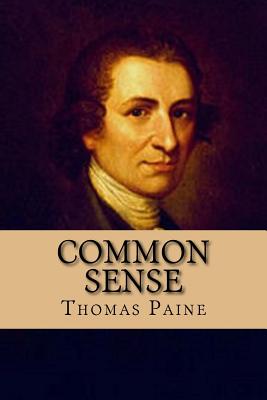
“Common sense” is the field marking of the incurious and disdainful, and holds particular power in our current, incurious, and disdainful moment.
The cruelty is the point: a momentary sense of victory in an otherwise diminished life.
There’s been a saying going around for a few years: “You can’t win an election by calling people stupid.” Well, 2016 and 2024 were empirical evidence to the contrary. Liberals and progressives weren’t merely called stupid, but evil and deranged and socialist. The name-calling was constant, because MAGA weren’t trying to convert anybody. They were trying to reinforce the voters that they already had.
This afternoon, I was in the parking lot of the local Shaw’s supermarket, always an ethnographically rich experience. Macho cars and pickups in various states of disrepair, people far too young to be missing all of their teeth, gaggles of people whose family relations were impossible to even begin to guess. (One of our neighbors got remarried to a far younger woman; they had another kid themselves, and a friend pointed out that the new wife now had a daughter-in-law older than she was.) And the word that came to mind was lumpenproletariat.
I can call out my white-trash relations because I was one. My father couldn’t move away from the African Americans he despised because he’d spent all his money on beer, cigarettes, project cars that rarely ran, and fishing boats. I know that black-flag-bumper-sticking-2A-god-guts-and-glory bad beer bullshit far too well. We aren’t converting any of those folks, even though we’ve invisibly supported their dysfunction for decades. You want to talk about “makers and takers?” Makers: California, New York, Massachusetts, Connecticut, Delaware. Takers: Mississippi, Alabama, Arkansas, South Carolina, Kentucky, West Virginia, Idaho.
Indeed, because it acted only out of socially ignorant self-interest, the lumpenproletariat was easily bribed by reactionary forces and could be used to combat the true proletariat in its efforts to bring about the end of bourgeois society. Without a clear class-consciousness, the lumpenproletariat could not play a positive role in society. Instead, it exploited society for its own ends, and was in turn exploited as a tool of destruction and reaction.—Robert Brussard, 1987.
Does this sound familiar to you? Does this sound like your “Let’s Go Brandon” neighbors? Easily bribed, exploited as a tool of destruction and reaction? Complaining that they can’t get ahead, never considering the role of the monster Ram coal-rolling pickup in the driveway and the scatter of other discarded and broken notions all around the house?
The lumpenproletariat hates the well-educated, mistaking us for the elites like Musk and Trump and Bezos who’ve actually gotten rich from exploitation. We live closer by, and are more visible and thus easier targets of their resentment. (Pretty much EVERYBODY is doing better than the lumpenprole, so their resentment overfloweth.) Own the libs, amirite?
I try. I really do. I don’t mind paying taxes to support things I don’t use directly, because I understand the difference between being a citizen and being a consumer. I can be kind to stupid people. But I can’t be kind to people who want to hurt millions of others just because they feel aggrieved. The fact that they simultaneously hurt themselves is just an inevitable byproduct, and one that I can’t be too upset about. I’ll help take care of them after the fact, as good liberals always do.
Forgive your brother seventy times seven.
Whatever you did for the least of my brothers, you did for me.
Let’s abandon Ukraine, threaten Canada and Mexico, and eliminate USAID.
A universal language, apparently (image by Claudio Schwartz, via Unsplash)
It’s been thirty-five years since I took one of my most important college courses, an elective to round out my general-education requirements. It just looked like fun—I didn’t know it would set the course of the rest of my life.
It was an upper-division Journalism course called “The Critical Review,” taught by the irreplaceable David Littlejohn. The very first class session brought a good-natured challenge. Professor Littlejohn asked, “What are reviews for?” We immediately went to the consumer-advice response: you should (or should not) go to this restaurant—see this movie—buy this book. “So why would someone write a review of a concert?” he said. “Paul Simon played the Oakland Coliseum last week, one night. No one can decide to go see him now based on your recommendation. Nobody cares about your recommendation.” We stumbled around for a bit, developing no motivations that were convincing even to ourselves as we tried them out. Finally, he gave his own judgment. “People read reviews for the same reason they read anything else,” he said. “They want to engage with an interesting voice.”
That was the first time I’d really come to terms with the craft of a review (just as, two semesters earlier, Paul Groth had asked me to come to terms with the craft of an academic paper). What did it mean to be not merely competent but engaging? That question has motivated my teaching, my public speaking, and my writing regardless of genre. (Littlejohn himself, in accepting his Berkeley Distinguished Teaching Award in 1985, said that his role as a teacher was to generate a period of time more shapely and pleasing than that of everyday life.)
The magazines I subscribe to are review-heavy. The New Yorker is filled with reviews of movies I’ll never see, concerts I’ll never attend, galleries I’ll never visit. It’s a rare day when the New York Review of Books reviews a book I know much about. Political journalism is now mostly reviews, after-the-fact assessments of “what it all means,” and how our political climate is like the McCarthy Era/the American Revolution/the fall of the Roman Empire.
It seems like a review of any sort is akin to a map, in which a landscape is abstracted into its most salient features. And that decision of salience, the choice of which features matter, is the unspoken core of the critical enterprise. We’re going to focus our reader’s attention onto some element or pattern of the thing and eliminate others from our consideration. We’re going to decide which other things are like this one, and thus generate a specific conversation among objects or periods or genres.
A bad review is vague—two stars, thumbs-up. A bad review is leveled, every aspect being mentioned at equal weight in a misguided attempt at thoroughness. A bad review is objective, claiming allegiance to some imaginary but unarguable standard of quality. The opposite conditions—detailed, specific, and distinctive—provide criticism worth reading.
We think of criticism as being inherently negative. We criticize things we don’t like. But writing strong and positive criticism is really important, and really difficult.
The old saying is that “heaven is generic and hell is specific.” This is often true of our criticism as well. When we tell a friend about a restaurant we liked, we often stop more or less at “it was great.” (Sometimes we talk about which dish we ordered, and then say “it was great.”) But when we tell a friend about a restaurant that was disappointing, those disappointments are much more sharply rendered. We speak with authority about what was over- or under-cooked, a sauce that was too sweet, service that was slow or over-attentive, the noise, the decor, the prices… an endless array of specifics that nettled us.
I get this as a writer quite a lot. Readers say “I loved it, it was great!” and then talk about a typo on page 118 or one character who didn’t strike them as fully real. And that makes the praise less impactful. With my own writing students, instead of marking up a paper front to back, I’d highlight one thing that they were doing really well, and ask them to consider how to do that elsewhere; then I’d highlight one practice or habit needing attention. It felt both more respectful and more helpful.
We see this in our relationships, too. When things are going along fine, we don’t mention it. But any gravel in the path is immediately commented upon. We’re petty critics, missing the forest of the good in favor of whining about that one weed over there.
So here’s your writing challenge for the day. Write a review of something you really appreciate. Be detailed—help us experience the phenomenon ourselves. Be specific—tell us exactly what’s working, exactly how it’s satisfying. And be distinctive—tell us how it satisfies YOU, how you relate this to other experiences you’ve had and the values you carry. You’ll get to relive that experience in an even more focused way, and you’ll be the engaging voice that your readers will want to read more of.
An unknown masterpiece of post-war Existentialist literature.
I’ve been reading a lot lately, and much of it seems to cohere in what Jung (or Sting) would have called synchronicity. I’ve been working for a year on a novel called A Woman of a Thousand Names, about a writer in the 1940s and beyond who becomes a driver of the paperback revolution, writing dozens of novels under endless pseudonyms and publishing thousands more.
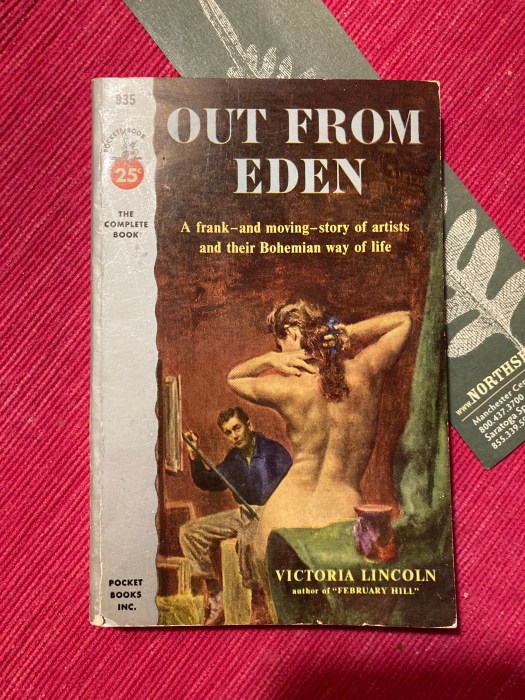
A couple of weeks ago, Nora and I were in Otter Creek Used Books in Middlebury, and I came across the book pictured above: Out from Eden, by Victoria Lincoln. It was a perfect model of what I’ve been writing about: published by Pocket in 1948, originally priced at 25¢, a salacious cover illustrated by a talented artist—in this case, Tom Dunn, who’d drawn for the Marine Corps during the war and went on to a career in commercial illustration. The standardized 4.25″ x 6.25″ format, designed for wire display racks. The nearly 100,000 words compressed by single spacing and 9-point type into a tight package of coarse beige paper with a dyed red edge. The book was so exactly what I was writing about that I paid five bucks for it and took it home.
Friends, it’s really good. It’s an excellent example of post-war existentialism, the loss of certainty that rocked the world from governments to individuals. In this case, it’s a family headed by a struggling artist who veers between full belief in his work and full despair over its meaninglessness. His wife is a lush innocent, his muse and model, who’s fully immersed in each moment and has no concerns over any future. Their son is bookish and mathematical, filled with ideas; their daughter is a savant, uneducated but visually brilliant. The two women actually hold the center of the book, as the churn of men and their noisy plans swirl around them.
Along with the subject matter, it’s Modernist in several other ways. The artist’s agent is coming to terms with his Jewishness, something he’d never fully had to consider before. His two sons have chosen entirely different paths after the war: one moving to California and a life of full American assimilation, the other moving to Israel and a pioneering life of Jewish statehood. And the novelistic methods are of a piece with the content. The point-of-view shifts frequently and with full control—all of the major characters are given internality in their respective chapters, and their voices are different from one another. Everyone is interpreting what everyone else thinks, a house of mirrors in which truth is unavailable.
It’s just a terrific book, never studied in literature programs, never mentioned in the historical overviews of mid-century lit. It was consumed, read, discarded.
The New York Times ran an article last week about lesbian pulp fiction of the 1950s and 60s. “The novels had to be presented carefully; even in the largest American cities, gay bookstores didn’t yet exist, so the covers, the titles and the stories all had to meet standards that would allow them to be credibly intermingled with run-of-the-mill paperbacks in a mainstream bookshop, or in a stationary store or pharmacy stocked by someone who was either sympathetic, opportunistic or both.” The offhand commonplace of paperbacks was a discretion that allowed them to touch topics that major publishers wouldn’t have dared.
It was also a tool that allowed the pulp houses to claim genres that major publishers and their literary patrons disdained. Romance, of course, the most beloved and most demeaned of all literary forms. Science fiction, westerns, crime and mystery, erotica in the 1960s and 70s… all of those forms had origins in “literature” (Austen, Cooper, Poe, Lawrence, Wells) but had become “popular” and thus not serious. Easy pickings for an industry who knew that the audience existed, even if the awards didn’t.
Speaking of awards, The New Yorker reprinted an article this week originally from 2005, by Louis Menand, called How Much Does Winning a Nobel Prize Matter? Menand writes of the ways that literary awards have always been a commodity, even as they desperately intend to stand above it.
In an information, or “symbolic,” economy, …the goods themselves are physically worthless: they are mere print on a page or code on a disk. What makes them valuable is the recognition that they are valuable. This recognition is not automatic and intuitive; it has to be constructed. A work of art has to circulate through a sub-economy of exchange operated by a large and growing class of middlemen: publishers, curators, producers, publicists, philanthropists, foundation officers, critics, professors, and so on. The prize system, with its own cadre of career administrators and judges, is one of the ways in which value gets “added on” to a work. <emphasis mine>
Look in any bookstore and you’ll find endless opportunities for publishers to slap a gold sticker on the front of a book proclaiming it a Booker or Pulitzer or Caldecott or Hugo or Lambda or Nebula or Newbery or Pushcart winner. In the endless, anonymous sea of fiction, these come pre-recommended, bolstering our insufficient judgment. Prizes like these (along with major-media reviews) are the water wings of the literary marketplace, helping some to stay afloat while the others sink.
All fields are susceptible to this. Architecture notably gives its awards to the unlivable and inhospitable, daily life and generosity not being topics of interest to the field’s gatekeepers.
Here’s a list. Sarah Bernstein, Jonathan Escoffery, Paul Harding, Paul Lynch, Chetna Maroo, Paul Murray. If you have ANY IDEA of any of these names, much less all of them and how they fit together, then you also need to recognize how far outside our cultural norms you stand. Simply naming your tastes “superior” doesn’t make them so. What makes some objects valuable is the recognition that they are valuable.
I’ve also started reading a book called The Late Age of Print, by Ted Striphas. (It was published in 2009, so I guess we’re in the Post-Late Age of Print now). It’s an interesting premise, unduly weighted down by its need to generate tenure for its author. His work was to examine what books are as objects as well as ideas. And that inevitably brought him into questions of commodity.
All books are commodities, in many ways similar to other commodities like a bushel of wheat or a dozen eggs. At any given moment, our local bookseller has something like 80,000 books on their shelves; a bewildering array that none of us can comprehend. The first order of business, then, is genre: the subdivision of those 80,000 into somewhat more comprehensible thematic and geographic groups. Fiction here—nonfiction there—kids upstairs. Then those first-order categories are subdivided, and subdivided further, until we end up at things like “thrillers” and “horror” and “mystery” and “romance.” The largest and least coherent is literary fiction, an anonymous rainbow of possibilities no different than the wire rack at the corner grocery, the magazine shelf in the airport. Our decisions are made by market forces:
Brand loyalty (choosing an author, or sometimes rarely a publisher, we’ve enjoyed before)
Recommendation of friends or experts (the publicist for my book said that if you get a review in the Times, you get congratulations from your friends; if you get a review in the Wall Street Journal, you sell books)
Packaging and shelf placement. There’s a reason why your bookstore has a “new and notable” table, or a Times Bestsellers shelf. There’s a reason why 98% of books are shelved spine-forward, and 2% are “faced” or shelved with the front cover forward. (Hint: publishers do pay for that.) And the book’s cover and spine do the same work as the box around the Triscuits—urging us to think “mmm, that looks good.”
Striphas’ own book was a commodity, with a different customer market—other academics who would decide whether or not to invite him into the club. That’s why he published with Columbia University Press rather than trying to fight his way into Random House.
One of the fun tidbits that Striphas delivers is the fact that the book industry was crushed in the Depression, and worked valiantly to save itself. One of their most successful efforts was to hire the PR pioneer Edward Bernays, who hit the problem sideways and worked with the housing industry (architects, contractors, and decorators) to feature bookshelves as a display of homeowners’ status and taste. “Where there are bookshelves, there will be books,” he said.
Bernays was a strong believer in not merely the power but also the moral importance of propaganda. “Intelligent men must realize that propaganda is the modern instrument by which they can fight for productive ends and help to bring order out of chaos.” That’s the role played by literature and MFA programs in universities, by award juries and the “little magazines;” to convince us unwashed of the intellectual and moral superiority of some books over others.
I used to tell my students that no human being in history has ever wanted a building. They want status, pride, comfort, family harmony, business or organizational success—and they bought or modified a building as a means of accomplishing that.
Likewise, no human being has ever wanted a book. We want more fundamental things, like pleasure or possibility or status or entry to cultural conversation. We buy books in order to accomplish those things.
Likewise, we don’t create books to have books. We create them for pleasure, or possibility, or status, or generosity, or as proof that our lives really have mattered. It’s only by acknowledging that we’re human that we have any hope of transcending commodity. That’s one of the great (and unexpected) blessings of not being part of the publishing industry; I don’t have to respond to market pressures. I can write because the stories intrigue me; because the craft demands my attention; and because I’m pleased to use them as instruments of generosity for my friends.
Nora and I went to a show tonight. I won’t tell you who. This performer has endless talent, and a fifty-year career fully deserved. But… it felt like what you’d hear at a really sophisticated nursing home. Smooth liked mashed potatoes and gravy, comfort food.
All the greatest hits came out. And was good, this performer absolutely hasn’t lost any chops at all, gave us two full hours. But the crowd was restless, lots of meandering back and forth to the restrooms.
This puts me in mind of my own writing. It’s good, and I can totally give you a great reading experience. But—is it the SAME experience? Is it the nursing home, simultaneously excellent and familiar?
I’m putting together a collection of short stories from the last year or two, all having to do with people who are socially isolated for some reason or another. How alike are they? They range across fifty years, rural and metropolitan, poverty and wealth. But they have that common theme—how do people find themselves with no peers, no friends, no family? As I’m pulling them together, they feel… I don’t know, they feel glossy. Perfectly polished, perfectly accomplished. I know how that machine works, and I’ve got it tuned.
One of my favorite bands of the 90’s, the Crash Test Dummies, had three really great albums back to back at the start of their career. Their fourth album, Give Yourself a Hand, came with a sticker on the CD case warning that this one wasn’t much like the ones before. I didn’t much care for the new one, but they needed to make the change, and I respect that.
I’m left wondering what will come next. And I kind of like that feeling, even as it makes me unsettled. Will my fans follow me, or will I betray their expectations? (How many folk music fans does it take to change a light bulb? Five. One to turn the bulb, and four to complain that it’s electric.) I guess the next one might need a sticker.