Iconography

I wrote a couple of days ago about my experience of the book’s independent life out in the world. I have to hope that my guidance and care in its upbringing will lead it to a successful career, but that’s now outside my control.

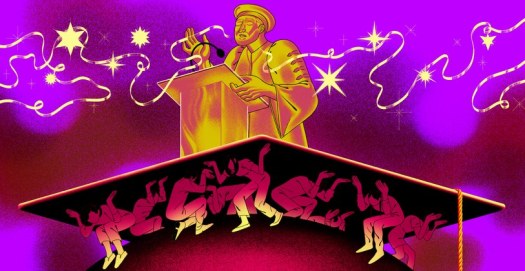
But another thing that’s outside my control is the way that the book, and I, are represented. Lots of articles have been headed by a thumbnail of the book cover, or the bland author photo I sent to the Press, or the somewhat more interesting photo that Janet Oberto took of me at a college event a few years ago, when I was driving four computers and two LCD projectors at once. Some publications have commissioned their own specific graphics for coverage. I’ve written thank-you notes to both Nate Kitch and Cathryn Virginia for their ingenuity in capturing the tone of the articles they illustrated, as well as to Isaac Tobin for the book and book cover design.

Jhumpa Lahiri wrote a lovely little book three years back called The Clothing of Books, in which she argues that the stuff around the textโ€”the cover illustration, the author photo, the blurbsโ€”can often work at cross purposes with the text itself. She wishes for the old Penguin Classics covers, like school uniforms… just the title, the author’s name, and the consistent publisher’s marks.

Anyway, all of that was brought to mind yesterday by my discovery of the weirdest artifact of this bookโ€”at least so far, and I hope ever. There’s a YouTube channel created by a user known as smokaj0000, to which three or four videos per hour are generated (almost certainly without human intervention) from articles in some selected publications. The algorithm breaks the text across a number of slides, finds some more-or-less related screen grabs to put behind it, and plays some public-domain telephone hold music that, as the Dude said, really ties the room together.

I wonder what Jhumpa Lahiri would think about authorial theme music…

What hath been wrought

Saturday’s event at the Northshire. Photo by Susannah Swearingen.

Now that the book has been unleashed into the world, it’s no longer mine.

Every reader will now embark on her own project with it. Will tie it into her own experience, her own position, her own motives, her own goals. Will read things that aren’t on the page, as every reader does, creating a new story with this story as a partial frame.

The writer can’t possibly imagine everything that others will do with the text. I spent most of three years making it, but now I’ve relinquished control. It’s become a tool for others to use. And the thing that’s been the greatest surprise is that the work most often taken up so far has been emotional. Coming to terms with our own role in higher edโ€”the fear of parents who want their children to pursue an employable career, the despair of good scholars set aside, the good daily work and high aspirations of those still within the clubโ€”that emotional work has been the project at the center of almost all of the response to the book. We have a deep human need to make sense of the world, and that’s only partly a project of data and pattern. It’s more importantly a narrative project, an identity project. How did we come to be who we are? And what does that mean about who I am in the midst of it?

That’s the work we don’t talk often enough about. We get scared, or we take pleasure, or we need reassurance, or we celebrate. I participated in an hour-long podcast this morning, which I’ll link to once it goes up this coming weekend. I was upstairs talking into my computer microphone, and Nora was downstairs working. When I came down, she said that she hadn’t been listening closely, but that the general tone of the conversation sounded like pastoral counseling. That’s the work I think I’m best suited for, a kind of academic chaplaincy, someone who listens closely, who says “Your story is not isolated. You didn’t do it wrong. Let me show you another way to think about it.” That work, far more than advancing the cause of any particular discipline, has always been at the core of my interests, even if I couldn’t quite name it before.

I worked on this book for a long time in complete isolation. It’s fascinating, in ways that I’d never anticipated, to see what others do with it.

And the crowd is going crazy!

Early Thursday morning, I wrote that I was going to see a friend defend her dissertation. And did she ever. She just did a brilliant job, she made everyone in the room smarter. All five committee members said that the work was exciting, thorough, showed intellectual maturity. They were offering advice about making the dissertation into a book, always a good sign. The nearly two hours of conversation were a celebration of the very best things about academic life, the perfect example of why people become fascinated with small details of life that illuminate larger regions.

And then the ref blew the call.

This dissertation, this marvel of scholarship, was not passed, and the PhD was not conferred. The work was “accepted with revisions.” In my experience, that usually means that the work is mostly sound but there’s some big methodological or theoretical hole that needs to be patched before the ship sails free. It’s an indicator of a couple of months of remaining effort, which the committee believes you to be capable of but is concerned enough that they’re reserving judgment.

But in this case… typos. Inconsistent capitalization. Bring us back a clean copy in three weeks.

It’s like calling back a towering home run because one cleat of one of the batter’s shoes touched the chalk of the batter’s box. It’s like closing down a run of a Broadway show because one actor’s suit jacket had two buttons instead of the appropriate three. Inconsistency in trivia is part of every fast-moving document. We all know it, and we all prepare to do copy editing before we go to final publication. But the editors who review for acquisition discuss the work on its merits, knowing that the tuning will occur.

So what a decent human would have done in this case is to congratulate their student, shake her hand and welcome her to the doctoral community… and then privately, off-stage, say “Here’s a marked-up copy. You’re going to want to do a little proofreading before you send this in to the graduate school for the archive.”

But no. This guy, who’d already taken three or four opportunities to demean the assembled graduate students who’d come in support of their colleague, decided that inconsistent capitalization was sufficient to withhold his blessing. He had one last chance to be a decent person to those in his care, and he fucked it up.

If this were a stadium, there would be beer cups flying onto the field. The commentators would be showing replay from six different camera angles, all clearly demonstrating the umpire’s error, the success of the play. And the raucous cry would emerge from fifty thousand voices:

Bullโ€”shit!

Bullโ€”shit!

Bullโ€”shit!

In the greater scheme of life, a blown call on the field or in the seminar room doesn’t really matter. My friend will have her PhD in three weeks, and the work will still be really smart. I’ll all be behind us. But this is the kind of petty exercise of power and status that academia is so deservedly mocked for. And it makes me grateful all over again to stand outside it.

(By the way… if you’re reading this and you’re wondering if it might be about you, if you’re the scholar who didn’t generously support the students whose careers literally depend on your judgment… then yes, it’s you. Even if you weren’t THIS guy in THIS room, take a moment to ask what you do, every day, to ease the lives of those who work tirelessly and intelligently to enter your community. Sometimes I think the opposite of “tyrant” is just “grown-up.” Be a grown-up, and don’t make things worse for the people around you.)

De-fense!

It’s been a long week, between answering tons of e-mail and doing road review duty all day Monday after the storm. But today, a treat. I get to drive to see a good friend defend her dissertation today, the culmination of years of rigorous, smart work.

One of my stories begins with a dissertation defense. This is what it feels like from inside.

Every test had been not merely met but exceeded. Which brought Kurt to this day in April, as he prepared to defend his dissertation, the moment in which he would walk into the arena defended only by the shield of his scholarship, to do battle with the aging lions of his discipline. Six years of work, courses high-passed and exams high-praised, publications and prizes, the final two years in the field and in the archives, all leading to his moment in the well of the lecture hall, alone in the face of three committee members and two outside readers who would, within this afternoon, decide his worth. There would be plenty of others in attendance: fellow doctoral students, stray faculty with nothing better to do, friends from other departments, maybe three dozen or more whose presence would make the room friendlier, make it seem more like an everyday classroom lecture. But only those five in the front row would have the power of jurors, to determine his verdict.

He had paid an individual visit to each of those five offices in the past two days, on the surface a courtesy call to thank them for their guidance to his research and writing, but really to sniff out hints of their pending judgment, to build a forecast of this afternoonโ€™s weather. The climate models looked promising, all smiles and compliments. His girlfriend Megan had reminded him that defenses didnโ€™t get scheduled unless the dissertation chair was satisfied with the workโ€”and Jane Clendenon wouldnโ€™t tolerate being embarrassed by her adviseeโ€™s performance. Jane’s permission to move forward had been the real hurdle, passed back in February; her words of reassurance yesterday served as her blessing and confirmation.

Heโ€™d run through his PowerPoint deck four times that morning, delivering his research talk to his empty office until it was burned into mind, not merely its content but its cadences, its natural points to pause, the places where an elegant turn of phrase could hang in the air for a momentโ€™s appreciation. Like many introverts, Kurt had learned to perform, had learned how to command a room in ways that forestalled more unplanned interactions. His course lectures had a theatrical sensibility, an appreciation for what a friend had called โ€œthe rhetorical circumstanceโ€ of a lone performer standing before dozens or hundreds of people. His students would occasionally bring visiting friends and family to see the show, to see the heights to which a University of Michigan classroom could rise.

Now there was nothing left to prepare. He checked his lecturerโ€™s toolkitโ€”remote control, laser pointer, water bottle, pen and legal padโ€”one last time. Walked from his office to the bathroom, where he peed a tiny volume, the third time in an hour, just to have something to do. Then he washed his hands, combed his hair in the mirror, adjusted his tie unnecessarily, collected his kit, and walked out onto the stage.

I’ll look forward to bringing you all the good news tomorrow.

Stop On By!

Dude! What the hell are these things doing on my chair?

The book has been released to the wild, but the official launch will be next Saturday, April 20, at Northshire Books in Manchester VT. If you’re in the region, stop by, hear a fun book talk, and have a great conversation with lots of interesting friends. It’s going to be a terrific time, and I’d look forward to seeing you there.

Spotted in the Wild

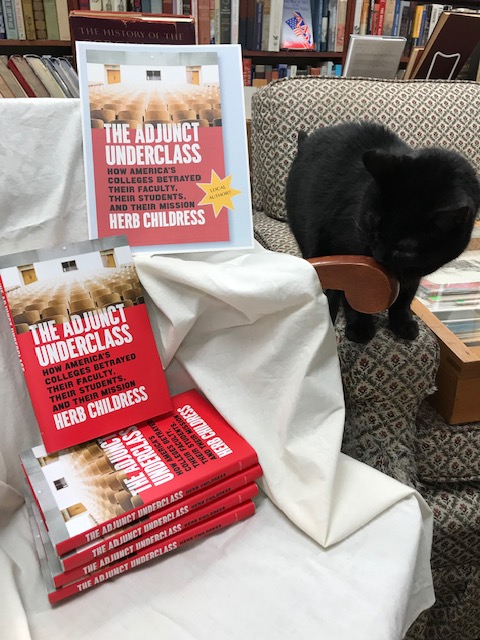
My good friend Patty McWilliams called me this afternoon with news that the first shipment of the new book had arrived at her shop, Hermit Hill Books of Poultney VT. Some time thereafter, she sent me the first glowing review:

Mitzi the shop cat looks adoringly at the new arrivals

Support your independent booksellers. Hermit Hill Books, 802-287-5757.

Terminal Emotions

We all have those pieces of writing that completely unlocked a new terrain for us. One of mine was Jean-Paul Sartre’s The Emotions: Outline of a Theory, from 1939. To unfairly collapse it all into a single line (and perhaps also unfairly to do it from the English translation rather than the French original), Sartre proposes that emotions are predictive, that they reflect our judgments of what we foresee. So anger, for instance, would be knowing what you want but identifying a person or circumstance that blocks you from getting it. Grief would be knowing that you’re fated to live without that person or place or pet in your life. Curiosity is separated from confusion only by whether you imagine that you will or will not be able to figure something out.

I’ve used this formulation to make sense of a lot of things over the twenty or so years since I first read it; it’s been a productive way of understanding the world. But I’m increasingly frustrated (itself an emotional descriptor of not knowing how to productively move forward) by a body of emotions that seem to me to not be future-referent at all, that seem inert, terminal. Emotions like outraged, or offended, seem to not offer a forward path at all. We drop one of those, and we’re just done.

Another core text for me is Z. D. Gurevitch’s “The Dialogic Connection and the Ethics of Dialogue,” an article published in The British Journal of Sociology in 1990. His notion of the ethical circumstance of dialogue includes three responsibilities: to speak, to listen, and to respond. That sounds trivial, but it isn’t, really. Dialogue is broken if someone refuses to speak. It’s broken if someone speaks and the other isn’t able to listen. And it’s broken if both people speak and listen, but there’s no real response, no sense in which thinking or behavior is affected by what’s been said and heard. And that, to me, is where being outraged or offended are themselves stances that violate the ethics of dialogue. They aren’t aimed at change or growth (being not future-oriented, they couldn’t be); they offer no possibility, only closure. They’re expressions of hopelessness, in a way, the belief that there is no meaningful future of rapprochement.

Decades ago, when I was in catechism class, I remember learning that “it is a sin to offend, but it is also a sin to take offense.” The notion was that if God could offer grace to all of us fallen, it was our duty to extend that grace to those we encountered. I’ve long since left that faith, but have increased my conviction in that attitude. Grace may be the opposite of outrage: the expression of constant hope for the powers of dialogic healing. Grace has a future. Outrage has no need for one.

The Right Conversation at the Right Time

Illustration by Cathryn Virginia, for The New Yorker

Sometimes you swim upstream for ages. Nothing feels like it has a landing point, nothing feels like it has traction or makes progress. And other times, you catch a current, ride a tailwind, your own work amplified by the pace of events and interest.

The new book is falling into that second category, which suggests to me that the broader conversations about adjunct labor in higher ed are primed to spring forth. After two weeks of churn about the excerpt in the Chronicle, there’s an extended review of the book on today’s electronic home page of the New Yorker! Hua Hsu (himself a faculty member at Vassar) has done a marvelous job comparing my work with that of John Sexton, retired president of NYU, to show that what you see depends on where you stand when you look. It’s a terrific piece of writing, which helps bring this sequestered academic conversation into broader communities.

Dogends and Cold Leftovers

Nora and I were talking this morning, and she said, “I wonder if all of these women-in-STEM and minorities-in-STEM initiatives are just a sign that STEM is finished…”

One of the arguments I make in the new book, drawing from research in economic sociology, is that once a career path is fully opened to women, it’s suddenly not compensated as well, not as prestigious, more highly regulated than it had been when it was mostly guys that did it.

For instance, Hadas Mandelโ€™s research describes what she calls the โ€œup the down staircaseโ€ phenomenon of โ€œdeclining discrimination against women as individual workers, and rising discrimination against occupations after the entry of women.โ€[i] Or Josipa Roskaโ€™s research that shows college grads entering male-dominated fields starting out at salaries far greater than those of college grads entering female-dominated fields.[ii] Or Anne Lincolnโ€™s research in the โ€œfeminizationโ€ of veterinary practice, and the ways in which male students begin to avoid academic disciplines that become the site of increasing womenโ€™s participation.[iii] Or Levanon, England and Allisonโ€™s research showing more evidentiary support for devaluation of โ€œfeminized professionsโ€ than for exclusion of women from โ€œmasculine professions.โ€[iv]

The Bureau of Labor Statistics says that it’s deeply uncertain whether the nation is facing a “STEM Crisis.” Certainly there isn’t one in academic science; the BLS study shows that the average doctoral faculty member in STEM produces about four new PhDs over the course of her or his career, far above the required replacement rate for academic jobs. In non-academic fields, employers in the study showed little difficulty in finding bachelor’s-degree holders for entry STEM work, but a shortfall in students with advanced degrees. But those industry demands are fluid, changing with the price of oil and Federal infrastructure and defense policy, fluctuating far more rapidly than a long educational process can predict.

(This is true, of course, for all career types. Students are asked to guess, at age 18, both what they want to do and what careers will be in demand, five or six years into the future. If they could accurately do that as a group, they’d be way, way ahead of almost every Wall Street investment house or venture capital firm, which are wrong most of the time.)

Anyway, when college was only for the sons of the well-to-do, there wasn’t much oversight, and wasn’t much handwringing about choosing the right major; now that women and students of color are there in high proportion, it’s become more vocational and subject to far more oversight. When college faculty were mostly men, there were plenty of tenured faculty jobs; now that women have succeeded enormously in faculty work, the job availability has collapsed and contingency has boomed (and the majority of adjunct teachers are women). When college was a mostly male endeavor, state governments funded more than half of the costs of public universities; now that college enrollment is nearing 60% women, state funding has collapsed almost everywhere.

So here’s an economic rule of thumb: once something that had been restricted to elite participants is now made available to a broad community, the original participants have mostly sucked the nutrients out of it, leaving a depleted landscape. Nora’s comment over breakfast makes me think that STEM is no differentโ€”we’re going out of our way to invite women and minorities in, just at the moment when the possibilities are drying up and we merely need cheap workers.


[i] Mandel, Hadas. โ€œUp the Down Staircase: Women’s Upward Mobility and the Wage Penalty for Occupational Feminization, 1970-2007.โ€ Social Forces 91, no. 4 (June 2013): 1183-1207. See also the Crates and Ribbons blog post, โ€œPatriarchyโ€™s Magic Trick: How Anything Perceived As Womenโ€™s Work Immediately Sheds Its Value.โ€

[ii] Roska, Josipa. โ€œDouble disadvantage or blessing in disguise? Understanding the relationship between college major and employment sector.โ€ Sociology of Education 78, no. 3 (July 2005): 207-232.  http://www.jstor.org/stable/4148915

[iii] Lincoln, Anne E. โ€œThe shifting supply of men and women to occupations: Feminization in veterinary education.โ€ Social Forces 88, no. 5 (July 2010): 1969-1998. http://www.jstor.org/stable/40927535 

[iv] Levanon, Asaf, Paula England, and Paul Allison. โ€œOccupational feminization and pay: Assessing causal dynamics using 1950-2000 U.S. Census data.โ€ Social Forces 88, no. 2 (December 2009): 865-891. http://www.jstor.org/stable/40645826