The Work of the Critic

A universal language, apparently
(image by Claudio Schwartz, via Unsplash)

It’s been thirty-five years since I took one of my most important college courses, an elective to round out my general-education requirements. It just looked like funโ€”I didn’t know it would set the course of the rest of my life.

It was an upper-division Journalism course called “The Critical Review,” taught by the irreplaceable David Littlejohn. The very first class session brought a good-natured challenge. Professor Littlejohn asked, “What are reviews for?” We immediately went to the consumer-advice response: you should (or should not) go to this restaurantโ€”see this movieโ€”buy this book. “So why would someone write a review of a concert?” he said. “Paul Simon played the Oakland Coliseum last week, one night. No one can decide to go see him now based on your recommendation. Nobody cares about your recommendation.” We stumbled around for a bit, developing no motivations that were convincing even to ourselves as we tried them out. Finally, he gave his own judgment. “People read reviews for the same reason they read anything else,” he said. “They want to engage with an interesting voice.”

That was the first time I’d really come to terms with the craft of a review (just as, two semesters earlier, Paul Groth had asked me to come to terms with the craft of an academic paper). What did it mean to be not merely competent but engaging? That question has motivated my teaching, my public speaking, and my writing regardless of genre. (Littlejohn himself, in accepting his Berkeley Distinguished Teaching Award in 1985, said that his role as a teacher was to generate a period of time more shapely and pleasing than that of everyday life.)


The magazines I subscribe to are review-heavy. The New Yorker is filled with reviews of movies I’ll never see, concerts I’ll never attend, galleries I’ll never visit. It’s a rare day when the New York Review of Books reviews a book I know much about. Political journalism is now mostly reviews, after-the-fact assessments of “what it all means,” and how our political climate is like the McCarthy Era/the American Revolution/the fall of the Roman Empire.

It seems like a review of any sort is akin to a map, in which a landscape is abstracted into its most salient features. And that decision of salience, the choice of which features matter, is the unspoken core of the critical enterprise. We’re going to focus our reader’s attention onto some element or pattern of the thing and eliminate others from our consideration. We’re going to decide which other things are like this one, and thus generate a specific conversation among objects or periods or genres.

A bad review is vagueโ€”two stars, thumbs-up. A bad review is leveled, every aspect being mentioned at equal weight in a misguided attempt at thoroughness. A bad review is objective, claiming allegiance to some imaginary but unarguable standard of quality. The opposite conditionsโ€”detailed, specific, and distinctiveโ€”provide criticism worth reading.


We think of criticism as being inherently negative. We criticize things we don’t like. But writing strong and positive criticism is really important, and really difficult.

The old saying is that “heaven is generic and hell is specific.” This is often true of our criticism as well. When we tell a friend about a restaurant we liked, we often stop more or less at “it was great.” (Sometimes we talk about which dish we ordered, and then say “it was great.”) But when we tell a friend about a restaurant that was disappointing, those disappointments are much more sharply rendered. We speak with authority about what was over- or under-cooked, a sauce that was too sweet, service that was slow or over-attentive, the noise, the decor, the prices… an endless array of specifics that nettled us.

I get this as a writer quite a lot. Readers say “I loved it, it was great!” and then talk about a typo on page 118 or one character who didn’t strike them as fully real. And that makes the praise less impactful. With my own writing students, instead of marking up a paper front to back, I’d highlight one thing that they were doing really well, and ask them to consider how to do that elsewhere; then I’d highlight one practice or habit needing attention. It felt both more respectful and more helpful.

We see this in our relationships, too. When things are going along fine, we don’t mention it. But any gravel in the path is immediately commented upon. We’re petty critics, missing the forest of the good in favor of whining about that one weed over there.

So here’s your writing challenge for the day. Write a review of something you really appreciate. Be detailedโ€”help us experience the phenomenon ourselves. Be specificโ€”tell us exactly what’s working, exactly how it’s satisfying. And be distinctiveโ€”tell us how it satisfies YOU, how you relate this to other experiences you’ve had and the values you carry. You’ll get to relive that experience in an even more focused way, and you’ll be the engaging voice that your readers will want to read more of.
Some Thoughts about Merit

An unknown masterpiece of post-war Existentialist literature.

I’ve been reading a lot lately, and much of it seems to cohere in what Jung (or Sting) would have called synchronicity. I’ve been working for a year on a novel called A Woman of a Thousand Names, about a writer in the 1940s and beyond who becomes a driver of the paperback revolution, writing dozens of novels under endless pseudonyms and publishing thousands more.

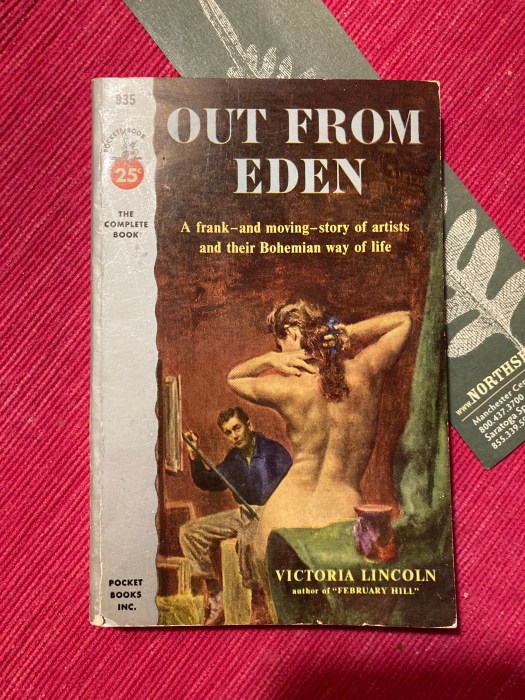
A couple of weeks ago, Nora and I were in Otter Creek Used Books in Middlebury, and I came across the book pictured above: Out from Eden, by Victoria Lincoln. It was a perfect model of what I’ve been writing about: published by Pocket in 1948, originally priced at 25ยข, a salacious cover illustrated by a talented artistโ€”in this case, Tom Dunn, who’d drawn for the Marine Corps during the war and went on to a career in commercial illustration. The standardized 4.25″ x 6.25″ format, designed for wire display racks. The nearly 100,000 words compressed by single spacing and 9-point type into a tight package of coarse beige paper with a dyed red edge. The book was so exactly what I was writing about that I paid five bucks for it and took it home.

Friends, it’s really good. It’s an excellent example of post-war existentialism, the loss of certainty that rocked the world from governments to individuals. In this case, it’s a family headed by a struggling artist who veers between full belief in his work and full despair over its meaninglessness. His wife is a lush innocent, his muse and model, who’s fully immersed in each moment and has no concerns over any future. Their son is bookish and mathematical, filled with ideas; their daughter is a savant, uneducated but visually brilliant. The two women actually hold the center of the book, as the churn of men and their noisy plans swirl around them.

Along with the subject matter, it’s Modernist in several other ways. The artist’s agent is coming to terms with his Jewishness, something he’d never fully had to consider before. His two sons have chosen entirely different paths after the war: one moving to California and a life of full American assimilation, the other moving to Israel and a pioneering life of Jewish statehood. And the novelistic methods are of a piece with the content. The point-of-view shifts frequently and with full controlโ€”all of the major characters are given internality in their respective chapters, and their voices are different from one another. Everyone is interpreting what everyone else thinks, a house of mirrors in which truth is unavailable.

It’s just a terrific book, never studied in literature programs, never mentioned in the historical overviews of mid-century lit. It was consumed, read, discarded.


The New York Times ran an article last week about lesbian pulp fiction of the 1950s and 60s. “The novels had to be presented carefully; even in the largest American cities, gay bookstores didn’t yet exist, so the covers, the titles and the stories all had to meet standards that would allow them to be credibly intermingled with run-of-the-mill paperbacks in a mainstream bookshop, or in a stationary store or pharmacy stocked by someone who was either sympathetic, opportunistic or both.” The offhand commonplace of paperbacks was a discretion that allowed them to touch topics that major publishers wouldn’t have dared.

It was also a tool that allowed the pulp houses to claim genres that major publishers and their literary patrons disdained. Romance, of course, the most beloved and most demeaned of all literary forms. Science fiction, westerns, crime and mystery, erotica in the 1960s and 70s… all of those forms had origins in “literature” (Austen, Cooper, Poe, Lawrence, Wells) but had become “popular” and thus not serious. Easy pickings for an industry who knew that the audience existed, even if the awards didn’t.


Speaking of awards, The New Yorker reprinted an article this week originally from 2005, by Louis Menand, called How Much Does Winning a Nobel Prize Matter? Menand writes of the ways that literary awards have always been a commodity, even as they desperately intend to stand above it.

In an information, or โ€œsymbolic,โ€ economy, …the goods themselves are physically worthless: they are mere print on a page or code on a disk. What makes them valuable is the recognition that they are valuable. This recognition is not automatic and intuitive; it has to be constructed. A work of art has to circulate through a sub-economy of exchange operated by a large and growing class of middlemen: publishers, curators, producers, publicists, philanthropists, foundation officers, critics, professors, and so on. The prize system, with its own cadre of career administrators and judges, is one of the ways in which value gets โ€œadded onโ€ to a work. <emphasis mine>

Look in any bookstore and you’ll find endless opportunities for publishers to slap a gold sticker on the front of a book proclaiming it a Booker or Pulitzer or Caldecott or Hugo or Lambda or Nebula or Newbery or Pushcart winner. In the endless, anonymous sea of fiction, these come pre-recommended, bolstering our insufficient judgment. Prizes like these (along with major-media reviews) are the water wings of the literary marketplace, helping some to stay afloat while the others sink.

All fields are susceptible to this. Architecture notably gives its awards to the unlivable and inhospitable, daily life and generosity not being topics of interest to the field’s gatekeepers.

Here’s a list. Sarah Bernstein, Jonathan Escoffery, Paul Harding, Paul Lynch, Chetna Maroo, Paul Murray. If you have ANY IDEA of any of these names, much less all of them and how they fit together, then you also need to recognize how far outside our cultural norms you stand. Simply naming your tastes “superior” doesn’t make them so. What makes some objects valuable is the recognition that they are valuable.


I’ve also started reading a book called The Late Age of Print, by Ted Striphas. (It was published in 2009, so I guess we’re in the Post-Late Age of Print now). It’s an interesting premise, unduly weighted down by its need to generate tenure for its author. His work was to examine what books are as objects as well as ideas. And that inevitably brought him into questions of commodity.

All books are commodities, in many ways similar to other commodities like a bushel of wheat or a dozen eggs. At any given moment, our local bookseller has something like 80,000 books on their shelves; a bewildering array that none of us can comprehend. The first order of business, then, is genre: the subdivision of those 80,000 into somewhat more comprehensible thematic and geographic groups. Fiction hereโ€”nonfiction thereโ€”kids upstairs. Then those first-order categories are subdivided, and subdivided further, until we end up at things like “thrillers” and “horror” and “mystery” and “romance.” The largest and least coherent is literary fiction, an anonymous rainbow of possibilities no different than the wire rack at the corner grocery, the magazine shelf in the airport. Our decisions are made by market forces:

  • Brand loyalty (choosing an author, or sometimes rarely a publisher, we’ve enjoyed before)
  • Recommendation of friends or experts (the publicist for my book said that if you get a review in the Times, you get congratulations from your friends; if you get a review in the Wall Street Journal, you sell books)
  • Packaging and shelf placement. There’s a reason why your bookstore has a “new and notable” table, or a Times Bestsellers shelf. There’s a reason why 98% of books are shelved spine-forward, and 2% are “faced” or shelved with the front cover forward. (Hint: publishers do pay for that.) And the book’s cover and spine do the same work as the box around the Triscuitsโ€”urging us to think “mmm, that looks good.”

Striphas’ own book was a commodity, with a different customer marketโ€”other academics who would decide whether or not to invite him into the club. That’s why he published with Columbia University Press rather than trying to fight his way into Random House.

One of the fun tidbits that Striphas delivers is the fact that the book industry was crushed in the Depression, and worked valiantly to save itself. One of their most successful efforts was to hire the PR pioneer Edward Bernays, who hit the problem sideways and worked with the housing industry (architects, contractors, and decorators) to feature bookshelves as a display of homeowners’ status and taste. “Where there are bookshelves, there will be books,” he said.

Bernays was a strong believer in not merely the power but also the moral importance of propaganda. “Intelligent men must realize that propaganda is the modern instrument by which they can fight for productive ends and help to bring order out of chaos.” That’s the role played by literature and MFA programs in universities, by award juries and the “little magazines;” to convince us unwashed of the intellectual and moral superiority of some books over others.


I used to tell my students that no human being in history has ever wanted a building. They want status, pride, comfort, family harmony, business or organizational successโ€”and they bought or modified a building as a means of accomplishing that.

Likewise, no human being has ever wanted a book. We want more fundamental things, like pleasure or possibility or status or entry to cultural conversation. We buy books in order to accomplish those things.

Likewise, we don’t create books to have books. We create them for pleasure, or possibility, or status, or generosity, or as proof that our lives really have mattered. It’s only by acknowledging that we’re human that we have any hope of transcending commodity. That’s one of the great (and unexpected) blessings of not being part of the publishing industry; I don’t have to respond to market pressures. I can write because the stories intrigue me; because the craft demands my attention; and because I’m pleased to use them as instruments of generosity for my friends.

Greatest Hits

I mean, they’re great and all, but… again?

Nora and I went to a show tonight. I won’t tell you who. This performer has endless talent, and a fifty-year career fully deserved. But… it felt like what you’d hear at a really sophisticated nursing home. Smooth liked mashed potatoes and gravy, comfort food.

All the greatest hits came out. And was good, this performer absolutely hasn’t lost any chops at all, gave us two full hours. But the crowd was restless, lots of meandering back and forth to the restrooms.

This puts me in mind of my own writing. It’s good, and I can totally give you a great reading experience. Butโ€”is it the SAME experience? Is it the nursing home, simultaneously excellent and familiar?

I’m putting together a collection of short stories from the last year or two, all having to do with people who are socially isolated for some reason or another. How alike are they? They range across fifty years, rural and metropolitan, poverty and wealth. But they have that common themeโ€”how do people find themselves with no peers, no friends, no family? As I’m pulling them together, they feel… I don’t know, they feel glossy. Perfectly polished, perfectly accomplished. I know how that machine works, and I’ve got it tuned.

One of my favorite bands of the 90’s, the Crash Test Dummies, had three really great albums back to back at the start of their career. Their fourth album, Give Yourself a Hand, came with a sticker on the CD case warning that this one wasn’t much like the ones before. I didn’t much care for the new one, but they needed to make the change, and I respect that.

I’m left wondering what will come next. And I kind of like that feeling, even as it makes me unsettled. Will my fans follow me, or will I betray their expectations? (How many folk music fans does it take to change a light bulb? Five. One to turn the bulb, and four to complain that it’s electric.) I guess the next one might need a sticker.

Compression

A lot of work for a moment
(Image by Towfiqu Barbhuiya, via Unsplash)

Our local theater company does an annual Ten Minute Play festival as a fundraiser for their educational programs. Mine was one of the four performed last night, and will be again tonight (come on by if you’re in the neighborhood).

It was a wonderful presentation. The director and actors found material there that they could inhabit, and the play became far more than my script. But because my brain just works this way, I was thinking earlier in the day about how much went into that ten public minutes.

There were eight plays presented over the two weekends. It took me about four hours to write mine, so we’ll say that’s thirty hours of donated time.

Each play was rehearsed three times, at two hours each. That’s six hours per play, times an average of three performers plus director plus playwright, so 6*5 is 30 hours; at 8 plays that’s 240 donated hours.

Dinner was included in the ticket price, so that’s ten people at two hours apiece making crockpots of soups or trays of desserts, times four nights: another 80 hours. Plus a crew of ten feeding people and washing up and taking admission, times four nights: another 120 hours.

The company’s leader herself probably put in at least another hundred on her own, laying out the website and managing ticket sales and scheduling the venue and the lights & sound.

So all of thatโ€”and there’s undoubtedly moreโ€”adds up to 500 to 600 hours. That’s how the world of volunteer communities works. Six hundred donated hours, compressed to what the public sees in the two hours of soup and salad and theater.

None of us know what it takes to create the things we consume so easily. Our life of gratitude would be full if we thought about all of the unseen behind the illusions of ease and convenience.

Schism

Image by Alexander Grey, via Unsplash

I grew up attending Bethlehem Lutheran Church, in western Michigan. Although I didn’t know it at the time, it was affiliated with the American Lutheran Church (ALC). All I knew was that it felt like home, and that its messages were about forgiveness, duty to others, humility, and mutual support.

I only came to recognize the uniqueness of my home culture when I entered another. For 7th and 8th grades, my folks sent me across town to Our Redeemer Lutheran School, which was affiliated with the Lutheran Church โ€“ Missouri Synod. The core messages there were pretty different, all focused on our need to accept Christ as our personal savior or face the eternal lake of fire. Forgiveness was focused on ourselves rather than others; our duty was to share the Good Word; our humility was rooted in Original Sin; and our mutual support was near to nonexistent.

Both of these communities relied not merely upon the same Bible, but upon the same man’s 16th Century commentary on the Bible. And they ended up in wildly different places: one gentle and hopeful, one self-centered and angry.

(When I then went to Catholic high school, with its extra books in the Bible and its extra sacraments and the elevation of Mary and the other saints… well, my conversion to anthropology was inevitable.)

I’m put in mind of all of that today as I sit quietly with my grief. We have started out with the same guiding documents, the same body of laws, and we have come to different places.

I will try to choose forgiveness, duty, humility, and mutual support. And because I’m fallible, I will fail, repeatedly. But for today, those principles sustain me. There’s work to be done, and only us fallible to do it.

Instrumentation

Let the data guide you.
(Image from Waves Audio)

I always imagine there’s a meter in your head, and this is positive and this is negative. And you’re just very lightly going through it and what you’re doing is reading that prose and watching that needle. And you’re not attributing cause, you’re not defending, you’re just watching. If the needle stays up in the positive, you’re good. And when you train yourself in this approach, you’ll see once in a while it’ll just drop. At that point, don’t say “Oh, no! I’ve failed. I have to go back to law school.” You just say very gently to the story, “What’s going on? I noticed that your needle dropped there, what do you think?” And if you approach it this way, eventually the story will say, “I don’t know, I’m just boring right here.” Once you get your defensiveness down, the story will very frankly tell you what’s wrong with it. And the fix is often quite simple. So my process is to read along in the story, hopefully keeping the needle up high. When it drops, don’t panic. You just keep going through the thing again and again, and eventually (you might be deluding yourself) you get to a point where it feels like the needle is up in the positive for the whole story. And then you’re done. โ€” George Saunders

The story I started in August 2023 has a lot of good stuff in it. To paraphrase Saunders, quite a lot of it’s in the positive zone. But there are places where the story is clear in its negative self-assessment, by which I mean I’m bored when I re-read it. The problem is that I haven’t done the work to figure out exactly where that is, and exactly what’s boring about it (and what I mean by boring in the first place). To use Saunders’ analogy, I haven’t had a meter; I’ve just had an idiot light, a big red bulb that just says “This whole story sucks. Stop now!”

So for the past couple of days, I’ve much more patient and detailed diagnostic work. I’ve gone back into the manuscript and laid out each scene within each chapter, as preparation for putting the meter onto each one individually. Using the opening chapter as an example, it looks like this:

At this point, I’ve done this for the first seven chapters, about forty scenes total. Just through the work of naming the subsections, I’ve discovered (for instance) that Chapter 6 Scene 10 isn’t accomplishing anything worthwhile for the story as a whole, and I’ll probably dump the whole 1,188 words in favor of a sentence or two somewhere else.

All of this work does a few things. First, it forces me to slow down and take what I’ve done in small segments, thinking closely about each one. Second, it allows me to celebrate the ones that really are working; more than I thought, perhaps. Third, it makes me more careful in defining “works” and “doesn’t work.” What exactly do I mean by those judgments? Is the language fun? Is the dialogue real? Is the scene advancing the plot, or developing one or more themes? Is it introducing uncertainties that will have to come to fruition later on? I spent much of the day today on Chapter 3 Scene 6, helping it do three pieces of work simultaneously instead of just one.

If it’s done right, the reader won’t notice any of that; she’ll just be carried forward. But the writer is working from a sounder foundation.

It’s Been a Hell of a Year

This is what the inside of my head has been doing.
(Image by Topsphere Media, via Unsplash)

It’s time.

2024 has been a productive and busy year, but it’s also been a creative lost cause. What exactly have I been doing?

The Town. Being chair of the Selectboard means that everything comes my way. When the Health Officer resigned, the board chair got that job by default. Three days later, a homeless drug user burned down the abandoned house she was living in after she was released from jail, and then the next day got bitten by all three of her dogs. We’ve had wildly contentious meetings about muddy roads and preserving trees and the quality of gravel from the local pit. When our transfer station attendant got a new job last December, one of the other board members and I have split the duties of running the place ourselves until we finally hired someone early last month. This is the year of renewal for our Hazard Mitigation Plan, and we’ve received a major grant for the renovation of a discarded Catholic church to become our new library (though we’re having trouble buying the building, with a new bishop coming in and the Diocese declaring bankruptcy… we should finally close a week from today).

The Election. Not merely the national scene, about which I’m optimistically terrified. Our local candidate for Vermont House needed Nora and I to step up and take over lots of campaign tasks. (There’s a whole story thereโ€”as Jack Webb used to say, names have been changed to protect the innocent.) Plus I’m a poll worker and an elections officer. The VT Secretary of State has issued guidance on what to do in the face of an active threat, and I’m seeing ads for junior-spaceman scam devices that supposedly detect wireless signals from voting machines to some secret web server where the Chinese-Venezuelan Jews can steal the election… there’s just a lot of lunacy out there. I’d say I’m looking forward to next Wednesday when it’s over, but in the Orange Era, elections are never over; they just turn into baseless, endless lawsuits. Or armed gangs.

Coaching. I led a writers’ group from September to May, which came to a trickling close when the specified end date arrived. I never knew how to be helpful. Maybe I was.

Work. I’ve taken on an external-evaluation job for a Federal grantee, which includes everything from questionnaire development and data analysis to buying 200 coffee gift cards for individual participants, all at a distance of 2,550 miles.

Home Life. It seems like we’ve had people over for dinner or potlucks, or staying with us for a few days, on every square of the calendar. It’s been a super-social year. And that’s before we get to the big project, which was the construction of our studio. It’s a treat (one of our neighbors called it “a public good”), but it occupied most of a year, from September to September.

Project by Glenn Tarbell, Tarbell Carpentry, Middletown Springs VT

With all of that going on, I haven’t made any space to just write. I’ve sat at the keyboard plenty, to no avail. I keep knowing that something’s going to come up, looking over my shoulder at all of my real and imaginary tasks, and so I don’t have the confidence to just go away for hours at a time and live in another world.

Writing isn’t about typing. It’s not about proofreading, or editing. Those things are all true, but they aren’t what writing is. Writing is fully inhabiting another life, as emotionally filled as my own. And that takes not merely time, but also permission. Permission I haven’t granted myself for a year.

I started this blog back in 2019, when The Adjunct Underclass was coming out. Since then, I’ve written three novels I’m really proud of; the blog was part of the discipline that let them emerge. But since last fall, I’ve had two really good ideas for a novel. And as the writer and teacher Robert Owen Butler says, if you have a good idea for a novel, you’re going to write a bad book. Stories don’t come from good ideas. They come from the spirit world, from what he calls “the place where you dream.” So I’ve driven those two books sixty or eighty pages into the swamp, with no hope of retrieval. That becomes its own cycle, work that doesn’t work that convinces me that I can’t do the work. Easier and safer to just lose myself to internet head.

So it’s time to be back, to clear the culvert and let the flow come free. Glad to see you.

Reserve Judgment

What did you say to me?
(Image by Mile Modic, via Unsplash)

You never get far away from town business when you’re in local government. I was getting ready to help out a little on our home construction site, and the lift operator came over to me. “I’d like to talk to you some time about this gravel situation.” And then I scarcely was able to track the next ten minutes, in which he told me about his pit that we didn’t buy from this year, and all the other pits around and which do and don’t provide good material, and about how he’s ready to help the Town any time but he won’t help the road foreman (even though the foreman is his cousin)… it was a real-time tour of the inside of someone’s mind.

I told Nora later that working in a small town is always like coming in to the middle of a movieโ€”people you don’t know, doing things you don’t understand, for reasons you’ll never hear. These are people who have come to their judgments of one another over decades, and who they are today is deeply inflected by who they’ve been before, who they’ve been around, who was kind to them or cruel to them or unfair to them, who slept with whom before who. It’s like the Garden of Eden: it’s a beautiful physical landscape, and if you go back one generation, everyone had the same parents.

But really, we encounter everyone we ever meet in the middle of the movie. That person who was thoughtless to us… they were raised in ways we’ll never know, have neurological structures we’ll never see, have goals that they probably can’t fully articulate even to themselves. I spent decades trying to look like I had my shit together, and I fooled a lot of people into thinking that I was a capable and balanced person. (Boy, were THEY wrong!)

When I first started studying teenagers, I met a big group of kids who met pretty much every night at a gravel parking lot in the middle of town. There were 25 other parking lots around town, but they (and their aunts and uncles and parents) always landed on this one. Now, we might think it’s strange, but if this is chosen and the others aren’t, there must be a reason for it. They’re trying to accomplish something, and using this tool to do it. It turned out that with a little patience and a lot of questions, I uncovered eight or ten things this parking lot did that made it perfect for teenage and young adult social life.

The great anthropologist Clifford Geertz once wrote that every good anthropologist he’d ever met had felt like an outsider as a kid. They learned not to take anything for granted, they studied the world around them rather than just accepting it as invisible and “normal.”โ€‚Judgment comes from believing that you know the rules; understanding comes from trying to learn someone else’s rules.

So remember today that when someone pisses you off, or confuses you, or does something heartless… you’re walking into the middle of the movie, and you just don’t know enough to pass judgment.

Christmas Guide 2023

What a lovely, festive wreath idea!!!

Here we are a week into December. Have you finished your Christmas shopping yet? Of course you haven’t. But I have just the thing. Go to my website (herbchildress.com), and have a look at the Books for Free tab. You’ll see more detailed descriptions of all eight of these books, plus some short story collections. Pick one, go to the Keep in Touch tab, and send me a message with your mailing address and the book you’d like. And guess what? You’ll get it.

For free. Really.

Now, that said, if you feel like covering some of the overhead, that’d be lovely. Each one of these books costs me about $8, plus another $5 to mail and $1 for the envelope. If you really do want one for free, I really will send you one for free. I’ve done it about a hundred fifty times so far. But if you want to get some as gifts, or to subsidize the free books received by others, you can Venmo me. @Herbert-Childress-1, whatever amount seems reasonable.

The community of independent literature thanks you.

Costs Money to Make Money

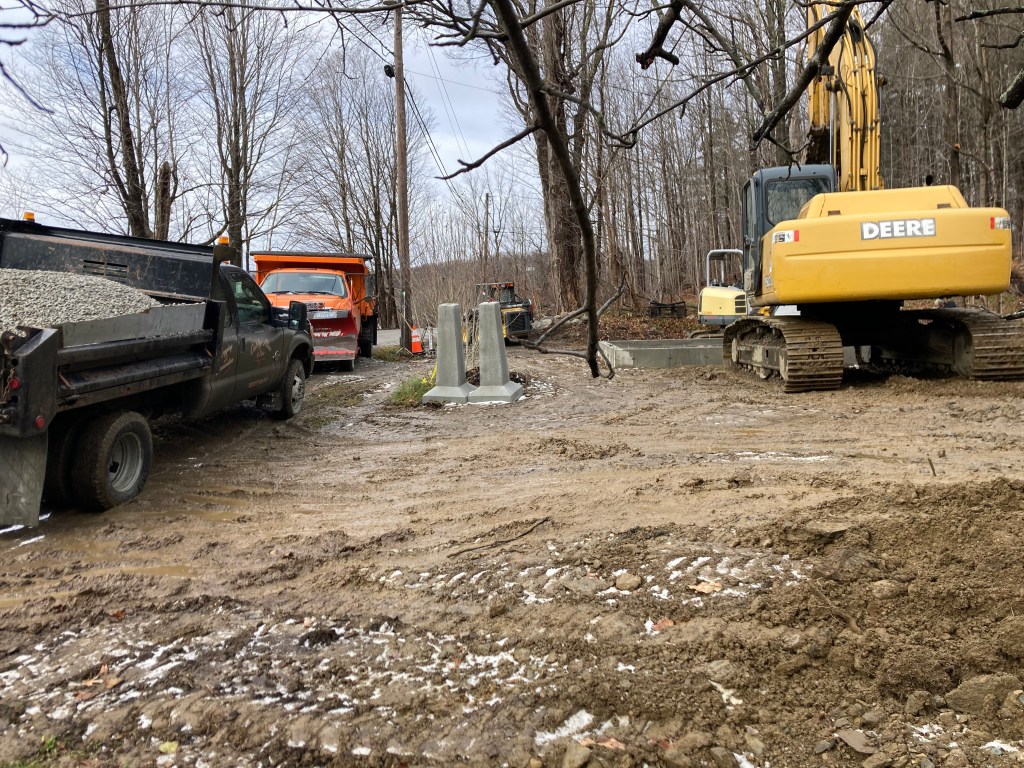
We’re having a smallish (26×30) new building put up on our site. At the moment, the foundation footing and frost walls have been poured, and the excavator is here to backfill and level around it before the slab insulation is laid and the finish concrete work is done.

Oakley Allen has been in the excavation and logging business for seven years, after having spent about thirty before that working for his uncle’s well-drilling business (he started there when he was twelve). The crew consists of Oakley and his son Levi… and a remarkable array of equipment. Have a look at this photo, taken at 11am today.

From left to right, we have:

  • a Ford F350 one-ton pickup with a dump bed
  • A Chevrolet Silverado 3500HD one-ton pickup with a dump bed, plow and plow hydraulics
  • (obscured by the two posts) a New Holland Super Boom Loader
  • (obscured by the big excavator) a Wacker Neuson EZ28 excavator
  • a Deere 160C LC excavator

Their big tandem-axle dump truck wasn’t in use today. Plus he’s got hand tools ranging from saws and shovels to pneumatic tampers.

This two-person business has equipment that, if all bought new today, would cost well over a million dollars. The concrete contractor, Tony Genier, has at least that much equipment of his own, plus the occasional arrival of a vast concrete mixer from JP Carrara. Then the electrician Eric Haynes, the teams from Green Mountain Power and Vermont Television, Dillon Hepburn who dropped the trees that were trucked by Jordan Martelle to the Woodell and Daughter sawmill to be turned into frame members by our general contractor Glenn Tarbell. This simple one-room building will have had twenty people on the site at one point or another, supported by at least five million dollars worth of equipment.

And that, friends, leads us to today’s vocabulary word: amortization. (A word that hardly any of these folks would use.) Once you buy an asset for business production, you need to pay it back a few dollars at a time through charging more for its use than you paid for it. (The self-employed contractor or small farmer is, without having ever read Marx, teetering right on the border between the MCM and the CMC economies.) I wrote a novel not long ago (called & Sons, after the common business names of so many small contractors) centered on a Nebraska corn farm that made over half a million dollars in commodity sales in one season, but only netted its owners the equivalent of about eight dollars per hour. Lots of money comes in, and almost all of it goes out without having stayed in the contractor’s pocket for even a minute.

During the California Gold Rush, most of the fortunes weren’t made by miners, but instead by merchants and suppliers who sold stuff to those miners. So too John Deere and New Holland and Chevrolet have made their money up front, and Oakley and his son scramble from one day to the next to try and earn it back. It ain’t makin’ any money just sittin’ there, one might say in the vernacular. You learn to run it all, you learn to repair it all, and only then do you get to practice your specialization.

There’s no moral to the story today, just a new appreciation for people who learn a trade and then have to learn to run a business alongside it.