Close to Home (Fiction Ethics #2)

For the writer, a paradoxically safer place
(image by Michal Nation, via Unsplash)

This is the second of several short pieces on the ethical responsibilities of the fiction writer.

The writer Peter Ho Davies has published three novels, each set in radically different time and place. The first book, The Welsh Girl, is set in 1940s Wales, portraying the lives of people distant from and yet fully caught up in the war. Peter is from Wales, but wasn’t born until the 1960s, and never served in a POW camp or a tavern. The second book, The Fortunes, is four different stories of what it means to be Chinese American, as seen through four different characters: a housekeeper/railroad worker of the 1860s, an actress of the 1920s, a Detroiter of the 1980s, and a couple traveling to China to adopt a baby in the 2010s. Peter is partially of Chinese ethnicity, moved to the US thirty years ago, and so has some grounding to explore Chinese American identity, but he never laid track nor acted in a movie nor saw his friend beaten to death in a parking lot nor adopted a child.

His third book, though, is different from those two. A Lie Someone Told You About Yourself, a domestic drama of a couple making decisions about parenthood, stands upon that contemporary ground of autofiction, a story in which the storyteller and author are difficult or impossible to distinguish. Is it a novel? Is it a memoir? Is there a meaningful difference between those two?


Our dinky little town is oversupplied with marvelous writers. We have a friend who’s spent a decade investigating the lives of Alfred Nobel and Bertha von Suttner for an epic novel about our continual responsibility in moving closer to war or to peace. We have a friend whose career has included several books about lives of women in the American frontier West. And of course, Nora continues her investigations about one particular 19th-century family of Quaker settlers in western Vermont, and about the ways that faith and community and distant powers all shaped their lives and their work.

Nobody ever asks them whether some character in their book is “really” their partner, or their neighbor. They have the freedom to write without the presumption that they’re engaged in shadow memoir.

My work is a little different than that.

A couple of days ago at dinner, a friend said, “You don’t have to tell me, but did that town in Michigan really get taken over by the mine?” Well, no, The City Killers is a novel. And I’m glad that it feels real enough that people are worried about the fate of Warrington Heights, but Warrington Heights does not exist. Places quite a lot like it do, of course, small industrial cities gutted by capital flight and divided by racial history. And the State of Michigan does have a questionably-legal emergency management plan in which the State is empowered take over the operation of local governments (Flint, for example). But The City Killers is a wholly fictional story, informed by my experiences of similar places.

Even closer, Nora tells me that a friend who’d read Trailing Spouse identified it as a story in its spirit about Nora and I. Well, no. It’s a story about a young man with a failed career who followed his wife’s college job to Vermont. The fact that it’s set in Vermont makes it local, and the fact that Nora and I used to be in academia makes it ground I know how to walk, but it isn’t our story. (We’ll talk in more detail about that specific issue tomorrow.)

My books are thematically tied. They’re about men. Specifically, they’re about young men who find themselves stuck, not where they’d intended to go but not having a strategy for moving forward. And some event provides them with an opening, but an opening that requires them to exercise their skills and good faith in new ways. A challenge that reveals unseen facets of their selves. They’re books about braveryโ€”not battlefield bravery, but the emotional bravery that allows us to walk into a new relationship or an old family and make them stronger.

My books are spatially tied. They aren’t all set in the same place like the works of Donna Leon or Kent Haruf, but they’re all set in places I know well. The industrial Midwest. The High Plains. The Bay Area, and the Redwood Coast of Northern California. Rural Vermont. Places that I know well enough to do thick description, not merely of the physical landscapes but of the social and historical forces that shape them.

My books are vocationally tied. They’re about characters who do work with which I’m familiar. College teaching, academic research, half-assed government consulting, hospitality. Readers have told me how unusual it is for books to really get into the unseen details of workplaces, which is something that’s always fascinated me. So I bring that to the work as well.

So in their collective effort, I suppose that my fiction is autofiction. It’s close to home, even when it’s set three thousand miles or sixty years away.


One of the things we don’t tell aspiring writers is that our first work will always, only, be read by people who know us. Not merely our ever-patient partners, but by friends and neighbors. And that raises two related problems. One is that those readers are tempted to pick at the bandage, to look at some character and say, “Oh, I know who that really is!” And the other is that they start looking over their shoulder, saying “Wow, so that’s what he thinks of us…”

If I wrote about werewolves, or King Tut, we’d all be safer. If I set my stories in Argentina or Angola, we’d all be safer. But I don’t do those things. I write about everyday people who are called upon to be brave in familiar contexts. And that in itself is brave, I think. But I’ve prepared myself to do that, through months and months of creation, each book borne upon the years of emotional and craft training that have come before. Readers catch these books cold, and the draft of self-recognition can feel personal.

We think of our obligations to readers as being formal. We entertain them, we challenge them, we illuminate the world in new ways for them. But we don’t know them. We aren’t engaged in relationships with them beyond the bounds of those pages. The early writer, though, is only writing for readers with whom there’s already a relationship in place, and that’s ground that we rarely discuss. Do we hold back, out of an attempt at kindness? Do we write only about times and places that can’t possibly be interpreted as mirror?

Do we only write about medieval vampires?

More tomorrow.

Our Dot in the Painting (Fiction Ethics #1)

How many snowflakes does it take to make a landscape?
(image by Cody Fitzgerald via Unsplash)

This is the first of several short pieces on the ethical responsibilities of the fiction writer.

I went with Nora and a friend yesterday to a regional arts show, a chance for craftspeople to present their work for Christmas purchase. A rough order-of-magnitude estimation showed about ten thousand items for sale. Ceramic mugs and baby onesies. Earrings and macrame flower pot slings. Paintings and drawings and printed note cards. Sewn dolls, knit hats, woven baskets. I looked past one of the masked artists, eager and resigned simultaneously as sheย sat in her metal folding chair, looked out the window at the light scatter of snow. As many unique snowflakes inside as out, each the product of its ecosystem, each more significant through collective than individual contribution. The work mostly unconsidered, effort mostly unrewarded.ย We browse, we pass by.

I thought to myself, uncharitably, that most of the work was somewhere between undistinguished and meager. But it was there. It provided the basis for several hundred people to have a pleasurable time browsing, and made fifty artists probably a few hundred dollars per, on average. That’s a good contribution to the world’s supply of generosity, made slowly, one drawing and one scarf at a time. The individual scarf mattered less than the event, which brought us all together to leave the news and the fear and the anger behind for an hour in a pretty space on a pretty landscape.

Everyone who makes any kind of art has this question at some point or another: isn’t there enough already? Does the world need my novel, when millions of novels have already been written? (We need to come up with a different word, by the way, now that the novel has shed all of its novelty.) Do we need more earrings, more mugs, more potholders?

And a second, related question: is my contribution any good? Pre-COVID, Nora and I went every December to the Arts Boston annual Christmas craft exhibition, a closely juried, highly competitive event held in a ballroom of the Hynes Convention Center. By “highly competitive,” I mean that maybe one or two of the fifty folks we saw locally yesterday might have passed the juried threshold for Craft Boston participation. Would my own writing pass a similar threshold? Am I making stories of quality, or stories dull and ill-constructed? And would all juries agree on my work’s position within an ever-shifting context?

Let’s turn this around, all this self-focused, self-critical inner conversation that stops us. Let’s imagine another way to describe all of this, which is that all of usโ€”all us writers, jewelers, weavers, potters, painters, papermakers, actors, furniture makersโ€”are building a landscape of generosity through our continued investment in generous work. We spend our hours working to see, to make, and then to offer. And we know the alternative: people who spend their hours working to hide, or to tear down, or to diminish. As Nora has said to me about miserable, nasty people, “Just be glad you don’t have to live inside that head.” And I don’t. I can live inside the head of someone trying to be hopeful and compassionate. It doesn’t matter if I “fail,” if I fall short from time to time. Trying to be hopeful and generous and compassionate is way better than trying to be powerful or dominant or defensive. And if I can spend my time with others engaged in the same effort, with all those potters and weavers and singers placing their offerings on the altar, then my days are better days than they’d be otherwise.

So I’d ask you to stop thinking for a few minutes about whether the work you do is any good, or about whether the world “needs” your product. What the world needs is for you to be the kind of person who does thoughtful and generous work. To be a dot in our pointillist painting of a kind landscape. Thanks for doing that.

More tomorrow.

The Spruce Knob Press Holiday Gift Guide 2021

Just imagine all the pleasure you can bring!

As of yesterday afternoon, the new novel & Sons is off to the printer, available soon. It’s really quite a moment to approve the artwork and page layout and paper weights and finishes, to make that simple and incontrovertible decision to say “go.” And now it’s out of my hands, and all there is left to do is wait for UPS.

(Well, that’s not the ONLY thing to do…)

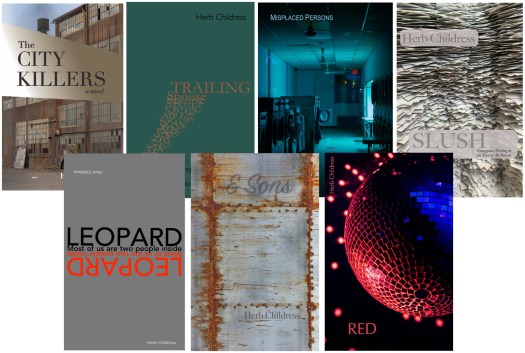
The holidays are here, and your gift-giving dilemmas are hereby solvedโ€”give your friends the pleasure of quality literature from Spruce Knob Press! Who doesn’t like a good story, right? We’ve got quirky short storiesโ€”Red and Misplaced Persons. We’ve got an outstanding YA novelโ€”Leopard. We’ve got heartfelt family dramasโ€”& Sons and Trailing Spouse. We’ve got an urban corruption storyโ€”The City Killers. And for the writers in your life, we’ve got Slush, a realistic look at the emotional churn of the aspiring author.

Give your friends the gift of these limited edition, autographed books. All you have to do is contact me with your name (or the name of the recipient), the book or books you want, and your US mailing address. You can reach me via e-mail if you know it; through LinkedIn messaging if that’s where you’re reading this; or through the “Keep In Touch” link at my website, herbchildress.com.

And to be honest, it’ll be your gift to me as well. What does every writer want for Christmas? (and Hanukkah and Arbor Day and the Lunar New Year, too?) Readers, that’s what we want. So let’s do some mutual giftingโ€”books for you, readers for me. Better than Secret Santa, right? Put on your worst Christmas sweater, get yourself a drink, and read a good book!

Platespinner

Oops… (image by Chuttersnap, via Unsplash)

I’ve got a lot of stuff going on right now. Two clients, two Town projects (maybe three…), lots of friends who deserve attention, prepping the house for winter… it just feels like there’s a lot of things moving right now, and every time I spin one of them, the others are all slowing down and wobbling.

And today, I dropped one. I hate when that happens.

It was a grant proposal. I’d been after a few people to get me information, and they hadn’t, and I had my attention on other projects with tighter deadlines and so didn’t follow up every single day to find out what was holding them up. And now the grant deadline is unattainable.

One of the most important, and most difficult, skills of management is to build teams and responsibilities among people whom you do not actually supervise. It’s actually kind of easy to be a boss, but it’s a lot harder when you’re working with people who are themselves already really busy with their own jobs in their own organizations. And it doesn’t always work.

A lot of things in life don’t always work. And we have to get used to that. Steph Curry’s on track for yet another MVP season and scoring championship, he’s reinvented the game with his three-point shooting… and he makes about 45% of them. If he misses two or three in a row, he can’t get into his own headโ€”he just has to run the next play, get himself open, and launch another one.

One of my favorite writers put out a new book last year. It’s not bad, but it’s definitely the third best of the three. If it had been the first one, there might not have been a second. Every musician who releases an album with twelve tracks has one or two that just aren’t up to the level of the others. We all just have to get used to coming up short once in a while.

It’s never fun, of course. But it’s absolutely normal. Don’t let anyone tell you otherwise.

Today’s Coolest Thing in the World

Story Code

Nora thinks I know a lot about pop culture. If I do (and I don’t, really), it’s because I start my day looking at the compilation feeds from a few different websites. The New York Times, the New Yorker, the Creative Independent… it’s like a little diary of what’s out in the world, from Federal policy to new recipes. So I follow one, and then through the miracle of hyperlinks, end up somewhere else, and all of a sudden have found things I have no reason to have found.

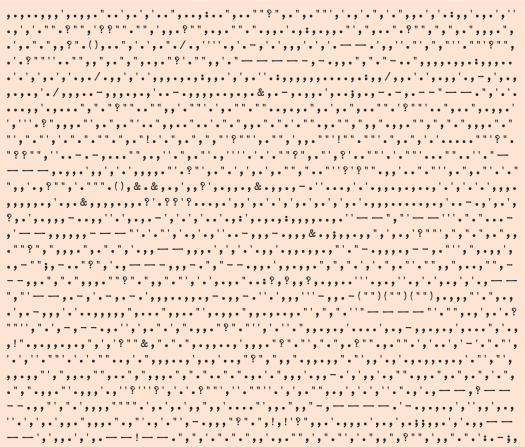
Here’s today’s. The freelance science-and-culture writer Clive Thompson put together a little web tool that allows you to paste in some block of text, hit “submit,” and have it return instantly with all of the alphanumeric characters removed, only the punctuation remaining. He’s posted an article about it at Medium, and it’s truly awesome. The graphic at the top of today’s post is from the first chapter of my new novel & Sons, and there’s something just magical about seeing your own work through some other structure.

There’s large scale and small scale understandings that we can take from that graphic. Look, for instance, at the fourth line, where we see four consecutive em-dashes. (โ€”). When I look back at the text, I see that I use those as markers of parenthetical commentary, but they aren’t all of the same sort. Sometimes, they’re used to give a specific listโ€”of materials, of options, of alternativesโ€”within a single category. Sometimes they’re usedโ€”pay attention, nowโ€”to shift perspective within a sentence, like a quick camera shot. And sometimes they’re used to give a definitionโ€”a more plainspoken explanation of something complexโ€”to demonstrate that there’s some knowledge that the characters take for granted but the reader probably won’t. So when you see a bunch of those in close quarters, it’s an indicator that the narrator is more actively guiding the reader through unfamiliar territory. Where it’s nothing but a string of periods and commas and question marks and quotation marks, it’s full scene, and the narrator expects that you’ll be able to track it just fine without the voice-over.

The 3,089 punctuation marks that were counted in my 32-page story were:

  • Periods: 836.
  • Commas: 927
  • Quotations, or “: 536
  • Apostrophes, or ‘: 536 also
  • Question marks: 78
  • Exclamation marks: 18
  • Em-dashes: 126
  • Paired parentheses (): 4 pair
  • Colon: 8
  • Semicolon: 8
  • Slash, or /: 5
  • Ampersand, or &: 7 (not surprising in a story called & Sons)

You might think that nearly a hundred punctuation marks per page is a lot, but it’s not as surprising as you think. They’re supposed to be invisible, you don’t notice them when you’re reading OR when you’re writing. (We just saw eight of them go by right there.) Anyway, there’s a lot of stuff we could talk about from that quantitative breakdown, but here’s the ones that stood out for me.

More Commas Than Periods. Clay’s an educated guy, he qualifies his sentences, thinks out loud toward a closer approximation of what he’s thinking.

Commas and Quotation Marks Are In Inverse Frequency. Where I look at strings of commas, quotation marks are in short supply. Conversely, where there’s lots of quoted dialogue, there aren’t many commas. This strikes me as fairly reasonable for the ways that most of us have conversations. We say something. Then maybe we say another thing. Then somebody else says something.

Lots of Apostrophes. And mostly these aren’t possessives. Mostly they’re contractions, which isn’t surprising in a dialogue-heavy story, but which also comes through in Cale’s narration to the reader as well. He’s a farm kid who hasn’t fully entered white-collar culture, and he’s just as likely to say can’t and wont and didn’t and we’re and you’re when he’s at work as he is back at the farm. Poker players like to talk about tells, the little involuntary motions we make when we’re excited or nervous. The use of contractions is Cale’s tell, and his colleagues on the faculty probably all feel it, even if they never overtly notice it. It’s a little culture marker that he’s not really one of us.

The Exclamation Marks All Come Together. There are eighteen of them total. Eleven happen within two pages, when Cale and his sister Ray are presented with their dad’s will and they both have to come to terms with his posthumous anger and disrespect and manipulation. They don’t like it, and they start barking at the lawyer and at each other. (Maybe we should just call ! the bark mark, because that’s what people do when they use it. They’re barking.)

Anyway, I don’t mean to suggest that quantitative analysis of writing should in any way become a standardized mode of literary criticism. But patterns are patterns, and they probably indicate something. We learn how to write by writing. But we learn how we write by looking back at what we’ve written, with whatever tools are in the box. If the patterns we find match our intentions, we’re probably doing what we intended. But if the patterns surprise us, we now have an analytical tool with which we can go back into the text, like spelunkers, and figure out what’s down there.

Publishing Empire

Job-creatin’, risk-takin’ hero of the free market!

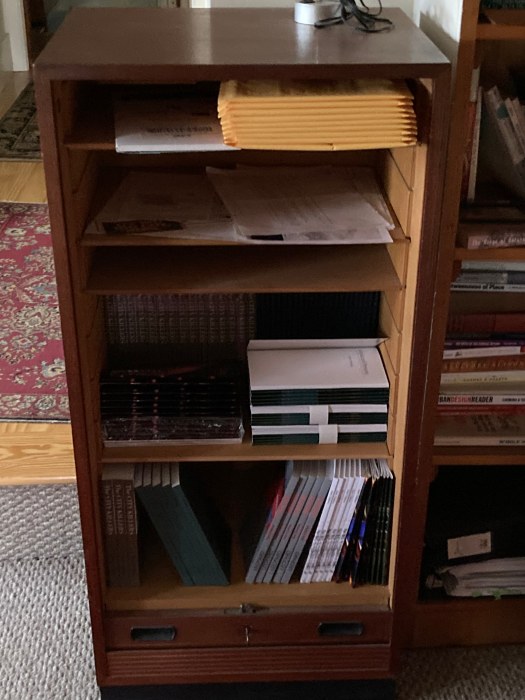
The photo you see above is the first public image ever released of the Spruce Knob Press’ Global Fulfillment Center (GFC). It’s a massive complex, nearly three square feet. Five levels, with sufficient build-out space to accommodate nearly double the Press’ current inventory.

Originally designed by Herman Miller in 1956 as a turnkey operations-management center, the GFC was painstakingly relocated in 2012 from its original Manhattan address to the Press’ current location in Vermont. In coming months, the Press’ already substantial catalog is anticipated to grow to a previously-unthinkable two-digit volume count. The GFC is thoroughly designed to manage the strong public demand for quality literature, and to uniquely support the Press’ innovative zero-revenue business model.

To learn more about Spruce Knob Press and its exciting literary catalog, follow this link. No salesperson will call.

The Gift Economy

Here we go.

It’s time.

I’ve been thinking about this for a little more than a yearโ€”taking some of the books I’ve written, putting them into attractive paperback versions, and then giving them away. For free.

It’s a fun process to take a story that’s lived its whole life in an anodyne Microsoft Word document and to give it physical form. To make it into a book. To make the hundred decisions about typeface and margins, about chapter headings and section dividers, about cover images and cover text, that every book requires. To design the graphic device (the publisher’s mark, which you can see at the top of this post) for Spruce Knob Press, which isn’t really a business, it’s just me making some books.

It’s also been fun to NOT make some decisions. My books don’t have ISBN numbers or barcodes. They don’t have e-book editions, or links to Amazon. They don’t have a price, or a link to a Square or Venmo or PayPal checkout. They’re simply gifts.

You’re welcome.

So now it’s your turn. Visit the “Books for Free” tab of my website to see a brief description of the six books that are currently available. Choose one. (We’re operating under the Thanksgiving-dinner model here: take only one. If you like it, you can always go back for seconds.) Get me your U.S. mailing addressโ€”by email if you know my email address, through the “Keep in Touch” tab of my website, or through the Messaging feature of LinkedIn if you saw this on that site. And I’ll put a book into the mail for you. It really is that easy. If I run out of one, I’ll get more made in a week or ten days, so don’t worry about that. (As Jay Leno once said on behalf of Doritos, “Go ahead, we’ll make more.”)

I’ll look forward to sharing stories with you. Thanks for all of your support and encouragement along the way. I hope you’ll enjoy them.

A Book You Should Have, If You’re In Higher Ed

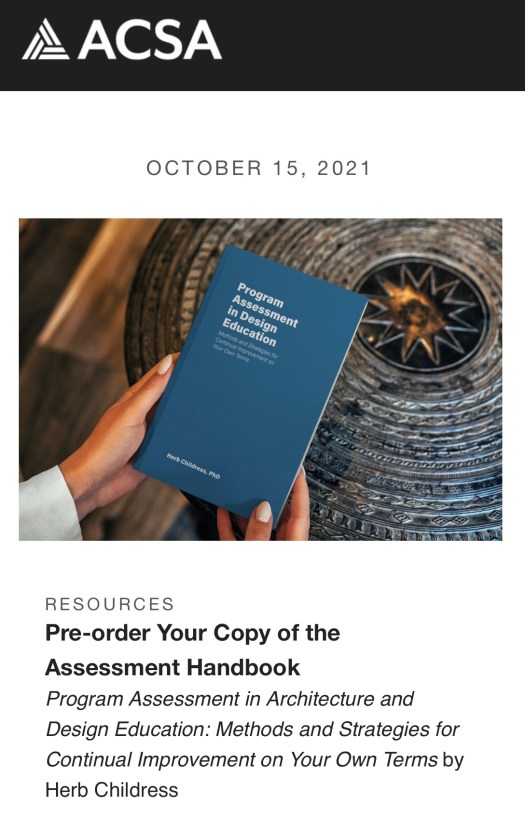
A few days ago, I talked about preparing to give some books away for free. Well, I can’t give this one away, but you should go buy it anyway. The Association of Collegiate Schools of Architecture asked me about a year ago to do some workshops on assessment, which in the end had over 200 attendees from about 50 colleges and universities. So we decided that an assessment handbook might be in order, and have spent the past few months making one.

And here it is.

Although it’s aimed specifically at assessment methods that will be of use for architecture schools, it’s a simple guide for any school (or frankly, any organization at all) that wants to develop systematic ways to get better at the things they really want to do.

Assessment scares people, but it really shouldnโ€™t. The cycle of assessment, from description to judgment to change, is a normalโ€”and crucialโ€”part of everyday life. Our new handbook describes both the practices and the opportunities of assessment.

Assessment can be an important lever for the pursuit of equity and inclusion, and for communication with stakeholders. Assessment can improve curricular alignment, and help your program to pursue your own unique mission. This plainspoken handbook is designed to help architecture programs at any level of development to create, improve, and make use of relevant and powerful systems of assessment.

The book is intended to be encouraging, to help your organization start somewhere and make some important and effective advances. So go pre-order one. If your school’s an ACSA member, it’s thirty bucks plus six for shipping; if you’re not an ACSA member, it’s forty plus six. And anybody can buy the electronic version that can be shared broadly across teams for a hundred. So go do one of those things. Right now. Go.

Re-Emergence

Uh-oh.
(Image by Duลกan Veverkolog, via Unsplash)

So for four months I was underground, digging away happily at the vein of ore in the mine. It was rich and productive, and I was fully immersed.

But now I’ve emerged, blinking, into the sunlight where all the complications of the world have waited patiently for my return.


The biggest problem that awaits the happy author of the completed manuscript is actually a mirrored pair of problems, a pushmi-pullyu that can’t successfully navigate in either direction. One head of the animal is finding readers. How can I get the book in front of people who might enjoy it? The world of literary agentry is the most fakakta enterprise ever invented, a community of connections for which you need pre-connections to get more than a desultory twenty-second review. Not their fault, of course; they’re looking for the love-at-first-sight moment, and using the equivalent of Tinder to do it. Swipe left… swipe left… swipe left…

I’m preparing to give copies of my books away to friends and their friends, but that means re-building my website, which means new plug-ins and new account levels and blah-de-blah-de-blah. I don’t need money, which means that I’m not all that attractive to the publishing world anyway, since words are currency over there. I’m actually looking forward to giving the work away for free, but that’s its own set of tasks.

But the other head of the creature is what might happen if I DID find readers. What are the book’s responsibilities in the world, and to whom? In particular, what do I owe Nora, my first and most steadfast reader? Can I publish things that she finds uncomfortable? Why would I introduce discomfort into the person I love most in the world?

I write lots of characters. I actually counted, in one book, that there were 84 specific, identifiable people who would have to be cast in the movie, not counting the anonymous crowds. Many of those characters are unlike me. In gender, in sexual orientation, in ethnicity, in age, in social class, in profession. I can research similar lives for months on end, but I can’t possibly “get them right,” because there IS no single right way to be female, to be Hindu, to be a corn farmer. All of those groups are wildly diverse within themselves, but lots of people are ready to be affronted if a writer’s expression of a community is different from their own. And I don’t mean to cause anyone else discomfort, either.

I’m not going to write about nothing but 63-year-old white guys who’ve moved to Vermont in the past ten years. That’s kind of a limited palette. (Although lots of memoirists have dug endlessly from a single mine. As David Chapin put it, they’ve become parasites on their own lives.) So what responsibility does my story bear to someone who might see herself “inaccurately” portrayed? And what responsibility does my story bear to people who ARE quite a lot like me, and might actually learn something about diversity (and about themselves) through the research I’ve conducted to bring my characters into being?

It’s dangerous above ground, right? Safer to duck back under and start another book!


One of the great things about my being married to a super-smart writer is that we have wonderful conversations. Nora and I actually went over a lot of these ideas this morning, while we were out digging potatoes and getting the garden ready for winter. We talked about what it meant to be novelists who were both trained as ethnographers, for whom the research can sometimes be more fun than the writing, for whom listening to characters has ethical importance. We talked about the limits of what must be known and what may be filled in with invention. We talked about what it’s meant that she’s read three of my novels in the past four months, and thus now knows all my tricks. “Oh, geez, that again?” Patterns you might miss if you dip into a writer’s work every couple of years become visible (and maybe annoying…) when you’ve seen them three times since summer. What of our repetition is our “voice,” and what of our repetition is just laziness? Or some authorial disability that limits our motion?

All that, plus we got potatoes.

Anyway, keep you eyes open for the web re-launch, and your opportunity to choose from among several new books that will be my gifts to any readers who ask.

Done.

As of about half an hour ago, the new novel is done. & Sons has been fully assembled, fired up and run on the bench with no damage. There’s a fair bit of cleanup left to do before we take it out to the show, but I know how to do that.

I opened my writing log and closed out the account for this one. One hundred twenty-six days, eighty-seven thousand words. And I discovered that, without my knowing it, this one has pushed me past a significant mark. I’m now over a million words of completed book-length work since I started doing this seriously back in 2013. I must be getting better at it, right?

Here’s the family:

Nonfiction: The PhDictionary. The Adjunct Underclass. Slush.

Fiction: The Abbot of Saginaw. The Triptych (The Host/The List/The Test). The City Killers. The Opposite of Control. A Field Guide to Men of the 1970s. Trailing Spouse. Leopard. & Sons.

Fourteen books in eight years. Productivity or compulsion? And who could know the difference?

I’ll be revising my website in the next few weeks to make some of this work available to you. I hope you’ll enjoy it. And thanks for following along with the journey so far. Your comments and thumbs-up’s have been sustenance on the trail.