
I’ve been reading a lot lately, and much of it seems to cohere in what Jung (or Sting) would have called synchronicity. I’ve been working for a year on a novel called A Woman of a Thousand Names, about a writer in the 1940s and beyond who becomes a driver of the paperback revolution, writing dozens of novels under endless pseudonyms and publishing thousands more.
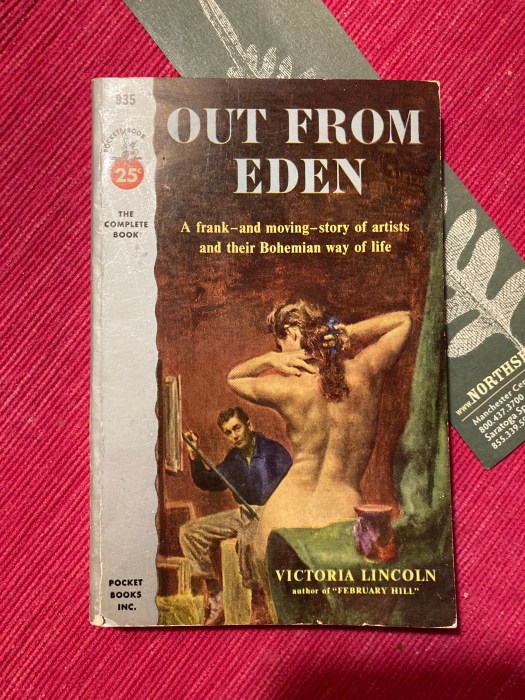
A couple of weeks ago, Nora and I were in Otter Creek Used Books in Middlebury, and I came across the book pictured above: Out from Eden, by Victoria Lincoln. It was a perfect model of what I’ve been writing about: published by Pocket in 1948, originally priced at 25¢, a salacious cover illustrated by a talented artist—in this case, Tom Dunn, who’d drawn for the Marine Corps during the war and went on to a career in commercial illustration. The standardized 4.25″ x 6.25″ format, designed for wire display racks. The nearly 100,000 words compressed by single spacing and 9-point type into a tight package of coarse beige paper with a dyed red edge. The book was so exactly what I was writing about that I paid five bucks for it and took it home.
Friends, it’s really good. It’s an excellent example of post-war existentialism, the loss of certainty that rocked the world from governments to individuals. In this case, it’s a family headed by a struggling artist who veers between full belief in his work and full despair over its meaninglessness. His wife is a lush innocent, his muse and model, who’s fully immersed in each moment and has no concerns over any future. Their son is bookish and mathematical, filled with ideas; their daughter is a savant, uneducated but visually brilliant. The two women actually hold the center of the book, as the churn of men and their noisy plans swirl around them.
Along with the subject matter, it’s Modernist in several other ways. The artist’s agent is coming to terms with his Jewishness, something he’d never fully had to consider before. His two sons have chosen entirely different paths after the war: one moving to California and a life of full American assimilation, the other moving to Israel and a pioneering life of Jewish statehood. And the novelistic methods are of a piece with the content. The point-of-view shifts frequently and with full control—all of the major characters are given internality in their respective chapters, and their voices are different from one another. Everyone is interpreting what everyone else thinks, a house of mirrors in which truth is unavailable.
It’s just a terrific book, never studied in literature programs, never mentioned in the historical overviews of mid-century lit. It was consumed, read, discarded.
The New York Times ran an article last week about lesbian pulp fiction of the 1950s and 60s. “The novels had to be presented carefully; even in the largest American cities, gay bookstores didn’t yet exist, so the covers, the titles and the stories all had to meet standards that would allow them to be credibly intermingled with run-of-the-mill paperbacks in a mainstream bookshop, or in a stationary store or pharmacy stocked by someone who was either sympathetic, opportunistic or both.” The offhand commonplace of paperbacks was a discretion that allowed them to touch topics that major publishers wouldn’t have dared.
It was also a tool that allowed the pulp houses to claim genres that major publishers and their literary patrons disdained. Romance, of course, the most beloved and most demeaned of all literary forms. Science fiction, westerns, crime and mystery, erotica in the 1960s and 70s… all of those forms had origins in “literature” (Austen, Cooper, Poe, Lawrence, Wells) but had become “popular” and thus not serious. Easy pickings for an industry who knew that the audience existed, even if the awards didn’t.
Speaking of awards, The New Yorker reprinted an article this week originally from 2005, by Louis Menand, called How Much Does Winning a Nobel Prize Matter? Menand writes of the ways that literary awards have always been a commodity, even as they desperately intend to stand above it.
In an information, or “symbolic,” economy, …the goods themselves are physically worthless: they are mere print on a page or code on a disk. What makes them valuable is the recognition that they are valuable. This recognition is not automatic and intuitive; it has to be constructed. A work of art has to circulate through a sub-economy of exchange operated by a large and growing class of middlemen: publishers, curators, producers, publicists, philanthropists, foundation officers, critics, professors, and so on. The prize system, with its own cadre of career administrators and judges, is one of the ways in which value gets “added on” to a work. <emphasis mine>
Look in any bookstore and you’ll find endless opportunities for publishers to slap a gold sticker on the front of a book proclaiming it a Booker or Pulitzer or Caldecott or Hugo or Lambda or Nebula or Newbery or Pushcart winner. In the endless, anonymous sea of fiction, these come pre-recommended, bolstering our insufficient judgment. Prizes like these (along with major-media reviews) are the water wings of the literary marketplace, helping some to stay afloat while the others sink.
All fields are susceptible to this. Architecture notably gives its awards to the unlivable and inhospitable, daily life and generosity not being topics of interest to the field’s gatekeepers.
Here’s a list. Sarah Bernstein, Jonathan Escoffery, Paul Harding, Paul Lynch, Chetna Maroo, Paul Murray. If you have ANY IDEA of any of these names, much less all of them and how they fit together, then you also need to recognize how far outside our cultural norms you stand. Simply naming your tastes “superior” doesn’t make them so. What makes some objects valuable is the recognition that they are valuable.
I’ve also started reading a book called The Late Age of Print, by Ted Striphas. (It was published in 2009, so I guess we’re in the Post-Late Age of Print now). It’s an interesting premise, unduly weighted down by its need to generate tenure for its author. His work was to examine what books are as objects as well as ideas. And that inevitably brought him into questions of commodity.
All books are commodities, in many ways similar to other commodities like a bushel of wheat or a dozen eggs. At any given moment, our local bookseller has something like 80,000 books on their shelves; a bewildering array that none of us can comprehend. The first order of business, then, is genre: the subdivision of those 80,000 into somewhat more comprehensible thematic and geographic groups. Fiction here—nonfiction there—kids upstairs. Then those first-order categories are subdivided, and subdivided further, until we end up at things like “thrillers” and “horror” and “mystery” and “romance.” The largest and least coherent is literary fiction, an anonymous rainbow of possibilities no different than the wire rack at the corner grocery, the magazine shelf in the airport. Our decisions are made by market forces:
- Brand loyalty (choosing an author, or sometimes rarely a publisher, we’ve enjoyed before)
- Recommendation of friends or experts (the publicist for my book said that if you get a review in the Times, you get congratulations from your friends; if you get a review in the Wall Street Journal, you sell books)
- Packaging and shelf placement. There’s a reason why your bookstore has a “new and notable” table, or a Times Bestsellers shelf. There’s a reason why 98% of books are shelved spine-forward, and 2% are “faced” or shelved with the front cover forward. (Hint: publishers do pay for that.) And the book’s cover and spine do the same work as the box around the Triscuits—urging us to think “mmm, that looks good.”
Striphas’ own book was a commodity, with a different customer market—other academics who would decide whether or not to invite him into the club. That’s why he published with Columbia University Press rather than trying to fight his way into Random House.
One of the fun tidbits that Striphas delivers is the fact that the book industry was crushed in the Depression, and worked valiantly to save itself. One of their most successful efforts was to hire the PR pioneer Edward Bernays, who hit the problem sideways and worked with the housing industry (architects, contractors, and decorators) to feature bookshelves as a display of homeowners’ status and taste. “Where there are bookshelves, there will be books,” he said.
Bernays was a strong believer in not merely the power but also the moral importance of propaganda. “Intelligent men must realize that propaganda is the modern instrument by which they can fight for productive ends and help to bring order out of chaos.” That’s the role played by literature and MFA programs in universities, by award juries and the “little magazines;” to convince us unwashed of the intellectual and moral superiority of some books over others.
I used to tell my students that no human being in history has ever wanted a building. They want status, pride, comfort, family harmony, business or organizational success—and they bought or modified a building as a means of accomplishing that.
Likewise, no human being has ever wanted a book. We want more fundamental things, like pleasure or possibility or status or entry to cultural conversation. We buy books in order to accomplish those things.
Likewise, we don’t create books to have books. We create them for pleasure, or possibility, or status, or generosity, or as proof that our lives really have mattered. It’s only by acknowledging that we’re human that we have any hope of transcending commodity. That’s one of the great (and unexpected) blessings of not being part of the publishing industry; I don’t have to respond to market pressures. I can write because the stories intrigue me; because the craft demands my attention; and because I’m pleased to use them as instruments of generosity for my friends.


 Herb Childress