You Start Where You Start

Because we all hear differently
(image by Kelly Sikkema, via Unsplash)

The mooc continues.

Zadie Smith, in a wonderful essay called “That Crafty Feeling,” talks about what she sees as two camps of writers, calling them “the Macro Planners” and “the Micro Managers.”

You will recognize a Macro Planner from his Post-its, from those Moleskins he insists on buying. A Macro Planner makes notes, organizes material, configures a plot, and creates a structure—all before he writes the title page. Because of this structural security, he has a great deal of freedom of movement. It’s not uncommon for Macro Planners to start writing their novels in the middle. As they progress, forward or backward, their difficulties multiply with their choices. I know Macro Planners who obsessively exchange possible endings for each other, who take characters out and put them back in, reverse the order of chapters, and perform frequent—for me, unthinkable—radical surgery on their novels: moving the setting of a book from London to Berlin, for example, or changing the title. I can’t stand to hear them speak about all this, not because I disapprove, but because other people’s methods are always so incomprehensible and horrifying.

Personally, I’m a Micro Manager. I start at the first sentence of a novel and I finish at the last. It would never occur to me to choose between three different endings because I haven’t the slightest idea what the ending is until I get to it, a fact that will surprise no one who has read my novels. Macro Planners have their houses basically built from day one and so their obsession is internal—they’re forever moving the furniture. They’ll put a chair in the bedroom, the lounge, the kitchen, and then back in the bedroom again. Micro Managers like me build a house floor by floor, discreetly and in its entirety. Each floor needs to be sturdy and fully decorated with all the furniture in place before the next is built on top of it. There’s wallpaper in the hall even if the stairs lead nowhere at all.

In my writing group, two of us are Micro Managers, two Macro Planners. It would never occur to Nathan to write a book sequentially. He works opportunistically, whenever some new idea has opened a different perspective onto a room not yet built. I, like Ms. Smith, discover exactly what’s two inches in front of my nose.

I’ve read one of our members’ work so far this week, created at blinding pace. As I was reading it, I thought to myself, this writer is creating the melody, by way of significant plot points. The harmonies (subplots and secondary characters, the backstory) will come later. The rhythm section (precision in the sound of language) will come later. The instrumentation (voices and attitudes) will come later. The repeated themes will make themselves evident later.

The thing is, every composer starts from a different place, and operates from different constraints. Some composers start with a hook that they know will be repeated, and then build the opportunities to repeat it. Some composers start with instrumentation, knowing beforehand that they’re writing a piano quartet or jazz with a horn section, and figure out ways for that voice to be most vivid. James Brown basically invented the genre of funk through his regular admonition “Every instrument a drum.” You always recognize James Brown through his sharp syncopation, the “hit-it-and-quit-it” precision.

You, too, can start anywhere. You can start with a genre and a plot. You can start with a compelling character with a specific problem. You can start with a landscape, or an object, that seems crucial to a way of life. You can start like a poet, with the way words sound. You will eventually build out the others, but you start with what’s compelling to you. That’s the truth of your writing.

I know where I start. But unlike a true believer, I’m agnostic as to where YOU start. You start where you start.

Love at First Sight?

Pretty. Intellectually interesting. Inert
(image by Brian Wangenheim, via Unsplash)

I wrote a story on Monday. It came from something that Nora and I saw on Saturday, which linked to things I’ve seen around here for years. I thought about it Saturday night and Sunday, and wrote it Monday. It’s only five pages long, and pretty elegant, if I do say so myself.

But I was talking with Nora at dinner last night, and she said, “I just couldn’t get involved with any of the characters.” Then she looked across the table and said, “You’re the one who says you have to love all of your characters.”

There, as they say, was a blinding glimpse of the obvious.

I can write anything. I have a decent level of craft. But if it’s really going to be MY writing, it has to be generous, and help the readers feel generous as well. That’s the mode I have for offer.

And that also helped to explain for me why short stories are less native to me than novels. Over the space of months, I can really come to know everybody in the book. I can start to learn why they do things that from the outside might look ill-advised. We all do things that are ill-advised, and if we can be careful, we can learn the underlying reasons for those actions.

Love at first sight rarely happens. Lust at first sight happens all the time, we know that. And that’s what Monday’s story was, a casual story rather than a commitment.


This helps me think about why I was a more native teacher and researcher than an administrator, as well. In a course, I have fifteen weeks to gauge how things are going, from the points of view of people I’m coming to know better and better. I can see them as individuals, and work to embrace and enhance all of their experience. In research, I have whatever time I need to immerse myself in a community, come to see its multiplicities, develop smarter questions than the ones I walked in with.

Administrators are mostly involved with instantaneous response to instantaneous problems. I never had the luxury of time; things needed doing and there were deadlines attached. It’s long been thought that leisure is required for the development of culture, of thinking about work that goes beyond immediate survival. That’s why the classical cultures flourished through enslaving others, and why the liberal arts have that name—they’re rigorous but relaxed modes of deep thinking that are reserved for those who are free. That’s why college presidents and CEOs surround themselves with administrators as well, to free themselves up for the larger and longer-range thinking that the job requires.

The pace of the world keeps us from careful thought. There’s always another YouTube Short to watch, always another hair-on-fire editorial to enrage us again, rage being an almost perfect thought-smothering device. I need to hold my own advice, and take the time I need to love the work I do. Clever is nice, but generous is more rewarding, for all involved.

Commodity

Find yourself in the literary marketplace
(Image by Daria Volkova, via Unsplash)

I’ve been tormenting myself by watching agents’ advice videos on YouTube. One video says a book cannot be sold without a one-or-two-sentence “hook.” But another by the same agency says that the emerging and big-selling category of “Upmarket Fiction” is a book that doesn’t have a hook. In the video about formatting cover letters, the two agents from the same agency disagree. Utter nonsense that we’re supposed to take seriously.

After watching these videos, I can say in general that we can understand what agents are looking for by thinking of books the same way we might think of any other product: hardware, groceries, sporting goods, whatever.

  • Where is it in the store?
  • Where is it on that aisle?
  • What’s the difference between yours and the ones around it?

An example:

  • Where is it in the store? It’s a condiment.
  • Good. What kind of condiment? It’s ketchup.
  • Good. What makes it different than the other ketchup? It’s chunky.

That’s literally all the agent wants from you. What is it? Fiction. What kind of fiction? Cozy Mystery. Why is yours different than other cozy mysteries? The dog sends messages about the crimes through letters she spells out in kibble.

And there you have it. Whether it’s chunky ketchup or Jessica Fletcher’s dog, an agent will read that and know whether or not to ask for more. It’s a discouraging way to think about books, but it’s the native language of the industry. Ignore it at your peril.

Speaking of the industry, I wrote a few days ago that I made $181.02 last year as a writer. In my professional life, I bill that much per hour. Any agent worth their cash drawer would tell me to give up the fiction nonsense and follow the known income. The fact that I don’t is the immeasurable gulf between the two cultures.


Here’s the first installment of the skns mooc.

Books are long. But sentences aren’t, and books are made of sentences. I’d like to share a story by writing coach Joni B. Cole, of White River Junction, amended from her book Good Naked: Write More, Write Better, & Be Happier (2017, University Press of New England).

Once upon a time my friend Alison was an acrobatic pilot who wanted to build her own plane. So she ordered a kit, and a tractor-trailer arrived at her house with a giant crate filled with all kinds of tubing, cables, an engine, fuel tanks, tires, a propeller, bags full of nuts and bolts, and a thick assembly manual.

Alison worked nights and weekends on her plane, making slow progress. Still, so much remained to be done. Would she ever fulfill her dream of doing barrel rolls and hammerheads in a machine of her own making? Across the country sat thousands of half-completed planes covered by tarps, abandoned by owners who had felt overwhelmed, just like Alison was starting to feel now.

Like most people who attempt to make their own planes, Alison belonged to an organization called the Experimental Aircraft Association. After she had been working on her project for about a year, one of the organization’s volunteer advisors paid her a visit. She shared with him that she was worried that the job was too big, and that she was going to fail. Her advisor looked at all the parts of her unfinished plane scattered around her garage, her basement.

“Don’t think about all the things you have left to do,” he said. “Just touch the airplane three times a week.”

Just touch the airplane. I think there is something so compelling, so right about this gentle advice. When I am feeling particularly resistant to quotas and accountability, I call on those words to beckon me to my own workbench, with the only expectation to visit the page, to get a feel for my story. Who knows? Maybe some ideas or scenes will fit together.

I would like to second this idea. The more time you spend in the world of your story, the more time you spend listening to your characters and the places they live and the work they do, the more you’ll be able to be honest and accurate about them… the more you’ll be able to be generous toward them. If you’ve got absolutely nothing in the tank on a given day, go back and re-read a section of your book—not to edit it, but to listen to it. As Fay Weldon once wrote: Nothing happens. And nothing happens. And then everything happens.

skns mooc

So for the last three years, I’ve led a short-story group that I call Eight-Week Fiction, in which local friends go from blank page to admirable short story in eight weeks. But a number of participants have larger projects in mind, so I’ve just started a new group that I’m calling the Spruce Knob Narrative Society, after the name of the gravel road I live on. From August 1 2023 through May 31 2024, a dozen of us will create full book-length works of other-focused narrative craft: fiction, memoir, or biography. (Yes, memoir is other-focused, because it’s about someone you aren’t any more.)

I’ll be doing a lot of coaching of the group, hosting twice-a-month sessions, reading bunches of drafts and scraps. But I’d like to offer some of that to you as well.


Back in the days of lunatic optimism over online education, MIT announced that it would put its entire catalog of courses online, free for anyone to take as they liked. MIT OpenCourseWare, it was called, but it launched a utopian model commonly known as MOOCs, or Massively Open Online Courses. Thousands, or tens of thousands, of people could take a course—listen to lectures, read texts, do problem sets. What they DIDN’T get, of course, was feedback.

The MasterClass commercial course subscriptions are much the same. You can watch David Mamet give twenty short lectures about playwriting, or Joan Benoit Samuelson do eleven sessions on distance running. You watch them at your own time and your own pace, You won’t get to talk with your instructor, won’t get direct feedback, but you might learn some things or pick up some inspiration nonetheless.

So what I’m going to do here in this space is put up all of the materials I’m sharing with the Spruce Knob Narrative Society, and you can have them all for free. I can’t do coaching with all of you, but you might learn some things or pick up some inspiration nonetheless.

They’ll come up one at a time, because I’m building the sessions based on local need. So there’s no curriculum I’ll walk you through, just the things that I’m seeing that are relevant at any particular moment. Sounds like a blog, doesn’t it?

So for the next ten months, expect this space to be focused a little more than normal on the techniques and the practices of fiction. Happy to have you with us.

What’s the Difference Between…?

Someday, all of this can be yours
(Image by Kristina Branko, via Unsplash)

I do love a good joke. The clean set-up, the surprise twist of the punch line. Here’s my favorite of the last week, amended from a delivery by Ray Romano:

This guy’s always being harangued by his wife for not doing any housework and not paying attention. She says, “the next time you ask me where something is and you should already know, I’m not gonna talk to you for a week.”

So he’s doing the dishes, and goes to the drawer for a dishtowel, and they aren’t there. He panics, looks in the other drawers. No towels. Finally, he screws up his courage and asks his wife, “Honey, I looked in the dishtowel drawer and didn’t find any. Do you know where they are?” She says, “Oh, I just did the wash. They’re in the dryer.”

Dodged a bullet there, the guy thinks. I better not ask her where the dryer is.


But today’s joke is only partly a joke. What’s the difference between a writer and a large pizza? A large pizza can feed a family of four.

Every few months, I’m reminded of that when I get my royalty statement. Over the course of the last year, my two books—one from 2016 and one from 2019—have sold a total of 87 copies. In a week or so, I’ll get a check for $181.02. That’s what being a writer made me last year: about fifty cents a day.

Really, though, that’s like a lot of professions. Raising strawberries, for instance, or running a restaurant. Doesn’t matter how good it was, it’s now over and you’ve got to do some more.

Hardly any writers make a living writing. They make a living teaching writing. They make a living doing writing-adjacent work like grant proposals, airline magazine profiles, content for the local weekly shopper. It’s all about the daily practice, not the imagined heroic life of press tours and best-seller lists. According to long-time literary agent Miriam Altschuler, about seventy percent of all literary fiction sells two thousand copies or fewer. At two bucks royalty apiece, that’s four thousand dollars for your year’s work, or five years’ work, or a life’s work. We can talk all we want about Donna Tartt and Nicholas Sparks and the other ATM writers who spew out fortunes on demand, but the daily reality for most of us will be something significantly different.

All we can do is the work.

But I’ve got some good news, too, coming tomorrow.

Building Opportunity

Generosity 101
(Image by Surface, via Unsplash)

Nora and one of our friends were in the same doctoral program long ago, and they’ve been writing back and forth over the past week or so about one of their shared doctoral advisers, who was notoriously reluctant to write enthusiastic letters for her students. Just before that I had a conversation with a neighbor who’d had an undergraduate adviser who was noted in his field. Of his own accord, that adviser called one of his friends who was a faculty member at an Ivy League graduate program to make an enthusiastic recommendation. Sure enough, our neighbor was admitted to that graduate program.

We can push all we want against the locked door, but someone has a key.

The great American myth is that success is specifically individual. We’ve seen that this week in the Supreme Court’s college admissions decision, but that’s only a confirmation of the general belief that we all rise exactly and only on our own merits. But as Malcolm Gladwell showed us well fifteen years ago, success comprises three elements: talent, effort, and opportunity.

So rather than be one of those motivational-speaker guys who says “What have you done TODAY to increase your value?” I’m going to reclaim the ecological condition of success. My question to you is “What have you done TODAY to create opportunity for someone else?”

The work of making space for others’ success is vital to every job, but I don’t think we foreground it the way we should. So I want you, today, to make a phone call or send an email on behalf of one of your coworkers, one of your students, one of your friends. To be the key for the door they hope to walk through.

And then do it again tomorrow.

A Fiction of Third Place

I’ll be there for you…
(Image by Sithamshu Manoj, via Unsplash)

The last couple of days, we’ve thought about what it means to be boring. I think that’s important, because after all, none of us want to be boring, and sometimes a negative example is as important as the positive. (Though, after having gone to thirty years of academic and professional conferences where speaker after speaker doesn’t learn from having been bored themselves all those years before, maybe we DO need to be more overt.)

I’ve put forth the idea that one of the core ways of being boring is to speak without checking in with the listener, just pouring out stuff without concern to their interest or engagement. We can also be boring in the opposite manner, by being bland and taciturn and giving our listeners nothing to grab hold of. We see both of those flaws in writers. “It was a nice day” is boring. “It was 83° Fahrenheit at 10:34 am, roughly 74% relative humidity with southwesterly winds at 8 mph, cloud cover increasing but broken…” is boring, too, unless you’re a pilot.

The opposite of being bored is being engaged. I’m going to go back to Gurevitch’s characterization from yesterday of the components of dialogue, which requires speaking, listening, and responding. And that’s a tough requirement for the writer, because we have no idea who’s listening, can’t actively check in on their engagement and calibrate our ideas to their interest. It’s an inherently distant relationship. So what does it mean for a writer to be engaging?

I have a couple of practices that I think help, having to do with two different but concurrent dialogues. The first, and the most important, is the dialogue I’m engaged in with my characters. I’m constantly, actively listening to them, considering the ways that they’ll respond to the circumstances I’ve launched. Considering who else might come along and change things up, because of their own interests and their own habits and patterns. Considering how the two of them (and later, the three of them, or four, or six) speak and listen to and respond to one another. Whenever I want my characters to do something, I’m going to write poorly, because I’m short-circuiting their interests and their agency. It’s no longer a dialogue, it’s a sales pitch, in which I’m moving them toward my goals.

So as a reader, you’re overhearing a meaningful dialogue among (mostly) intelligent people. There’s always something fun about eavesdropping, right? But then again, a little bit of that can go a long way. Even the most interesting conversation wouldn’t hold our attention for hours if we weren’t included somehow. And that’s the role of the second of the concurrent dialogue, which is hosted by the story’s narrator.

I use that word “hosted” deliberately here, because I think that the narrator plays the same role as a good bartender or waiter or party host—to build connections. Specifically, narration in a story is a constant attentiveness to the distance between what the characters know and what the readers probably know, gradually introducing readers into a greater depth of understanding of the community they’ve entered.

I came across Ray Oldenberg’s The Great Good Place shortly after it was published in 1989, and although he never intended this purpose, the book has shaped me as a writer. His argument (he’s a sociologist by training) is that community is built by voluntary gathering, and that the first two places of our lives, home and work, have to be augmented by third places of collective engagement. He uses for his subtitle examples such as “Cafes, Coffee Shops, Community Centers, General Stores, Bars, Hangouts.” A book is a similar kind of a hangout—it’s a place independent of our own into which we wander, and ideally want to return to. But whether it’s a bar or a book, when we first stumble across the threshold, we know nothing. It’s the role of the narrator to welcome a reader into the world of the story, to help us make sense of the strangeness we’ve encountered and gradually to help it feel native.

Some hosts do that directly: “Come over here! There’s someone I want you to meet!” Some hosts do that indirectly, the bartender who sees a new patron listening to a bickering conversation and says (to the new client, but for all to hear) “If these guys couldn’t complain, they’d have nothin’ to talk about at all.” By so doing, he further cements his relationship of affectionate banter with the regulars, and becomes the translator and the first friend of the newcomer. The tone that our narrator uses marks the personality of the place, or what writers call the voice of the work.

So the narration of the book becomes the reader’s first friend, the guide who’ll make the rest of the tale both intelligible and welcoming. And the narrator also checks in on all the relationships between the regulars, to make sure they’re engaged as well.

Come on in. We’ll have a great time.

Thrilling, Mile-A-Minute Tales of Adventure!!!

No, really, I AM listening. Please go on…
(Image by Ekoate Nwaforlor, via Unsplash)
  • Axiom 1: Ordinary people make for boring stories.
  • Axiom 2: Fortunately, there are no ordinary people.

As I said yesterday, my most recent book is about a plow driver in a rural community of about 800 people. And that’s not a pitch that’s going to immediately lend itself to a Hollywood bidding war. How on earth can anybody go on for 350 pages about a damn truck driver?

Today, we’re going to talk about boring stories, and why sometimes they might not be. But first, let’s investigate this idea of something being boring. Entire television franchises have been built around people who buy storage locker contents at auction. Nascar and IndyCar races are nothing but following that old guy whose left-turn signal has been flashing for three hours. As George Will once said, football is mostly committee meetings. The world is filled with boring things that somehow have drawn broad and enthusiastic attention.

I think that grammar is at fault. Being boring is not an appropriate adjective to describe a thing. Being bored or boring is an appropriate adjective to describe a person’s state. Things are not inherently boring; they have just encountered a recipient for whom there is no appropriately shaped port. Boredom is a state of being disconnected from one’s surroundings. Not pleased by them nor menaced by them nor curious about them, but utterly disconnected. Think of how Charlie Brown’s teacher is portrayed in the animated shows… an offstage muted trumpet playing nonsense tones. What ninth-grader in 1970’s Michigan is going to be attentive to a lesson on the Boxer Rebellion in China, when presented by a teacher on the glide path to retirement? We were a whole room of disconnected cables there…

So indeed, things can be boring to one person and interesting to another simply because of the way we’re shaped. But I don’t want to give way to radical relativism, the idea that one thing’s as good as the next and we can just blame the audience when something doesn’t get their interest. That doesn’t help us strive for quality, it’s just the endless drivel of 480 cable channels.


  • Axiom 3: Boring people tell boring stories.

What makes a person boring? A boring person is going to tell you whatever they want to tell you, with no regard at all for whether the listener is engaged. A boring person is only a transmitter, has no interest at all in the status of the receiver. We all know folks who go on endlessly about their grievances or their enthusiasms. I mean, I can tell you the names, jersey numbers, and field positions of every member of the starting lineup for the 1968 Detroit Tigers. Really, I can do that. (Nora calls it brain lint.)

But I won’t. Because I have to assume that it won’t be nearly as interesting to you as it was to me, the ten-year-old Michigander who listened to Ernie Harwell on the radio for every game when the Tigers won the 1968 World Series. There are a few dozen other people in that situation, and if I ever ran into one, we’d have a shared connection. We wouldn’t be bored, because we’d have the appropriate intellectual and emotional cable set.

So I can be aggressively boring by delivering information that I KNOW is of no interest and no value to its listeners. Blah blah blah blah blah.

The philosopher Z.D. Gurevitch says that the dialogue has three components: speaking, listening, and responding. There’s no dialogue if the writer doesn’t write. There’s no dialogue of the reader isn’t reading. And there’s no dialogue if the reader doesn’t think a little differently after having read.

So that’s my effort to not be a boring person. Yes, I initiate the dialogue by writing something. But I hope that I invite dialogue by writing something that might actually help a reader color their thinking just a shade or two.

Let’s talk about that tomorrow.

Umm… hi?

I’m sorry I’ve been away..
(Image by Dương Trí, via Unsplash)

It’s been six months since I’ve been here. And it’s not you, it’s me.

Gosh, what have I been up to? Well, I’ve rejoined our town’s Selectboard, this time as its chair. So that means I’ve written two grant proposals, fielded endless complaints about spring road conditions, have begun coordinating the physical move into our new town office this fall, instituted a couple of new task forces, and started to collect job descriptions from other communities in preparation for rebuilding our highway crew after a soon-to-come retirement.

I’ve led my nearly-annual short fiction coaching course in February through April, in which thirteen local writers went from blank page to admirable short story in the space of eight weeks. Along with the coaching, I wrote a story of my own, designed the book’s cover and page layout, had it all printed, and organized a celebratory event with excerpts from each story performed by members of our local Theater in the Woods company.

And, as of about nine o’clock last night, I safely landed a new novel.


My new copy of Poets & Writers magazine arrived in the mail yesterday. It has sections on writer profiles, new and notable books, industry gossip, issues of craft, and advice on the business. One of the business articles was on writing pitch paragraphs, which of course open the door to someone reading the full 94,275 words later on. So let’s try it with the new one.

For Angie Torvala, the only woman road foreman in Michigan’s Upper Peninsula, some things never change. Snow. Broken equipment. Road complaints. But in the midst of that stability, some things do change. Her daughter Esther about to leave for college, a world that Angie never knew. Her summer boyfriend Grant—maybe around no longer, maybe becoming something more. And the innumerable, quiet tragedies that an isolated winter can bring.

Another couple of weeks of language-level tuning, some design work, and off to the printer it’ll go.

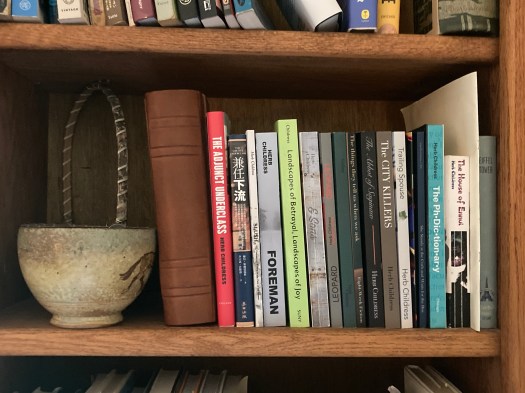
This was a rough one. I’ve had books that have just fallen like rain, books that I was barely able to keep up with. My novel Leopard, roughly the same length as Foreman, took me only 90 days. This one took me 204. I’ve been distractible, easily jarred off track.

And yet, here it is.


One of the other elements of the pitch article had to do with “comp titles.” As in real estate, the book business often relies on comparable properties to set value and market interest. That can lead to cliches like “The Sopranos if it was mixed with Bridget Jones’ Diary,” or “Dances with Wolves, but set in contemporary New Orleans.” The work of devising an appropriate set of comparables, like the work of building any category, depends entirely on the quality of the connections we make.

The most immediate, and most unlikely, comparable I’ve read in the past year is Sayaka Murata’s novel Convenience Store Woman (2016, English translation 2018). Like Foreman, this book is about an everyday, unseen life, and the marvels that it contains. A book about a way of life and a way of thinking that most of us never consider.

But maybe the most important reason why it’s comparable is that it ends almost exactly where it starts. This is entirely unlike most Western fiction, in which the crisis leads to an entirely different state of being at the end of the story. Fiction teacher Matthew Salesses tells us something about that in his analysis of Asian stories:

The plot structure follows kishotenketsu, which does not require conflict and is a four-act structure rather than a three-act (or five-act) structure. Instead of beginning, middle, and ending (a beginning in which conflict is introduced, a middle in which conflict is faced, an ending in which conflict is resolved), ki is introduction, sho is development, ten is twist, and ketsu is reconciliation. Conflict is not necessary.

Matthew Salesses, Craft in the Real World (2022), pp. 107-8

The idea of a world established, disturbed, and ultimately restored is a quieter form of storytelling than our superhero era has taught us to appreciate. It’s more like sitting on a dock watching a glassy pond, tossing a stone in to see the spreading ripples, and then appreciating the smooth water once again.

How is that not boring? We’ll talk about that tomorrow.

Unintended Irony

Yeah, yours and ten thousand others…
(Image by Alexander Grey, via Unsplash)

Some while ago, I wrote a funny little piece about the uniquely inert literary genre of the rejection letter. I’ll copy it here.


Thank you so much for querying our agency and for giving me the opportunity to review your manuscript. After reading your letter I’m afraid I just wasn’t hooked enough to want to ask for more. But this is a highly subjective business and another agent might feel differently.

•••

As an agent with an established list, I’m very selective about requesting more material at this time. For that reason, I’ll need to pass on your manuscript. I wish you all the best of luck with your future queries.

•••

Publishing is a long game, keep writing and persevering. I wish you nothing but the greatest success. Best of luck and success in finding the perfect advocate for your work.

•••

Thank you so much for your submission. I received 68 of them before lunch today, and literally have to clear them with a wheelbarrow before I can get back to work. Ugh! Best of luck!

•••

Our agency is migrating to a new submittals portal, and I have to clear the cache in the old one before the changeover can be completed. So thank you for your submission of February 2014. No. 

•••

Don’t you read my blog? I HATE writers! Maybe someone wants your needy, misshapen beast, but it isn’t me. I wish you success as you move forward with blah blah blah whatever. 

•••

I’m sure that we did meet at Bread Loaf last summer, but I only went in order to try to poach Lauren (Gravy Train) Groff from her current agent. The rest of you were pretty indistinguishable, and she wouldn’t budge. Wasted trip.

•••

Regardless of what my bio says on our agency website, I’m not currently accepting new clients. Yeah, that’s it…

•••

Although your proposed novel is indeed very close to the request I’d posted on Manuscript WishList (“How about a work of literary fiction set at an elephant rescue park in Thailand, through the eyes of the people trying change the treatment of animals?”), your manuscript isn’t the way I’d do it. #MSWL #notquitewhatImeant

•••

I have to go in for a dental hygiene appointment this afternoon, and I’m kind of freaking about it, so I’m afraid that I couldn’t give your manuscript the attention it no doubt deserves.

•••

Swipe left.

•••

Do you seriously not understand how hard my job is? And you bring me this?

•••

I have reviewed your first pages, and I’m very eager to read the entirety of your manuscript… psych!! 

•••

Although your proposal is indeed interesting, a quick Google Image search has shown that you are not nearly photogenic enough to be a contemporary author. Your work seems better suited to a prior era, one that existed before author photos and Instagram. Another agent may, of course, feel differently, but it’s doubtful. 

•••

As I’m sure you know, roughly three-quarters of literary fiction sells two thousand or fewer copies. And fifteen percent of nothing remains, alas, nothing. My daughter’s riding lessons lead me to require something with greater market potential. I would, however, encourage you to purchase at full list price one of the numerous books published by the authors that I do represent.

•••

It’s not you, it’s me.

•••

I’ve decided to become monogamous, and to focus my attentions on a single client. Karl-Ove and I have been very happy together.


And in an unintended irony, I received the following from The New Yorker today in response to that piece:

Dear Submitter, We’re sorry to say that your piece wasn’t right for us. Thank you for allowing us to consider your work.

These are Q-Tip letters, the single idea NO wrapped in a little ball of protective cotton. I swear that agents and editors and HR offices all go to the same weekend workshop to learn how to say nothing whatsoever. (Probably get continuing education credits, too.)

Don’t pretend. Don’t be passive-aggressive. Just say no.