The House of Ennui

The third in a series on fiction and fiction writing. The first two are here and here.

It was twenty years ago this fall that I embarked on my most spectacular failure.

I’d finished my dissertation, got a publication contract for it, and was casting about for my next project. I decided to write a close ethnography of one young man I’d met as a high school senior, who had continued correspondence with me as a young-twenties adult. He was making absolutely no headway toward what we might think of as adult life, and I wanted to learn how he was configuring that project. So I moved in with him and his two housemates for a month.

The House of Ennui, which will never be published*, is the record of that month, and of my own descent into despair over the adulthood I’d created for myself. Pete’s life was nothing but inertia, a block of resistance moved only temporarily and resentfully by any outside force. There was no word in his language for “toward.”

One of the books Pete shared with me that month was Michael Chabon’s debut, The Mysteries of Pittsburgh. Here’s part of what I wrote about it.

The basic logic of fiction is that a protagonistโ€”a character having certain strengths, weaknesses and motivationsโ€”is set into a situation in which those strengths are tested, those weaknesses emerge, and those motivations are fulfilled or denied or come into question.The Mysteries of Pittsburgh, the first novel by Pulitzer-winning Michael Chabon, is a fascinating experiment in fiction because it omits one of those three elements:  its protagonist has no motivation whatsoever.  As such, it is by far the most annoying well-written book Iโ€™ve ever read, Art Bechstein the least interesting leading character.

Nothing that had ever happened to Art happened because he had desired or pursued it for himself. As heโ€™s finishing his last college paperโ€”lateโ€”in the school library in June, he sees a pretty girl, gets chatted up by a pretty boy, and proceeds to be dragged around all summer through an endless series of social circles, near-events, and pointless drama. The pretty young woman and the pretty young man both pursue him, because he is beautiful and because his blankness offers them the reflections of themselves they both desire.  His pursuers dislike and distrust one another, and Art cannot choose between them, and so offers himself to whichever is nearest or speaks with more persuasion at the moment.  He loves neither, because โ€œto loveโ€ is a verb, and Art does not do verbs.  Art is far too distant and disengaged for any effort beyond observation and reportage.

The current book on the table, Ling Ma’s Severance, falls exactly into this same camp. Candace cannot bring herself to do anything, or to want anything. She eats, but takes no pleasure in it. She has sex, but takes no pleasure in it. She has #friends, but takes no pleasure in them. The other people in the story are props, flat and unsophisticated, not because the author is careless but because Candace is.

And it all makes me wonder. I wonder why such talented and driven people are writing about such motivationless characters. Michael Chabon went to college at Pitt and got his MFA from UC Irvine, a program with a 2% acceptance rate. Ling Ma went to college at U.Chicago and did her MFA at Cornell, a program with a 1.6% acceptance rate. Jia Tolentino, who wrote of Severance that it was “the best work of fiction I’ve read yet about the millennial condition,” was an undergraduate Jefferson Scholar at Virginia and did her MFA at Michigan, a program with a 1.5% acceptance rate. These are not people who sit around and let the world happen to them.

The identifying field mark of literary fiction is suffering. No one’s aspirations are satisfied for even a moment before being dashed in even more baroque ways. Even imagining a happy ending is seen as naรฏve and implausible, perhaps even irresponsible. No possible indignity can be spared; no misfortune can be too unlikely; no character can be respected strongly enough to have her best intentions fulfilled for more than fleeting moments before the next humiliation. As perhaps befits our zeitgeist, too many of the most celebrated literary novels of recent years have portrayed life as tormented, degraded and diminished. โ€œRealismโ€ means unrelenting layers of misery. Weโ€™re far more likely to suspend disbelief about vampires, dragons and zombies than we are about regular people living regular lives with some degree of nobility and hope.

This body of anhedonic, anti-aspirational literature does harm, I think. Like Ma’s imagined Shen Fever, its spores are everywhere, slowing us to nostalgia for when things were all okay, leaving us less able to take action in the face of the troubles around us. “Well, we’re all fucked” is nothing but a declaration of inertia, a raising of the white flag so that maybe we won’t be hurt even further. We are oversupplied with irony and mockery, are left anemic by our deficiency of hope.

*That book, in its draft form, did a lot of harm to the people I wrote about. As Joan Didion said, “A writer is always selling someone out.” Now they’re all twenty years older, and don’t deserve to undergo public scrutiny of their pasts. And Pete isn’t really his name.

Paratext

This is the second of a multi-part series on fiction and fiction writing. If you haven’t read the first yet, you should start there.

Ling Ma, the author of Severance, teaches in the creative writing program at the University of Chicago. A quick look at their faculty page shows us that even a well-heeled institution like Chicago isnโ€™t immune from contingency. Five of their thirteen โ€œcore facultyโ€ are within the tenure stream, seven are professors of the practice (a polite term for an academic job with a term limit), and one a postdoc. And these thirteen core faculty are surrounded by a larger group of seventeen visiting faculty, to whom the university takes an even more delimited obligation.

Again, it all depends on how you count. By my count, there are thirty people teaching in this program, and five of them are faculty.

Looking at their bios, thereโ€™s remarkable diversity in detail, remarkable sameness in structure.

  • MFAs from Virginia, Harvard, Boston University, Cornell, Iowa. PhDs from Berkeley, Yale.
  • Fellowships and residencies with Bread Loaf, Macdowell, Sewanee, Millay
  • Awards: the Rome Prize, the Guggenheim, PEN Emerging Writers
  • Publications in Granta, Threepenny Review, Glimmer Train, Virginia Quarterly Review, Antioch Review, Ploughshares

Thereโ€™s no walk-ons on this team. The pedigrees are immaculate, groomed through years and years of the right connections, the right programs, the right mentors. This is not to say that they arenโ€™t all wonderful writers, wonderful people. Iโ€™m sure theyโ€™re lovely. But they came to the team through the scouting reports, through the minor leagues, passed up the line from hand to hand. These are the kinds of credentials it takes now even to be contingent at an elite school.

They didnโ€™t come to their publishers as unknowns, either, as a crumb of ice within the slush. They came through cocktail parties, through conversations on the lawn in Vermont and Tennessee, through conference panels and service on the editorial boards of the little magazines. Their three-paragraph pitch letter didnโ€™t stand on its ownโ€”it was supported by volumes of paratext, the things we know about texts before we ever encounter them as texts. Their pitch didnโ€™t come in a batch of fifty, to be cleared through in the hour commute on the trainโ€”swipe left, swipe left, swipe left. They came in personalized e-mails, with subject lines like โ€œNice to meet you at Joanโ€™sโ€ฆโ€ They came over lunches, the vague, handwaving got-an-idea-for-a-story that gets incubated over a salad and a glass of Sauvignon Blanc. They come through publishing chapter after chapter as standalones in literary journals, a habit that becomes its own form (the medium, as we know, being the message), the novel reduced to a twitchy series of short stories.

All of this is, as Iโ€™ve said about faculty life, a form of sponsorship, of standing members vouching for the newcomer to the rest of the community. If you donโ€™t have a sponsor, you donโ€™t get to join the lodge. Or, to use a Chicago story, Abner Mikva (future judge) walked into a Democratic Party ward office in 1948 and asked the ward chairman, Tim Oโ€™Sullivan, if he could volunteer for the Adlai Stevenson campaign. โ€œWho sent you?โ€ Oโ€™Sullivan said. โ€œNobody sent me,โ€ Mikva replied. Oโ€™Sullivan jammed his cigar back into his mouth and said, โ€œWe donโ€™t want nobody that nobody sent.โ€

The response to โ€œWho sent you?โ€ is a form of paratext, a larger knowledge within which we read the specific story. If the answer is the Iowa Writersโ€™ Workshop, or The Sewanee Review, weโ€™re predisposed to read the story generously. If the answer is the submissions-form portal on the agency website, weโ€™re predisposed to think poorly of it.

And again, this is not to imply that those whoโ€™ve come up through the system arenโ€™t deserving, in authorial or faculty life. It merely implies that there are an awful lot of people whose work is deserving, many of whom will not be properly introduced.

House of Commons, House of Lords

The first of a few consecutive pieces on fiction and fiction writing. If I knew how many there’ll be, I’d tell you.

In August 2017, I attended the Bread Loaf Writers’ Conference, as a “contributor.” That meant that I contributed full tuition so that the important people, the real writers, got to be there for free. It was an enormously hierarchical event, the 270 or so of us clustered into herds of Faculty and Fellows and Waitstaff, the young and beautiful and serious who waited tables during the week in exchange for their tuition waiver, just as they taught freshman comp and introduction to poetry at the colleges that hosted their MFA programs. The tribes almost never intersected except within the bounds of prescribed roles. Workshop leader and participants. Lecturer and audience. Waiter and diner. We all knew our places, and didn’t struggle against them.

Along with the workshops and readings and afternoon craft talks, the middle of the conference featured visitors from the industry, agents and editors who’d made the drive up from New York or Boston for a genial few days among their friends in the woods. Like summer camp or a Catskills resort, to which the privileged return like migratory birds each season.

In exchange for catching up with old friends and sharing industry gossip, they too had a roleโ€”to meet, individually or in small groups, with the desperate, with the outsiders seeking knowledge, seeking the password, the secret key to the club. And the two people I met with performed that role in as dull and desultory a fashion as one might expect, the House of Lords communicating distantly with the House of Commons.

The first was an agent with thirty years’ experience, who calmly informed us during her talk that she no longer knew how to do her job. “It used to be that you could manufacture a bestseller, that you could put a hundred thousand dollars into promotion and guarantee a big book. Now, books with big marketing budgets go nowhere, and books no one expected somehow go viral.” She did let us know that seventy percent of all new fiction sells fewer than two thousand copies, and that her business model didn’t include those books. “If I sell a book that makes two thousand dollars, I’m going to make three hundred. I can’t spend my time on that.” She closed by urging the masses to support the project of literature. “Buy books,” she said.

When I later met with her individually, I attempted to describe my project, as she smiled blandly at my desperation. I was merely an anonymous, fifteen-minute middle car in the freight train of hope that blocked her path that afternoon. “You’re asking men to think about their emotions,” she said. “They don’t want to do that.” Okay, then, thanks.

The other, whom I met with for an abbreviated hour in a group of five, was a fiction editor with Farrar, Strauss and Giroux. She had no interest in our projects, asked no questions, just came in and sat and waited for us to lead things. She stressed the importance of being able to encapsulate a novel in just a few words. “Everyone involved in a book is trying to sell it to the next person in line. The agent is selling it to the editor, the editor is selling it to the editorial board, and editorial is selling it to the marketing team. The form we use, once we’ve got a book and we’re sending it to the marketing department, has a field we fill out for the book’s description. It’s 130 characters.” We were enrapt, as outsiders areโ€”that’s why we read gossip magazines, too, for any glimpse of how the celebrities live. “Can you give us an example?” I asked.

She could not. She had not even done the most basic preparation of attempting to bring details from the books that supposedly enlivened her. She flailed for a moment, and then said, “I’m working on a project right now, I’m really excited about it. It’s the first post-apocalyptic office novel.” That descriptionโ€”the first post-apocalyptic office novelโ€”certainly met the goal of abbreviation, clocking in at a mere thirty-nine characters. But it communicated absolutely nothing at all. Well, not nothing. There was “novel,” meaning a book length work of fiction. And there was “first,” which meant that no one had ever attempted to jam those two pieces together before.


Last weekend, I went to our local bookseller’s annual customer appreciation weekend. As I was browsingโ€”and what an apt word, looking down on the lush bounty and considering which blade of grass might be tastiest, most tender. Anyway, as I was browsing, I spent a few minutes at the “New and Notable” table, upon which I spotted a nearly plain, pink paperback, its graphic design laid out as though it were a manila envelope: the title and author on a paper sticky-label, surrounding text applied as though with faded office ink stamps.

That book is Severance, by Ling Ma. The first post-apocalyptic office novel, acquired originally by Farrar, Strauss and Giroux. And I’m reading it now. I’ll have plenty to say in the next few days, far more than 130 characters.

Read This Now

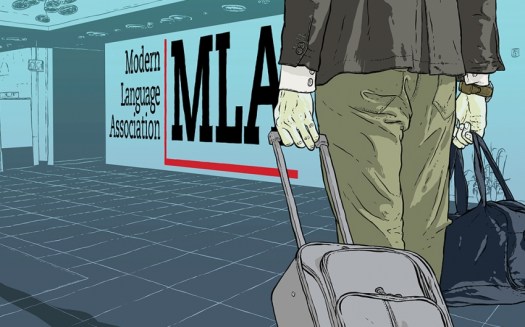
Jan Feindt’s illustration for Academe’s Extinction Event, by Andrew Kay

Stop what you’re doing, safely but right this minuteโ€”pull out of traffic, finish your surgery and wash up. You need to spend the next thirty minutes reading this.

Andrew Kay has written one of the finest accounts I’ve ever seen of the dissolution of an academic life. It’s rife with quotable lines, but rather than Twitter-pick it, I want you to read it. All of it. Right now. It’s completely, wrenchingly, wickedly perfect.

Kaleidoscopic Grief

Psychologist Elisabeth Kรผbler-Ross has become widely known for her work On Death and Dying (1969), and especially its model of the stages of grief. When faced with a loss, she claimed, we go through five relatively predictable sequences of response.

  • The first is denialโ€””This can’t be happening.”
  • Then angerโ€””Why is this happening to me?
  • Then bargainingโ€””If God will change things, I’ll be a better person for the rest of my life.
  • Then depressionโ€””What’s the point? Why bother?
  • And finally, acceptanceโ€””This is what’s happened, and I have to move forward.

But much of what we know about grief comes from the experience of single ruptures: a divorce, a diagnosis of terminal condition, a death of a pet or a partner. Losing a career could be as simple as that, of courseโ€”you don’t pass the bar exam, your manufacturing job moves to Indonesia. It’s just over with. But the special torment of losing a career in higher education is that no one ever tells you that you’re done. They keep hiring you one course at a time, keep hinting that success is just around the corner, keep telling you that the next application is sure to strike gold. And so we relive the hope and the grief over and over and over again, every semester a new cycle of possibilities raised and crushed. No one ever gives us the terminal diagnosis, because we’re just more useful if we’re hopeful.

Because of the constant cycling, the stages of grief aren’t sequential at all, they get mashed together into a perpetual, kaleidoscopic bewilderment in which we can go from anger to denial to depression to hope to bargaining within the space of minutes. It’s emotionally exhausting, for us and for everyone we live with.

In my prior book The PhDictionary, I offered the following advice under the glossary entry for Adjunct Faculty:

If you are a doctorate-holding adjunct instructor for more than two years, you must seriously think about a career change.ย There are ways of making a living that will use some of your intellectual skills and give you livable pay and benefits.ย Donโ€™t be the guy who refuses to leave the casino, thinking that the next hand will be the big turnaround.ย You gambled, you had a good time but you lost.ย Go home. Now.

I didn’t realize at the time, though, the emotional importance of that statement. I thought of it as merely an economic reality, but its greater value is in the release of one’s soul from endless torment. Go ahead and declare that dream dead, so that you can grieve properly and then move on. It may feel like you’ll never recover; but if you don’t let it go, you’ll never have the chance to recover.

Unthinkable

It would be utterly unthinkable to try to run a contemporary college without an IT department. A college without wi-fi, without a learning management system, without a server and e-mail system and website, without desktop and laptop computing being fully ubiquitous.

It would be unthinkable to try to run a contemporary college without a student affairs office, the counselors and advisors and programs that make the institution survivable for students without much money, without much family history with education, without strong high schools behind them, without the luck of the draw that lets the entitled feel entitled.

It would be unthinkable to try to run a college without federal financial aid, without compliance with Title VI and Title IX and Title III programs, without an accounting department and legal advice to keep it all in line.

It would be unthinkable to run a college without an admissions office, recruiting and vetting new students. It would be unthinkable to run a college without being accredited, without tracking grades and course completion, without keeping the lights on and the air conditioning going and the roofs intact. Unthinkable to run a college without a library, without academic databases and archives.

All of these things are crucial. Definitional. College would not be college without them.

So how is it that it’s not merely thinkable, but normal, to have college without a faculty? What does it mean for our definition of college that it must have a website, but needn’t have an extensive, reliable body of intellectual guides?

College, in any meaningful way, is in fact unthinkable without a permanent faculty, without a lasting community of scholars making collective decisions about intellectual values, welcoming young people into the family of ideas. So I think, by definition, that what we’re providing most students is something other than college.

Man, that’s gonna be a SWEET ride once we get an engine in there…

Compatriots

We’re fortunate that two of the most thoughtful writers on higher ed are also among the most frequent. Matt Reed, more or less the provost at Brookdale Community College in coastal New Jersey (his actual job title is Vice President for Learning), writes a near-daily blog called Confessions of a Community College Dean for Inside Higher Education. And his stablemate John Warner, a novelist and long-time adjunct instructor and publishing columnist for the Chicago Tribune, writes another regular IHE blog called Just Visiting. Both of them are close to the ground, describing the complications of higher ed in ways that make it clear what’s at stake for students and teachers alike. If you want to know what the work looks like, and what it means, they’re a great place to start.

So when I discovered that John had reviewed my new book for his IHE post today, I was delighted. But I hadn’t expected how powerful the review would be. I’ll quote his first line: “Normally the only contingent faculty career that could bring me to tears was my own, but the latter stages ofย The Adjunct Underclass: How Americaโ€™s Colleges Betrayed Their Faculty, Their Students, and Their Missionย by Herb Childress had my eyes filling sometimes with sadness, sometimes tinged with anger.”

And again, it’s that sense of despair, that sense that we all know that we could do it right but yet somehow choose not to. We’ve walked slowly but steadily in the wrong direction for nearly forty years, and now we’re so far from home that it seems impossible to reclaim. I still think we could get there, but it would require a powerful reimagining of our path, and powerful argument to make that path meaningful to a broader public.

If we’re going to make that turn toward home, it’ll take people like Matt and John, like Karen Kelsky and Sara Goldrick-Rab, like Adam Harris and Hua Hsu. People who carry the unique blend of empathy and knowledge and powerful, accessible writing. I’m grateful to be on their team.

Standing Off to the Side

I’ve been back into my novel again for the first serious work since February, reading the first 50,000 words over again to re-learn the characters and their struggles and their hopes. There are some lumpy spots, probably one vestigial scene that needs to be cut away, but in large strokes, it’s a good story.

I’ve arrived now at the frontier, at the place where the crisis will be foregrounded and then resolved. I don’t yet know how it will play out, or which direction the resolution will take them. I have to let that happen, I can’t make it be one way or another. I’ve painted the circumstance in which they find themselves, and it’ll be up to them to negotiate that terrain, and one another.

As part of letting go of that control, I’ve spent the past couple of days writing from the point of view of someone who had not yet had much of a role, though she’s about to. I had to understand what this opposing force wants, in order to understand how she’ll act. I understand Kurt and Megan, I understand their adopted daughter Sarasa. But Sarasa’s mother is back to reclaim her daughter, after eight years of silence, and I needed to understand this pending conflict from her point of view. I need to presume that she’s an honorable person who wants to recover her family, who “wants the best” for her daughter, and is utterly uncertain what “the best” would be. What has she been through in her decade of separation from her daughter, in the eight years since she’s even been able to communicate with her?

This material will never make it into the book. But it was necessary work to understand why Svara would come forward at this point and ask for the return of her now-teenaged daughter. It makes the problem matter even more; as Hegel said, the nature of tragedy is right versus right.

When I write nonfiction, I do way more interviews than I’ll ever be able to use. Partly that’s because I never know who’ll say something particularly illuminating. But partly it’s because the tone of those conversations bleeds a little emotional charge into everything else. I expected my adjunct correspondents to be angry, to be resentful. And they were, a little. But I didn’t expect the despair. And that despair, that sense that we all know what could be but never will, lent its tint to the flat white of the data. The unused words from those interviews are not “on the cutting room floor.” They are infused through every paragraph of the book.

Likewise, Svara’s testimony to me through the past two days, though it will not be tied into the book verbatim, will change the color of the conflict, will make it richer and less transparent. We learn so much through unnecessary work; through it, we become receptive to meaning.

It’s Good to be Married to a Writer

Nora took yesterday off from the work on her book, and spent the day in the Berkshires with friends, while I got myself reacquainted with Kurt and Megan and Sarasa in my own novel that I’ve not worked on in two months. When she came home at dinner, we talked about our respective days, and she was marveling at the casual wealth of the tony homes and grounds of western Massachusetts. She described one particular hobby farm that produced cheese, selling it in a self-serve farmstand with an iPad and a Square reader instead of a tin box that you put six bucks into. They drove slowly through the grounds, because there were chickens everywhere. “And they’re gorgeous! These are not working class chickens!”

The Posh Chicken of the One Percent

That’s one of those sentences that’s never before been spoken, a concise description of a specific attitude toward life. These are not plebian, proletarian chickens. These are the entitled chickens of the lesser nobility. These chickens’ parents would absolutely buy the naming rights to the rowing clubhouse in order to get them admitted to USC.

It’s good to be married to a writer. You get instant literature over dinner.

The Array of Conversations

The world of higher education is remarkably opaque to us. You’d think we’d know more about an industry that twenty million Americans at a time are involved in. But then, you’d think with 275,000,000 cars on the road, we’d understand mechanical systems and be better drivers, too.

Cars and colleges are so ubiquitous, and so thoroughly designed, that they become invisible in daily use. We go out the door in the morning, and there it is, ready.

So when that ubiquity is questioned in some way, we’re surprised, and many people want to think more carefully. When we read stories of the master’s-degree barista… or the millions of people in their thirties and forties with decent jobs and still a negative net worth because of their loans… or industrialists and TV actors buying their kids fake test scores and fake credentials as a water polo player or fencer… then what had seemed inevitable is suddenly recognized as a specific, designed phenomenon. And we can start to question that design.

The Adjunct Underclass seems to have arrived at that moment of question. It’s been reviewed in professional circles, in Science and the Library Journal. It’s been excerpted in the Chronicle of Higher Education, and the subject of a long Q&A with Inside Higher Education and another with Karen Kelsky’s The Professor Is In. But the reviews I find most gratifying are among the civilian population, finally invited in to see the workings of the engine. The Hour of History podcast, available to anyone on YouTube. A review in the Washington Monthly magazine. A book-based essay by Hua Hsu in the New Yorker. And then yesterday, a review in the Wall Street Journal.

It’s clear that a lot of people are wondering what’s under the hood, how the thing works, and why, and for whom. I’m grateful that my book has arrived at this particular moment, a project launched three years ago and landing at just the right time.

Thomas Frank and Malcolm Gladwell have both written compellingly about the role that luck plays in success. Gladwell frames success as having three components: native talent, enormous hard work, and opportunity. Talent and effort will not take root without opportunity. And Frank says that people who don’t recognize the role that luck has played in their lives, people who imagine that all of their success is due to their own intelligence and effort, often don’t think to create beneficial conditions for others.

So yes, I know a lot about higher ed and about writing, and yes, I did a ton of work to learn more about both for this project. But I’m especially grateful for all the opportunities that others have given to the knowledge and the work, so that it’s been able to take hold and be productive.