One of the awesome things about getting married to a smart person is that Nora, the smart person in question, knows words that I don’t know. Words like stochastic (randomly distributed), or hematoma (a blood clot within body tissue instead of in a blood vessel). But my very favorite one, and the one that I’ve taken up into daily life, is anhedonic as an adjective or anhedonia as a noun.
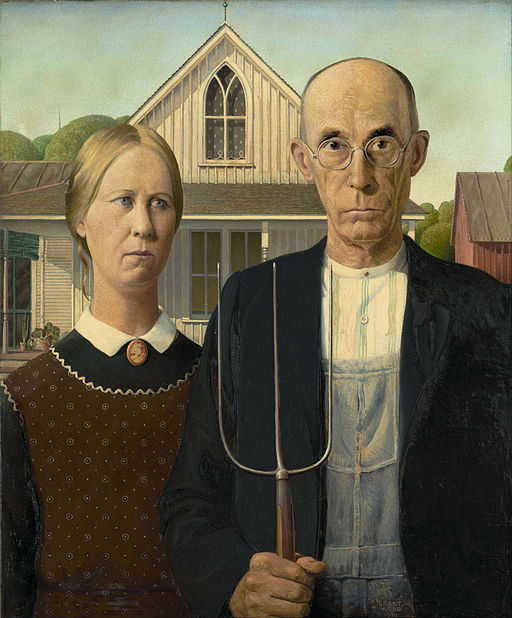
Someone who is anhedonic (an- for without, and hedonic for pleasure) is unable to take pleasure in much of anything. Think of your most dour eighth-grade teacher, or Eeyore, or the buoyant couple in Grant Woods’ famous painting, American Gothic. Some take it further, declaiming not merely the possibility of pleasure for themselves but more fully that others shouldn’t have pleasure, either. H. L. Mencken defined puritanism as “The haunting fear that someone, somewhere, may be happy.”
Nora’s been studying the Quakers of 19th-century New England. There’s a jolly crowd. They drummed people out of meeting for dressing too brightly (not unlike Eileen Fisher, or the Modernists of mid-20th-century architecture, who believed that concrete was decorative).
I got a phone call today from someone who wanted to complain that his neighbor was getting some sort of unfair advantage. The complainant didn’t want that advantage himself, just that his neighbor no longer have it. In second grade, we would have called him a tattletale, but I think that anhedonic is both more mature and more accurate.
A friend originally from Yugoslavia tells a traditional joke. A villager’s pig has died, and he is morose. He comes across a can, kicks it, and a genie emerges to grant him a wish. The villager ponders for only a moment before saying, “I wish that my neighbors’ pigs should be dead as well.”
So I offer this word, anhedonic, to you today. Use it as a sort of dowsing rod, to know who to avoid in your lives.
This is the third of three pieces inspired by my visit to the Clark Art Institute in Williamstown MA.
Roger Fenton, Orientalist Study, 1858. From the Clark Art Institute “Travels on Paper” exhibit.
Although Roger Fenton journeyed to the Crimean Peninsula to document the war there in 1855, his so-called “Orientalist Suite,” comprising fifty photographs, did not require any travel beyond his London studio. Fenton called upon his friends, manservant, and a professional artist’s model to portray a range of ethnicities – a jarring discrepancy noted by some nineteenth-century critics. The assortment of costumes, furniture, and accessories collected from across the Middle East may have been borrowed, brought up to the studio from Fenton’s home, or purchased for the occasion. As with his models, Fenton’s deployment of these props to connote a range of cultures results in vague pastiche rather than ethnographic accuracy.
I’m beginning today’s thoughts with the same image and curatorial card as yesterday, because of the curator’s clear distinction in the last sentence between “vague pastiche” and “ethnographic accuracy.” It’s clear that in that writer’s mind, the former was regrettable, and the latter commendable. But, as an ethnographer, I’d like to raise some questions about whether ethnographic accuracy might not carry its own problems.
Ethnography can be its own form of colonization, in which we enter a less powerful region to extract resources and bring them back for our benefit. In this case, the resources aren’t coal or diamonds or oil, but concepts and patterns of behavior that expand our understanding. But regardless of the material extracted, the benefits typically flow in a single direction, away from those for whom the material is common, toward those for whom the material is precious. The wealth of oil does not reside with the people of Nigeria or Yemen; the wealth of corn and soy do not reside with the people of Iowa. In both cases, the wealth flows upward and outward. My great mentor Paul Groth once wrote of his own North Dakota childhood to explain why he studied everyday landscapes:
No one explained how the grain elevators that towered over the landscape explained the economic reality of our region. We were a colony of the rest of the U.S.: all the locally grown products were exported a thousand miles away, along with the profits to be gained from them, and everything else was imported, retail.
So yes, wheat wealth flows outward. But so does ethnographic wealth. The everyday practices that support lives in less privileged places become the basis for publications and tenure and renown in more privileged places.
So imagine a writer who tells a story that isn’t his. For instance, my own experience of living with some of the teenagers of a small California town. When I wrote my first draft of the book and shared it with the kids, I was horrified to learn that they saw themselves in the stories, but didn’t have access to the framework I’d built around it. One kid said to me, “It’s like you wrote it for a bunch of psychologists.” Which, of course, I had. So I rewrote it front to back, in a way that felt more natural, felt more like storytelling. In a way that the participants themselves could have access to.
That was step one in my responsibility to them, to not remove their resources from them and hold them within the academic display case, out of reach. (Step zero, if we could call it that, was that I paid attention to them, I respected them, I laughed with them, I played hacky sack with them, I told them some of my stories as I listened to theirs, I bought lunch and gas once in a while and tried to do them honor in our daily lives together.) But step two—”ethnographic accuracy,” my responsibility to get the story and its meanings right—was not always enough.
For some kids, the fact that their story could be seen in the world was a huge benefit. They had no power, they were invisible, and so having a more powerful and visible proxy was like having a bodyguard. “I’m so glad you told our story; no one ever listens to us.” But for others, there was a sensation that I can only describe as the equivalent of identity theft. “How DARE you presume to tell my story?” It was as though I were impersonating them in public.
All three of these steps—of respecting people while you work with them, of making their own resources available to them as well as to others, of negotiating boundaries and consent—are steps founded on relationships. They cannot be answered singularly, cannot be encoded into a series of correct steps and research-board approvals. They are negotiated, revised, and stumbled over. Even though the project may be singular, the relationships are many and unique, and they will not resolve themselves with equal happiness.
Now let’s carry all of this forward into fiction, and what it means to write characters who are different from ourselves. I wrote a short story about a young man—in northern Michigan, in the 1970s—who was trying to understand his own sexuality. One of my friends who read it, a friend who is himself gay, was really troubled by it, because it didn’t reflect his own experience of gay youth. He didn’t read it as a specificity, he read it as a representation of a community, which is a political as much as literary act.
It’s a particularly fraught relationship when I write, as I did in that story, about people who are part of an historically disadvantaged community that isn’t my own. It falls right back into the same dilemmas of ethnography, of representing a “type” rather than a group of specific individuals. Not merely the problem of “vague pastiche,” but larger and more intractable problems. The rights of representation. The encroachment onto identity. The dangers that less-powerful communities have historically faced when the powerful get to define them.
I can’t have the same kind of relationship with my characters that I did with the kids I wrote my ethnographies about. We don’t get to negotiate consent. We don’t get to converse in the same way. Even though I have a powerful sense of listening to my characters, of reporting rather than inventing, I can’t give them a first draft and ask them how they feel about it.
My relationship with my readers is even more tenuous. I have no idea who will read my stories, nor what experiences they will bring to it. I can attempt to do honor to a character, and find that one reader is herself honored, while another is troubled.
The writer’s responses to all of this are many, mostly bad. We can throw up our hands and say that it’s all out of our control, and we can just do whatever the hell we want because it’s all unpredictable. We can avoid the problem altogether and only write thinly veiled representations of our own lives and those of our friends and families, so that we can borrow some sense of authenticity—and by so doing, eliminate most of the world from being seen in our stories. We can do ethnographic work, and expand the array of lives from whom we can steal interesting details, “local color.” Or we can quit altogether, to not try to find a resolution to the irresolvable dilemma.
The reason why fiction matters is because of its ethical positions, because it shows us in careful, rich detail the life of someone faced with an unpredictable and surprising situation that she or he must pick their way through. And ethical positions are never globally held, are always contested, because they are distilled from our unique experiences. As fiction writers, we have chosen to enter that disputed territory rather than to stand as spectators. It can come as no surprise when we find ourselves confused and conflicted, when our work undertaken in good faith is seen by some readers as a hostile act. We can only step back, reconsider, learn more, and try once again.
This is the second of three pieces inspired by my visit to the Clark Art Institute in Williamstown MA.
Roger Fenton, Orientalist Study, 1858. From the Clark Art Institute “Travels on Paper” exhibit.
Although Roger Fenton journeyed to the Crimean Peninsula to document the war there in 1855, his so-called “Orientalist Suite,” comprising fifty photographs, did not require any travel beyond his London studio. Fenton called upon his friends, manservant, and a professional artist’s model to portray a range of ethnicities – a jarring discrepancy noted by some nineteenth-century critics. The assortment of costumes, furniture, and accessories collected from across the Middle East may have been borrowed, brought up to the studio from Fenton’s home, or purchased for the occasion. As with his models, Fenton’s deployment of these props to connote a range of cultures results in vague pastiche rather than ethnographic accuracy.
From the curatorial card at the Clark associated with the photograph above.
The story I’m writing now scares me. It scares me for a lot of reasons, but most centrally because its two main characters—high school kids who’ve fallen in love—both have Anglo fathers and Asian-American mothers. I didn’t choose that, exactly. It’s a common enough circumstance in the South Bay of the San Francisco region, and it absolutely makes sense that David, the son of two elite table tennis players, would have parents who reflected the state of US table tennis thirty years ago.
I was a serious table tennis player myself in college, absolutely terrible, which means I was better than almost anyone else at my school of 6,000 students. (In any endeavor, the gulf between “pretty good” and “good” is often the most visible and insurmountable.) So, although the story is filled with specificity that I know well, David is just an immensely better player than I ever was. Which means he would have grown up in one of the two serious table tennis metropolises of the US, San Francisco or New York, and I know the Bay Area far better than I know NY/NJ. So Milpitas it is. And my former research life included years of ethnography among American teenagers; I have an ear for the pace of conversations, and the constant laughter of young adult life. The dialogue will be true.
So I have a lot of research to draw upon for this story. And I can watch YouTube video of contemporary tournaments to see what the state of the art of competition strategy looks like. I can read the USATT Olympic Trials structure to get the tournaments and the training right, and the USOC’s nutrition guidance to see what David would have been eating. I can use Google Streetview to see what’s down the block from Milpitas High School, and visit all of the admissions-department websites of major universities to see when he and Gwen would have been receiving their early-admission college decisions. I can closely describe the campus of Laney College in Oakland, where David’s first tournament is held and where I went to school myself for a couple of years back in the ’80s.
Those are all just facts, and I can get those right. What I can’t possibly get right is the daily lived experience of being an Asian-American teenager in 2019. (As though that were one thing anyway…) What I can’t get right is the way in which David feels like the whitest kid in the room with his Asian friends, and the most Japanese kid in the room among his white friends—more borrowed research, from a conversations with biracial friend who did her dissertation on the fixed-ness or fluidity of biracial identity. I can’t get his mother’s experience right, a second-generation Japanese-American scholar who teaches physics at Smith College. I know a lot about academic life, but I don’t know physics, and I don’t know what it’s like to teach at a women’s college (and even if I had, I wouldn’t know what it was like to be a woman who taught at a women’s college…)
There are a ton of things I can’t get right in fiction. I can try to get them true, which is all fiction can ever do. But truth is less certain than factual correctness, more open to dispute. Every reader who comes to a story brings her own life, her own data pool with a tiny n, and asks whether this book is reflective of her experience. Whether the story is trustworthy.
Of course, I can’t get any of my characters “right.” I don’t know the daily life of a tavernkeeper in 1956 Saginaw, or a structural engineer at work on college science buildings around the country. I don’t know the daily life of a young woman in a doctoral program in philosophy at Stanford, or of a young man in Vermont asked to temporarily adopt his friends’ daughter when they’re deported. But my troubles are multiplied with each variable of distance from my own experience, and the trustworthiness of representation matters to people who’ve far too often had their experiences reduced to “vague pastiche,” a museum-card term for stereotype.
It’s entirely likely that, even if writers reduced our output to nothing but memoir, we wouldn’t get that “right” either. We protect the innocent and shame the guilty, and decide all on our own who deserves which label. We avoid the sensitive topics that would inflame friends and family, or humiliate ourselves beyond some self-set boundary. We sanitize. We glamorize. We decide which scraps of the life should be framed and which discarded from our carefully structured tale. Even memoir, that most indisputably correct genre, can still be pastiche.
It’s always hard to be true. It’s hard to know when we’ve been true. And there will be no agreement about whether we’ve been true. And that places a vast obligation on any writer. To use the words of Horst Rittel and Melvin Webber, we can never get it right, but we have no right to be wrong.
This is the first of three pieces inspired by my visit to the Clark Art Institute in Williamstown MA.
The Cliffs at Etretat, Claude Monet. Part of the Clark Art Institute permanent collection.
Let’s look at excerpts from three curatorial cards on three different paintings in the Clark’s permanent collection.
Inness often worked on his paintings over extended periods. He started this painting in 1882, making changes to the composition and the color over the next three years.
George Inness, Scene at Durham, an Idyll, 1882-85
He developed this painting from the preparatory sketch and study, working on it intermittently over the next twenty years.
Theodore Rousseau, Farm in the Landes, 1844-67
Between October and December 1885, Monet made nearly fifty paintings of the Normandy coast.
Claude Monet, The Cliffs of Etretat, 1885
So these three remarkable paintings, all (to use the wonderful formulation of Komar and Melamid) about the size of a dishwasher, took three years… or twenty three years… or a long day.
We have several illusions of the artist, one of which is the hermit who shuts himself or herself away in the studio for years and finally emerges with a fully-worked masterpiece, every stroke under full control, every stroke in fact reconsidered and scraped away and painted over, again and again. And finally, on one glorious and exhausted day, the master emerges into the afternoon light, bearing the full expression of his or her vision. The value of the work resides, at least in part, in the labor invested in it, like a car. Or a dishwasher.
But here’s Monet, who painted one of these landscapes every day or two for three months, in the winter when he was 45. What are we to make of that? Is it somehow less? Less thoughtful, less noble, less trustworthy?
I was struck by these three exhibit cards because, for the past two weeks, I’ve been in the full throes of story. I started the current book back in August, bumping my way along for a few weeks, getting my footing. Every stroke reconsidered, and scraped away, and written over, again and again. But since the second week of November—in the swirl of a super-busy period of town governance and the aftermath of a failed financing vote—the manuscript has grown from about 20,000 words to 65,000. It has been a (dare I say it?) Monet-like burst of full attention and full immersion and waking up every day to see what these characters have done.
Part of me doesn’t trust it, because it’s come so fast and so fluid. Rationally, I read it and it feels true. Rationally, I know that I’ve been writing steadily for fifty years, and so the woodshed is filled. But emotionally, there’s a nagging unease, the sense that its quality must somehow be compromised by its pace of arrival.
I am eased, a little, by my long-lapsed Lutheran heritage, and Martin Luther’s famous formulation Salvation not by works, but by grace alone. Sometimes the story comes through labor; sometimes it is simply a gift, one that we should accept with gratitude, and not squander through mistrust.
And indeed we shall submit… submission is the price of hope.
I get notices in my e-mail from a journal called The Masters Review, which publishes “new and emerging writers.” It’s free to submit material to them, but you can get an expedited review for ten bucks, and a letter from the editor about your work for sixty bucks. Plus their contests charge a $20 entry fee, which is how they build their prize funds. I don’t mean to indicate that it’s a scam, not at all. It’s just one of the innumerable mechanisms for monetizing hope, for people to pay to try to realize some dream.
It’s no different than the big writers’ conferences, after all, except that those charge three grand instead of twenty bucks. It’s no different than MFA programs, except that those charge twenty grand, or fifty grand, or a hundred grand. It’s no different than college or grad school of any kind, in which we push the chips of our tuition to the center of the table, and place our bet on our aspirations to become a dental hygienist or a mechanical engineer or a social worker.
I’ve entered professional bowling tournaments, professional pool tournaments. The vast majority of players have a few hours of fun, or agony, and then go home lighter than they came. Those handful with real talent are the beneficiaries of our longing, taking their substantial portion of our pooled funds of hope.
The original form of monetizing hope is, of course, gambling. But there, we have no pretense of skill nor of identity. We have no impact on what lies under the silvery dots on the scratcher, where the ball will rest on the chambers of the wheel, whose horse will have a strong day. The more conflicted, complicated version is when people who truly want to exercise their best selves—as writers or musicians or artists or college faculty—enter a competition with great cost, no agreed-upon standards of judgment, and wholly unpredictable outcomes.
As always, the legal question cui bono is in effect. Who stands to gain from the monetization of our hope? Answer that, friends, before you lay your money down.
There are some discourses that are almost entirely scripted, filling in only a local detail or two. Here’s one:
Adjunct faculty: The way that I’m being treated is unjust, and endangers our entire profession.
TT faculty: You’re right! I’ll do anything I can to help! What should I do?
Adjunct faculty: Here’s a specific thing you could do.
TT faculty: Oh, well, we could NEVER do that!
Adjunct faculty: I have to say, I’m not feeling your allyship right now…
TT faculty: How could you say such a thing? Solidarity, dude! Just tell me what I should do!
Adjunct faculty: Here’s another specific thing you could do.
TT faculty: Oh, well, we could NEVER do that!
And repeat until exhausted.
Here’s another.
Get a small group together to conduct some special project.
The group is somewhat self-selected, because they’re interested in that problem.
The other members of the community start to feel excluded.
The working group shares more information in the face of the larger community’s feeling that they don’t know what’s going on.
The larger community ignores the information, or doesn’t come to the info events at all, because, hey, everybody’s busy, right?
The working group comes to a recommendation, and brings it to the larger community for action.
The larger community picks it apart in detail rather than in principle, sends it back for more work to be done, and complains about how long it’s taking and that they’re always in the dark and don’t know what the working group is doing.
Some members of the working group quit in frustration. New members raise new issues and take even longer.
When the working group comes to a new recommendation, the larger community again micromanages the plan and complains again about how long things take and that they’re always in the dark and don’t know what the working group is doing.
I see you smiling back there. You’ve seen this, haven’t you…
The Pareto Rule plays out in so many instances, the notion that 80% of the outcomes are drawn from 20% of the inputs. I think that there are a handful of these discourse tropes that undercut the vast majority of projects. If we could catalog those carefully—really develop the field guide to project failures—we could learn to spot a dozen or fewer patterns, learn to disrupt them, and make almost all of our program management better.
I don’t see them as often as I used to, but there’s a car in town with a bumper sticker that reads “AMERICA—Love It or Leave It!” Those stickers, usually with their iconography of flags or eagles or soldiers or handguns, remind us that their bearers hold a singular definition of America and no room for dissent.
I was put in mind of that yesterday when reading what has become a fairly contentious article in Inside Higher Ed. John Warner, one of their regular opinion commentators, took the piece that I wrote a week or so back for the Chronicle of Higher Education, and used it to forward one particular idea I’d raised that he wanted to explore and advance. So far, so good. But as often happens, the comments section of that article has become a morass. A great rule for online life, I suppose, is never read the comments.
One particular flavor of those comments, like the bumper sticker above, regularly appears whenever we talk about adjunct faculty. Here’s one specific version of it:
All I would say is, I am baffled that folks are not taking their skills and voting with their feet to leave academia if it is so bad to them. Even teaching at a private high school is a better job, or getting a teaching credential for the publics. Don’t get me wrong, I get that things are different in the humanities, I have a couple of close friends who got caught in the adjunct trap at our local community college. In the end, one got a teaching credential and started teaching high school, the other went into administration. In the end, you can chose to not be exploited….
This person, who elsewhere claimed that the humanities are a cesspool of impractical unemployables in the current academic job market, also said that “Anyone who is paying attention knows that your chances of getting a faculty position with a biomed Ph.D. are in the 5-10% range and much less if you want to work at an R1 in a TT job.” So things aren’t different in the humanities, by his or her own evidence. But whatever. The main point is this idea that we can choose not to be exploited.
Love it or leave it.
One of the things I tried to do in the book is to discuss the ways in which young scholars are groomed to become members of the cult. We’ve been told from kindergarten onward that we were special, that we were smarter or more talented or worked harder than the other kids. We were given even harder things to do—AP courses, honors curricula—and excelled at those, too. We were admitted to competitive colleges, we got terrific grades there, we were invited to be part of faculty conversations every so often, and those faculty wrote us letters of recommendation to really strong graduate programs.
We enrolled in those graduate programs, went through a remarkably rigorous curriculum, learned hundreds of years of history of our field at the same time we learned the cutting edge of current knowledge. We invented a research project for ourselves, designed that project, defended our design, conducted that research, wrote the manuscript, and were deemed by senior scholars in the field to have accomplished it all with panache and power.
We have become exquisitely trained to be obedient, to be instantly responsive to the wishes of our superiors, to dance their dance whenever the tune is played. And now, after twenty or twenty-five years, we’re told that there’s no need for us, that there’s no room to employ that remarkable curiosity, no room to help lead others into a field that we have come to love so much.
That is not merely a dollars-and-cents transition. That is a rupture in identity, a shunning from the congregation, a death in the family. It is learning how to become a different kind of person, and that just takes some time. It will always be infused with longing for the life we were told over and over that we’d earned, that we rightfully deserved.
So can it be any surprise when we try to stay? Our institutions offer us a provisional membership, at a lower tier but still adjacent to the mansion, and we want to remain a part of that family, even when that family has been demonstrably uncaring. We still believe that we can demonstrate our worth—after all, we’ve done that successfully for a quarter of a century, it’s a strategy we know and a strategy that’s worked reliably before.
The tenured community does not see the danger to themselves in their own complicity in the structures of contingency. In the end, if their own institutions make the claim that they can find people to teach pretty much any course for three thousand dollars… that they can have postdocs run their labs for the NIH’s recommended $50,000… then their own claims to specialness will soon run aground.
It seems, all around us, we are surrendering democracy for oligarchy, a concentration of more resources into fewer hands. And the easy dismissal of suffering, the “love it or leave it” bumper sticker attitude, will soon be its own undoing.
If we love it, we’ll want to stick around and make it even better, to help it live up to its claimed values.
Well, the story didn’t, but the character did. I woke up a few years ago from a dream in which a saxophone player—a member of the Lawrence Welk Orchestra—was in full improvisational jazz wail, bent back, on his knees, while the rest of the band looked at him as though he was having a seizure, halfway between pity and panic.
So I wrote a story about a jazz musician trapped in a “beautiful music” television orchestra. It’s called “Red.” The language is a little coarse, as befits a jazz player, but not as bad as if it were on HBO… As always, let me know what you think.
This is the second of two consecutive ideas about categories, sort of.
I leave Sisyphus at the foot of the mountain! One always finds one’s burden again. But Sisyphus teaches the higher fidelity that negates the gods and raises rocks. He too concludes that all is well. This universe henceforth without a master seems to him neither sterile nor futile. Each atom of that stone, each mineral flake of that night filled mountain, in itself forms a world. The struggle itself toward the heights is enough to fill a man’s heart. One must imagine Sisyphus happy.
Albert Camus
Sisyphus, by Franz von Stuck. 1920.
My ex-wife once told me that I ended my career by choosing an interdisciplinary graduate program. I could have stayed at Berkeley and done a PhD in architectural history, but no, I had to go off to a lower-prestige school and study small-town teenagers in a program with a title that nobody would understand.
She was right, of course.
But the work itself was exactly the right work, and that program gave me the intellectual latitude and the resources to pursue my own ideas rather than simply mirroring someone else’s. I got to work with geographers and novelists and historians and psychologists and designers to create my own recipe of thought, and it was absolutely exhilarating. The fact that it didn’t turn out to be a spendable currency probably could have been foreseen, but I wasn’t interested in work that was only means toward an end. The learning and thinking and writing were worthy ends in their own right.
And now, I’m repeating that pattern, by writing stories that don’t have an identifiable shelf-tag. There’s a lot of professional coaching about personal brands, about doing that one thing really well and “staying in your lane” and “focusing on your core competencies.” But the unspoken half of that message is that it’s a lot easier if everybody recognizes that your lane exists. John Grisham built his brand through a steady stream of legal/political thrillers, creating a product that led to an appetite for more of the same product, like Doritos. Elizabeth Gilbert changed paths in mid-career, moving from a broad array of writing into a series of coaching memoirs, and now has a devoted Oprah-like community of women who will follow her magic. All of the writers whose names are larger than the book titles on the covers got that “big name” by producing a reliable, high-quality, consistent product.
My writing life is just like my grad-school life. I have curiosities and compulsions that don’t lend themselves to known paths in major markets. I’ve written one book that might be called a romance, but I’m hardly a romance writer. I’ve written one book that’s a political thriller, but I’m not interested in becoming John Grisham. And now I’m writing a young adult, without the expectation that I’ll have a YA “career” like Rainbow Rowell. People just come to me, and I write about them.
Last week in the New Yorker, the brilliant (and newly Macarthur-annointed) cartoonist and creativity teacher Lynda Barry published an exercise she calls the “face-jam.” The idea is that people draw part of a face and then pass the drawing to someone else who adds another feature, literally seconds at a time, until eight different people have had their hands on each drawing. And in the end, each of those invented faces reflects a personality. Barry writes:
How can such specific mood-states show up in faces made by eight different hands? No one intended to make any of these people, yet here they are with specific dispositions. Who creates a comic? The person who drew it or the person who sees it?… We draw a face to see who shows up. We draw to activate our everyday super-power: we find faces, people, creatures in a few scribbled lines. They arrive intact. We can answer questions about them.
And that’s it, both in grad school and in my writing life. The people arrive intact, and I answer questions about them. I owe it to them to move into their lane, rather than have them force-fit into my own.
Like Sisyphus, I’ve taken the same task as a writer that I took as a graduate student. I follow a path that isn’t a path, and hinder my “career” by doing so. We repeat our patterns, don’t we? We learn the same lessons a thousand times. And yet, to borrow from Camus, the struggle toward the heights is enough, and I can be happy in the daily labor. I only worry when I’m at rest; when I push the stone, the stone is all there is.
This is the first of two having to do with the pitfalls of categories.
The Gestalt principle of continuation, from Smashing Magazine. Do we look at the colors or the shapes to decide what we’re seeing? Which category matters?
Item One. Which of these four things doesn’t belong?
fork
knife
spoon
plate
Most people would pretty easily say the plate is the outlier, because three of them are “silverware” or “cutlery,” and the plate isn’t. And they’d be right, but only within one system of knowing. Any of the other answers would be correct as well.
fork doesn’t belong, because the others are all five letters and “fork” is only four.
knife doesn’t belong, because the other three are all designed to carry food.
spoon doesn’t belong, because it’s the only one with a repeated letter.
Item Two. What do these three things have in common?
Grand piano
Vibraphone
Timpani
Well, of course they’re all orchestral musical instruments. But they’re also things I can’t afford, and things too heavy for me to carry.
Item Three-A. What kind of writer writes about all these different things?
The cultivation of oranges.
Professional tennis.
North American geology.
The history of fish.
Item Three-B. What kind of writer writes novels about these different characters and circumstances?
A divorced pool player in his fifties
An orphaned chess player from her ages 8 to 20
An alien who comes to Earth to retrieve water for his dying planet
The answer to 3A is John McPhee, and the answer to 3B is Walter Tevis.
(I had the chance to meet John McPhee once, a wonderful storyteller. And he said that bookstores hated shelving his books, because they never knew where to physically put them. Sports? Natural sciences? Agriculture? Business and economics?)
Item 4. Let’s say you have a book about the ways that American suburban teenagers use their homes and their schools and their communities, a book about how kids form particular kinds of emotional relationships with their places. Which of these Library of Congress designators would you use to catalog the book?
GF, for human ecology and “anthropogeography”
HM, for sociology (specifically social structure)
HT, for communities
NA, for architecture
Well, you’d be wrong no matter which you chose. The publisher put my first book under HQ, for The Family, Women, Marriage, and Sexuality.
All of this has been on my mind for the past few days because I’m at work on a new novel, which almost certainly would be put on the bookstore shelves as Young Adult. (A little hubris there, imagining my fiction on a bookstore shelf… a boy can dream.) Since I started writing fiction in 2013, I’ve completed seven novels and now at work on the eighth. And none of them would sit on the same shelf in the store. So what kind of writer am I?
Not to mention the giant category divide between my fiction and my nonfiction, already two genres that a single writer shouldn’t straddle. When you apply to writers’ conferences, you have to declare your allegiance to nonfiction or novel or short story or poetry. You aren’t allowed to just show up and be a writer, you can’t have dual citizenship. You have to declare a community and forsake all others.
The closest analog to what I do would be “women’s fiction,” which isn’t a genre like mystery or romance or horror, it’s not a category about plot structure. The Women’s Fiction Writers Association defines their field as “layered stories in which the plot is driven by the main character’s emotional journey.” And that’s exactly what I write: layered stories in which the plot is driven by the main character’s emotional journey. The difference is that my main characters are men, of widely varied age, having reached some point of unsatisfying accomplishment in their lives and wondering what, if anything, might be next. And the Wikipedia entry for women’s fiction clearly says that “There exists no comparable label in English for works of fiction that are marketed to males.”
And now we’re back to another category system, one that claims that men are from Mars and women are from Venus. I described my writing to a long-established literary agent a couple of years ago, and she said, “You’re asking men to think about their emotions. They don’t want to do that.”
I have an uncategorical response to that, which I’ll spare you.
It’s hard enough to describe a book in five seconds, as Joe Biel claims is necessary. It’s even harder to describe a writer. Categories help. But they aren’t right.