Schism

Image by Alexander Grey, via Unsplash

I grew up attending Bethlehem Lutheran Church, in western Michigan. Although I didn’t know it at the time, it was affiliated with the American Lutheran Church (ALC). All I knew was that it felt like home, and that its messages were about forgiveness, duty to others, humility, and mutual support.

I only came to recognize the uniqueness of my home culture when I entered another. For 7th and 8th grades, my folks sent me across town to Our Redeemer Lutheran School, which was affiliated with the Lutheran Church โ€“ Missouri Synod. The core messages there were pretty different, all focused on our need to accept Christ as our personal savior or face the eternal lake of fire. Forgiveness was focused on ourselves rather than others; our duty was to share the Good Word; our humility was rooted in Original Sin; and our mutual support was near to nonexistent.

Both of these communities relied not merely upon the same Bible, but upon the same man’s 16th Century commentary on the Bible. And they ended up in wildly different places: one gentle and hopeful, one self-centered and angry.

(When I then went to Catholic high school, with its extra books in the Bible and its extra sacraments and the elevation of Mary and the other saints… well, my conversion to anthropology was inevitable.)

I’m put in mind of all of that today as I sit quietly with my grief. We have started out with the same guiding documents, the same body of laws, and we have come to different places.

I will try to choose forgiveness, duty, humility, and mutual support. And because I’m fallible, I will fail, repeatedly. But for today, those principles sustain me. There’s work to be done, and only us fallible to do it.

Instrumentation

Let the data guide you.
(Image from Waves Audio)

I always imagine there’s a meter in your head, and this is positive and this is negative. And you’re just very lightly going through it and what you’re doing is reading that prose and watching that needle. And you’re not attributing cause, you’re not defending, you’re just watching. If the needle stays up in the positive, you’re good. And when you train yourself in this approach, you’ll see once in a while it’ll just drop. At that point, don’t say “Oh, no! I’ve failed. I have to go back to law school.” You just say very gently to the story, “What’s going on? I noticed that your needle dropped there, what do you think?” And if you approach it this way, eventually the story will say, “I don’t know, I’m just boring right here.” Once you get your defensiveness down, the story will very frankly tell you what’s wrong with it. And the fix is often quite simple. So my process is to read along in the story, hopefully keeping the needle up high. When it drops, don’t panic. You just keep going through the thing again and again, and eventually (you might be deluding yourself) you get to a point where it feels like the needle is up in the positive for the whole story. And then you’re done. โ€” George Saunders

The story I started in August 2023 has a lot of good stuff in it. To paraphrase Saunders, quite a lot of it’s in the positive zone. But there are places where the story is clear in its negative self-assessment, by which I mean I’m bored when I re-read it. The problem is that I haven’t done the work to figure out exactly where that is, and exactly what’s boring about it (and what I mean by boring in the first place). To use Saunders’ analogy, I haven’t had a meter; I’ve just had an idiot light, a big red bulb that just says “This whole story sucks. Stop now!”

So for the past couple of days, I’ve much more patient and detailed diagnostic work. I’ve gone back into the manuscript and laid out each scene within each chapter, as preparation for putting the meter onto each one individually. Using the opening chapter as an example, it looks like this:

At this point, I’ve done this for the first seven chapters, about forty scenes total. Just through the work of naming the subsections, I’ve discovered (for instance) that Chapter 6 Scene 10 isn’t accomplishing anything worthwhile for the story as a whole, and I’ll probably dump the whole 1,188 words in favor of a sentence or two somewhere else.

All of this work does a few things. First, it forces me to slow down and take what I’ve done in small segments, thinking closely about each one. Second, it allows me to celebrate the ones that really are working; more than I thought, perhaps. Third, it makes me more careful in defining “works” and “doesn’t work.” What exactly do I mean by those judgments? Is the language fun? Is the dialogue real? Is the scene advancing the plot, or developing one or more themes? Is it introducing uncertainties that will have to come to fruition later on? I spent much of the day today on Chapter 3 Scene 6, helping it do three pieces of work simultaneously instead of just one.

If it’s done right, the reader won’t notice any of that; she’ll just be carried forward. But the writer is working from a sounder foundation.

It’s Been a Hell of a Year

This is what the inside of my head has been doing.
(Image by Topsphere Media, via Unsplash)

It’s time.

2024 has been a productive and busy year, but it’s also been a creative lost cause. What exactly have I been doing?

The Town. Being chair of the Selectboard means that everything comes my way. When the Health Officer resigned, the board chair got that job by default. Three days later, a homeless drug user burned down the abandoned house she was living in after she was released from jail, and then the next day got bitten by all three of her dogs. We’ve had wildly contentious meetings about muddy roads and preserving trees and the quality of gravel from the local pit. When our transfer station attendant got a new job last December, one of the other board members and I have split the duties of running the place ourselves until we finally hired someone early last month. This is the year of renewal for our Hazard Mitigation Plan, and we’ve received a major grant for the renovation of a discarded Catholic church to become our new library (though we’re having trouble buying the building, with a new bishop coming in and the Diocese declaring bankruptcy… we should finally close a week from today).

The Election. Not merely the national scene, about which I’m optimistically terrified. Our local candidate for Vermont House needed Nora and I to step up and take over lots of campaign tasks. (There’s a whole story thereโ€”as Jack Webb used to say, names have been changed to protect the innocent.) Plus I’m a poll worker and an elections officer. The VT Secretary of State has issued guidance on what to do in the face of an active threat, and I’m seeing ads for junior-spaceman scam devices that supposedly detect wireless signals from voting machines to some secret web server where the Chinese-Venezuelan Jews can steal the election… there’s just a lot of lunacy out there. I’d say I’m looking forward to next Wednesday when it’s over, but in the Orange Era, elections are never over; they just turn into baseless, endless lawsuits. Or armed gangs.

Coaching. I led a writers’ group from September to May, which came to a trickling close when the specified end date arrived. I never knew how to be helpful. Maybe I was.

Work. I’ve taken on an external-evaluation job for a Federal grantee, which includes everything from questionnaire development and data analysis to buying 200 coffee gift cards for individual participants, all at a distance of 2,550 miles.

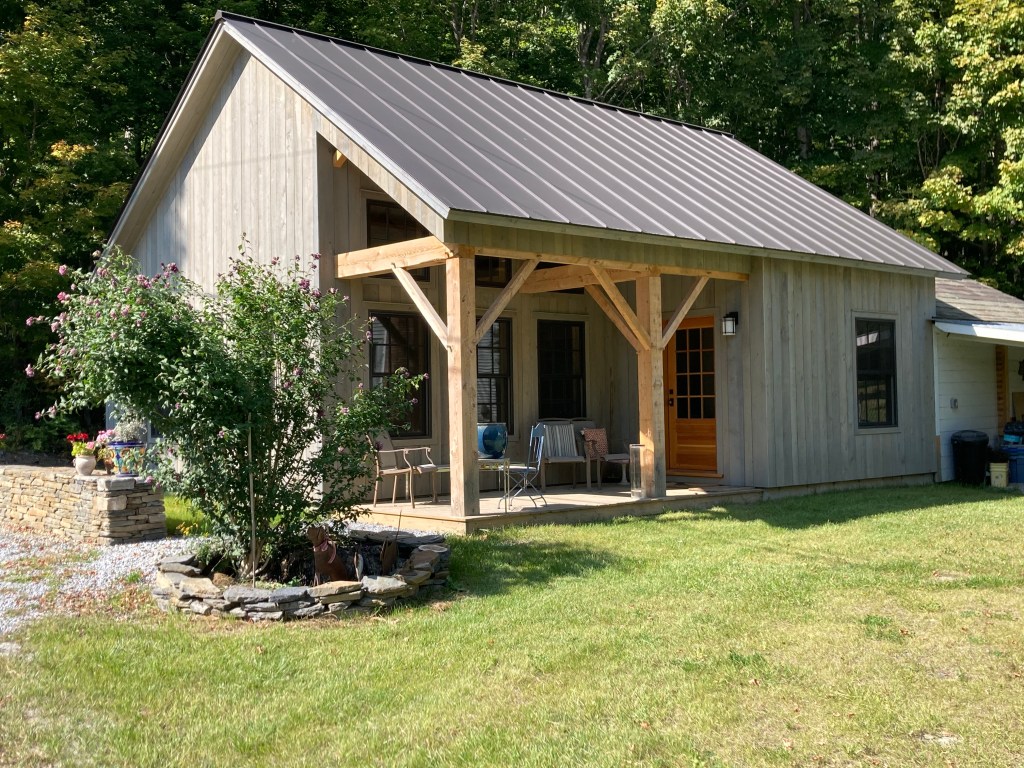
Home Life. It seems like we’ve had people over for dinner or potlucks, or staying with us for a few days, on every square of the calendar. It’s been a super-social year. And that’s before we get to the big project, which was the construction of our studio. It’s a treat (one of our neighbors called it “a public good”), but it occupied most of a year, from September to September.

Project by Glenn Tarbell, Tarbell Carpentry, Middletown Springs VT

With all of that going on, I haven’t made any space to just write. I’ve sat at the keyboard plenty, to no avail. I keep knowing that something’s going to come up, looking over my shoulder at all of my real and imaginary tasks, and so I don’t have the confidence to just go away for hours at a time and live in another world.

Writing isn’t about typing. It’s not about proofreading, or editing. Those things are all true, but they aren’t what writing is. Writing is fully inhabiting another life, as emotionally filled as my own. And that takes not merely time, but also permission. Permission I haven’t granted myself for a year.

I started this blog back in 2019, when The Adjunct Underclass was coming out. Since then, I’ve written three novels I’m really proud of; the blog was part of the discipline that let them emerge. But since last fall, I’ve had two really good ideas for a novel. And as the writer and teacher Robert Owen Butler says, if you have a good idea for a novel, you’re going to write a bad book. Stories don’t come from good ideas. They come from the spirit world, from what he calls “the place where you dream.” So I’ve driven those two books sixty or eighty pages into the swamp, with no hope of retrieval. That becomes its own cycle, work that doesn’t work that convinces me that I can’t do the work. Easier and safer to just lose myself to internet head.

So it’s time to be back, to clear the culvert and let the flow come free. Glad to see you.

Reserve Judgment

What did you say to me?
(Image by Mile Modic, via Unsplash)

You never get far away from town business when you’re in local government. I was getting ready to help out a little on our home construction site, and the lift operator came over to me. “I’d like to talk to you some time about this gravel situation.” And then I scarcely was able to track the next ten minutes, in which he told me about his pit that we didn’t buy from this year, and all the other pits around and which do and don’t provide good material, and about how he’s ready to help the Town any time but he won’t help the road foreman (even though the foreman is his cousin)… it was a real-time tour of the inside of someone’s mind.

I told Nora later that working in a small town is always like coming in to the middle of a movieโ€”people you don’t know, doing things you don’t understand, for reasons you’ll never hear. These are people who have come to their judgments of one another over decades, and who they are today is deeply inflected by who they’ve been before, who they’ve been around, who was kind to them or cruel to them or unfair to them, who slept with whom before who. It’s like the Garden of Eden: it’s a beautiful physical landscape, and if you go back one generation, everyone had the same parents.

But really, we encounter everyone we ever meet in the middle of the movie. That person who was thoughtless to us… they were raised in ways we’ll never know, have neurological structures we’ll never see, have goals that they probably can’t fully articulate even to themselves. I spent decades trying to look like I had my shit together, and I fooled a lot of people into thinking that I was a capable and balanced person. (Boy, were THEY wrong!)

When I first started studying teenagers, I met a big group of kids who met pretty much every night at a gravel parking lot in the middle of town. There were 25 other parking lots around town, but they (and their aunts and uncles and parents) always landed on this one. Now, we might think it’s strange, but if this is chosen and the others aren’t, there must be a reason for it. They’re trying to accomplish something, and using this tool to do it. It turned out that with a little patience and a lot of questions, I uncovered eight or ten things this parking lot did that made it perfect for teenage and young adult social life.

The great anthropologist Clifford Geertz once wrote that every good anthropologist he’d ever met had felt like an outsider as a kid. They learned not to take anything for granted, they studied the world around them rather than just accepting it as invisible and “normal.”โ€‚Judgment comes from believing that you know the rules; understanding comes from trying to learn someone else’s rules.

So remember today that when someone pisses you off, or confuses you, or does something heartless… you’re walking into the middle of the movie, and you just don’t know enough to pass judgment.

Christmas Guide 2023

What a lovely, festive wreath idea!!!

Here we are a week into December. Have you finished your Christmas shopping yet? Of course you haven’t. But I have just the thing. Go to my website (herbchildress.com), and have a look at the Books for Free tab. You’ll see more detailed descriptions of all eight of these books, plus some short story collections. Pick one, go to the Keep in Touch tab, and send me a message with your mailing address and the book you’d like. And guess what? You’ll get it.

For free. Really.

Now, that said, if you feel like covering some of the overhead, that’d be lovely. Each one of these books costs me about $8, plus another $5 to mail and $1 for the envelope. If you really do want one for free, I really will send you one for free. I’ve done it about a hundred fifty times so far. But if you want to get some as gifts, or to subsidize the free books received by others, you can Venmo me. @Herbert-Childress-1, whatever amount seems reasonable.

The community of independent literature thanks you.

Costs Money to Make Money

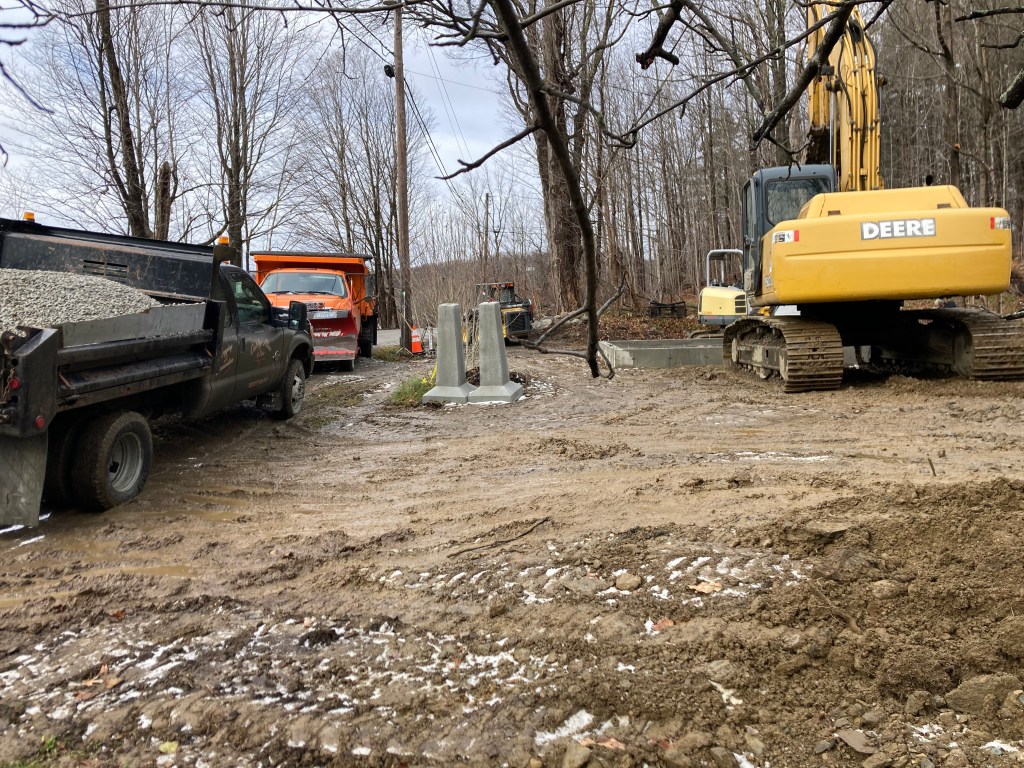
We’re having a smallish (26×30) new building put up on our site. At the moment, the foundation footing and frost walls have been poured, and the excavator is here to backfill and level around it before the slab insulation is laid and the finish concrete work is done.

Oakley Allen has been in the excavation and logging business for seven years, after having spent about thirty before that working for his uncle’s well-drilling business (he started there when he was twelve). The crew consists of Oakley and his son Levi… and a remarkable array of equipment. Have a look at this photo, taken at 11am today.

From left to right, we have:

  • a Ford F350 one-ton pickup with a dump bed
  • A Chevrolet Silverado 3500HD one-ton pickup with a dump bed, plow and plow hydraulics
  • (obscured by the two posts) a New Holland Super Boom Loader
  • (obscured by the big excavator) a Wacker Neuson EZ28 excavator
  • a Deere 160C LC excavator

Their big tandem-axle dump truck wasn’t in use today. Plus he’s got hand tools ranging from saws and shovels to pneumatic tampers.

This two-person business has equipment that, if all bought new today, would cost well over a million dollars. The concrete contractor, Tony Genier, has at least that much equipment of his own, plus the occasional arrival of a vast concrete mixer from JP Carrara. Then the electrician Eric Haynes, the teams from Green Mountain Power and Vermont Television, Dillon Hepburn who dropped the trees that were trucked by Jordan Martelle to the Woodell and Daughter sawmill to be turned into frame members by our general contractor Glenn Tarbell. This simple one-room building will have had twenty people on the site at one point or another, supported by at least five million dollars worth of equipment.

And that, friends, leads us to today’s vocabulary word: amortization. (A word that hardly any of these folks would use.) Once you buy an asset for business production, you need to pay it back a few dollars at a time through charging more for its use than you paid for it. (The self-employed contractor or small farmer is, without having ever read Marx, teetering right on the border between the MCM and the CMC economies.) I wrote a novel not long ago (called & Sons, after the common business names of so many small contractors) centered on a Nebraska corn farm that made over half a million dollars in commodity sales in one season, but only netted its owners the equivalent of about eight dollars per hour. Lots of money comes in, and almost all of it goes out without having stayed in the contractor’s pocket for even a minute.

During the California Gold Rush, most of the fortunes weren’t made by miners, but instead by merchants and suppliers who sold stuff to those miners. So too John Deere and New Holland and Chevrolet have made their money up front, and Oakley and his son scramble from one day to the next to try and earn it back. It ain’t makin’ any money just sittin’ there, one might say in the vernacular. You learn to run it all, you learn to repair it all, and only then do you get to practice your specialization.

There’s no moral to the story today, just a new appreciation for people who learn a trade and then have to learn to run a business alongside it.

Earthquake

The aftermath of what we hadn’t seen.
(Image by Dave Goodreau, via Unsplash)

Example One. Iโ€™m having some jaw pain this week. Iโ€™m pretty sure that I can track it back to dental work I had done about eight months ago. Other dentists have wanted to take out that oddly placed eyetooth since I was about twelve years old. It was never really in the way, wasnโ€™t doing anything, but my new dentist thought that its absence would help me clean in a less crowded location.

Well, of course, all the other teeth around it had been held apart for fifty years, leaning against that harmless little canine wedge. So now that itโ€™s gone, everything else is moving a little bit. (Thatโ€™s the principle behind orthodontics, of course, that your teeth can be moved at glacial pace.) It hurt a lot about three or four weeks after the removal, was fine all summer and fall, but now weโ€™ve hit a new moment where those subterranean forces have reached a tipping point and need to find a new resolution. Invisible and unnoticed for six months, and then all at once, an uncomfortable week of motion. 

Example Two. One of our neighbors attempted suicide last week. He wasnโ€™t successful, for which weโ€™re grateful, but it took all of us by surprise. But now that weโ€™re hearing from his family about whatโ€™s gone on over recent years, it shouldnโ€™t have surprised anyone at all.

He always seemed pretty close to his animal nature, doing the same thing day after day, week after week, season after season. He worked around town, mowed lawns, plowed driveways, unchanged for the dozen or more years Iโ€™ve known him. But on Thursday, he hit a new moment where his subterranean forces reached a tipping point and needed to find a new resolution. Invisible and unnoticed for a decade, and then all at once, an uncomfortable night of truth.

Example Three.ย On December 20 and then four days later on Christmas Eve 1940, two earthquakes occurred beneath Ossipee, New Hampshire. There was a lot going on underground, of courseโ€”anywhere there are mountains, thereโ€™s been some kind of geological thrust. But it seems also that there had been:ย 

  • a collapsed volcano 120 million years ago which made vertical breaks in the stone; 
  • the perimeter of the former St. Lawrence Sea or Mer de Champlain, which would have borne the weight of trillions of gallons of water but has been relaxing since the seaโ€™s recession ten thousand years ago; and 
  • a likely meteor strike in Charlevoix, Quebec about 45 million years ago, which formed permanent shear fractures in the rock structure for hundreds of miles.

But in December 1940, all of those subterranean forces reached a tipping point and needed to find a new resolution. All of it invisible and unnoticed for millennia, and then all at once, an uncomfortable week of shuddering.

Why Are We Talking About This? Everything that happens has precursor events. Some we know about, some we donโ€™t. But as narrative writersโ€”whether fictional or memoirโ€”we have the difficult task of making moments of great change simultaneously surprising and inevitable. 

โ€œForeshadowingโ€ is a technical term that makes it seem like weโ€™re winding up a music box thatโ€™ll play some tinny tune when we lift the lid. John Irvingโ€™sย The World According to Garpย has always struck me that way, cleverly designed but devoid of lived care. What weโ€™re really doing, I think, is following our charactersโ€™ concernsโ€”within the social context around themโ€”to their logical conclusion. The work of narration is selecting from the details weโ€™ve found to highlight the ruptures that will ultimately fail, the subterranean forces that reach a tipping point and need to find a new resolution. All of it invisible and unnoticed, and then all at once, an uncomfortable moment that reveals what everyone had hoped would be unseen. Or maybe never knew at all.

Of course, the event of rupture is followed by something. There is an aftermath of an earthquake, both collectively and individually. We rebuild the way it was, or we remodel from whatโ€™s left, or we leave town altogether for some place where the land seems more stable. 

Think of how much stress we can bear, right up until the moment we canโ€™t. And then think about all the work it takes to move forward from the collapse. Thatโ€™s where the emotional weight of the story lies.

What Must We Write?

There are things that weigh on us. Write that.
(Image by Christopher Catbagan, via Unsplash)

In her essay โ€œIn Praise of Panic,[1]โ€ novelist Stephanie Danler writes about the necessity of staying close to your own core emotions. In one jokey passage, she writes:

Writing can be taught. Itโ€™s not magic. Itโ€™s a technology for communication, and one can only hope it is our most enduring one. The best way to become a better writer is to read as widely as possible and then find a subject that keeps you up at night. There, I just saved you two years and fifty thousand dollars on an MFA.

But jokes aside, I think we can only write well about things that keep us up at night. We talk about a writersโ€™ themes, but I think those are only externally applied names for the writerโ€™s barely-identified inner obsessions, the itch they just have to scratch over and over again.

Joan Didion wrote five novels and ten books of nonfiction between 1963 and 2021. Theyโ€™re all different. Theyโ€™re all about different places and times and characters. But at the root of all of them, I think, is the question of what we do when we discover weโ€™ve been lied to. So many of her stories are about someone whoโ€™s been betrayed: by their culture, by their men, by political forces that emerge from across the horizon, by their belief that theyโ€™ll be protected by beauty or money. To use a sports analogy, she writes about people who learned the rules and played the game, had some early successesโ€”and then all their points were taken off the scoreboard and the rules changed, never again to be explained at all. 

Thatโ€™s a reasonable thing to write about for a girl born to Sacramento wealth and political power in the 1930s and โ€˜40s, who saw everything about Californiaโ€™s social structures come apart in the 1950s through 1980s. Someone took her silver spoon away, and she never recovered. (And I say that as someone who deeply admires her work. Joan Didion taught me how paragraphs work.)

Walter Tevis wrote six novels, all of which are about someone with an early sense of mission and mastery, a clear arc toward success, derailed by oneโ€™s own distractions and vices, but later (usually, not always) to recover a more mature version of that first mission. 

  • Eddie Felson, the pool player distracted by gambling and gamblers, who remembers in the end why he plays.
  • Thomas Jerome Newton, the alien who comes to take Earthโ€™s water for his dying planet, and discovers alcoholism instead.
  • Beth Harmon, the chess prodigy who loses her drive to drinking and uppers and anger, but who emerges with a purer respect for the game and her talents. 

Thatโ€™s a reasonable thing to write about for a boy with rheumatic fever who lived in a childrenโ€™s convalescent hospital for a couple of years, a boy who became a man who lost a prodigious writing talent to two decades of gambling and drinking and teaching college. A man who finally quit it all, moved to Manhattan and wrote for four brilliant, scorching years before dying way too young. 

Every writer has only one tale to tell, and he has to find a way of telling it until the meaning becomes clearer and clearer, until the story becomes at once more narrow and larger, more and more precise, more and more reverberating.

James Baldwin

Kenzaburo Oeโ€™s work is inescapably linked to his life as father to a disabled son. Nevada Barrโ€™s mysteries are all about a person who deeply loves the innumerable forces and expressions of nature, but whose National Parks job inevitably brings her into disappointing contact with mere humans.

Write what you know, they say. I know nothing of being a championship-level athlete at the end of high school, or of raising an adoptive daughter. I know nothing of driving a plow truck or raising field corn, of running a tavern or being a structural engineer. But I do know what it means to look like Iโ€™m doing okay from the outside, and know that Iโ€™m collapsing inside. I know what it means to have my work not pay off, and have to build a new life from old skills. I know what it means to have to choose between a good thing and another good thing.

Write what you know. Find a subject that keeps you up at night. Every writer has only one tale to tell.

And you may not recognize what that is for a long, long time.


[1] In The Sewanee Review, Fall 2023.

Controlling the Pace

They’re all there for a reason, bud.
(Image by Unervi Gonzรกlez, via Unsplash)ย 

The worst writing advice ever isย Show, donโ€™t tell. Itโ€™s like sayingย Gas, not brakes. You need both, and you need to be able to manage how you choose which pedal to emphasize.ย 

There are books that are chewy and dense, filled with ideas. Novels about social change, novels about questions of justice, novels about great historical trends that continue to play out. And there are books that are mile-a-minute, that suck you in and just wonโ€™t let go. โ€œI couldnโ€™t put it down,โ€ we say. And even within either kind of book, there are moments that move more quickly, and moments that draw back.

Thereโ€™s no โ€œright pace,โ€ thereโ€™s only decisions about how we control pace. There will be times when we want to be quick and immersive, and times when we want to be more deliberative and abstract. There will be some genres, like mysteries and romances, where weโ€™ll skew toward speed more often than not; there will be other genres, like novels of social criticism, where weโ€™ll skew toward deliberation.

If our craft is up to the task, our readers will be doing what the characters are doing. When our characters are arguing, our readers are tense. When are characters are doing something, our readers are feeling it. When our characters are observing, our readers are observing. When our characters are pondering, our readers are pondering along with them. Thinking is always slower than feeling; ideas take us out of scene and make us do more work.

Here’s a quick thought about the kinds of tools we have at our disposal to make a passage faster and slower.

Mine, (c) 2023. Make your own.

Imagine this as a series of sliders. If you mash them all the way to the right, it feels faster. If you push them all the way to the left, it feels slower.

Vocabularyโ€”short and simple words read quickly. Long and specialized and unfamiliar and esoteric words read more slowly.

Syntaxโ€”Simple declarative sentences read quickly. Longer and more qualified sentences, especially those with lots of internal punctuation (like this one) that require you to remember a root structure, read more slowly.

Plot Adjacencyโ€”scenes that are about the core character and their primary dilemma move faster; digressions and secondary/tertiary characters and subplots require us to keep track of more things.

Chronologyโ€”linear and relatively close-sequenced chronology is familiar. Chronological jumps, flashbacks, long absences, a narrator from the future commenting on the narrative present: all of those slow a passage down.

Activityโ€”if the scene is about people doing or talking, it’ll go quick. If it’s about people thinking, making connections, remembering, taking stock… so will we as readers.

I was at a talk recently in which the author spoke unambiguously about the importance of pace and tension. All good, but he’s an extrovert author of political thrillers, and he wasn’t able to reflect on the importance of different paces for different needs. It’s like a drag racing driver on a Formula 1 courseโ€”he’s just gonna go through a wall in pretty short order if he doesn’t do work that’s in a straight line.

All of this is like drivers’ training. It’s not enough on its own to know where the pedals are and what they do, it takes a lot of practice to be able to use them without lurching. But it’s a starting point, and I think that it makes something that a lot of writers do by feel into something maybe more learnable and controllable.

The Editor’s Early Roles

Gimme a minute… We’ll figure it out.

Nora and I were at the membersโ€™-exhibition open house last night at Stone Valley Arts, here in Poultney. We knew about a third of the artists, including two of the folks in our current writing group (Thanks, Melissa! Thanks, Burnham!). We snacked, we chatted, we looked at the work.

The organization of the show was interesting on its own terms. Itโ€™s different from a craft fair, in which every vendor is geographically segregated from every otherโ€”Daveโ€™s turnings over here, Nicโ€™s stonework over there, and so on. At this show, each participating artist had work in three or four different locations around the two rooms, commingled with the others. But it wasnโ€™t just a dumping ground. There was a logic to the organization. 

The first thing that drew my attention to that decisionmaking was a painting in one corner that had an oval-pear form at the lower left which closely mirrored the oval-pear form of a woodturning below it. The exhibition designers had clearly seen that formal connection and emphasized it through adjacency. We viewers then saw something more than weโ€™d have seen without that decision.

The editor plays a lot of roles over the development of a project, but the work of critique lies somewhere in the second half of the project. The work of the first half includes:ย 

  • Encouragement and identification of whatโ€™s going well
  • Deadlines and check-ins
  • Expansion of opportunities
  • Negotiating the writerโ€™s intentions and the readersโ€™ desires
  • Identification of themes and organization of the work to amplify/reinforce those themes
  • Preliminary thoughts on formโ€”what kind of a thing IS this, and how is it arranged?

Just as the writerโ€™s work changes over the duration of a project, so does the editorโ€™s.


Just so you know, Iโ€™m about to nerd out a little bit here. Stick with me.

Music is the space between the notes.

Claude Debussy

Iโ€™m just had the first rehearsal of the play I submitted to this yearโ€™sย Theater in the Woodsโ€™ Ten-Minute Play event, in which local writers come up with very short plays that are then performed together in a pair of single-evening shows: half on Friday night, half on Saturday.ย (Mark your calendars for Friday November 10 and Saturday November 11, with an additional Sunday matinee of three new kids plays, too.) Iโ€™ve done that a couple of times in recent years, and itโ€™s a fascinating experience to hand your work over to other readers in live-time.

One of the most common pieces of advice given to writers is to read your work aloud as you revise, to hear the lumpy spots. And you doโ€”boy, do you ever. Thatโ€™s kind of a normal part of my revision process. Where do I hear the emphasis within the sentence? Where do I hear vowel sounds align? Where do I place the hard-stop consonants that break long phrases into haiku?

So as I hear my plays performed for the first time, Iโ€™m not often surprised by how the actors read the words. Iโ€™ve done most of the work to let the text read itself. What I wasnโ€™t prepared for, what was really revelatory, was hearing the silences. Hearing how long someone paused between lines. Or within a line. Silences in a conversation, or even a monologue, are the moments where weโ€™re thinkingโ€ฆ and I could hear these characters thinking. 


One of the reasons I love typography (like that little separator we just passed, or the parentheses around this comment) are that they guide the reader to think in spaces and not just in sounds. We steer your thinking with all that stuff that isnโ€™t actually words. We help you slow down, help you hit words harder, help you hear repetition. Just read the score of a piece of classical music sometimeโ€ฆ composers offer instructions with the pace and density of an air traffic controller. Every note is guided not merely by pitch and by duration, the stuff on the staff, but also from above, a voice from God to guide us into right thinking about volume, cadence, connection or disconnection with the neighbors. He even offers little endearing Italian murmurs like affettuoso or sospirando, telling us what attitude toward life we should embrace as we play.

Text is filled with breathing instructions. The little channel between the period and the next capital letter (a gulf thatโ€™s narrowed over the past decades from two spaces to one as the pace of our lives has increased). The different tools we use to separate non-restrictive clausesโ€”commas, parentheses, brackets, em-dashes, even footnotesโ€”each of which signals a different kind of side trail from the main path of the sentence. One of the tools I rely on far too often: the ellipsisโ€ฆ a foot on the clutch to more gently shift gears, the three little dots that ease our pace as we enter the curve.

We have the word, the phrase, the clause, the sentence, the paragraph. The scene and the act. The novel and the three-novel trilogy and the whole Nancy Drew / Harry Potter / Jack Reacher oeuvre. We are taught to read by a broad taxonomy of spaces, given a chance to breathe and to think and to prepare for whatโ€™s next. Even when we binge-watch The Crown, we get to go to the bathroom once every 55 minutes, and use that moment to reflect on the collective tragedies of the last episode before we get into the next one. 

I know better than to even start Lucy Ellmannโ€™s 2019 novel Ducks, Newburyport, its single sentence stretching in a uniform-bordered carpet across literally a thousand pages. (One reviewer said โ€œthis book loves itself very much.โ€) I donโ€™t know how to read that. I donโ€™t know where I would stop by choice and where I would stop by exhaustion and where I would stop from impatience, but I know I canโ€™t stay awake long enough to read a thousand pages. Itโ€™s been called an โ€œambitiousโ€ novel, but I donโ€™t feel the need to be caught up in her ambition. The weakness may be mine, probably is. Thatโ€™s okay. Iโ€™ll own that. Iโ€™ll opt for the comfort of textual convention that allows readers to THINK theyโ€™re ignoring the road signs, even as those signs influence every driving decision. I mean, if I gave you a test to remember every single road sign between here and Rutland, no way could you do that. But you see them, and you use them, even as they (mostly) donโ€™t enter your conscious thought. 

When youโ€™re a reader, ignore all that, the man-behind-the-curtain stuff. Pretend you didnโ€™t see it, let it be invisible. It ought to be. But when youโ€™re a writer, start to look at something other than the 26 letters of the language. Start to seeโ€”and to hearโ€”the spaces.