Trance Time

Olga Ernst, Sunset at Long Beach (South Africa); Wikimedia Commons

Photographers and cinematographers have long known the power of the “golden hour,” when the sun is low in the sky, the shadows are long and dramatic, and the blue is all filtered away, leaving only golden orange.

But I would say that it’s the responsibility of all creative people to know what every time of day is good for. And that’s different for most of us, but the fact of being capable of different things at different times of day is just a fact of our own diurnal clock. It may be hormonal, related to our differing production of cortisol. It may be environmental, having to do with when the rest of our family leaves us alone. (Joyce Carol Oates, in her otherwise abysmal MasterClass lecture series, says one illuminating thing: that for the most part, writers are less hindered by lack of talent than they are by being interrupted.)

Whatever its source, there are times of day when we’re better suited to some things than others. For myself, I know a few things (all times approximate but pretty darn close):

  • Mornings (6:30 to 10:00) are for sustained, focused work.
  • Late mornings (10:00 to 1:00) are for chores, picking things off the list in ten-minute bits. Great for e-mail, household chores.
  • Mid-day (1:00 to 4:00) is social, the times when I can get on the phone or have a meeting.
  • Evening (4:00-8:00) is relational and transitional. It’s the time when Nora and I catch up, when Derrick stops by to show us what’s come from the garden, when we’re planning and cooking dinner.
  • Night (8:00-11:00) allows the return to sustained, focused work.

If you slow down for a day or two and pay attention, you’ll find similar patterns in your own life. The times when you can get things done, and the times when you lose track of yourself and fall into the trance. I’ll speak in particular about writing: I can tell the difference between editingโ€”shoving words around, being analytical and diagnosticโ€”and the loss of self and context (what psychologists might pejoratively call a “dissociative state”) that is necessary to genuinely inhabit other selves and other contexts.

You need to know this about your own relationship to the clock and the day. And you need to be ruthless about protecting trance time. Block out your calendar, don’t waste time online, leave your e-mail until later, and let yourself fall.

Open Studio

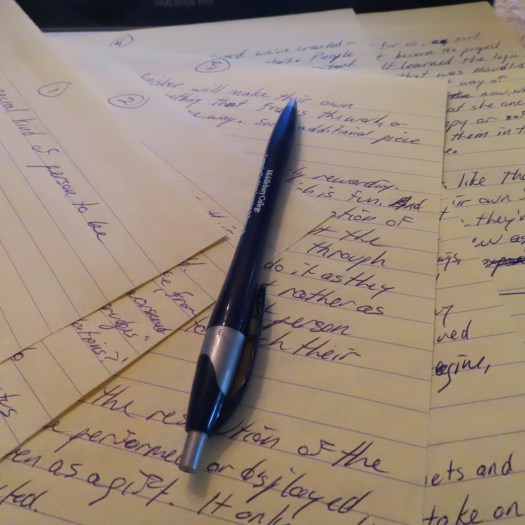
I woke up at 3:50 yesterday morning, with an odd thought in my head: a thought about an unseen group who do unseen kindnesses. I lay in bed for a couple of hours, working things through, hearing key phrases, seeing examples. So when I got up at five thirty, I handwrote five pages of notes, then built the first draft of a story. I knew I’d be working on firewood all day and then on client work all day Wednesday, so I had only until about 9:30 to get a draft together.

This is what it looks like.

The Elizabeth Ida Page Fund for the Completion of Things Left Unfinished

It takes a special kind of person to be a Finisher.

Here, Iโ€™ll show you one of my favorite ones. We have a database, of course, but some of them Iโ€™ve looked at enough times that I can go right to the volume and the page. This oneโ€™s in book 1982b. Tom Clayton. The Finisher on this was Phillip Chen, he’s a locksmith.

Tom was ten years old when he drowned at a cousinโ€™s swimming pool. Heโ€™d been working on a model car, and his parents talked about how much he loved cars. And they wanted this car as a memory of him. When Phillip talked to them, he started to realize that it wasnโ€™t really a model car at all, it was his image of the kind of car he really wanted. It was a ten-year-oldโ€™s picture of being an adult. So the car kit, when Phillip got it, was a gluey mess. Look at this picture, when it came to us; I mean, thatโ€™s just what a ten-year-old can do. But Phillip knew that Tom had an image of himself as a master model-builder, and of himself as a young man who might have a car just like this one day. So he spent four days disassembling the parts of the kit that Tom had already done, finding a solvent that would remove the glue but not damage the plastic parts. Then he built the model the way that Tom would have if heโ€™d been capable. See the seat-belt buckle on the seat there? Phillip used a single cat whisker to paint the center release button on that. Tom had already bought the can of metalflake blue paint that he knew he wanted, so Phillip painted three coats of that and then six coats of clear on top. Look at the finished picture, that little car just gleamed. Phillip built that stand that itโ€™s sitting on, too. Lots of our Finishers make something else in addition to the thing they started fromโ€”something that frames the work, or responds to it in some way.

Tomโ€™s parents are gone now. I think his sister has that model now.

Every one of these books, all the way back to the first one in 1907, is filled with stories like that one. We all have our favorites; you will too.


Although we have one namesake, there are really three founders of the Page Fund. Elizabeth Ida Page was a wonderful painter, she did portraits and magazine illustrations, some of her work is in private collections, thereโ€™s a small gallery at the Peabody. But when she died, she left one landscape in her studio that sheโ€™d worked at on and off for nearly twenty years. It was this romantic scene of her childhood, the creek behind her familyโ€™s summer cottage.

All unfinished projects are romantic, arenโ€™t they? They express some great inner longing that somehow we couldnโ€™t bring to fruition.

So when she passed, her husband James Wilson Page contacted another artist, a friend of Lizzieโ€™s named Constance Mullen. Connie spent two weeks at the Page home, and every day, sheโ€™d spend hours studying that painting, and Lizzieโ€™s other paintings, too. And every afternoon at six, she and James would sit in the studio with a glass of whisky and talk about that painting. About its techniques, its intentions, its spirit. They used that word a lot: spirit. Mr. Page thought that much of the disturbance of life, from wars to kitchen-table arguments, was worsened by the turmoil of the spirit world. In his letter that he wrote to establish the Fund, he wrote โ€œWhat are grudges if not the lingering spirits of unfinished relations?โ€

That became the mission statement of the Fund: To release the spirits of those who have left, to ease the spirits of those who remain, and to fulfill the spirits of the things themselves. And in some ways, thatโ€™s our three founders. Lizzieโ€™s spirit could rest with her painting complete. Jamesโ€™ spirit was comforted by having that painting with him. And Connie allowed the painting itself to fulfill its spirit, to come to the appropriate closure for its nature.

Thatโ€™s what weโ€™ve done, for over a hundred years, from Lizzieโ€™s painting in 1905, before the Fund was started, to last month. Each of these books is a gallery of spirits fulfilled. An unfinished novel or concerto completed. A summer cottage built out. A wood blank turned into a bowl. We donโ€™t privilege any kind of project. Weโ€™ll finish a sweater or a baby hat, or the studio of a fabric artist whoโ€™d wanted a teaching space for her technique, or a bed of irises that was the pleasure of someoneโ€™s lawn.

Our instructions to our Finishers are simple: to complete the thing in its spirit.

Phillipโ€™s finished a few things for us; Iโ€™ve turned to him a dozen times. I like how he frames it, he says it builds his creative empathyโ€”itโ€™s a new way to conceive of the kind of work he already does. Our Finishers find the work enormously rewarding, and most come back for other projects. They refer their friends to become Finishers, too. Certainly itโ€™s an intellectual challenge, which is fun. And some of themโ€”not all, but someโ€”accept the notion of the spirit world. But almost all of them talk about the liberation of being asked to see a work through the eyes of its own creator. To do it not as they themselves would have imagined it, but as its originator imagined it.

Thereโ€™s one writer who works with us, she teaches in a big creative writing program, sheโ€™s won lots of awards. No one knows that sheโ€™s a Finisher. Her own work is short and abrupt; itโ€™s been described as brutal, a description she doesnโ€™t mind. But she finished a novel for us, a family epic that had been left behind. And she said that because the project was maudlin and ornate, she herself learned the logic and the pleasures of making a story that was maudlin and ornate. She was able to inhabit that way of writing, to inhabit that motive spirit. And now, when her students come to her with stories that she might have rejected outright as being sappy or soft, now she knows more ways to support the spirit of what they want to achieve.

All of our Finishers come to us by referral from other Finishers. They know a few friends who have that ability to keep their technique but let go of their own motives. To see what exists in a half-finished thing, and to finish it on its own terms.

Really, all of our work is by referral. We donโ€™t make our work publically visible. When we called you a month ago, youโ€™d never heard of us either. Thatโ€™s our goal. Our clients come to us through a network of grief counselors and estate lawyers and hospice nurses, people who encounter unfinished spirits every day in their work. When people are near the end, they often talk about some great project that theyโ€™d never spared time to finish, that weighed on their closing days. After a death, families often talk about some great project that their parent or partner had always set aside in order to help others. Those conversations are the origins of our work.

Our donors all come by referral as well. Mr. Page left half of his estate to this project, the other half stayed with his family. Over the years, itโ€™s grown, of course, but weโ€™ve always wanted to keep our projects and our capabilities level. We have no need to be any particular size, weโ€™re not Harvard; we just want to do the work weโ€™re given. Our current donors know their own friends well enough to know who would be touched by our mission, and who donโ€™t need their names on a building. Or who already have their names on enough buildings.

Some of the client families are in a position to donate to us as thanks for our work, and we welcome that, of course. But we take on any project that appears. And often, our Finishers donate their work, or reduce their rates, because they find the idea of spirit completion to be compelling. Phillip spent over a hundred hours on Tomโ€™s model car, and charged only for the fifty dollars he spent in paint and glue and solvent. Tomโ€™s parents couldnโ€™t have afforded even that. It was our gift to them.

This whole library is filled with those stories, a book or two or three for every year. Every project has a statement about its original creator, and the status of the project when it arrives to us. It has the Finisherโ€™s statement of guiding principles that they believe are the projectโ€™s motivating spirit. And then it has a record of its completed stateโ€”photographs, audio recordings, published texts.

The Fund is its own project of completion, just like all the others, and we find our own replacements to move our work forward. And now youโ€™ll be the Finisher in Chief, as it were. Iโ€™ll be writing my record of the closing state as Iโ€™ve delivered the Fund to you, and youโ€™ll be writing your record of the status of the project as youโ€™ve encountered it, and the spirit that you believe motivates it as you carry it forward. Each of us has done the same at the beginning and end of our termsโ€”only five of us in a hundred fourteen yearsโ€”and that archive is here as well.

Iโ€™m looking forward to my retirement. There are a few things Iโ€™ve always wanted to get to but never made time for.

A few months ago, I shared a first draft of a much shorter work, again in the spirit of letting you see that what comes first isn’t necessarily what will be completed. I’m not convinced by the form of this yet; it came to me as a monologue, but it might be a fairy tale. The point of view might change away from the retiring director to that of the incoming director, or it might become a dialogue between them.

You could Finish it yourself, if you like. To take it in the spirit of its conception and move it forward.

There’s a long practice in Vermont on Memorial Day and Columbus Day weekendsโ€”the Vermont Arts Council puts on an Open Studio weekend, and publishes maps with the hundreds of woodworkers and potters and painters and jewelers around the state who are willing to host visitors in their workshops. There’s always work for sale, of course, but part of the pleasure of the day is being able to see the sequence of work that’s normally kept from us. To see the block of raw clay cut with dental floss into cubes that will be put onto the potter’s wheel. To see the dribbly pots of paint that become the landscape. To talk with the wood turner while the chips scatter on the floor beneath the lathe.

Writers don’t do open studio. We sequester ourselves until a story or an essay is “complete,” whatever we consider that to mean. We don’t make our notes public. And I think that’s too bad. The work starts to seem either mysterious (the writer as mystic) or plain (the world is full of text, after all, and it must be pretty easy to make), depending on the hubris or humility of the reader. And it’s neither. It’s work, like any other.

So welcome to my open studio day. Thanks for stopping by.

GIFs of Mortification

Today, friends, I’m going to do you a huge favor. Three favors, in fact. I’m going to let you know that you’re not alone. I’m going to give you language that lets you re-name something, and thus get some ownership and control over it. And I’m going to forgive you… and myself.

Every so often, with no prompting and no relationship to what’s actually going on around me, I’ll recall some moment of my life where I was stupid or thoughtless. Sometimes I’ll actually moan out loud at my dumbassedness, ashamed all over again of something I said or didn’t say, something I did or didn’t do, forty years ago.

The worst of those are in the middle of the night, where I wake up at four in the morning for no discernible reason, and one of those will run me over and I’ll lie there for half an hour thinking about it. But although we have that stereotype of the churning, sleepless night, these moments can come to us any time. While we’re chopping vegetables for dinner. While we’re driving. While we’re waiting in line at Panera.

You too, huh? Thought so. And there’s favor number one. You’re not alone. This is a normal experience.

And although these kinds of moments of mortifying remembrance happen to us all, and always have, we don’t have good language for them. I’ve heard them called “cringe attacks,” which isn’t bad. But I think that the 21st century has finally let us see those cringe-worthy memories for what they really are. They’re GIFs. They’re little snippets of the movie, pulled out of context and set into a loop. Your head is its own little Pinterest board of GIFs, its viewership set to “private.”

So thereโ€™s favor number two. GIFs are fun, right? Theyโ€™re dumb little moments that exist outside our present selves, that make us laugh. We donโ€™t look for them, they just come to us in e-mail blasts from our friends or our moms. We look at them for a few seconds and then go on to whatโ€™s next. Your little cringe-GIFs can be the same, passing by us as we move along our day. Let ’em go and get back to work.

Favor number three is a reworking of an old folk saying: Youโ€™re gonna eat a peck of dirt before you die. Well, youโ€™re gonna be a bunch of memes before you die, too. We all are. We all say stupid, insensitive things. The questions are a) were they accidental or ignorant, or cruel and purposeful? and b) are we trying to grow past them? You are bigger than your memes. You are more than your GIF pinboard of mortifying errors. Itโ€™s okay to have been wrong. Just try to be right next time. And know that you wonโ€™t, always.

You’re welcome. Go be strong, okay?

Tough Times

It’s been a couple of weeks since I last wrote here. To use one of my favorite words, I just haven’t had the gumption for it.

I’m not afraid of the dark, or afraid of public speaking, or afraid of thunderstorms, or afraid of spiders unless I get surprised by one. I have three phobias, things that render me completely incapable of reason. One is heights; I can’t stand on a balcony or look over the railing or stand within a hundred yards of a bluff or a cliff edge. A second is coming up the stairs from a basement, always imagining what might reach out to me from behind. And a third is anger. Live, sizzling anger that feels like the last second of the fuse before the dynamite.

We’re living in a time of anger. Of gangs that call themselves militias and mobs who call themselves patriots, ready to engage in some half-assed civil war instead of actually trying to listen to their neighbors. Of senators willing to declare that decorum and precedent and evidence are no hindrance to their willingness to get what they want. Of pastors sending sexually violent threats to female reporters. Of a President who says that our nation’s death toll wouldn’t be so bad if you just subtracted those states that didn’t vote for him.

Even locally, vendettas feel more immediate than cooperation. Our local online bulletin board has seen a flurry of angry rumor-mongering in advance of the fall election. People saying things that are demonstrably false or self-contradictory, trying to gin up some righteous fury for November.

Any phobia produces an immediate fight-or-flight reaction. And that’s useful for the thirty seconds it takes to run away from the bear, but completely untenable if we inhabit it for days or months. It depletes us, wears us to nubs, leaves us nothing but the dregs in the bottom of the cold coffee.

There’s been a lot of scholarship about the emotional impacts of Covid and social isolation. We’re already lonelier, more separated, our comforting routines no longer available. And so we’re depleted, and thus more susceptible to quick, reactive thought anyway. Anger flourishes when we’re weakest, when we have no other options. It feels better than the malaise. It’s like trying to heat a cold house by lighting matches: it takes a lot of matches, leaves us surrounded by waste, burns our fingers quite a few times… but at least it feels like we’re doing something.

I grew up as a burrowing animal, going underground at the signs of danger. (My totem creature is probably the groundhog.) I grew up with plenty of anger, unpredictable as anger always is, and I learned isolation. But there’s no way to isolate yourself from an angry culture. We can only try to be the countervailing force, the infusion of generosity into the howling pain around us. We have to focus outward, look for places where kindness can calm the burn.

So yeah, I’m back. Let’s think about something interesting for a change. Come on in.

It’s All Good, Man…

Don’t harsh my mellow…

Let’s recap the last couple of days. We’ve discussed the perpetual fussing over the boundary between literary and genre fiction, and proposed instead that we should be discussing the difference between writing that acts as a pioneer into unknown terrain, and writing that acts as a settler of that opened frontier. As I wrote yesterday, that diminishes the value judgment inherent in assigning something “literary worth,” since one can be a good or an inept pioneer, a good or an uncivil settler.

So we’re left with the question of “good,” the question that drove Robert Pirsig to madness as he pursued his study of Quality. What makes some things good and other things less good? And why can we disagree about a thing’s quality?

Arthur Krystal, the guy whose essay started my little Chautauqua, talks about the writer’s (and by extension, the reader’s) sensibility, the ability to appreciate and respond to complex emotional or aesthetic influences. So in this formulation, multiple opinions about quality are simply judgment errors made by those without sufficient sensibility. If you like Cardi B or Doritos or muscle cars, you just aren’t mature enough to know better. We spend far too much time in this place, blaming one another for their decisions rather than trying to understand them. That position of judgment is its own act of low quality, leading to our current irretrievable polarization.

But the opposite shore, that of radical relativism, offers us nothing better. “It’s all good, man” is nothing but an abdication of agency, an assertion that no decision can ever be seen as better than another. As the philosopher John Cougar Mellencamp put it, “nothin’ matters and what if it did.”

Let’s propose a new path. To do that, we’ll assert that nothing exists on its own, but rather in community with every other thing. An ecological understanding of quality, let’s say, in which we ask how all other things are affected by this one. In that formulation, we would then ask: does this thing enhance other things, or diminish them? Is it generous, or hostile? And of course, to claim that something enhances other things would mean that it makes those things also more generous, in a long and not fully predictable chain.

The relationship between any individual object and its ecosystem gets pretty complicated. Let’s think of sports, for example. The grace of beautiful, superhuman physical action lifts us all. LeBron James’ famous block of Andre Iguodola’s late-game layup, for instance, is one of those moments of grace that will stay with its viewers for years. And yet, any sporting event can also be reduced to chest-thumping tribalism in which we all try to enhance ourselves by the very fact of diminishing others. The way we consume an object is also part of its fate, part of its quality judgment.

When we speak to our political opponents, do we try to defeat or demean them, or do we try to move them a quarter-inch further down the road toward wisdom? And are we willing to be moved incrementally as well?

When we listen to music, do we hope that it washes over us, a soundtrack to our tedium and inattention? Or do we try to hear decisions, try to understand what it’s doing and what its alternatives might have been?

When we read, are we engaging the work from a place of growth and kindness and humility, or a place of hubris and ranking, or a place of distraction no different than scrolling at random through YouTube? And when we write, are we creating something that will lift, or illuminate, or offer? Or are we creating monuments to our own intellect, or marketable content, or more fuel for a flame war?

Show me something that inspires you, and tell me why. That’s where Quality resides.

Pioneers and Settlers

Covered Wagon in Kansas Windstorm, Harper’s magazine, 1879

We talked yesterday about the difficulties in differentiating between literary fiction and commercial fiction. Today, I’d like to offer an alternative classification scheme. But I need to give you a little backstory first.

I’ve written before about an editor at a major house describing one of her recent acquisitions as “the first millennial post-apocalyptic office novel.” I was, and remain, unimpressed by the innovation, but I know that people love to put things together in new ways. And this takes us to another of the comments I’ve received from my writing group:

The academic angle by itself would be a tough sell, and the foster angle by itself has been done many times over. Put them together and thereโ€™s great potential for new energy.

This, I think, is perhaps one of the most crucial differences between what we think of as literary fiction and all the rest. Those who would aspire to the “literary” label must be pioneers. They must construct something unlike what has come before. They are pushing the boundaries of what is known about fiction; their allegiance is to literature as a practice, rather than to any particular story itself.

I’m grateful for pioneers. But a vastly larger number of writers might better be described as settlers, building productive and neighborly lives on land already cleared.


Even in literature and art, no man who bothers about originality will ever be original: whereas if you simply try to tell the truth (without caring twopence how often it has been told before) you will, nine times out of ten, become original without ever having noticed it.

C. S. Lewis

Where does this drive to novelty (the word novel, of course, being closely related) come from? Well, there’ve always been pioneers, in every field. But to oversimplify, I think that a lot of the pressure to create self-consciously literary fiction comes from the second half of the 20th century and the normalization of the MFA in creative writing. University faculty have their jobs not merely because of what they know, but because they’re engaged in the creation of new knowledge. They research and publish things that the rest of the world has never before understood.

That’s easy to demonstrate in the world of physical and social science. We do a literature review that tells us what we do and don’t know about some phenomenon, and then we propose a question and a set of methods that will help us know something more than we did. MFA faculty are likewise pushed to create that which has not before existed; not merely a more perfectly honed version of a known form, but a new form that advances (and occasionally unsettles) the field. The abilities to name the established knowledge and to formulate a hypothesis are substantially different than they are in more “tame” fields, but the drive toward advancing our knowledge is the same.

Since college faculty recreate their own interests among their studentsโ€”not through imitating the smallest areas of content and form, but in dedication to the larger principles of originality and advanceโ€”all of those MFA grads who now populate agencies and editorial offices and book-review columns are trained to see novelty as a definitional trait of serious fiction. It’s a paradoxical sort of meta-copying, nervously looking over our shoulder to see the wave of current interest crashing down behind us. We will surf, or die.


I often find it useful to compare one’s field to others; the comparison helps to highlight things we take for granted in our work, that are entirely unlike the work of different crafts.

There are a handful of restaurants, for instance, that carve out the boundaries of what can be done with food. Molecular gastronomy, cellular aquaculture, gas-injected protein foamsโ€”the culinary world is always moving, just as any craft is always moving. But the proportion of restaurants that live out on that edge is minuscule; most restaurants are just trying to provide a good evening of hospitality, as its particular body of customers defines that. And that’s noble work, and damned hard to do well.

Culinary schools and kitchen apprenticeships focus on known craft, and teach their participants how to do good work reliably, efficiently, and with some degree of grace. If there were a master of fine arts in culinary production, the restaurant professions would shift much more thoroughly toward the pioneer rather than the settler. Conversely, if writers were trained in literary institutes, preparing for steady professional lives in writing, those programs would be turning out lots and lots of settlers who were prepared to offer solid genre experiences.

And let me be clear that the difference I’m proposing between pioneers and settlers is in no way a value judgment, whether we’re talking about dining or reading. It’s a statement of preference rather than absolute worth, and it relieves us of the burden of deciding what’s “canonical.” We’d quit worrying about representation and dead white men, and we’d be talking about different kinds of experiences for different communities who held different preferencesโ€”and we’d be talking in detail about those preferences and experiences, and thus broadening all of our own.

One last pass through this stuff tomorrow.

Dismissed

When I was in architecture school in the late 1980s, there was a commitment to architecture that could not be easily understood. Architecture that stood apart from its surroundings, offering aloof commentary. Architecture that was entirely about the creation of logical order, and not at all concerned with either the logistical or emotional support of those who would encounter it.

That was really what Modernity and Modernism were about, no matter what field we were engaged in: the idea that rational progress was the only goal, and that any sorts of emotional or cultural attachments were merely sub-rational reflexes which we could be trained to leave aside.

I wasn’t wired in the correct intellectual array to accept Modernism. I was a working class kid from the Midwest who knew that people wanted to come home after a long day in the shop to some combination of comfort and delight, both of which are concerns declared out-of-bounds in Modern discourse. And so it’s not a surprise that, as a writer of fiction, I again have no clear footing in the academic categorization within which books of Literature are on one side of the fence, and those of Genre or Commercial Fiction are on the other.


A few days ago, my Sunday New Yorker feed linked to eight or ten “classics,” articles from the magazine’s archives to which I, as a subscriber and member of the cultural elite, am granted access. And one of them just pissed me off: the October 2012 essay on literary fiction by Arthur Krystal entitled It’s Genre. Not That There’s Anything Wrong With It!

To sum up quickly, Krystal argues that there is an inevitable and true boundary, like a river, between the lands of Literature and Genre. The relations between the two nations are occasionally friendly, occasionally hostile, but the root fact is that they represent two entirely different cultures, and that it’s crucial that we all understand the difference. He insists that we acknowledge that “good commercial fiction is inferior to good literary fiction.”

The problem with his essay, perhaps inherent to the limitations of magazine real estate, are that he leaves all of his terms undefined. There is no firm definition of what constitutes “commercial” or “literary” fiction; no firm definition of the good in “good fiction” of either type; and no firm definition of what would make something “superior” or “inferior.” It’s a shaggy essay that ought to be sent back for revision.

But let’s do what we can. Let’s see if we can intuit what he means by any of this. He’s in the New Yorker, after all, so his ideas must be worth exploration, unlike some guy with a blog.

Let’s start at the end, with his examples of things that fit into one or the other camp.

Quality comes in different forms: there is Cole Porter and there is Prokofiev; the Beatles and Bach; Savion Glover and Mikhail Baryshnikovโ€”the difference between them is not one of talent or proficiency but of sensibility.

Because we’re culturally savvy, we’re supposed to quickly read the differences between those pairs. So what are the differences?

  • the Popular side are from the 20th century; the Serious side are from traditions much older;
  • the Popular side were aimed at the masses, and the Serious side at the more educated elite; and
  • let’s be honest: the Popular side are drawn from the non-white traditions of jazz and rock ‘n’ roll and hip-hop, those from the Serious side from Northern Europe

If the differences between the Popular and the Serious are “not one of talent or proficiency but of sensibility,” then we need to take the idea of sensibility (the ability to appreciate and respond to complex emotional or aesthetic influences) seriously. We are either “able” to appreciate complexity or we aren’t; it is a moral judgment of the consumer as much as of the producer.

And literary trends are by definition about the reader. If a whole bunch of us go left, then the sales figures will show that; if we then move right, that trend will emerge as well. Literature of all stripes by necessity has writers and readers; a verdict about which camp a book falls into is a verdict about both parties in the exchange.

Krystal trots out a few possible differentiating field markings of literary or genre fiction, and then immediately disqualifies them himself. The division isn’t based on plot versus lyricism. It isn’t on the quality of language, of raw sentence-craft (though he spends a lot of words on genre’s “language that is at best undistinguished and at worst characterized by a jejune mentality and a tendency to state the obvious”). It isn’t about the writing at all, in fact. Let me try to cobble together a working definition of the boundary from his essay:

A good mystery or thriller isnโ€™t set off from an accomplished literary novel by plotting, but by the writerโ€™s sensibility, his purpose in writing, and the choices he makes to communicate that purpose. There may be a struggle to express whatโ€™s difficult to convey, and perhaps weโ€™ll struggle a bit to understand what weโ€™re reading… One reads Conrad and James and Joyce not simply for their way with words but for the amount of felt life in their books. Great writers hit us over the head because they present characters whose imaginary lives have real consequences (at least while weโ€™re reading about them), and because they see the world in much the way we do: complicated by surface and subterranean feelings, by ambiguity and misapprehension, and by the misalliance of consciousness and perception.

So as best I can make out here, literary fiction is literary because a) it’s hard, and b) its characters are conflicted. That’s pretty thin porridge. It’s kind of like the schism between the Orthodox and Hicksite Quakers in the 1820s, a community who divided themselves forever on the slimmest theological grounds. The divide is, simply, books that are read by people like us… and books that are read by people like them.

And note again his examples. Joseph Conrad. Henry James. James Joyce. The marble busts in the library, carved into their perpetual scowls.

Modernism is merely an intellectual manifestation of masculinity, the last pre-feminist landscape of the humanities. So it’s no surprise that it employs masculine justifications for its reading biases. It sorts the world quickly into tribes, and declares one of those tribes to be superior and deserving of our loyalty. It valorizes the stoicism of “close reading,” picking one’s way across stony and inhospitable fields, and denigrates ideas like generosity and welcome. It’s all head, and no heart.


With all that in mind, let’s look at some of the recent critique of my own writing, from my group of friends who meet monthly or so to read and talk about one another’s work. Critique is always hard businessโ€”we’ve put our very best work on the table, for review and dissection by others. And the critiques are really wonderful, after the bruises heal. We see our own work in new ways, see doors that we’d overlooked on our first visit. These friends are talented writers and readers who have enriched my craft.

But sometimes, the terms in which the critiques are framed are revealing of our differences across this boundary of “serious” and “commercial” fiction. Here are a few selected excerpts:

  • Perhaps your main challenge will be to avoid โ€˜Melrose Placeโ€™ territory, and Iโ€™m sure you aspire to more than a soap-opera plot
  • Iโ€™m not sure whether this opening is departing all that much from the conventions of the romance novel
  • The repartee between Dan and his sister is good, but maybe you can hint at some darkness there.
  • I felt very strongly that the story was suddenly organizing itself around a classic love triangle: unhappy/neglected wife finds new vitality with another man.

Because my friends are serious writers, they’re quick to sniff out the rot of genre, to wish always for “ambiguity and misapprehension, the misalliance of consciousness and perception.” They’re uniformly quick to point out the quality of the writing itself, that it’s polished and has wonderful turns of prose and carries the reader effortlessly from front to back (one of my favorite comments ever was “it does crack along!”). But that craftsmanship is not sufficient to the demands of Modern intellectual fiction, which is always about ambiguity and uncertainty and the struggle for the reader to understand what’s going on.

Those concerns are simply not of interest to me, just as they weren’t in architecture school. And as Krystal points out, the difference between literary and genre fiction is at least in part “the writerโ€™s sensibility, his purpose in writing, and the choices he makes to communicate that purpose.” So I guess I know which nation I’m a citizen of.

More on Friday.

Skimming

You’ll notice they’re both wearing suits… that we paid for.

All of the names related to today’s learning have been redacted, because it’s just too much to deal with. And really, the specifics don’t matter. It’s the pattern. Always look for the pattern.

Nora and I just refinanced our home loan, taking advantage of lower interest rates. We always prefer to do business with people and groups we like, rewarding them for their prior good work, attempting to build a longer relationship. So we used a mortgage lender affiliated with our retirement investment company.

You know what? It’ll be simpler if we just use letters.

We have our retirement accounts with financial group A. They have a division (A1) that does mortgage work, so we used A1 for the refinance. At the closing, we discovered that A1 had already transferred ownership of our loan to mortgage lender B. We hadn’t even signed the closing documents, and there was already another partner in the deal.

Before we could even make our first mortgage payment, we learned that Fannie Mae (C) had bought the loan from B, so that B could have more money to make more loans. That’s what Fannie Mae is: a liquidity engine that lets banks keep lending the same dollars over and over without having to be big enough themselves to cover it all. But B will continue to be our “mortgage servicer,” which means they’re handling the bookkeeping of our payments and the escrow for taxes and insurance, so even though we bought the loan from A1 and it now belongs to C, we pay B.

Good so far?

So we called B today because we wanted to clarify a small inaccuracy in the property taxes, and we were told that the tax component of the escrow payment was only an estimate, that B would pay the actual billed amount of tax, and that we’d re-balance the escrow account when the annual tax rates are recalculated next summer. B uses a different company altogether, D, to actually make the phone calls to county offices and insurance companies to verify actual rates; according to our very nice customer service rep at B, all the mortgage lenders hire D to do this for them.

For every transaction, so many people in line with their hands out, demanding their vigorish to organize the game. Every time you spend money, there are invisible people skimming their percentage to lubricate the proceedings.

When a farmer sells milk, they don’t get the $4.50 per half gallon that organic milk costs in the supermarket. The farmer sells it to the coop for processing, who sells it to a packager, who pays a distributor, who gets it into the grocery store. And each of those intermediaries gets paid. The farm price for raw milk in Vermont is about a sixth of its final retail value; about 85% goes to all the others in the sequence.

I was corresponding with a friend who’s an adjunct college teacher. She told me that she was finishing a twelve-week graduate writing course for eighteen students, a course for which she’d been paid $2,000. So the teacher’s cut was $9.26 per student per week. Each student was getting a rich and closely personalized intellectual experience for about the cost of a mocha frappuccino and a pumpkin scone plus tax. She should have a tip jar.

The school charges each student twenty-six times that much, just so you know. Or, to calculate it a different way, our beleaguered teacher receives 3.8% of the total tuition for the course.

When you buy a $28 hardcover book, the author gets about $2.25. (And then subtracts 35 cents for her agent.)

When you buy a pound of Rainier sweet cherries for eight bucks at Whole Foods, the field picker got twenty cents.

It’s really astounding how many people have their hands out, and how little of the final take actually goes to the worker. We support all of those invisible skims every time we offer our labor in the marketplace, and pay them with every transaction.

The Reliquary of Unknown Writers

Language of the Birds, by Brian Goggin and Dorka Keehn. San Francisco, 2006-08.

I have discovered my next project. A repository of sentences created by the unpublished and unseen writers all around us.

In every endeavor, there are those few who are celebrated and remembered. That celebration necessarily obscures the contributions of the multitudeโ€”anonymous on the fieldโ€”who also played our necessary roles. There are so many writers whose work, crafted with every fragment of attention we can muster, will never reach publication. Will never reach readers. Will never move those who would most benefit from it.

The heroes will have their statues and awards, as heroes do. We will have our own reliquary of the works we have brought aboutโ€”a reliquary containing shards, scraps, the fossilized remains of our dreams. We may never be known, but in this space you will see the artifacts we have made. They come to you, as fossils do, incomplete. Without context, without attribution, with precise histories unknown. They are left for you to interpret as you will… and to honor, for a moment, the unknown writers who have brought them into the world.

This project will bring us one tiny passage from each of the larger works submitted. Will remind us that even in the least fan-fiction, in the least eighth-grade short story, grace is possible. We watch the world carefully, we writers. We bring news from the front, forecasts of emergent climates, signals from space. We are secular oracles, carrying prophesy that we do not entirely understand ourselves.

Each passage will bear its own magnetic charge, which may draw readers slightly away from their planned course. We may find ourselves subtly rearranged by forces too small to be seen.

These scraps will appear at random, unsequenced, as though by hand of fate. They will not be searchable. They will not bear the name of writer or story. They will simply be sentences, which is all the writer ever has.

The reader can use each sentence as it arises, as they choose, as readers always do. Sometimes as pleasantry, sometimes as divination, sometimes as meditative koan, sometimes as a spur to writing of their own.

This project will grow over the coming months, and probably will look different than I currently imagine it. But now it exists already, because it has been named. Because it has been made into words.

It will be a beautiful landscape, a monument to labors unseen and unacknowledged. A landscape that will reward our patience and consideration.

I have been bitten by many innocents, but sometimes thatโ€™s what kindness gets you.ย 

Before Utah they carried their clothes in sacks on their backs. His father taking them from beet farm to beet farm. In Nebraska, the harvest took every ounce of their energy.ย 

There is public property that is not meant to be touched.ย 

The new god said: Worship me and I will save your children both in life and in death.ย 

There were no lentil salads in Orlando. There were no fresh scallops atop a bed of greens.ย 

He didnโ€™t think of himself as a lawyer. And he felt the pressure coming on of not only having to speak and behave as though he were one – well, in fact, heย wasย one – but also to speak and behave as though he were comfortable being one and thinking of himself as one.ย 

Youโ€™re not even twelve and yet I have nothing to teach you. It would be easier to produce the ordinary, to be ordinary. But I know you wonโ€™t settle for that. I fear for you.ย 

It is this easy access to casual voluptuousness that so agrees with her.ย 

I tried really, really hard to think of her as a colleague rather than a girl with pretty fingers and a cute haircut.ย 

But that was all in the days before she started secondary school where the art teacher started in on her, filling her head with notions, turning her sights on different landscapes.

Swimming Against the Current of Unearned Confidence

There’s a nineteenth century sayingโ€”variously ascribed to Mark Twain and Josh Billings and Will Rogers (probably not) and Artemus Ward and Kin Hubbardโ€”that encapsulates how I feel about the world today:

It ainโ€™t what you donโ€™t know that gets you into trouble, itโ€™s what you know for sure that just ainโ€™t so.

There’s a vast crowd of people who get their information from Facebook who believe that mail-in voting is a scheme for massive voter fraud, even as they aspire to more “local control” over elections, local control that’s been demonstrably (and almost definitionally) uneven.

The birthers are back, this time wondering if Kamala Harris is eligible to be VP. “I heard it today that she doesnโ€™t meet the requirements… I have no idea if thatโ€™s right.”

Nora was called to the town office today to review the one minor-party ballot cast in last Tuesday’s state primary, to see who got the one write-in vote. The Board of Civil Authority (BCA) members present, along with our state representative and our town clerk, representing both major parties, unsealed the ballot bag and took careful notes along the way. But they were told firmly by a state representative from another district (a friend of the clerk) that what they had done was ILLEGAL. Not merely that it didn’t comply with best practice, though I haven’t looked up the state code to see what it says, but ILLEGAL. The BCA members appropriately called the secretary of state’s office and described what they had done and why, and were reassured that it was all perfectly acceptable, and thanks for checking.

Stupid people lean on their caps lock, both figuratively and literally. They seem to equate loud with true, repetition with fact. The concept of slowing down and looking something up has never once occurred to them. And in the time it takes me to look up and debunk one bullshit thing, they can broadcast seventy-four more. The ratio is off. And when they’re disproven, they back away from it, and say, “I just thought it was funny.” Honest, I spent a whole Saturday back before the 2016 election carefully looking up each so-called fact that someone had sent me in a giant group e-mail, taking each one apart with real statistics, and sent it to the fellow who had first forwarded the nonsense to his group. His reply? “I just thought it was funny. Something to think about, right?”

No. No, it’s not something to fucking think about. It’s something that should never have made it to the table in the first place, because it makes no sense. Don’t be stupid.

I was reading an online comment a few years ago by someone claiming that Social Security was imminently about to go broke because of the aging population. Well, that’s a claim that can be tracked actuarially and investigated in both policy and finance, but he followed that by saying “75 million Americans retire every year now.” And that’s just stupid. Do the arithmetic. There are about 330 million Americans altogether, from birth to advanced age. A lot of them are under 18. A lot of them are already retired. So let’s just guess that there might be 250 million Americans of working age. A third of them are going to retire every year? Every single American will be retired in the next three or four years? Really?

I mentioned this to my correspondent, who became wildly belligerent. “Just ’cause you don’t like it don’t mean it ain’t true,” he said. Well, that’s correct. I don’t have to like it or not, but I do know that 250 divided by 75 equals bullshit.

The internet has fully weaponized the Dunning-Kruger community, and the mob has seized the day. But Dunning and Kruger themselves have posed the remedy:

Dunning and Kruger suggest that as experience with a subject increases, confidence typically declines to more realistic levels. As people learn more about the topic of interest, they begin to recognize their own lack of knowledge and ability. Then as people gain more information and actually become experts on a topic, their confidence levels begin to improve once again.

So there’s today’s lesson. Slow down, look it up, ask other people if what you just said makes sense, and work harder to learn more before you speak. Peer review is just as self-corrective in community life as it is in intellectual life.