Obsession and the Writer

You probably don’t need to know the history of how rubber bowling balls were supplanted by polyester were supplanted by polyurethane, and how that mirrored the change in lane surfacing from shellac to lacquer to water-based finishes. You don’t need to know why the warranty of the Columbia Sur-D bowling ball of 1974 was voided by the mere fact of drilling its finger holes, what a Yellow Dot serial number beginning with 8R represents, what the Brunswick LT-48 stands for. But I do.

You probably don’t need to know the difference in staple length between the fleeces of a Polwarth and a Blue Faced Leicester and a Romney, the difference between clockwise twist and counterclockwise twist (and which one is called S-twist and which is called Z-twist). You don’t need to know the appropriate fibers used on a treadle wheel and on a great wheel, the implications for household domestic production when the bat’s head was supplanted by the Amos Minor accelerating head. But Nora does.

These are the practices that mark us, the bodies of knowledge that come from a life of attentive focus, the things that we just know, the things that don’t matter outside our small universe.

Our fictional characters are no different. They are imprinted by their obsessions, the knowledge that they have sought out in the pursuit of that one great thing. Robert and his billiards, Tim and his choral music, David and his table tennis, Gwen and her mathematics, Clay and his focus on receptivity and hosting. Samuel and his wood tools, Rebecca and her flax. In order for readers to truly see these people wholeโ€”not merely see what they do but the spiritual force that drives themโ€”readers need to be introduced to those obsessions. We’ve all played pool, and so we fall back on our kindergarten-level understanding of what pool is and what it means until we’re guided into a deeper understanding of its precision and its variety, its risks and its pleasures. You cannot understand Robert until you understand the galaxy of possibilities that are contained within those rails, and the ways that he considers them. You have to see the table through his eyes, and through his thirty years of history with the games that can be played onโ€”and aroundโ€”that cloth.

The danger, the delicate balance that writers walk, is between showing too little of the obsession, and having readers say, “yeah, he plays darts, so what?” โ€” and showing too much, introducing the detail between knurled and smooth dart barrels, between oval and fan-tailed dart flights, between the thick round wires that separated scoring zones of your parents’ generation of dartboards and the thin oval wires that separate the scoring zones of contemporary tournament boards. We’re always searching for that precise recipe of showing enough detail that you’re carried into the secret world, but not so much that you’re either overwhelmed or bored with it all.

And a character’s obsession is a vastly powerful tool for the writer, because it shows you character like nothing else can. Show me the thing that she’s learned for decades, that she’s drawn back to endlessly, and I can tell you everything else I need to know about her. It’s not merely action, it’s why that action matters so much.

There’s been lots of articles about the Netflix adaptation of The Queen’s Gambit, and Nora and I both enjoyed the show enormously. But if you really want to understand Beth Harmon, you have to read the 1983 novel. Walter Tevis gave us a character who didn’t really want to be the best chess player in the world, not really. What she wanted was a life in which everything was as pure and clear as the chess board, in which strategy and analysis were the water of life. The writer Sarah Miller said that she recommended the book to her friends this way:

I promised them that anyone who has ever felt lost, rejected, or underestimated while nurturing a fierce, mute hope that something residing deep within them might somehow save their life would love this book.

Sarah Miller, “The Fatal Flaw of ‘The Queen’s Gambit’,” New Yorker, December 1, 2020

That’s what obsessions do for usโ€”that fierce, mute hope that enlivens us in the face of all else. And that’s what the writer risks everything to portray, even as we know that one drop too much will spoil the meal.

We walk our readers right up to the edge of tolerance, even as we know that some are daredevils who’d prefer to go further and others want to stay protected a hundred yards back. I don’t really know where that boundary lies for any individual reader, so I’m left with my own judgment. Worse than that, I’ve done the research that it’s taken to know what matters and why, which makes me already an unreliable judge of the tolerance of others. My frontier of interest is way further out than most people’s just because I’ve spent months to know the things that this character must know. I’m no longer a representative reader; I’ve been infected by some of that obsession myself.

Writers must allow ourselves to be carried down the same stream as our characters. We have to know what they know, fear what they fear, want what they want. If we hold them distant, our writing will instantly fail, schematic and flat instead of lived. And then, after the story is told, we step away from it, try to regain some distance from those obsessions, decide on the appropriate reduced dosage for our readers’ benefit. And we’ll likely be wrong. It’s the hardest decision a writer will make, I think, because it asks us to empathize with not our characters but our readers, far more imaginary and less understood. We haven’t lived with YOU for months on end, after all.

So when a writer goes overboard with the details of a profession or a way of life, know that they’re doing it not to show off, not to mansplain, but from a place of love and enthusiasm. We commit errors of exuberance, knowing that when it works (once in a rare while), it’s perfect.

The Herb Childress Official Christmas Catalog

Washed Duck, by Aimee Lee

Every year for the past six or seven, Nora and I have driven down to see the Boston Society of Arts & Crafts’ CraftBoston Christmas show at the Hines Convention Center. We usually make two full days of it, one day to browse the 175 or so booths and the second day to shop. We always tour in opposite directions, so that we can talk with artists and pick out things that the other one won’t see until it’s too late (ha!).

But in this pandemic year, the holiday showโ€”usually a fundamental part of how artists and craftspeople make their livingโ€”isn’t available to us. So I thought I’d do some beloved people a favor, and recommend their work to you. Imagine that you were walking from booth to booth, and had a chance to stop and chat. It would reward your time to visit their websites, and just to slow yourself down and browse and read and look around.


When Nora first saw the work of Bonny Hall, she told her “Now I’m going to have to get pregnant just so that I can give my kids your animals!” We have a pair of Bonny’s Beasts, and they lend their vast enthusiasm every time we see them. If we have anything like a totem animal, it’s one of Bonny’s dogs. We aspire to be as joyful as they are.


My friend David Munyak has been turning wood here in Middletown Springs for a long, long time. I think I probably have eight or nine of his turnings (plus a pair of salad scoops, just because they’re comfortable). He just sees wood in ways that I don’t have many precedents for. The grain comes alive in his hands, turns into shapes and curves that are just brilliantly wonderful.


I met Aimee Lee when she reached out to me after reading The Adjunct Underclass. And our friendship has been one of the very best things about that book. She’s just so smart and so committed to both the visual and material character and the cultural history of paper, and to bringing a new generation of viewers and students into the craft. Nora and I are the proud owners of one of her ducks, looking out the window at the garden. And I also have one of her handmade artist’s books, which I keep next to my writing desk as an inspiration for those inevitable lonely, difficult days.


I met Kurt Meyer seven years ago at CraftBoston, and seek his booth out every year when I return. He is a master of geometry: sometimes precise and mathematical, other times revealing the patterns that already live inside the wood that he presents. We have some of his ornaments, as well as a wonderful and intricate jewelry box. And if you’ve paid any attention to the media world in the past few months, you’d know that The Queen’s Gambit is the biggest thing on streaming TV this year. (Watch the Netflix show, but read the book, too, one of my long-time favorites.) Chess has become such a big thing this year that chess sets are in short supply. But you can get one from Kurt. And you should.


Jewelry comes in thousands of flavors, and tastes will all vary. But when Nora wants to reach for a necklace-and-earring set that’s light and easy and eye-catching, she puts on the “Vertigo” work from Meghan Patrice Riley. It’s simultaneously simple and unique, super light, and you won’t find anything else like it.


It’s a good thing we like our friends. Otherwise, I’d have to wonder about questions of inappropriate harassment every time Nora wears her goddess pendant from Carolyn Morris Bach. People instinctively reach for it, stare at it, want to touch it. It has magical powers. It lures people in, perhaps too close.


I already told you about Kurt and his chess sets. But if you’d like to learn to play pool, I’d have you come visit for some lessons… and I’d have you invest in a cue from Thierry Layani of Quebec. The engineering is ingenious and productive, and the visual craftsmanship is absolutely stunning. (And we’d be using Aramith balls, and playing on a first-generation Brunswick Gold Crown table, covered with Simonis worsted-wool cloth. These tools are not merely fun and games; they enable spiritual growth.)


Christmas and Hanukkah and the new year are coming, thank god, and it’s the appropriate season for gifts. I would wholeheartedly recommend a gift from any of these wonderful artists. Sure, you could get your love another pair of socks, or some gimmicky bullshit from the Sharper Image or Hammacher Schlemmer catalogs that’ll break or be stuffed in the back of the closet by February. But if you want to give the blessing of repeated engagement and lasting fascination, these are the crafts you want.

Options and Choices

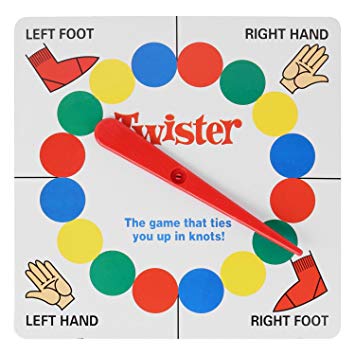
Take a spin and see what happens.

Engineers know more and more about less and less, until eventually they know everything about nothing. Architects know less and less about more and more, until eventually they know nothing about everything.

Anonymous folk wisdom

In the past four days, I’ve had half a dozen ideas of things to write about here. Each on its own would have been fun and interesting, but one of the problems I’ve always faced is too many possibilities. I’m just interested in a lot of things, and that has its own power. When you appreciate a diverse array of fields, it gives you the power of metaphor, of seeing one thing in terms of another, of making connections between things that people normally see as discrete.

But when you know one single thing… wow, you can be really great at it.


I’ve recently finished a novel called Leopard, in which I play out one of the reasons I never wanted to have kids. Would I encourage my kids to develop a thousand interests, to be the “well rounded” person with sufficient Velcro to stick to any circumstance? Or would I encourage my kids to be monomaniacal, and thus have the opportunity to reach truly elite heights of performance?

Here”s a passage from Leopard, in which a US Olympic coach is talking to his junior team members:

โ€œIโ€™m going to give you some names,โ€ he said, โ€œand I want you to tell me what they have in common. Ready?โ€ We all nodded.

โ€œRound One. Roger Federer, Pete Sampras, Rafael Nadal, Serena Williams.โ€

Tennis players. โ€œYes, but more importantly.โ€

World champions, world #1โ€™s. โ€œYes, but before that. Let me add some and see if it changes your mind. Ready? Simone Biles, Shaun White, Kobe Bryant, LeBron James, Wayne Gretzky, Martina Navratilova, Danica Patrick, Arnold Schwarzenegger.โ€

Pioneers in their sport.

Greatest of all time.

โ€œIโ€™ll add a few more. Beyoncรฉ. Hilary Swank. Leonardo DiCaprio. Emma Stone. Bruno Mars.โ€

Now we were all just lost, quiet.

โ€œIโ€™ll tell you what they have in common. And they share that same trait with Xu Xin and Ma Long and Timo Boll and Jan-Ove Waldner and Chen Meng. They decided, when they were really young, that they were going to dedicate themselves fully to their talent, and they chose training over college.โ€

What would it be like to be that good? What would it be like to be trained from birth, to have coaches and agents compete for you, to be drawn ever forward into the next level of excellence? And what would it be like to leave everything else behind?


In a strange bit of meta, the story line for Leopard was suggested to me by a character from one of my other novels. (Yes, they’re real people, shut up.) Katie, in her first date with Colin in the book The Opposite of Control, was talking about wanting to write a young adult book related somewhat to her own childhood as an elite gymnast:

โ€œSo I have an idea for a character, sheโ€™s fifteen, an athlete, and she and her best friend are on a team together. I donโ€™t know what sport yet, I could do gymnastics but that feels too easy. Iโ€™m thinking basketball, or track, or something. Anyway, theyโ€™ve been friends practically since before they were born, their moms knew each other when they were teenagers. And theyโ€™re both terrific athletes, both have colleges coming to recruit them. But one of them wants a kind of more normal life, wants to date and go to college for math and play other sports. The well-rounded kid, right? And the other one wants to be in the Olympics, wants to be the best in the world, and she knows that means that she has to miss out on almost everything else. She canโ€™t play a musical instrument, because thereโ€™s no time to practice. She canโ€™t play softball, because she might get injured. She canโ€™t go out with friends, canโ€™t hang out with boys, because sheโ€™s either training or practicing or doing homework or sleeping. She doesnโ€™t even go to, like, birthday parties, because thereโ€™d be Taco Bell and a birthday cake, and she canโ€™t eat anything but her training diet.โ€

โ€œWhat a great premise,โ€ he said. โ€œAnd theyโ€™re both jealous of the other one, a little bit, having the life they didnโ€™t choose for themselves.โ€

โ€œExactly right. They completely love each other, theyโ€™d do anything for each other, but their relationship is coming apart a little, partly because theyโ€™re envious, but partly because they canโ€™t just hang out the way they used to.โ€

That little snippetโ€”three-tenths of one percent of one bookโ€”became an entirely new book three years later. Being a generalist is a trait good for a writer, because it allows you to empathize with a hundred ways of life. But you always look over your shoulder and say “what if…?”


When I was a kid, I wanted more than anything else in the world to be a professional bowler. I was good at school, I loved the pastor at our church, I liked to sing, but there was something about bowling that was truly spiritual for me, a set of bodily and intellectual expressions that could have been made manifest in no other way.

I chased that goal until I was 25, becoming awfully good but realizing in the end that I would never be good enough. But I grew up with another kid who went further. A kid who won a regional professional tournament when he was 16, a kid who got a job in a bowling alley in junior high and high school exactly and only because he could afford to practice. He had no interest whatsoever in school, went to class only in order not to go to jail. He never had a girlfriend, never had another hobby. He was purely a bowler. The very best I’d ever seen.

He made it to the lowest level of professional competition before his anger and his frustration and his drinking derailed him. He went back home and went back to work in that same bowling alley, which is where his memorial service was held when he died at age 54.

Several years later, in my early 20s, I had moved to another state and continued to compete, and ran into a couple of other bowlers who had come specifically to Amarillo, Texas to be part of the West Texas State University bowling program, at that time the equivalent of Duke basketball or Alabama football. They were far and away the two best bowlers I had ever known. One of them, Bud Loveall, went out on the tour for four years before going into a career in IT.

The other, Jack Jurek, also went out onto the tour in the mid-80’s (he’s the guy in this clip who’s smart enough not to wear pants with two different-colored legs) before moving back to his hometown and buying a bowling alley. But he kept competing, and won two professional tournaments, in 1996 and 2009 (at age 46), and now coaches at Villa Maria college in Buffalo.

What is a life made of? What makes some people resilient and others brittle? What is it that led Walter Ray Williams to win 47 professional bowling tournaments, and Jack Jurek, as great as he is, to have won two? And Bud Loveall, a national all-star, to win none? And my high school friend to die early and broken, and have his funeral in a small-town bowling alley? And me to be a writer?


I don’t know that this essay is about anything. It’s the musings of a committed generalist, someone who’s lived my life knowing an awful lot about an awful lot of things, able to make loads of connections while always wondering what it would be like to be the very best at one thing.

If there’s such a thing as karma, in which we are reincarnated in order to learn some lesson that we couldn’t in an earlier life, I might have been really good at one thing in my last life, and needed to be sent back to see another way. Or I might get to do that next, to learn a new way of singular excellence after this broad life. (Or I might become a cow, who the hell knows?)

The river of time flows downstream and fast, and we can’t row back to see what was out that other tributary. And any of us who believe we know what’s further ahead are just deluding ourselves. But we can always wonder.

The Id of the Dispossessed

When I taught Writing 20 at Duke, I got to teach courses based on my own areas of topical interest. I taught seven or eight different courses over my ten semesters of teaching there. Some of them had to do with my enduring academic interests: ideas about the concepts of youth and adulthood, about abandoned industrial landscapes, about epistemology and the construction of knowledge. Others were more immediate: after two years of hearing my students talk about how “we” beat Carolina in some game or another, I built a course about the construction of identity through team loyalty, brand loyalty, and regional loyaltyโ€”through things that are not inherently of us, but that we adopt and hold dear.

Now, fifteen years later, I’d teach a different array of courses. I’d teach courses about the debilitating constructions of modern masculinity. I’d teach courses on genre literature. I’d teach… well, if you read this blog at all, you know the kinds of things I’d teach.

But one of the courses I never had the chance to teach, having thought of it after leaving the freedom of a liberal-arts university, is a course on American stand-up comedy. It would be a Ken Burns kind of thing, in which comedy would be the vehicle through which we would examine all kinds of other social developments. We’d start with the vaudevillians and the burlesque houses and the origins of the Jewish comic. We’d talk about the influences of mediaโ€”first radio, then television, then the LP album, and now streaming services and YouTube clipsโ€”on not merely the distribution of comedy, but on its definition and form. We’d talk about the 1950s and 60’s expansion of who gets to be a comedian: Black and women comedians, from the bawdy (Redd Foxx and Rusty Warren) to the quick and clever (Richard Pryor and Joan Rivers). We had the cool intellectuals (Bob Newhart and Tom Lehrer), the childhood nostalgics (Bill Cosby and George Carlin). And then we’d encounter the countercultural hinge, the moment in which two of the most prominent TV standupsโ€”Pryor (1967) and Carlin (1969)โ€”both decided, independently, that the polite work that had made them successful was no longer true to themselves or their times. That the world demanded something different of them.

Then the explosion of identities on stage: Korean American and Japanese American and Native American and Indian American, working class men and working class women, gays and lesbians. A blessing of diverse comics who continue to expand our understanding of what it means to be funny in America.


All of this returned to me while I was stacking firewood this morning, and thinking about our little town. One of our neighbors has a quick wit and a quick temper, and they often merge. He once told another fellow in town, “Your mother shoulda shot you and raised a pig, at least she’d’a had something to put in the freezer!” Another guy, helping as a favor to offload some hay at night at a farm he’d never been to, said “I’m just gonna back up ’til it sounds expensive.”

Comedy has no room for politeness, nor for power. Comedy is where the powerless get to stand up there, alone, and talk about the things about their lives that their (predominantly white, predominantly comfortable) audience would never have known. Modern comedy is the venue of self-revelation, and through that mechanism, of cultural revelation. It’s a sort of figure-ground exercise: Here’s some truth about who I am. If you didn’t know that, what does that say about you?

As just one example, the Blue Collar comedy phenomenonโ€”from Jeff Foxworthy to Rosanne Barr to Larry the Cable Guyโ€”is a direct offspring of the Reagan Republican. They set aside of the interests of the educated elite for the interests of the people who just have to get from one day to the next with some humor. They poke fun at themselves, and by so doing indicate some gaps in the larger conversation.

There’s a long history of whining-guy diatribe about women standup comics not being funny. And that stems from women’s lives not being of interest to the men who dominated both the performance and the consumption of comedy for so long. Anyone who thinks that Ali Wong and Whitney Cummings and Yumi Nagashima aren’t talented comediansโ€”outstanding writers and perfectly timed performers and creators of a unique and coherent stage personalityโ€”has merely pronounced their own intellectual limitations. You may not like their material, you may think that they’re too rough or too blue, but you have to give them credit for careful craft.

Standup comedy, from the guy doing patter between striptease artists to the 90-minute HBO special from Radio City Music Hall, has always been the place where the dispossessed have been able to finally be free, to set aside the protective ego and the scowling super-ego and just let the id stand alone in the spotlight. And we’re all lucky that they’re brave enough to do it.

Docent, or Non-Docent?

You’ll never see a museum the same way again…

Nora is mildly lactose intolerant. That’s a sad fact for someone as committed as she is to cheese, but she gets over it. Hard cheeses present few problems, but soft cheeses like Mozzarella and Camembert (and ice cream, another long-time family favorite) require intervention, in the form of a pre-dinner Lactaid, an enzymatic digestive aid that helps to decompose lactose into simpler sugars that the intestines more easily absorb.

Hang onto that idea. We’ll be back.


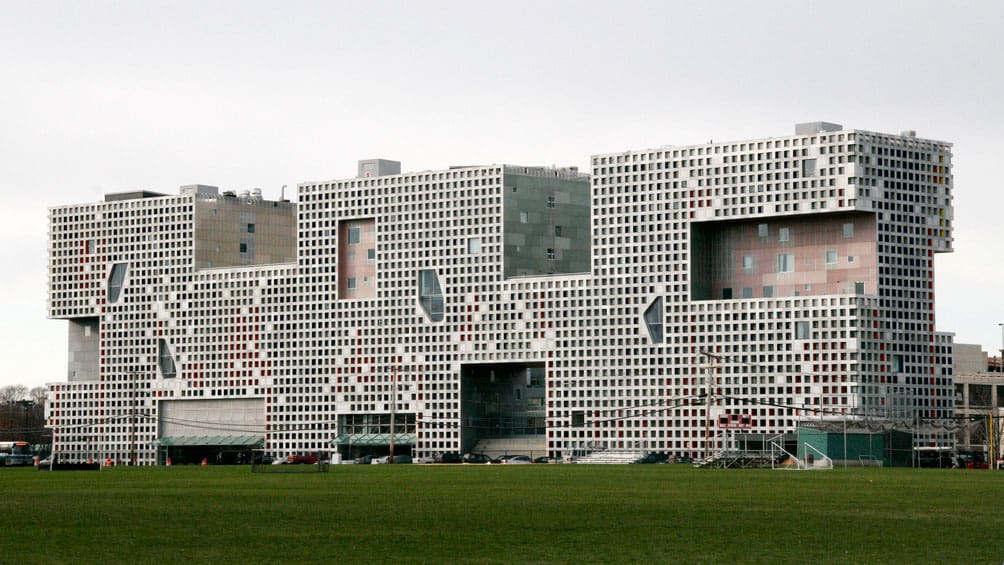
Here’s a photograph of a building.

Simmons Hall, MIT โ€” Steven Holl, architect (2002)

Let’s return to our discussion of William Hubbard’s three discourses of architecture from a few days ago. The client wants the building to be an instrument to reach their organizational goals. The designer wants the building to be an interesting problem upon which to exercise analysis and the development of order. And the everyday user and passerby want the building to act as a cultural symbol of a good life. The grades for this building would be a client B, a designer A, and a user/passerby F, or a GPA of 2.33โ€”a solid C+ across the discourses.

Let’s examine the validity of my quickly-applied grades. The client, the Massachusetts Institute of Technology, has a vested interest in buying (and photographing, and patronizing) interesting buildings. There are some number of MIT undergrads who are absolutely thrilled that they get to live in Simmons Hall. Who cares if you only get to move the furniture one time when you move in, because it’s then fixed to the floor? It’s kind of like dating Justin Bieberโ€”it’d be a huge pain in the ass, but I mean… it’s JUSTIN BIEBER, dude! And MIT was willing to buy the very most expensive dormitory in American history at over $500 per square foot (twenty years ago!) for the same reason that Bieber buys a $400K Lamborghini Aventadorโ€”it’s not a lot faster in most circumstances than my thirteen-year-old Civic Si, but he can brag about it more than I can, and he looks bad-ass in his Instagram feed when he pulls up to a nightclub.

So Simmons Hall does the work of housing a few hundred undergrads. It’s insanely overpriced, but everything at MIT is insanely overpriced, so that alumni kick dollars back to the endowment, so maybe it pays part of its premium. I think that’s a B, depending on its return on investment.

We’ll give Holl his A, taking his word for it. I’m not especially interested in the problems he set forth for himself. Blah blah blah whatever. Good job, buddy, here’s your participation ribbon.

But for the rest of us, this thing is just intellectually opaque. It’s a rectangular prism, with rectangular prismatic voids carved out of it here and there. Why are they asymmetrically placed and sized? Why are they different depths? Why are they less penetrated than the windowed surfaces around them? Which one of those giant garage-door-looking things at the bottom is “the front door,” and which one is where the Zamboni gets parked? Why are some of the crossword cells filled in, and is there really a 38-letter word that fills in 262โ€“Across? Why is it sitting alone on the lawn away from the rest of campus, like the shunned child at recess? What is it about this building that signals “dormitory,” or “higher education,” or “urban campus,” or anything else at all? It is a building that carries no cultural significance, because it has sprung fully formed from the “concept” of its designer.

I’ll quote one of my great mentors, the late architectural historian Spiro Kostof, from the final lecture of his masterful Arch 170B course at Berkeley:

It may be communication, but it’s an exceedingly private communication… The architect has to go around on the lecture circuit, do a lot of explaining… or write books, or have books written about him, where we are told what the particular assemblage really means. Did you know, did you reallyโ€”now confide in meโ€”did you really know that the unexecuted Classical village on the roof of Michael Graves’ Portland Public Services Building alludes to Proissan, to Rossi’s “Analogous Cities,” and to the roofscapes of Chambord? Did you? Did you? And did you know that that wedge-shaped element there is really a Mannerist keystone of the 16th Century, like Giulio Romano? Did you? Did you see that? Well, of course you did. And if you did know any of these things, did you think what any of them have to do with Portland? Or a public services building?

I don’t know why a sea sponge is a productive analogue for a building. But Holl apparently does. And I’ve spent years studying phenomenology, in pretty significant detail, and I have no idea what the hell is phenomenological about any of his work. But it’s a pretty word, and it lets him charge $500 a square foot for an undergraduate dorm, so, you know, knock yourself out, dude.

The designers of the building I taught in in Boston had some bullshit story about how part of the inspiration of the building hearkened back to Paul Revere’s lamps. Did you see that? Now confide in me, did you? Of course you did.


There’s a whole body of buildings that I call “docent architecture,” buildings that have no communicative power without the guided tour, the curatorial card, the monograph, the docent talk. They cannot be digested without additional enzymatic power. They are, on their own, inert. They have no representational character, no cultural allusion, no contextual borrowing or ecological fit. They “stand out boldly.” They “recontextualize,” in the same way that an aggressive drunk recontextualizes the wedding reception: by being belligerent and uninterested in anyone else’s pleasure.

Lots of Modern and Postmodern art is docent art, meaningless to the lay audience until explained. Don’t get me wrong, we can look at ANY art and learn more about it than it presents us on the surface. We can become connoisseurs about anything we participate in, going beyond its surface pleasures and its genre conventions. But surface pleasures and genre conventions have their own importance. They offer the invitation that allows us to be willing to gain the unexpected second and third layers of richness.

Too much contemporary art, whether visual or spatial or literary, offers no handholds to pull ourselves up from the ground. All we can do is stare dumbly, and wonder why we’re so stupid that we don’t get it. The only lecture I walked out on at the Bread Loaf conference was by a deeply self-impressed writer whose most rousing condemnation for a piece of writing was that it expressed “workmanlike craft.” He pleasured himself with melodrama like “every poem is an aborted suicide note.” And I gave him all of about twenty minutes before I headed for the door. I got no patience for that.

Whole careers are made by explaining the nuances of the work of others, of proclaiming both the subject and the object worthy of acclaim because of their shared conceptual vocabulary, a discourse unavailable to the rest of us. I never had any patience with that, and I have a PhD! I mean, I knew right off the bat that I was never going to make it in architecture studio, because I was asking questions like “who’s going to live there?” and “what is it an oasis from?” I wasn’t interested in ideas. I was interested in pleasure, and comfort, and happiness. And those interests marked me, in the world of design, as secondary, as less-than. Fortunately, I discovered architectural history, and then cultural geography after that. Entire disciplines dedicated to the client’s motivations for buildings, dedicated to a culturally-located interpretation of what mattered. I found a home that valued the questions I raised.

So, to my colleagues in art and design and literature… do you need me to take a Lactaid to help me digest your work? Will your ideas communicate without a docent’s script? To whom are you speaking, and to whom do you offer the insider’s dismissive condescension?

Life’s Work

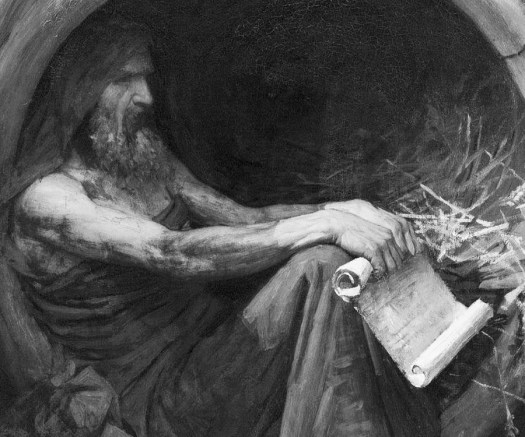
An excerpt from the painting Diogenes, by John William Waterhouse, 1882

Iโ€™m working on my photography and my writing… writing yet another of what look to be my unpublishable books. Unpublishable? But why? Well, I canโ€™t think of any compelling reason why anyone should read them. Theyโ€™re not how-tos. Theyโ€™re not explications of scientific fact. Theyโ€™re not calls to arms. Theyโ€™re just books I have to write. Some sense I have to make of this world I was hurled into and am passing so quickly through.

Tetman Callis

The philosopher Hannah Arendt, in her book The Human Condition, divided human life into three different modes of activity in the world. Being a philosopher, she used the Latin to name those modes, and so we shall as well.

The first mode of effort she called the animal laborans, or laboring animal. Following Marx, she described the “futile necessity” of assembling resources for life. We all work to provide sufficiency for ourselves and our families, but that on its own does not differentiate us from birds or beavers. Labor is a necessary but not sufficient marker of what it means to be humanโ€”we all must do it, but only as a part of our work.

The second mode of effort she referred to as homo faber, or man the maker. There are some things that we take on with greater purpose than survival; we hope to leave behind something enduring, some mark of our intentions. We conceive of and create a thing that we hope will be of value, whether that value is economic or emotional or cultural. This is an important and uniquely human mode, but isolating. It makes us perpetual individuals, hoping to place our faint mark on the permanent record.

The third, and Arendt believed the highest, mode of effort is what she called the vita activa, or the life of action. And she means something specific by the term action, something that in English might be more akin to engagement, an investment of ourselves in some larger social purpose. Whether at the grand scale of public policy and public persuasion, or at the smallest everyday scale of comforting a friend, Arendt claims that our highest duty is intervention in the affairs of the world.


When we think of what artists do, we often think of their works. But the vast majority of art will go unrecorded, and largely unseen. There aren’t all that many enduring works, Led Zeppelin IV’s or Nighthawks, Grapes of Wraths or Mary Tyler Moore Shows. Here’s a quiz: what do these have in common?

  • A Spool of Blue Thread
  • A Little Life
  • The Fisherman
  • The Year of the Runaways
  • Satin Island
  • A Brief History of Seven Killings

These six books, now largely unread, were the six finalists for the Man Booker Prize in 2015, only five years ago. The six best English-language books of that year, now mostly lost to time.

Yesterday’s London Times lighting today’s wood stove. Last week’s New Yorker in this week’s toilet basket in next week’s recycling bucket. Literary quality and craft all around us, consumed and discarded. Did it change its readers along the way? Did it give us our moments of wisdom, or insight, or simply of pleasure? Did it contribute to its ecosystem during its brief appearance?

A few years ago, I happened across a stack of CDs at our local transfer station, maybe 25 of them. (Glen often pulls things aside from the waste stream that he imagines someone else might find a use for.) I browsed through them quickly, not recognizing any of the musicians or knowing anything about their genres. “What are all these?” I asked.

“Oh, those are CDs that musicians sent in who wanted to be part of this year’s Solarfest.” Twenty-five musicians and musical groups all putting their best work on the table for consideration at a decidedly lower-tier music festival (actually, a solar energy/sustainability festival that had some music), all passed over and stacked at the dump. Did they imagine that they had created their version of Kind of Blue? Were these the lost artifacts of desired immortality?


Those of us who make things are asked to live in two worlds at once. We create the very best version of whatever it is that we do, something worthy. And at the same time, we have to recognize that our work, as all human work, is ephemeral. A restaurant meal at Atelier Crenn is finished in two hours, as is an evening at a performance of the Hiromi Uehara Trio. We make a sculpture that is viewed in three minutes, write a book that is read in a few hours. How has it contributed, during its moment, to the lives of the others who have swum through its waters?

That judgment, I think, may not be for us to know, as much as we might want the surety of that knowledge. We can only work with our odd combination of rigor and generosity, and then turn our labors over to the great, invisible world.

The Bends

Careful how rapidly you rise…

I’ve been coaching a writer on what might become a really wonderful book project. A couple of days ago. she shared a great idea with me. I’ll paraphrase, because the words are hers, but in sum, it was about the most dangerous lie we learn in schoolโ€”that talent will be recognized and rewarded. This is a simple root belief of our culture, and it’s wrong. Here are a few reasons why it’s wrong.


The wrong people tell us that we’re talented. When your third grade teacher says you’re the best student at arithmetic that she’s ever had, that’s just a low bar. When you’re the best gymnast ever to come through Tammy’s Tumblerz, or the best junior bowler in Ravenna, Michigan, you might think you’ve got something, and you’re likely wrong at the larger scale. Talent is always relative, and the less we have daily exposure to the very best in our field, the more we conflate the relative with the absolute.

I like to think of it in orders of magnitude. Let’s use baseball as an example. Every time you rise from T-ball to little league to high school to college to minor league to major league to All Star to Hall of Fame, you’re being run through a filtering device that eliminates more than 90% of the level below you. As the Bard of New Jersey put it:

I had a friend was a big baseball player
back in high school.
He could throw that speedball by you
make you look like a fool, boy.
Saw him the other night at this roadside bar
I was walking in, he was walking out.
We went back inside, sat down, had a few drinks,
But all he kept talking about was...

Talent without effort goes stale. Education writers often talk about the dichotomy between a fixed or a growth mindset. In the fixed mindset, we talk about talent as something that one has or is, that a particular talent is (or is not) a person’s innate component. In the growth mindset, we talk about talent as something that someone manufactures. And it seems to be the case that the growth discourse is better for students. The difference between “you’re really good at that” and “you’ve really put in a lot of work at that” is that the second gives us a stronger sense of agency. I can’t choose my attributes, but I can choose to work more and get better.

We all know those kids who were really good at something but who then left it behind, didn’t push it further… or didn’t have the opportunity to push it further. And we also know lots of kids who were told that they weren’t very good at something, and just stopped trying altogether.


Talent is contextually valued. Our environments are set up to absorb some kinds of talents and not others. Our town of 750 has plenty of opportunities to exercise skill at plowing snow or prepping firewood, plenty of ways to exercise skill at making pies and mittens. There are no opportunities here to exercise skill at literary fiction, or at drag performance, or at papermaking.

Talent has to be recognized and valued in order to grow, and cultural venues differ in what they recognize and value. Talent recognition is gendered; a girl doing something that “girls are supposed to be good at” will get more approval than a girl doing “boy things.” The opposite equally holds. Talent recognition is class-related: a family of mechanics will make fun of the writer, a family of writers will be disappointed by the mechanic. Getting a PhD from a teaching focused school will teach you how to do research and teach undergrads; getting a PhD from an elite research school will teach you how to do research, resent the demands of undergrads, and raise money.


In light of those first three facts, talent is communal. As 1960s chess guru Benny Watts puts it in the new Netflix miniseries The Queen’s Gambit, the Russians dominate chess because they understand that it’s a team sport. They confer, they debate, they coach one another and analyze one another’s games. American players never reach that level because of their precious individualism. Our commitment to isolated evaluation of the individual makes us all into competitors rather than collaborators, leaving none of us able to rise as far as we otherwise might.

Talent is also communal in that it needs to be visible to a community. As Chicago Tribune columnist John Warner once wrote, you could eliminate every single writer from The Atlantic tomorrow, replace them with an entirely new roster, and it would continue to be a fine magazine. Different, but fine. The ability to be an excellent magazine writer isn’t limited to the few thousand people who currently do it. But those who are doing it came up, for the most part, through an informally understood but elaborately structured minor league system. The right MFA programs or journalism schools, the right emergent online magazines, the people who know people and make the referral over cocktails. You can have talent and effort out the wazoo, and if nobody sees it, there’s no next step.


And finally, because of all that, talent can be painful. If we’re talented at the things that our ecosystem has a niche for, we’re right at home, and our rewards are commensurate with our skills. But if we’re talented at something that isn’t contextually recognized, then we’re left with a lot of difficult decisions. Do we 1) stay home and 1a) keep doing the thing we’re good at even in the absence of reward and further challenge, or 1b) quit doing it and pick up something else that our families and friends approve of? Or do we 2) leave home and 2a) become traitors to our families and culture while simultaneously 2b) being seen by those we hope to join as an intruder, a grasping, naive climber who’ll never really know which glass to use for the red and which for the white?

As history has proven, once your family connections get to a certain level, you don’t even have to be especially good at anything to win even more. It’s not hard to enter the race when you’re born already inside the stadium. But for the rest of us, ascending too fast can give us the bends, the debilitating ache of being ill-suited to the world we’ve trained so hard for, have reached for too soon.

Maybe our grandkids’ talent will be recognized. Ours, too often, will be squandered, excellent seeds falling onto infertile ground.

Misdirection

Fascinating, but not so fun to drive…

Back when I taught in architecture school, one of my courses was called Year One Seminar. I had all of the incoming students in one space, and gave them an abbreviated heads-up for what they were about to encounter. About how their curriculum would work, and about how Boston worked. About the economic and the spiritual value of professional life, and about the joys and stresses of academic life. One student called them sermons, which is probably about right. (And there’s a whole story behind that, which I’ll tell you someday.)

Anyway, as part of one of my sermons, I said something one normally doesn’t hear in a school of architecture. I made the assertion that no one in human history has ever wanted a building. People wanted to make more money, or to have a happier family. They wanted to have smarter students or more rapidly recovering patients. They wanted a symbol of their power, or of God’s power, or of community cohesion. They wanted to be dry and warm and comfortable. And they bought a building because they thought it would help them have those things. Architecture students, I said, were outliers because we cared about buildings as things; nobody else does. For everybody else, they’re tools or symbols or experiences. (If I’d understood this when I was younger, I would have gone into interior design, where we work with people’s desires at a much finer and more tactile scale.)

George Bernard Shaw once famously said that every profession is a conspiracy against the laity. But to turn that on its head, every profession is also a focus on the invisible work that brings about visible experiences. Most of us just want to drive our cars, and we’re lucky that there are a small number of people for whom cars themselves are interesting technical exercises. We don’t want to go to a hospital, we just want to be healthy; we don’t need to focus on how hospitals work, but we’re fortunate that there are other people who do.

Where professions go astray, when they do, is that they lose track of the fact that they’re working on behalf of a lay audience, that most of us don’t really care about their tricks and their specialized practices. They foreground the technical and theoretical knowledge of their profession in a way that actually distracts from the experiences that the rest of us want. Hospitals, of course, are a great lesson in this, as are airports and high schools. If you’ve ever felt like you were being moved through space and time like a machine part, just an object to be appropriately scheduled and handled, you’ve been in a space that is thought of in its professional terms rather than in experiential terms. Timothy Snyder, in his book Our Malady, says that during his recent hospital stay, he was given three medications, and each was on a six-hour cycle. But the six-hour clock for each started from its first moment of administration, and that first administration didn’t happen all at once for all three… so he was awakened at 10pm for one drug, and then again at 11 for another, and then again at midnight for the third. It wouldn’t have taken much to get all three onto the same cycle, but the hospital didn’t see him as an exhausted human who needed to sleep; they saw him as a technical demand to be precisely scheduled.

Whatever we do, whether chef or engineer, teacher or athlete, we are called upon to inhabit a paradox. We are asked to master the details of our trade, to learn new things every day, to raise our level of skill and precision. And we are simultaneously asked to make all of that invisible, and to focus on what really matters. To not brag about the things we can do, but to downplay our skill in favor of the experience we hope to foster.


Writers live this paradox as well, and are equally subject to its professional failings.

I’ll make the same argument about books that I did about buildings. Readers don’t want books. We want stories. We want the experience of being removed from one world and placed wholly into another. We don’t want technical gimcrackery, we don’t want the flashy flourish that calls attention to itself; we want all of that to fall away so that we can be fully absorbed in other places and lives.

But alas, the poor writer has only gimcrackery to fall back upon. We need decades of practice at working precisely with letters and words and punctuation, with point of view and verb tense, with document layout. None of that should be overt for the reader, but every single bit of it is overt for writers as we do the work.

And when we share our work with other writers, we often forget the lay experience we hope to foster, and focus entirely on the techniques we’re seeing. We talk about theme and metaphor, about the position of the narrator and the manipulation of chronology. We get under the hood, behind the curtain… and we forget that there are readers out there who would be distracted by all of our tricks, who just want to get on the plane and go for a journey.

I think that writers’ groups and MFA programs and literary analyses can lead us astray, because of their inevitable focus on insider issues. We start to admire our own cleverness, start to forget the vast lay audience who just want to read and not think about our authorial ingenuity. Writing awards often go to books that are clever rather than compelling, because they’re juried by people who privilege the craft over the experience. (Architectural awards almost always go to buildings that are clever, because there’s so rarely any discussion in design education or design practice of the experience of going to a library to use a library, of going to a concert hall to hear a concert.)

William Hubbard’s book A Theory for Practice: Architecture in Three Discourses is specific to the practice of architecture, but I think that it has broad applicability across professions. Hubbard describes the design of a building as having three interested parties, who hold three sometimes incommensurate sets of values. In Hubbard’s terms, the three groups use different discourses to describe what a building does.

  • The client describes the building as an instrument, interested in its effects and outcomes
  • The designer describes the building as a problem, interested in its analysis and order
  • The public describes the building as an experience, interested in its contribution to a good way of life

A book is the same as a building. A client (publisher or agent) strives for money, prestige, and industry influence. The writer addresses the problem of the book at hand, the myriad technical decisions that make up the whole. But the reader cares about none of those things. The reader wants to momentarily leave World One and enter World Two, to fully and unreservedly inhabit this other place through these other people.

Writing for readers is just different than writing for other writers, and certainly different than writing for publishers. These discourses frame the uneasy paradox that we’re all called to live within, no matter what path we choose. If professions are to be modes of service, we need to place the service at the center, rather than ourselves.

A Second Meditation on Category Failure

We talked a few days ago about the failure of categories to sometimes deliver us useful policy information. The categories, for instance, of Latino and Asian American, which reveal some facts and conceal others. Lots of categories contain differences that can be misleading when lumped together without care, a beige that conceals its red and yellow and black and blue pigment components. And a friend of mine gave me a new one to think about yesterday. As she wrote in her email, with regards to the fallout from last week’s election:

And when I heard yesterday that a LOT of college-educated white women voted for DumpsterFire, I thought, I don’t think “college-educated” holds water anymore, because what is college these days, anyhow?

As I wrote in The Adjunct Underclass, the term “college” is similar to the word “restaurant,” another category that contains vast dissimilarity. Alinea, for instance, is a restaurant. In order to get reservations (two months in advance), you need to go to their website at exactly 11am Eastern time on the 15th of the month and hope that you click first, like a game show. Dinner for two with wine will easily crack a thousand bucks. Taco Bell is also a restaurant, of an entirely different sort.

Now that “college” has become as ubiquitous as “restaurant,” we start to see that the category does less meaningful work. You could have a college degree from, say, Williamsโ€”its cost of attendance is $75,000, they accept only 12% of their applicants, students at the bottom range of their incoming SAT scores are in the top five percent of the nation, and faculty teach two small courses per semester. Or you could have a college degree from… well, you can fill that in with your own local favorite, the affordable school that accepts 98% of its applicants and graduates 30% of them, the school where the permanent faculty teach four or more huge courses every semester and the temporary faculty (who constitute most of the teaching force) make $2500 a class. Schools like those can do good things… but they don’t do the same things. They’re just set up to accomplish different outcomes.

There’s a lot of chatter about how colleges have become bastions of leftist bias, which I suppose may be true in English and Women’s Studies and so on at Ivy League schools, but far less true in the state-college free-market business schools or the libertarian professional-prep programs where the majority of our students spend their time.

The Classical (that is, Greek and Roman) model of education focused on the “liberal arts,” or the cultural and strategic knowledge befitting a free man who would have standing in public debate and policy. (Slaves and peasants had to get things done, and were trained rather than educated.) And it’s not etymologically surprising that the core practice of liberal education is deliberation, the work of judicious discussion that reveals the hidden corners of what might have seemed to be settled matters. This model held sway through the early parts of the 20th century, when only a single-digit percentage of young men attended college: they were being groomed to rule the world, as their fathers and grandfathers had before them. They needed to learn strategy and analysis and synthesis rather than information.

But now that a majority of high school grads attempt college, and half of those who start actually graduate, college has become reconfigured in ways that make the category less coherent. The risky and speculative fields of math and science are on the decline in college majors, for instance, while various forms of immediately useful technology have grown by orders of magnitude. Look in the want-ads of your local paper: you won’t see jobs in “math” or “physics,” but you can get a job in medical technology. And so our preparation has geared itself away from deliberation and toward workforce development, the accumulation of settled information and practices that can be correctly applied. The children of wealth and privilege will continue to go to deliberative schools that prepare them for entirely different livesโ€”and entirely different attitudes.

“College graduate” is a sticky political-polling category exactly because it used to be scarce. But now, the National Center for Education Statistics shows that although about 15% of Americans over 70 have college degrees, that’s up to near 30% for people under 35 (and more women than men, another important cultural shift). It’s just another box that holds too much dissimilarity to be deliberatively useful.

We have a lot of handwringing about why political polling is less than perfectly accurate. I think it’s not because people are lying to pollsters, and it’s not because the pollsters don’t understand sampling methods. It’s because they’re relying on antiquated and unexamined demographic categories that aren’t as unified as we might imagine.

Today’s Vocabulary Words

And I want to watch a TV show about dim, venal, mean-spirited people because why? (Photo by George Lange/NBC/NBCU Photo Bank via Getty Images)

I don’t watch much TV any more, and I rarely watch movies. I find that far too often, I don’t have the emotional capacity to watch people being cruel to one another, which is what an awful lot of television is about. I mean, take any piece of sitcom dialogue and say it, without warning, to your wife or your dad. (Actually, don’t.) It’s just snotty and mean. The characters get over it, because the writers move them on to whatever’s next, but the rest of us wouldn’t. It would become a chip in the accumulated slag heap of disrespect and diminution that we would bear forever. It would become yet another of our collected GIFs of mortification.

And today I learned that there’s a word for that experience of not being able to watch TV because I identify too closely with the characters being dim or venal or mean-spirited. It’s a German word: fremdschรคmen, meaning “borrowed shame.” I read about it this morning in an article by Dianne de Guzman in the San Francisco Chronicle, in which she talks about being unable to watch PEN15 or The Office. I know that I’ve never been able to watch even an entire single episode of Seinfeld, and quit watching Frasier back in the day as Frasier Crane dug his craven well deeper each week. Will Ferrell has talked about every single one of his characters being someone with undeserved self-regard. He thinks that’s funny. I don’t, and I can’t watch it.

One particular episode of The Office, called “Scott’s Tots,” is used as a litmus test for fremdschรคmen. In this episode, the dim, venal, craven Michael Scott has followed his native instinct for self-aggrandizement to promise a bunch of Scranton kids that he’ll cover their college tuition when they graduate from high school. It gets him photos in the paper when they’re in grade school and all, but then the kids graduate, the debt comes due, and the entire episode is his staff’s anticipation (with glee or with horror) that he’s going to have to stand in front of a bunch of high school seniors and tell them that he’s lied to them for ten years. Those of us susceptible to fremdschรคmen could never bear to watch that, because we have some degree of empathy with both Michael and with the kids. Because we internalize that experience of having let people down, or having been let down by someone you trusted. Because we know it too well.


The contemporary literary world presents us a similar test. Do I want to read six entire books about Karl Ove Knausgรฅrd being an asshole? No, I do not. Do I want to watch Lauren Groff or Jennifer Egan drag her characters through endless cruelties? No, I do not. A friend described his Faulkner reading group, and one member of the group saying “When will something GOOD ever happen to one of these characters?” To which my friend said, “You might be in the wrong reading group.”

The alternative isn’t sunny Reader’s Digest “good news” stories. We aren’t limited to a binary of trauma and treacle. The alternative to misery is agency, people deciding what they value and taking halting, difficult steps toward achieving it. They may never get there, they may discover that their values change, they may get part of the way and become a new person while they’re doing it, but they’re doing their best. That’s what I want to live with, that experience of aspiration and effort and wanting.

Our political landscape bears this division as well, between those who can watch cruelty without feeling it and those who can’t bear it. The desire to “own the libs” or to take pleasure in “the tears of the snowflakes” (or, as one of my neighbors does, the ability to fly a Trump 2020 flag that bears the tagline “Fuck Your Feelings”) reveals exactly the kind of person I never want to be. Why would I ever think that someone’s misery is funny? I mean, Timothy Snyder, in his important little book Our Malady, cites public health and political research to show that one of the very strongest predictors of a county voting for Trump in 2016 was the severity of its opioid addiction. I don’t celebrate that. I don’t want them to suffer, even if at their own hands. I always want people to thrive.

Snyder coins his own term for our political landscape: sado-populism, an isolated rage that leaves us unable to see past our own pain, that leads us to visit miseries upon others because it momentarily deflects from the injustices we believe have been delivered unto us. It is the injured dog that bites you while you try to help it, the child who swats away your hand while you comfort him. And the inability to empathize, to look beyond ourselves, has led to the casual degradations of reality TV and Seinfeldian cruelty. It has led to a Senate whose only operational rule is to kneecap the opposing party. We have become a ruthless people, unable to offer or to receive help. And we will die from it.

We can continue the cycle, or we can try to break the cycle. We can rub it in, or we can try to rub it away. And we get to decide every single minute which we want to be.