
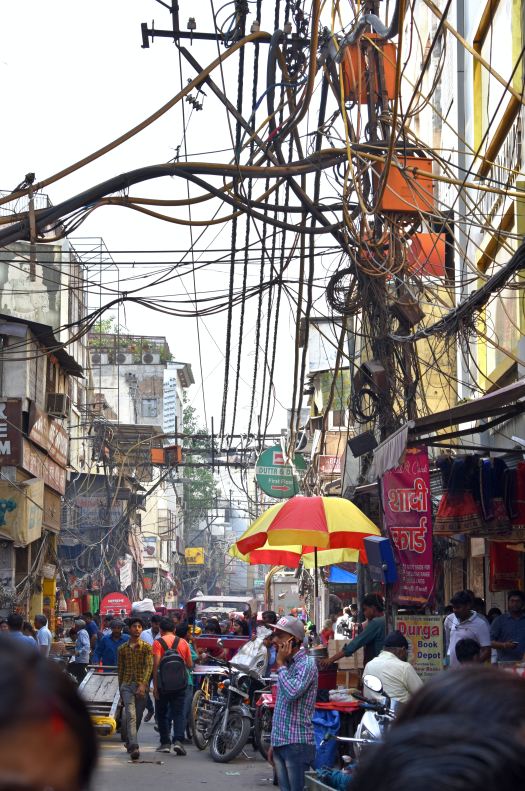
(image by Brijender Dua, via Unsplash)
The term “novel” has come to mean any book-length, continuous work of fiction. Romance novel, mystery novel, historical novel, literary novel… whatever the iteration, we now understand the word to have three essential components:
- It goes all the way from one cover to the other, unlike something that’s part of a magazine or a newspaper or a collection.
- It concerns itself with one story, whether that story takes place on one day or over decades. It is differentiated in this way from the single-author short-story collection, which is more discontinuous in character or setting or focus.
- It is overtly a work of imagination rather than reportage. There is no expectation of factual verisimilitude.
There are, as always, exceptions to any of these, but in lay terms, these three things are what we anticipate when we see the little words “a novel” on the book cover.
I’d like to offer an alternative. I’d like us to think of ourselves as creating extended works of ecological ambition. (“Novel” is easier to say, though, isn’t it…) “First I went here and then I went there and then I did that” is a story, sure, but it’s not a very interesting one. Why not? Because it has no system of referents within which it has meaning. And I think that’s one thing that strong memoir and strong fiction and strong personal essays have in common: they create a whole world, a cultural ecosystem in which individual actions mean more than their individual instances. In which people’s choices are constrained in particular ways, in which some possibilities might never occur to the characters even though they clearly occur to us readers. Conversely, a world in which possibilities exist for those characters that never would have been apparent to us at all. We westerners are so immersed in individualism, the idea that we have free will and an open playing field, that it’s easy for us to lose track of how much a part of a time and community and culture we all are. But every one of us work both within and against our context, and the very best longer stories have the opportunity to really play out the systems within which individual lives carry on.
A bad romance novel, for example, really doesn’t matter where and when it is. The Fifty Shades books were desperately awful in part because they didn’t take place in any knowable human landscape at all. The characters were young and attractive and rich and that’s all that mattered; it could have been in 19th C London or 21st C Hong Kong and told exactly the same story. Paradoxically for a work of supposed erotica, there was no friction: nothing that Christian and Anastasia had to work within or against. Contrast that against Helen Hoang’s wonderful The Kiss Quotient, in which Stella’s life with Asperger’s sets her apart from an easy mainstream of romantic life, and her work in consumer algorithms is by contrast far easier and more rewarding. It’s a body of work that’s enormously specific as to its time and place and way of life.
The writer Charles Baxter says that one of our roles as writers is to be a cultural curator, to hold for history the details of what it was like. It’s one thing to toss in a note in our story that Lindbergh just landed in Paris; that’s enough to tell us that the story’s set in 1927. But it tells us nothing at all about what 1927 was like: how the buoyancy of his daredevil flight was spurred by the buoyancy of the Golden Age and the belief that the party could never end; that The Great Gatsby in 1925 was part of that same heedless, reckless optimism; that the first sound movie “The Jazz Singer” premiered just after the great Mississippi flood killed 700,000 destitute people; that Niccola Sacco and Bartolomeo Vanzetti were executed in a fit of anti-immigrant fury. It tells us nothing about what it’s like to live in the first half of Prohibition and the rise of organized crime, in which poor people were blinded by homemade liquor and the wealthy had champagne and brandy without interruption. It tells us nothing about Jim Crow, nothing about sharecropping and tenant farming, nothing about the growth of mechanized agriculture.
Science fiction and fantasy writers talk about “worldbuilding,” which Wikipedia (the source of all knowledge and wisdom, and a clearly 21st century reference) describes as “developing an imaginary setting with coherent qualities.” All of us are responsible for developing an imaginary setting with coherent qualities, whether that’s a 19th C Vermont settlement or a 21st C Nebraska corn town or a planet in Solar System EMN298y65. And then we speculate what the lives within that would have been like, at the smallest detail of clothes and slang, at the largest forces of religion and politics.
What our characters do is meaningless without close attention to the landscapes around them.






 Herb Childress