Ethnographic Characters

Warning: well-read but entirely amateur philosophy ahead. Stay alert and proceed with caution.

I said yesterday that I feel a sense of responsibility to my characters, fictional though they may be. Let me work my way toward understanding why I think that.

1. In Z.D. Gurevitch’s discussion of discourse ethics, he claims that discourse entails three obligations: the responsibility to speak, to listen, and to respond. That’s a pretty decent description of how I write. I speak, through imagining a character and a circumstance. But then I listen. I take the character seriously enough to be attentive to how she or he engages that situation and the other people likely to be involved in it. I try to take all of those other people seriously, too, listen to what they want. And then I respond, which doesn’t mean merely speaking again but rather speaking in a way that is responsive, that is modified by what I’ve heard while listening.

Novelist and medical ethicist Alexander McCall Smith has said that he writes fiction from a place of “mild dissociation,” meaning that he has taken leave of his sense of identity; he’s no longer invested in his own thoughts. We think of dissociation as a form of mental illness, but of course, it’s also what happens when we’re fully absorbed in what’s around us, facing entirely outward. It’s a negative term for what Czikszentmihalyi more positively calls “flow,” and what Gurevitch might call dialogue: the setting aside of ego in favor of authentic engagement. We become dissociated from ourselves, attuned entirely to the other.

2. We’re all familiar with real-life conversations that don’t rise to the level of discourse. The arrogant person who lets you talk once in a while, but doesn’t actually change anything about what he was already going to say. The salesman or evangelist whose only interest in “listening” is in moving us closer to his position. The supervisor who just tells an employee how to reach a predetermined outcome, and the employee who only tells his boss what he wants to hear.

Authors can be equally closed-minded, never actually responding to what’s happening in front of them, just tracking the path they’d already determined. Zadie Smith talks about two general camps of writers. The first she describes as Macro Planners, creating the plot and the scenes long before any details arise. “I know Macro Planners who obsessively exchange possible endings for each other, who take characters out and put them back in, reverse the order of chapters, and perform frequent—for me, unthinkable—radical surgery on their novels: moving the setting of a book from London to Berlin, for example, or changing the title.” This is a deductive form of writing, starting from principles and moving to the specific case. Writing as an exercise of will.

The inductive form of writing, starting from the specific and figuring out what it all means, is the mode that Smith calls the Micro Manager. “I start at the first sentence of a novel and I finish at the last. It would never occur to me to choose between three different endings because I haven’t the slightest idea what the ending is until I get to it, a fact that will surprise no one who has read my novels.”

3. If we work in the inductive Micro Manager way, in dialogue with our characters, then we enter into what Carol Gilligan has called an ethics of care, in which our primary responsibility is not toward rules or a desired end state but to the needs of the people involved. The core ethical question is not “what is right,” but “how to respond.” It is an ethics grounded in dialogue, in mutuality. We speak. We listen. We respond.

Inasmuch as we choose to be Micro Managers—and I don’t think that I ever made that choice, it’s just how I do my work—we also adopt a particular ethic to guide our work.  Having given my allegiance to an ethnographic method of writing in which I try to understand the unspoken rules behind what I see, I’m then asked to take responsibility for everything I learn, and for those from whom I’ve learned it.

Readers, of course, always take characters as real, if the book is any good. Neal Gaiman has called the book “a little empathy machine. It puts you inside somebody else’s head. You see out at the world through somebody else’s eyes.” I think that alternative life we experience is the life of those characters, not of their author. If readers can so easily and readily welcome the reality of those we read, so can the writer.

The Price of Everything

For a lot of reasons that I won’t go into today, it’s been a rough intellectual week. So I did something that I occasionally do when I’ve run short on self-confidence: I re-read one of my novel manuscripts.

It’s like getting an e-mail or a phone call from out of the blue, from friends you haven’t heard from for a long time. And I realize how much I miss them. In this case, it’s three people that I spent hours every day with for a year. I sat with them and listened to them and did little else from September 4, 2014 through September 1, 2015. I know Clay and Cam and Thanh better than I know the other people in my grad school cohort, better than I know my colleagues on the Selectboard, because they have revealed every secret in their lives to me. The fact that they’re “fictional characters” is irrelevant; they are more real to me than any of the people I encounter at potlucks or professional workshops.

I could get caught up in questions of whether the work is any good, but at least for me, that’s an uninteresting (and unanswerable) question. The more important judgment is that these are good people, actively working to become better people. And that places a burden on me; I have helped them to become real, and thus I bear a responsibility for their well being.

Like Dr. Frankenstein, perhaps.

I wrote for a number of years about qualitative research ethics, about the responsibilities we take on with regards to those who’ve allowed us to see and represent their lives. It is not enough to merely not treat them badly, which is what most research ethics is focused on. We have a positive obligation as well: to do things that participants will find valuable, to help them benefit from our presence just as we take intellectual and career benefit from the work they do to help us understand them.

Is it entirely lunatic to imagine that we have similar obligations toward our fictional characters? In principle, of course it is. But Clay and Thanh and Camille are not principles. They have jobs and friends and families. Cam is getting ready for grad school. They live in Indianapolis. I’ve been in their apartment, I’ve seen the Jennifer Bain painting over the mantle, I’ve seen the array of takeout containers down the kitchen counter that night that they were all too tired—and too happy—to cook.

Here’s the deal. When I finished The Adjunct Underclass, it was a thing, an object. I was proud of it, my editor was proud of it, various communities of reviewers approved it, I worked with Renaldo for months to get the copy editing right, tuning sentences and disagreeing over the differences between OK and okay and why those differences mattered. But it was external to me. It became real when I started to hear back from its readers, who told me their stories. Who told me that they felt less alone and less confused.

We spend all this time on the object, but not because of the object. The things we make are only media that convey emotional or intellectual value. We’re like plumbers, in a way; we care deeply about the craft of joining the pipes, but the value comes to the family who, months and years later, can make dinner and clean dishes. Who can shower after a long day, water the garden.

I think that fiction holds the same possibilities, and responsibilities. I want my readers (as imaginary as my characters—far more imaginary, in fact, since I haven’t lived with them for a year) to feel less alone and less confused. And I want Cam and Thanh and Clay to live among others, the way that they deserve to. I want the depth of their experiences to be seen and acknowledged.

Oscar Wilde once described a cynic as someone who knows the price of everything and the value of nothing. Writing is a business, and its labor is paid at whatever variable rate is in effect at that moment. But writing is not merely a business. It is a series of obligations that we voluntarily undertake, an expression of value that cannot be quantified. And I believe that some of those obligations are due to the characters who reveal themselves to us, who share their dreams and fears and shames and joys for our consideration.

Composition and Performance

I once wrote a long meditation on the idea of errors. Tennis commentators record unforced errors as part of explaining the status of a close match. A baseball shortstop who misplays one ball out of a hundred might win a Gold Glove, but missing five balls out of a hundred might cost his job. I compared that against a friend who’s a professional clarinetist, playing thousands of notes per hour with maybe one bum note all evening.

I think about this a lot as a writer, engaged in an art form that’s more errors than clean fielding. And I console myself with knowing that’s just part of the nature of composition. We strike through, we delete, we shift order and find alternative words, toss entire scenes. And that’s not just at day’s end; every sentence is subject to continual revision, almost unnoticed, the delete key just another tool on the keyboard. Performance requires that errors be made offstage, in the rehearsal hall; the daily experience of composition is nothing but errors.

People who don’t write often think that good writers are naturally gifted. Well, we kind of are, just because we’ve read so much and practiced so much that the reflexes are baked in. I’ve been listening to people talk since I was tiny. I made a living for a lot of years by listening to people talk. So I got to be pretty good at capturing the specifics of word choice that mark individual speakers. But writers also revise. Endlessly. Constantly. Readers don’t see that.

So I thought maybe today I’d show you just how bad things can be when they’re left alone in draft form. I need to write a three-paragraph description of the novel I just finished. Here’s the first pass:

Kurt Genier had been a star, from grade school through his successful PhD. When his academic career failed to gain hold, he followed his wife Megan to her own faculty job in rural Vermont—a trailing spouse far away from friends, from scholarly life, from the diversity of an urban university—and struggled for the first time to invent an identity aside from the teacher’s pet he’d always been.

But when their closest friends were deported, Kurt and Megan both were called upon to invent new selves, in the service of a child they’d never met. They discovered strengths and allegiances they had never imagined, fought against the weight of bureaucracy and habit, defended an unfamiliar family life from those for whom different meant dangerous.

Trailing Spouse explores the question of whom a child belongs to, and how the interests of individuals, families and cultures collide. It asks us to consider who we are, when who we thought we were has collapsed. And it asks how far we would go to protect the future of another.

So, first, some truth in advertising. Like software, this has already gone through some beta testing. I tried to just write it front to back and leave it alone, but the reflexes of revision are so ingrained that I changed quite a few things on the fly without even noticing . So this is something like version 1.8: still in its first generation, but with an awful lot of patches installed.

And like first-generation software, this writing is pretty bad. I’m glad it exists, because I’ve got something to think about, but every bit of that is terrible, right from the first sentence. “Kurt Genier had been a star, from grade school through his successful PhD.” Yes, I want to introduce the protagonist early, but that sentence ends on the wrong note. PhD is not the point of that sentence; the point of that sentence is that he was a star. And it’s bland, non-specific. So here’s a 2.0 version: From grade-school spelling through his top-tier PhD, Kurt Genier had always been an academic star. (That’s actually version 2.2; I had something in there about twenty years of stardom, but I couldn’t make it rhythmically fit anywhere, and people have a rough sense of how long it would take to go from grade school through doctoral program anyway, so I took it back out. But it still felt like it needed bit more emphasis on the consistency of his success, so I put in always instead.)

Lots of those sentences end wrong. …struggled for the first time to invent an identity aside from the teacher’s pet he’d always been. Teacher’s pet is the best image in there, dude! Close with that! The contrast between different and dangerous may be the only good sentence conclusion out of the seven. And the sentences go on forever. Seven sentences for 176 words, an average of 25 words. Please…

It’s also awful because it sounds like an essay. Look at the verbs! followed… struggled… called upon to invent… discovered… explores… asks… I mean, I know Kurt’s a bookish guy, but geez, can he find some more vigorous verbs? It’s like a literary criticism convention in there! All I’m missing is interrogate, disrupt, and grapple with, and I’d fill the whole MLA bingo card. That whole thing has three good verbs: failed, fought and defended. The rest are cringing apologies. It’s a pitch for people who think that Monterey Jack is just a little too tangy.

Anyway, the book is better than that, because I’ve been working on the book for a year, and I’ve been working on this pitch for three broken-up hours. The book is, like, on version 12. It’s stable, most of the glitches are gone, and it’s got way better functionality without having lost the core of its intentions. By the time I’m ready to share this pitch more broadly, it’ll be on version 4 or 5, and won’t look much like this at all.

So please accept my embarrassment as a gift. As with The PhDictionary, I offer my errors as a platform for you to launch from.

Today’s Oxymoron: Complete Draft

As of about 5:00 yesterday afternoon, a complete draft now exists in the world of the novel Trailing Spouse. I celebrated by mowing the lawn before the rain, making cauliflower and vegetarian chorizo on rice, and then spending an hour with Nora—watching clips of Stephen Colbert and Trevor Noah narrating the primary debates of Wednesday and Thursday—before she went back to her own storytelling obsessions.

What does it mean for a “draft” to be complete? Isn’t that an arbitrary notion? Yeah, kind of… but I think it’s still meaningful. First, a draft feels complete to me when the journey has an origin, a motive, a route and a resolution. The ship has arrived at a meaningful destination. (And the marine definition of draft is the distance between the water’s surface and the lowermost bottom of the ship. Trailing Spouse feels like a ship with pretty substantial draft; it sits low in the water, carrying a lot of cargo. Other of my stories are more nearly pleasurecraft, gliding, easily maneuverable. Every story carries different freight, accesses different waters.)

A second marker that the draft is complete is that I trust all of the crucial characters. I know who Kurt and Megan are, I know why they do the things they do. I know why they argue, and why they still love one another. I’ve learned who Sarasa is, watching her grow from three years old to fifteen. About a month ago, I figured out who Sarasa’s mother is, through writing a scene that isn’t in the book at all but which I needed in order to understand what she’d been through. I know them all well enough to know what they’d do when the world gives them an unplanned circumstance; they think and act like coherent, integrated people.

So it’s complete. Why, then, is it a draft? Why shouldn’t I self-publish it tomorrow? Well, the obvious answer is that it needs to be sanded and trimmed and burnished. (I refer to burnished rather than polished, because that work isn’t about the vanity of brass-plated surfaces; it’s about hardening the grain, sealing the pores, making it fit for enduring service.) So there are typos to correct, but more importantly, there are sentences to reorganize. Each measure has to serve the larger song, has to develop the tone and rhythm that creates emotional experiences as we encounter them in a temporal sequence.

Both music and stories are linear and chronological in their experience. We begin the concerto at the first note and conclude 28 minutes later with the last; we begin the story on page 1, proceed to page 2, and carry on to the terminus. The composer of each is responsible for thousands of emotional moments, points of surprise alternated with points of reassurance. The difference between confusion and mystery is whether we believe that what comes next will have meaning. Here’s one of the best examples I’ve ever seen: Brad Mehldau’s performance of the Radiohead song “Paranoid Android” at the 2000 Montreux Jazz Festival. We all know the song, but he leads us through it in uniquely revealing ways. The transition between 1:50 and 2:00 makes me cry every time I hear it. Writers can do that, too, though it’s just as hard and as rare.

There are minor characters whom I don’t yet understand, for whom I haven’t yet done the respectful work of learning what they want and how those desires appear through their actions. I have a few characters in the book who are merely difficulties for Kurt and Megan and Sarasa to endure and resolve. But those difficulties won’t matter until I really understand what Jimmy Haynes and Louise Carr want, until I understand why their deeper motives run counter to those of the people I love. I have to do them the justice of honoring their own goals, even when I don’t agree with them.

Finally, there are scenes which may be nice digressions rather than meaningful ports of call. Even the most pleasurable trip has an interest in some efficiencies, in getting from Boston to Barbados without tossing in a side trip to Biloxi. Now that I know where the story has landed, I can go back in time and retroactively take away some episodes that don’t make meaningful progress. They helped me write the book; they won’t help you read it.

The complete draft is the most pleasurable point of the entire writing process, the fulcrum on which the past and future are balanced. The fear and confusion of getting underway are behind us, along with the blind absorption of mid-course, receiving instructions from afar and just taking dictation. The microscopic examination of revision, the ruthless search for the hollow spots, lies ahead, as does seeking a readership. The complete draft allows a moment of both faith and satisfaction, a temporary but still important resolution amid the larger composition.

On Decadence

One of the problems of getting older is that you get older. Specifically, you start having moments of bewilderment at contemporary culture, which can easily become TURN THAT NOISE DOWN AND GET OFF MY LAWN!!! crabby grandpa rants.

So I’ll try to say what I’m going to say today with some degree of reserve and humility. I’ll probably fail.

Nora forwarded me an article from the New York Times this morning, about the LinkNYC project. The project is simple enough in concept: a series of wireless* hubs, phone docks, and USB chargers that allow connected New Yorkers and visitors to sustain their electronic lives. I totally understand the value of doing that. And yet…

[The kiosks] are outfitted with sensors and cameras that track the movements of everyone in their vicinity. Once you connect, the network will record your location every time you come within 150 feet of a kiosk… [w]hen millions of these data points are collected and analyzed, such data can be used to track people’s movements and infer intimate details of their lives.

There’s been tons of commentary about the conflicting interests between privacy and safety and public health and so on. I could go there—Nora and I once had a deeply troubling conversation with friends who literally could not name a single interest in the value of privacy—but I have a different agenda for the day.

How does Google make its money? How do YouTube and Twitter and Facebook and online newspapers and magazines make their money? How are free things the backbone of companies collectively worth hundreds of billions of dollars? The same way that free radio and free television broadcasting made money; by delivering you, the product, to their paying clients, the advertisers.

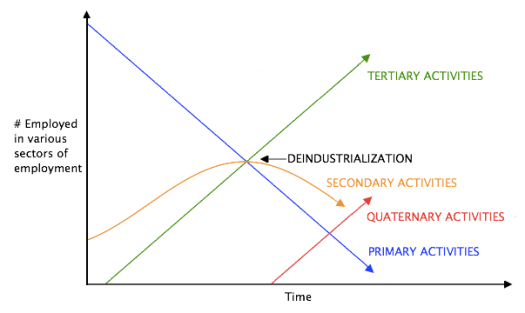
So the question for the day is… how can there be so much advertising? How has our culture’s center of gravity shifted from making to selling, from working to consuming? At some point, there’s a balance point that we’ll pass (or have passed) at which more people will be selling things than making things.

I think we have passed it, actually. The British-Australian economist Colin Clark claimed that only a quarter of all employment in the UK is in the primary (extraction of natural resources) or secondary (manufacturing) economies, with three quarters in the tertiary (service) or quaternary (information and finance) economies.

It’s highly likely that the US and most of Europe is organized along the same proportions. The problem is that it’s invisible, and thus we don’t think to ask ourselves whether or not we like it, or could do something different.

An analogous phenomenon is taking place in higher education, in which the things being made (classroom experiences for students) are overcome by the services and organization supposedly behind them all. At the school I most recently worked at, there are 37 employees organized within the educational unit of the college (including the library), compared against 62 employed in other institutional functions. There are nearly as many people in non-educational student services and support (29) as in education itself.

(This doesn’t accurately reflect the actual labor of providing education, of course. Those 37 employees are themselves largely involved in the management of the two hundred adjuncts who staff the vast majority of classrooms. This is true in the larger economy as well, in which the small number of Americans engaged in manufacturing are in many cases assembling products and materials created by a vast and unseen army of manufacturing staff in other nations, equally disregarded and off the books.)

And that brings us to the idea of decadence, which holds two related definitions: a focus on self-indulgence, and a sign of decline or decay. Without going too puritanical, I do think that a culture of expensive coffee and free information and perpetual pop-up sidebar advertising is just a different kind of culture than a manufacturing economy in which most of us are involved in making things (at a decent, unionized wage). And I think that a college that spends as much money on admissions and financial aid and student life and student services as it does on education is just a different kind of a college than the more monastic, idea-focused schools we once aspired to.

Here’s a simple example. When I went to college forty years ago, I lived in a slum. They called it a dormitory, but really, we had twelve hundred students in the building, sixty guys for each bathroom, the hot water didn’t make it to the north side of the building in the winter, and the food service options were “you want it or not?” (It was a slum with beer, and thus pretty enjoyable.) But this condition would no longer be acceptable for the majority of students and parents considering college.

I’m not going to wind this up today with some thundering moral lesson about how hard we had it and how tough it made us. I’m just going to say that I’m wondering what our focus on convenience and variety and innovation has made us become. And I’m going to think some more about the idea of decadence.

*I refuse to use the term wi-fi, a term copying the 1950s interest in high-fidelity (hi-fi) stereo equipment. The “fi” of the wi-fi construction doesn’t stand for anything at all, it’s just a baby-talk sound. There’s a whole metaphor there that I’m too weary to explore today. Get off my lawn.

…Someone Who Does That…

Archie Goodwin, as illustrated by Austin Briggs for the Saturday Evening Post, 1958

I once met an important research scientist who travelled on average probably ten days a month, to other labs and to conferences and to give presentations. I asked him how he managed his travel, and he said blithely, “I have someone who does that.”

I did not. I spent far too much time on Travelocity, weighing the random alternatives of layovers and pricing and departure times.

Every creative person could use “someone who does that.” As an example, I’ve long been enamored of the Nero Wolfe mysteries, written over the course of forty years by Rex Stout. Although private detective Wolfe is at the center of each book, the heart of the stories comes through the voice of his assistant Archie Goodwin, who has an unspecified though crucial job description:

I know pretty well what my field is. Aside from my primary function as the thorn in the seat of Wolfe’s chair to keep him from going to sleep and waking up only for meals, I’m chiefly cut out for two things: to jump and grab something before the other guy can get his paws on it, and to collect pieces of the puzzle for Wolfe to work on.

Rex Stout, “The Red Box,” 1937

All of the novels are told in Archie’s first-person narration, as he goads and explores, acts as both security and investigative agent, negotiates with police and suspects and witnesses, and does the mundane work of bank accounts, taking dictation, and recording the germination records of Wolfe’s ten thousand orchids. Along with Archie, Wolfe also has a full-time gardener for his rooftop greenhouse, and a live-in chef/quartermaster for his culinary demands.

I’d go for that. I’d probably change some of the details, though, as I don’t raise orchids.

Through conversation with an artist recently, I’ve been led to imagine what kinds of work partners I’d find most valuable in my writing career. Lots of writers have had research assistants, for instance, tracking down data sets and making phone calls and transcribing interviews. Lots of writers have had proofreaders and editors (often known by their alternative title, wife), working behind the pages to make wild ideas legible. And of course, lots of writers have had support in childcare and housekeeping and meal preparation and banking and mailing (see also: wife).

Institutions are well equipped with support staff. Even the smallest college has an IT service group that makes sure that computing and printing and projecting and web connections are reliable, and swooping in to rescue the moment things go awry. Bigger colleges have offices of sponsored research, who investigate funders and manage interdepartmental agreements that grant proposals require, who read proposal drafts and track expenditures after the awards are made. Department secretaries schedule class times and rooms, wrangle course evaluations, assist with events.

In the world of gig employment, though, we have none of that support. Each writer, each artist, each adjunct teacher or Lyft driver is every department all at once. We are accounting and IT, facilities management and human resources, custodial and grounds maintenance, food service and housing, social life and professional development. All of which adds time to the nominal work week, an unacknowledged multiplication of roles.

I would happily conform to standard software and computing practices in exchange for someone else managing my technology, both software and hardware. The troubleshooting of web connections, the software glitches that accompany every update, the flinky Bluetooth interface between computer and printer, all that stuff that should be invisible but never is. I’d be delighted to give that all up.

I’d also be happy to surrender the process of sending material to literary agents and magazines. They all want something a little different, their own desires are remarkably opaque, the timing of their responses covers the full range between now and never, and every rejection is yet another nail in the bed we lie on. I’d be delighted to prepare all of the standard submittal materials, and leave it to someone else to investigate agents, respond to their individual requests for info, and track the responses. If I got a monthly report that said, “We submitted twenty two times, got fifteen rejections, one request for the full manuscript, and six with no response,” I could process that in less than a minute at a low emotional temperature, and get back to work.

I like to cook and make drinks, to do laundry and dishes, to go grocery shopping and visit the hardware store, to mow the lawn and shovel snow, stack firewood. But I could live a long and happy life without cleaning another litter box, paying the monthly bills, managing the expiration dates of subscriptions, scheduling meetings and phone calls, painting steps. All of those not only add hours to the work week, they take up mental energy more profitably spent doing my work and learning new ways to do even better.

It seems to me that many of us could use an Archie Goodwin, filling in the ten thousand unspoken tasks that can crowd the work aside. We need “someone who does that.”

House Trained

Back when I used to go to academic conferences, the thing I dreaded most was the “poster session.” It’s hard to even describe the futility and incoherence of this event, seemingly designed to be simultaneously non-communicative and demeaning.

Let’s try, though. You’re a scholar, and you want to report on something you’ve learned. So you put a condensed version of your paper onto a four-foot by three-foot poster. If you’re a lab scientist whose paper might be four pages long in the Journal of Organic Chemistry, you might be able to get nearly the whole thing (including all the citations) onto that poster, using the electronic cut-and-paste equivalent of using a glue stick. If you’re a philosopher or cultural geographer whose paper might run thirty or forty pages, there’s a lot more condensation ahead of you. Go ahead, give it a try.

Once your poster is printed and mounted, take it to a barn and set it up alongside two hundred or five hundred or two thousand others just like it. Put on some nice clothes, and stand next to it for an hour or two, to see if anyone wants to stop and talk about it. It’s like the real-world experience of Tinder, being swiped-left on by identifiable individual humans, over and over and over.

A doctoral student in psychology has developed a different model for poster layout. Rather than trying to cram too much content in 14-pt type onto a single board, Mike Morrison (who has a prior history as a user-experience worker in web development) suggests that we should use an abbreviated version readable from several feet away at walking pace, a design that would invite browsers to stop and actually ask questions if the topic and finding are interesting. He’s created a YouTube video laying out his argument, but he’s also offered a template as a suggestion:

Mike Morrison’s template for scientific posters

The quick-read (QR) code at the bottom allows passers-by to access the full article instantly with their phone.

This is all super-intelligent, elegant, and innovative. So you can imagine the pushback. “People have been very quick to adopt an untested format on the recommendation of a splashy video,” says one commentator, as though the standard version of the research poster has ever really been tested against any meaningful alternatives. You want a test? Here’s the test, the experimental condition to compare against the barn full of control population. (Also, about the splashy video: it’s gotten people to quickly engage with an idea and to take action, which is kind of the goal of, say, a poster session. It worked, and so some people don’t like it.)

When people say “best practices,” they usually mean that they don’t dare try something new. The best practices may in fact be horrid, but at least when someone adopts them, they won’t be uniquely horrid, they’ll just be equally horrid with all their colleagues. And I cringe that my friends in undergraduate research have so fully embraced the archaic poster model as they teach research communication to their young people. Physicist Max Planck once claimed that “Science advances one funeral at a time.” It’s going to advance more slowly than that if we apprentice our young without serious reflection on our current practices. Mentorship can be an active, mutual learning, or it can be mere housetraining, enforcing meaningless norms because they’re familiar and comforting.

There’s so much about higher education that could be different. And whatever’s different will by definition be untested, at least until we test it. How did a community dedicated to the advancement of knowledge come to settle into such predictable and ossified forms? It’s going to take some real bravery to build a new model, a willingness to chop through a forest of no before we can say yes.

A Meditation on Human Nature

Full-page ad in the Toronto Star last Monday

Every time someone says that their preferred solution is “common sense,” I know they don’t have a great argument for it.

Every time someone says that it’s a “best practice,” I know they’re done thinking about possibilities.

And every time someone bases their argument on “human nature,” I know they’re just universalizing their own traits.

This is part of the most famous motivational speech ever given by Vince Lombardi:

There is no room for second place. There is only one place in my game, and that’s first place. I have finished second twice in my time at Green Bay, and I don’t ever want to finish second again. There is a second place bowl game, but it is a game for losers played by losers. It is and always has been an American zeal to be first in anything we do, and to win, and to win, and to win…. It is a reality of life that men are competitive and the most competitive games draw the most competitive men.

Competition is human nature, yes. But so is compassion, and admiration of the excellence of others, and the need for love and affection, and the desire to learn and to become greater than we are. We are a recipe, not a single ingredient.

I loved watching the NBA finals this year, not merely because I wanted the Warriors to win another title. I wanted BOTH teams to excel, so that we could all be treated to the wonders of superhuman performance from stars and role players alike. And when the Warriors lost game 6 and the series, my mild disappointment was far outweighed by the awe and joy of having seeing thirty men regularly do impossible things for six straight games.

And clearly, based on the advertisement at the top of this post, the Warriors felt much the same.

One of my characters, a pool player and former Benedictine monk from the 1950s, once gave a very different kind of motivational speech:

The realm of competition is the mythic frame of our culture.  We are a gladiatorial society, measuring our worth in medals or dollars, in recognition or simple blood-spattered survival. Endless competition has left us narcissistic, unable to see beauty on its own terms. Competition is a paradox. It is the realm of the weak, the insecure, those who must constantly prove to themselves their own worth at the expense of others.

The mythic frame tells us that it is only through competition that excellent work is honed, that in the absence of competition we would do work merely adequate to immediate need. But it is only in doing work that we name as worthy of the doing that we move through the action to its greater depths. It is true that we are frail, that we tire and cut corners and lose focus, and that those frailties result in our work being less than it might. Although competition is thought to root out those weaknesses, a more powerful tonic is to continually surround ourselves with work that we admire, whether in our field or another endeavor entirely.  To mark for ourselves what is worthy of our aspiration, to remind ourselves of glory.

If we can participate in a competition without investing our self-worth in the outcome, if we can focus only on the work at hand rather than on future states of pride or embarrassment, then we have gained from the experience.  We have confronted the mythic frame and found it to be the thin façade that it is.  We have seen past the curtain to the truth.

This is what human nature can look like:

Photo by Nathaniel S. Butler/NBAE via Getty Images

Central Place Theory

Remember when destination weddings were a thing? When prima donna brides just told everyone they had to fly to Barbados or Denali if they wanted to participate in the wedding? Yeah, I’m glad that’s over, too.

But I’ve now seen a state regional comprehensive college, a school designed specifically to serve students from a particular catchment area, publicly state its desire to become “a destination university.” Well, aside from out-of-state tuition being more than double the in-state rate, I’m wondering why they’d want that. (Cynically, I suppose that IS why they want that.) I’m also wondering what they think they’d be offering as the lure for those destination students.

Back about 80 years ago, a German cultural geographer named Walter Christaller developed a theoretical system of habitation scales that he called Central Place Theory. The fundamental point was that it took a specific scale of population to be able to offer specific kinds of services, so towns of smaller size would be served by one central place of larger size, those places themselves being served in some number by a city of even larger size, and so on. Here’s an example:

  • My town, Middletown Springs (pop. ~725), has a post office, general store, church, and takeout restaurant. If you want to buy gas or go to a full grocery store or get your hair cut, you’d drive to…
  • Poultney (pop. ~3,000). But if you lived in Poultney and wanted to go to a movie or a Home Depot or buy a new car, you’d drive to…
  • Rutland (pop. ~16,000). But if you lived in Rutland and wanted to go to an elite restaurant or see a major performer live or go to a nationally connected airport, you’d drive to…
  • Burlington (pop. 35,000). But if you lived in Burlington and wanted to go to a world-class symphony or a major-league baseball game or an international caliber hospital, you’d go to…
  • Boston (pop. ~700,000).

Public higher education has long been organized in a sort of central-place-theory model, in which the dozen scattered campuses of the Community College of Vermont serve the smallest regions, the four baccalaureate (and increasingly master’s) Vermont State Colleges serve the State’s more advanced educational needs, and the singular University of Vermont is the research university with the med school and the doctoral programs.

This model is the norm around the country. Michigan has 28 community colleges, a dozen regional colleges (sometimes called “directional schools”—Eastern, Western, Northern, Central, etc.), and three research flagships. California has 114 community colleges, 23 Cal State master’s level schools, and ten University of California system research schools.

And I honestly have no idea why anyone would travel to any of those middle tier of schools. Why on earth would anybody from (say) Minnesota want to go to college at (say) West Texas A&M? One reason: for over a decade, West Texas had one of America’s elite college bowling programs. So that’s a good reason for, like, 15 people to go there. Everybody else, not so much.

And that’s not to say that West Texas or its compatriots are bad schools, of course not. But destinations? Why? On what grounds? When I lived in far northern California years ago, kids came from away to go to Humboldt State because it was a beautiful landscape in a very specific way (green, foggy, rainy oceanfront), and because high quality marijuana was vastly, easily available. Now that recreational pot is legal in California, I predict a substantial enrollment decline at HSU. It’s a good school, but why go there and not Chico State or Fresno State, much less come in from far away and pay double rate?

All this reminds me of something Nora’s knee surgeon said to us a couple of years ago. “I do four hundred of these a year, I’m really good at it. But there are a thousand people in America who are really good at it. I appreciate it when people make referrals to me, but there’s no sense in driving past another hospital to get to this one.” So why would anybody drive past dozens, or hundreds, of other state schools to get to yours?

Keep It Real

One of the things that bites me is when someone contrasts college against “the real world.” At any given moment, there are twenty million people involved in higher ed: as students, faculty, staff, and administration. That’s almost ten times the number of people involved in every branch of the armed services and Department of Defense combined. Anything that twenty million people are doing seems to me to be, by definition, real.

I had yet another person reach out to me today about the book, talking as so many people have about how much they miss their students. And I do, too. But let’s be specific. What do I miss about them?

I miss how much they want, and how open they are to trying. Trying damn near anything. If we give them work they find meaningful, they throw themselves into it with an abandon that I always found breathtaking. We are blessed to work with young people during their age of optimism, before the “real world” has broken them to cynicism and limited their beliefs.

I miss how much they love each other, how willing they are to have each others’ backs, how easy it is for them to share what they’re afraid of and what they dream of, and that so many of them are able to hear and respect each other. We are blessed to work with young people during their age of inclusion, before the “real world” has finalized its sorting into us and them.

I miss how easy it is for them to try new things, and to imagine themselves to be new people. We are blessed to work with young people during their age of possibility, before the “real world” has insisted on a career path and a job title.

One of the things I fear about our wholesale adoption of the “workforce development” model of higher ed is that it introduces cynicism and transactional thinking into what could be the last protected place. The entire logic of workforce development, for colleges and students alike, is simple: “If I do X, then I can have Y.” It eliminates considerations of optimism and inclusion and possibility, setting them all aside in favor of comfort and predictability and economic development.

The Urban Dictionary offers the following definition (from 2003) of the term keep it real: “When someone does not change who they are or what they believe due to societal pressures.” College—positioned as it is prior to life’s most weighty societal and economic pressures—might represent our last (and most) real place.