Thinking in Slow Motion

Kristen Renn, Michigan State University

Philosophy is thinking in slow motion. It breaks down, describes and assesses moves we ordinarily make at great speed – to do with our natural motivations and beliefs. It then becomes evident that alternatives are possible.

John Campbell, Philosophy, University of California at Berkeley

One of the great joys of academic life is that we haven’t the faintest idea where we’re going. This allows us to actually examine what’s around us, ask questions about why it exists in the form that it does, ask whether other forms might be possible.

(This sets academic life in direct opposition to university administration, of course, in which the daily facts of money and buildings and regulations and investments constrain our options to near zero. The fact of moving from faculty to administration means leaving behind, forever, the possibilities of unfettered investigationโ€”the unfettered investigation that drew us all in the first place.)

One of the people I’ve worked with in my academic writing coaching has spent many years investigating the issues around marketing toward multi-racial consumers. For instance, if one has both white and Black family, does one identify more fully with advertising featuring white or Black actors or spokespeople? What radio stations do you spend your advertising dollars with?

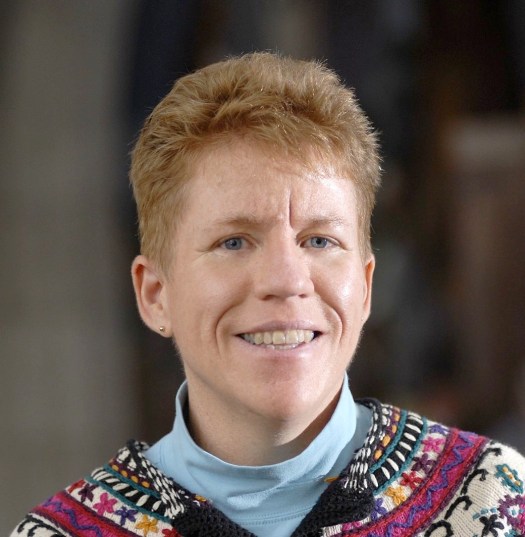
She’s relied extensively on the work of Kristen Renn, the person whose photo is at the top of today’s message. One of Renn’s key contributions to our thinking is the idea that our identityโ€”the identity we think of as entirely individualโ€”may not exist solely within our own history, or our own DNA. She has developed a body of theory called situational identity or ecological identity, the core of which is that whatever circumstance we find ourselves within offers us some range of identities that we can take up. Specifically, in her own research around multi-racial college students, she says that some students identify strongly with one race or another; some identify specifically as multi-racial; some reject the idea of race and refuse what they believe to be artificial categorization; but some identify differently depending on the situation they find themselves in at the moment. They might be the Blackest person among their white friends, and the whitest person among their Black friends. They might choose to take up different aspects of multiple cultures, and those choices might change over time, or in relationship to different institutions. Just the form we receive that asks us to check a box does two things: it restricts our identities to those named, and then requires that we select only one of the options. It is a situation that enables a particular kind of response.

The idea of ecological identity is way more complex than I can lay out here. (I’ve used it extensively in my own fiction writing, a development that Renn likely never would have predicted.) My point today is that we can only develop productively unsettling ideas when we have the time to do that. Our drive toward speed and efficiency (and distraction and constant engagement) makes it much less likely that we will spend the time required to ask fundamental questions about why and what else. To spend the time to explore the contradictions that inevitably arise in any system of beliefs, and to not paint over them but to take them apart and discover why they exist, what they imply.

The great blessing of being (semi, sort of) retired is that I don’t have to go to any more meetings. I don’t have to write reports that respond to someone else’s outline, for someone else’s purposes, reports in which the outcomes are foreordained and all we do is fill in the local color. Writers get to ask annoying, nonproductive questions, and then write our way out of them. We get to think in slow motion.

I can’t imagine anything more fun.
Good Things Don’t Scale

Now I would like… five hundred more sets.

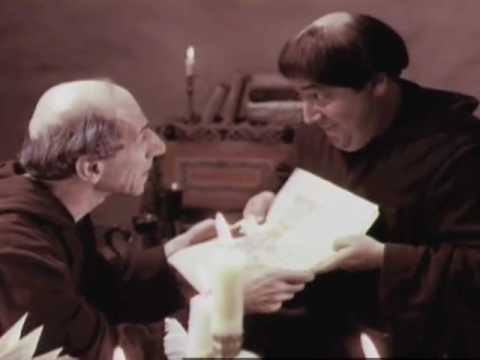
Back in the late 70s, before Xerox was a generic term meaning “photocopier,” the Xerox company made an advertisement about their new and remarkable product. Brother Dominic (at right, above) had painstakingly hand-illustrated a manuscript, and eagerly brought it to the monastery’s abbot (at left). “Very nice work, Brother Dominic… very nice. Now I would like… 500 more sets.” So Brother Dominic sneaks out and goes to the Xerox shop, and returns soon after with the stacked sets. The abbot says, “It’s a miracle…”

Well, no. It’s just a mechanical reproduction, with none of the attentiveness or love of the original.

I got an e-mail this week from someone who’d recently read The Adjunct Underclass, and was telling me about her teaching expectations at a third-tier state university. Four courses per semester, averaging 35 students per course, plus all of her departmental and university service work. That’s just mechanical reproduction, with none of the attentiveness or love that we would hope a real education could carry.

I’m in the final days of teaching my independent fiction course, with twelve students. For each of the first five weeks, I wrote two assignments, and thought through what each participant had sent in each case. For the past three weeks, they’ve moved from research to writing story drafts, and I’ve marked up anywhere from six to a dozen drafts for each of the twelve participants.

Twelve students for eight weeks. And I’m tired. It’s real work to be that attentive to that amount and that diversity of work. Just the logistics of organizing papers and naming files and making sure that I’m looking at the most current draft is an addition to the effort.

So when I think about 140 students for 15 weeks, or 21.875 times the workload I just finished, it scares me. It scares me because the only way one human can do that much work is to rely, like Brother Dominic, on mechanical reproduction. To repeat the lesson plans, to make the homework into quizzes, to give every student one bite at the apple rather than sit with the repetition and revision that enables understanding and seals growth into place.

For the students, too. Each of my dozen writers has been at work on the same story at least twice a week for three weeks. They’ve swapped out characters, dropped whole hard-won scenes that were necessary for manufacture but not for use, have circled closer and closer to their prey. We’re at the point now where we’re considering punctuation and typography, microscopic but meaningful contributors to the voice of story. And they’re exhausted, too. But in a week or two, when they recover, they’ll know what they’ve gained.

Education… real education… is slow, and expensive, and (to use the awful language of marketing) “high-touch.” It used to be a luxury good, purchased only by the wealthy. And so what we offer now is a vastly diminished version, a mechanical reproduction that carries the content without the care. This is not the fault of any participant; everyone involved is smart and hardworking. But like any product, what was once sold at Bonwit Teller bears only passing similarities to what is now sold at Dollar General. The fate of all mass products is that they are mass products, subject to regulation and reproduction and worker quotas. They become commodities, responsive to price pressure rather than quality pressure, interchangeable across providers.

There are no miracles available to us, only love and attentiveness and focus. When those are removed, we are left with quantity, and marketing, and loss.

Individuals, in the Tide of Culture

I just saw a tagline from someone’s personal profile on a social media site. This person is a social and political conservative, and an active commentator on the current state of social unrest. His tagline reads, in part, “I will NEVER apologize for things I didn’t do!”

That’s just heartbreaking. As David Foster Wallace once wrote, in his remarkable talk later published as This Is Water, we all have “the freedom to be lords of our own tiny skull-sized kingdoms, alone at the center of all creation.”ย This is the heart of contemporary masculinity, this notion that we are responsible only for the things we do as individuals. We take no responsibility for the things we do collectively as a culture or a society; we also take no responsibility for the things we did NOT do, those sins of omission where we COULD HAVE stepped up but chose not to.

That kind of voluntary isolation, that emotional self-quarantine, leaves us hard and cold and bitter and angry and defensive. Like a dog left alone and chained to its coop, we bark and lunge and snap at everyone who passes by.

Our role is not self-aggrandizement, or personal accumulation. We know those people; they are hollow, and thus must constantly build a thicker and harder shell to prevent collapse. No, our role is to belong. To sit with the hard conversations and the difficult histories that have brought us to be a member of our community and our culture, and to learn ways to enhance the lives of all around us. To fail, and to be okay with failure if it was in the service of trying to do better. To forgive, over and over and over, and to ask for forgiveness for the things we haven’t done but should have. To rebuild the things that our ancestors had broken.

Individual snowflakes will melt. But together, we can form a blizzard that will transform our landscape, and lead toward the healing of spring.

Changing the Frame

Image from Guardian UK

The frame we create to address a social issue can only hold some specific things, and the shape of the frame forms its contents. So letโ€™s talk about one frame weโ€™ve constructed, the one we call law enforcement. Thereโ€™s two words there, and they both matter.

First, law. Laws are the boundaries we place around unacceptable behavior, the fence we put up and say, โ€œno further than this.โ€ By their very design, they have nothing whatsoever to say about a good life; they define the bad, the offense, the criminal, the fraudulent. The focus on law is a capitulation to a particular moment in history: the Calvinist doctrine of utter depravity or the inherent, ruinous sinfulness that lies within all of us, conjoined with Enlightenment beliefs in reason and the perfectibility of human structures. In short, the lawmakers will get it right, which is a good thing since the rest of us are fated to get it wrong wrong wrong.

Second, enforcement, which of course means โ€œto apply force.โ€ If you step beyond the fence of law, you will be met with aggressive response.

That combination, law enforcement, is a bitter recipe that has always allowed the powerful to set their forces against those who will not, or cannot, or sometimes should not, stay within the fence. And the fence always moves, and the position of the fence is set by people with power and money, and so laws tend to exclude the reasonable interests of those who are less able to establish them.

Law enforcement is, in both terms, a deeply masculinist construction: the faith in reason to achieve the correct law, and the faith in aggression to enforce it.

So letโ€™s imagine an entirely different frame with which to hold a similar function. Letโ€™s call it civic protection. Like law enforcement, civic protection has two words, and again, both words matter.

First, civic. Rather than focusing on an external toolโ€”the lawโ€”attention to the civic means diagnosing and resolving problems to the civitas, or community. The community is made up of everyone around us, of every age and every race and every history and every gender. Itโ€™s made up of consumers and businesses, made up of workers and employers, made up of streets and houses and shops and skyscrapers. The fundamental question is the health of the community, which is a matter of collective judgment about which disagreement might reasonably be expected. So a core skill of civic protection would clearly be mediation, in which a disagreement is aired, tested, and (temporarily) resolved.

Second, protection. The basic work of civic protection would be to protect the members of the community from harm. Rather than law enforcement, which focuses on the violator, civic protection would focus on the violated. In domestic violence, for instance, civic protection would start by removing the woman and kids and pets from danger rather than beginning with a confrontation with the man. Police engaged in civic protection would fundamentally be observant for things being harmed, rather than for those engaged in harmful behavior.

Similar work might get done under each frame. Police might pull over someone whoโ€™s driving erratically, for instance, but their response would be entirely different. Right now, the law enforcement protocol would be to do a field test for intoxication, with a hard threshold of 0.08% blood alcohol that would trigger an arrest or a release. A civic protection protocol would be to say, โ€œYouโ€™re driving erratically, and weโ€™d like to get you home safely. Weโ€™ll send someone tomorrow to follow up and see whatโ€™s going on.โ€ The goal would be public safety in the shorter and longer term, not arrest and prosecution.

Thereโ€™s a long tradition of restorative justice, in which the harmed and the one who caused harm are brought together to build a reconciliation. The idea is to restore a healthy community, which is considered to be the normal, baseline state rather than the presumption of criminality we begin with now. Restorative justice is slow, and it can be expensive, though you can pay for a lot of mediators for the price of an armored personnel carrier. But the current system of publicly sanctioned revenge leaves everyone wounded, and works against rather than on behalf of civic protection.

Officer Patrick Skinner of the Savannah GA police department describes better than I ever could what civic protection can look like, and what it can accomplish.

More tomorrow. 

Apologizing for Doing the Right Thing

Photo from the Atlanta Black Star

So many of the awful things we do come from the underlying frame weโ€™ve built them upon. 

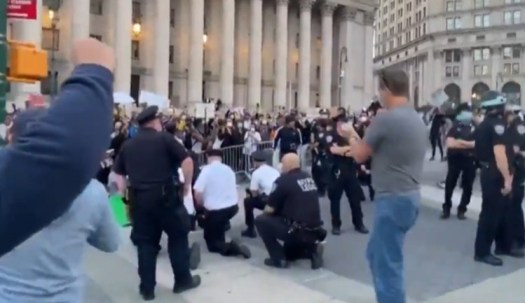
Letโ€™s take a look at a news story from last week. During the protests in New York City, there was a humbling and hopeful moment, during which at least a few police officers stood with the protesters, talked with them for a bit, and then knelt together in a show of solidarity and unity. For just a few seconds, they werenโ€™t occupier and occupied; they were fellow New Yorkers hoping for peace in their city.

One of those officers, Lt. Robert Cattani, subsequently apologized for this moment of humanity. In a letter to his colleagues, he wrote:ย 

To The Men and Women of Midtown Precinct South,

I know most of you hate reading emails and are probably too exhausted to keep your eyes open long enough to read this so Iโ€™ll try to keep it as short as possible.

As most of you know on Sunday during the protest at Foley square, I made a horrible decision to give into a crowd of protestors demands and kneeled alongside several other officers. The conditions prior to the decision to take a knee were very difficult as we were put center stage with the entire crowd chanting. I know I made the wrong decision. We didnโ€™t know how the protestors would have reacted if we didnโ€™t and were attempting to reduce any extra violence. I thought maybe that one protestor/rioter who saw it would later think twice about fighting or hurting a cop, I was wrong. At least that what I told myself when we made that bad decision. I know that it was wrong and something I will be shamed and humiliated about for the rest of my life. We all know that the asshole in Minneapolis was wrong, yet we donโ€™t concede for other officersโ€™ mistakes โ€ฆ. I do not place blame on anyone other than myself for not standing my ground. I did not consider the consequences or facts of what I was doing โ€ฆ. Anyone who really knows me, knows that this goes against every principle and value I stand for. I would like to think that being up for almost 40 hours and walking over 32 miles in two days might have clouded my judgement, yet still no excuse โ€ฆ. I was there for the peaceful protests, I was there for the fights with the rioters at night. I walked, I fought, I bleed and I still kept showing up. I spent the first part of my career thriving to build a reputation of a good cop. I threw that all in the garbage on Sunday.

So from the bottom of my heart and soul I am sorry and ashamed. Since then I have been struggling with the decision I had made, not being able to eat, or sleep. I at one point came to a rash decision to leave the department. I could not imagine the idea of ever coming back to work and putting on the uniform I so wrongly shamed. However, I decided that was the easy way out for me and I will continue to come to work every day being there for my personnel.

I want especially apologize to everyone from MTS: I let you down, I understand your frustration and anger. I know the cop in me wants to kick my own ass. I want you to know that I donโ€™t expect anyone to accept my apology, nor do I deserve it. Please know that just like the first half of my career I will work every day for the rest of it to rebuild the confidence you once had in me.

Thank you and may god watch over you all.

So the fact of apologizing for attempting to find common ground with protesters is a sad state, and the reaction of the police unions that theyโ€™re โ€œout there battlingโ€ and demanding that politicians and the media โ€œstop treating us like animals and thugs and start treating us with some respectโ€ shows us how long the road to civic health will be.

But as bad as those are, itโ€™s the language beneath it all that shows the rotted frame that any meaningful police reform must dig out.

  • Lt. Cattani apologized for “giving in,” for not “standing his ground.”
  • He apologized for attempting to use personal judgment rather than following orders.
  • He apologized for trying to reduce tensions.
  • He apologized for taking some responsibility for the bad actions of some police colleagues.
  • He believes that being a โ€œgood copโ€ means that he walked, he fought, he bled, but he still kept showing up.
  • His apology includes other manhood-markers like he was โ€œup for almost 40 hours and walk[ed] over 32 miles,โ€ the valorization of stoic suffering.
  • His own assessment of his reputation is now โ€œin the garbage.โ€ย 
  • When someone makes a mistake, the appropriate police response is to kick his ass.
  • He hopes that god will watch over his fellow officers rather than the entirety of a city in crisis

This is the abbreviated anthem of our stunted, wretched beliefs about manhood. And thatโ€™s why efforts toward police reform are so difficult; weโ€™re applying policy tools to a culture problem.

More tomorrow.

Hoping for A While Rewarding B

Peace officer?

One of the primary arguments of The Adjunct Underclass is that we can’t claim that we’re interested in serving low-income college students and having them make the successful transition from high school to college, and simultaneously give them a teaching force that is made up of people who are not supported by their institutions, who don’t really even belong. But that’s only one of thousands of practices, across all areas of society, that work directly in opposition to our desired outcomes.

Our careers, for instance, are full of gateway experiences that absolutely don’t prepare one for the life beyond the gate. I’ve often described architecture school, for example, as a bait-and-switch, in which training as a theoretical sculptor is the threshold for entering a profession that mostly builds cost-effective rectangles. As a culture, we do an awful lot of things that lead directly toward ends that we claim we don’t want.

In writing, for instance, the path to being noticed goes through short stories and flash fiction, building credibility through small publication credits. MFA programs create short story writers, because that’s the amount of story that semesters can hold. But being a novelist is just a different practice, and our novels have been reduced in possibility through being molded from the wrong model.

Hannah Gadsby said something similar in an interview with the New York Times, about the necessity of success in the short-story form of club standup to get a chance to do the longer-form work she thrives in:

What I was talking about there is club comedy. Because thatโ€™s the world that built comedy. Our comics come out of this gladiatorial setup/punch line shock. People celebrate club comedy like it is the art form. I love long-form comedy, but in order to get to that place where you can perform it, youโ€™ve got to fight it out in the clubs. I know how to do that. I know how to tear someone a new [expletive]. I donโ€™t feel good about it. I donโ€™t like going onstage after other people whoโ€™ve done rape jokes, and thatโ€™s how I had to cut my teeth: Make a group of people whoโ€™ve just laughed at a rape joke laugh.

I’ve been thinking about this while watching police violence around the country. And I’m surprised that we’re surprised at it. When law enforcement agencies hire, they privilege ex-military members, sometimes by policy and law. They place enormous logistical and cultural barriers to participation by women, reinforcing all of the travails of fragile masculinity and instant reaction to perceived disrespect we talked about a couple of months back. And then we put them into armor, give them tanks and a broad array of sophisticated weaponry, and we’re somehow then surprised when we see American streetscenes that look like Kandahar.

We can’t be surprised by that. We select for it. We’ve written it into policy. We’ve abandoned the idea of the “peace officer,” and created an occupying army instead.


We’re hearing conversations about “Defund the Police.” And the immediate leap is that the inevitable next step is “eliminate the police,” which is absolutely not the point. It’s a handy claim to make, though, because it scares people, and scared people are easier to manipulate.

We could, though, scale way back on the weaponry. We could bring large numbers of police officers to a scene in school buses rather than armored personnel carriers. We could recognize that desert or forest camouflage uniforms are just symbolic in an urban American setting, a shorthand for the brutality of warfare that could be unleashed without warning. We could stop pretending that “non-lethal force alternatives” don’t cause lasting injury. And we could acknowledge that communities of color have been the occupied nation for America’s entire history.

We could shift our funding toward mental health first responders, so that every public instance of mental illness or domestic disturbance or neighborhood dispute aren’t met by an armed response. We could work in policy to end unannounced or “no-knock” warrants, remembering that the Fourth Amendment is at least equal in importance to the Second. We could put a lot more policing and prosecutorial power behind the control of white-people crimes like fraud and insider trading and conflicts of interest that cost all of us vast amounts of money and opportunity.

Our rethinking of police can’t just be logistical and tactical. It is, at heart, cultural. We’ve trained our law enforcement personnel through years and years of high school football and military service and masculine enculturation; we can’t ask them to instantaneously reject all the training that we ourselves have provided and steadily rewarded. We have work to do to heal ourselves on every front; there are none among us who have not been dyed in this pot.

This is the time for us to have a lot of serious cultural conversations. The nature of law and order, and law enforcement, is high among them. The alternatives are not binary, a choice between no police at all and exactly the police we have today. The alternatives are endless, and the deliberations must not be only among those who benefit from the status quo.

Cluelessness

1938 Federal map of neighborhood loan-worthiness. Green, “Best.” Blue, “Still Desirable.” Yellow, “Definitely Declining.” Red, “Hazardous.” In case you wondered where “red-lining” came from…

I talked a few days ago about how much I treasure curiosity, in myself and in others. And diversity is a great tool for curiosity, because it naturally surrounds us with people who might reasonably be expected to have had different life experiences, and thus to have developed different concerns and different values. Diversity isn’t about “tolerance.” Have you ever been tolerated? It’s pretty uncomfortable.

But most of the environments I’ve ever inhabited haven’t been all that racially diverse. Growing up in Michigan, our town was actually two towns, divided by Broadway; white to the south, Black to the north. You could watch the “for sale” signs go up on the lawns in our neighborhood when their oldest kid got to sixth grade; K-6 was in a neighborhood elementary school, but 7th grade was in the city’s one junior high, north of Broadway. I saw white flight in person every year as my friends moved from Muskegon Heights to Norton Shores, a community that was 96% white.

An engineering college in far northern Michigan in the 1970s? Pretty white.

West Texas in the late 70s-early 80s? Pretty white.

Oakland in the mid-80s to early 90s was far more diverse, though still somewhat geographically segregated. And going to college at Berkeley while I was there… awfully white.

Grad school in Milwaukee? White, except for international grad students. While I was there in the mid 1990s, Milwaukee was named as America’s most segregated city, with 95% of the Black population of THE ENTIRE STATE OF WISCONSIN living in a two-mile-by-two-mile square area of the northwest of Milwaukee.

Research on the Northern California redwood coast? Super-white, except for the Native American community.

Professional work with California county governments while I was living in San Luis Obispo? Flat white.

Teaching at Duke? A white fortress in the middle of a Black city. The Black staff of the university called it The Plantation, for clear and enduring reasons.

Teaching in Boston? The school itself was fairly diverse, but the city and its suburbs remain isolated islands, with the mayorship being traded every few years between an Italian and an Irish Catholic.

And now, here I am in Vermont.

Seems like maybe I have some issues to work through, doesn’t it?

And I consider myself fairly progressive, fairly enlightened, but every so often I recognize how little I know. It didn’t occur to me, for instance, that Asian Americans would be physically targeted by stupid people because of COVID, but an Asian American friend saw it coming far in advance. She was right.

So here’s something I didn’t think about until someone smacked me in the head with it. College loan forgiveness sounds like a reasonable issue to discuss, with two whole generations of kids starting adult life over their heads in debt. That’s just bad social policy. But then someone raised the question: Why are we afraid to talk about reparations for slavery, but willing to calmly consider a trillion-and-a-half-dollar benefit that will flow disproportionately to white people? And then I raised a second question: why didn’t it occur to me to ask that first question myself?

I mean, I’ve written a whole novel about the white business and political structure of Michigan conspiring to steal an African American city. I’m no stranger to what it means to have had assets devalued by redlining and having labor unions that resisted Black workers and a city with an invisible but fully understood line right down the fucking center of it. But I haven’t LIVED it. I don’t know the daily desperation of people who are threatened and excluded and barred from entry, who somehow aren’t “a good fit” for our department. I understand that, but I haven’t felt it. I know what social class feels like, because I have lived that. I know what it’s like to be a working class kid trying to move into a white-collar world, and I know what it’s like to be a white-collar professional feeling resentment about my privileges from my blue-collar friends and family. I own that life, in ways that I can’t own some others.

Our physical segregation and our emotional segregation from one another feed our inability to hear and feel. One event may be the ostensible cause of another, but really, the cause was hundreds of years and millions of related experiences that finally have become too much to bear. Just because I might not have seen them all doesn’t make them less real.

The Ecumenical, Evangelical College

NOT a trade school…

So yesterday I laid out a strategy for contingent faculty to work within colleges as they are currently configured. But here’s the dirty secret. I don’t like colleges as they are currently configured. They are the problem.

Let me explain.

College, for a lot of people, is 13th through 16th grade; something to do after high schoolโ€”but still quite a lot like high schoolโ€”that holds you out of the labor market for a few years and gets you some kind of a “gumption certificate” on the other end (plus a lot of parties and ballgames in between, and a network of friends you can turn to in later life). It’s a four-year extension of K-12’s necessary but rarely-spoken role as public-subsidy daycare.

College, for a lot of people, is a trade school for indoor jobs. You declare at eighteen or nineteen that you’d like to be a physical therapist or a nurse or an engineer, and we provide you with four years of increasingly focused training that will prepare you to take your professional exams and step into that job. Any time you hear a college president or a state’s legislature (or a parent, too often) talk about “workforce development,” that’s what they mean.

If we took those two motivations of college out of the current mix, we’d see the universe of American colleges drop from about 5000 down to 500. And I think that we could. We could replace college with job training, save everybody a year or two along the way, and serve millions of people, probably better than now. We could replace college with a four-year cruise ship, let everybody just ripen themselves from 18 to 22, and serve millions more.


The strategy I laid out yesterday for the protection of adjunct faculty was the development of a teaching-services corporation that would supply hundreds or thousands of colleges with the anonymous component courses needed to service their degree programs. Composition, languages, calculus, science for non-majors, intro to social sciences, history surveys… the courses that students pack with them when they transfer, and that they rightly expect will bolt directly into the new platform with no loss of serviceability.

And as I laid out the bones of that structure, a nagging little part of me said, “but what about academic freedom?”

Here’s the deal. Trade schools don’t live on academic freedom, because they don’t do anything academic; they provide knowledge, not curiosity. Cruise ships don’t live on academic freedom, because everyone is a concierge engaged in guest satisfaction. Trade schools and resorts are both managerial businesses, with employees that do what they’re supposed to when they’re supposed to, all providing a proscribed and predictable customer experience.

Those two models of collegeโ€”the two prominent models in most people’s thinking, I’d wagerโ€”are exactly why people don’t get up in arms about the adjunct crisis. I mean, too bad for you and all, teaching your class for $2,400, but it’s no skin off my nose as long as it saves some money for me or for my kids. If the decision comes down to fairness or affordability and convenience, the American business landscape has bet on affordability and convenience every time, and never been wrong.


College, when it matters, is something other than trade school or resort. A good college (dare I say, a real college) is where one goes to determine what kind of an adult s/he’s going to become. It is not a place of data, or of information, or of knowledge, or of skill, but rather a place of wisdom, of deliberation, of guided exploration through the many, many ways of adult thought.

In order to do that, we take young people away from their parents, place them together in protected and distant grounds, and surround them with obsessives. With unreasonable adults, fixated on a particular problem, missionary about the practices of their field. But not all in one field, no, never. A dozen different paths, evangelical loonies at every turn, each beckoning their students to follow this path, not the others. This is the one true way! they each shout, and some number of students are convinced by one prophet or anotherโ€”or better yet, build their own synthesis of the multiple theses and antitheses that flood them every day. And we surround them with other young people on a similarly bewildering journey, so that they can compare field notes along the way, argue themselves into further complexity.

This is the one role of the teaching faculty that deserves academic freedom; the freedom to be a wild-haired lunatic in the pursuit of antebellum American history, or of the power of quantitative pattern, or of the life-changing joy of a novel. The undergraduate faculty requires academic freedom only inasmuch as their freedom allows them to be dangerous. The institution itself must be strictly ecumenical, favoring no branch of the faith; but each individual faculty member must be allowedโ€”no, expectedโ€”to be a mad prophet, an unreasonable glint in their eyes when they talk about actinide chemistry or competing models of macroeconomic policy.

At the end of a couple of years of that, we ask students to “declare.” To declare an adult life that is worthy of their endeavor, to declare that one intellectual path is so compelling that they will build the rest of it themselves.


There is no intellectual danger in a trade school. There is no intellectual danger on a cruise ship. Those environments accept contingent faculty exactly because both teachers and schools are meant to be the same as another, interchangeable by design. Academic freedom is anathema to trade schools, which rely on students leaving class A prepared for what awaits them in class B, and at the end of their curriculum, to be able to reliably pass a nationally-normed professional-licensure exam. Academic freedom is anathema to resorts, which need their faculty to be ingratiating and ready to serve, to ensure that each patron has an optimal experience exactly as she or he defines it. Academic freedom cannot exist in any meaningful way in most of American higher education as we have currently defined it.

If we want something worthy of us, weโ€”like our studentsโ€”will have to build it ourselves.

Component Manufacturers

Sure, we can make you batteries in whatever configuration and dimensions you like. You give us the service specs, we’ll get you the parts you need.

In order to understand the status of the contingent worker in higher education, itโ€™s important to understand what colleges sell. (Our discussion here will focus on the teaching of undergraduates; the work of graduate education and research raise their own questions of contingency, with their own paths forward.)

What exactly do colleges sell? They sell degrees. They sell BAs and BSs and BMs and BFAs and B.Archs and such. Thatโ€™s what a student steps up to purchase. Not courses. Not experiences. Degrees. The analogue to this is when you step into a Subaru dealer (Iโ€™m writing this in Vermont, and so must be patriotic to the state car). What do you want? Do you want brakes? Do you want a transmission? Yes, but only insomuch as what you really want is a car, and the car is outfitted with all of those component parts. What you want is to be able to drive to work in comfort, to be able to carry skis or child seats or potting soil as you see fit, to impress the neighbors with your judgment and your automotive wokeness. The components are largely invisible in the shadow of the greater experience, which is to be the owner of a Subaru.

Subaru does not make brakes. Nor seat belts, nor air conditioners. Subaru does not make batteries nor spark plugs nor tires. Subaru does not make paint nor rear-view mirrors nor windshields. Subaru buys all of those, designed and built to its own specifications, from subcontractors located across several continents. Those subcontractors are chosen on three bases: a) ability to meet the spec, b) reliability of service, and c) low cost.

The batteries that go into a Subaru are more or less the same as those that go into a Honda, just as Calculus I is more or less the same no matter where you take it, because it has to be able to be press-fit into some other institutionโ€™s degree. Forty percent of undergrads transfer some time in their process, and all those components need to be fungible enough to fit another car.

A college’s degree, as a whole, is a carefully designed product that only a handful of people (the permanent faculty and the academic administration) get to shape. The permanent faculty get to do the assembly, and to applaud the finished products when they roll off the line. Nobodyโ€™s applauding for the tires. The components, by design, are interchangeable across make and model.

This helps to explain why labor practices borrowed from the era of massive, self-contained factories have had such meager results when applied to higher ed. Ford Motor Company once DID make all of those parts, in subsidiary units like Autolite and Motorcraft and Philco. The UAW was able to act as a single massive force in nearly equal opposition to the massive force of the corporation. But now, only a relatively small number of people work for the automotive corporation, with far more employed at hundreds of specialty shops, each with its own labor force and its own labor organization (or lack thereof). Likewise, only a fraction of the teaching force works for the academic corporations, with far more as independent contractors judged on a) meeting the spec, b) reliability of service, and c) low cost.

So perhaps the best protection for contingent faculty, instead of labor organizing, would be the creation of a large national corporation that provides the component parts for the degrees sold by lots of factories. An employer like Sodexo, for instance, that has employees with wages and benefits and everything, that has to offer workplace protections to those it hires, who then sells its services to colleges from Beijing to Baltimore.

So letโ€™s imagine a professional-services corporation with a million or so employees and dozens of regional offices, each of which provides the higher-edinstitutions of that region with reliable (and fully employed) teachers for all of those lower-division courses. If Sacramento State needs teachers, they call ProfCo, and ProfCo enters into a year-long contract to provide exactly the services required, at sufficient mark-up to pay employees a respectable wage and benefits and give them an office and computing.

As long as weโ€™re individual contractors, even if we have a union to negotiate on our behalf, weโ€™re subject to being undercut by individuals from outside. What ProfCo could offer would be one-stop shopping and quality control, so that Central Michigan or Bridgewater State or West Texas A&M could make one phone call, write one contract, and have three hundred teachers on the ground in a month. And ProfCoโ€™s leverage would be the ability to withdraw that contract, and its three hundred teachers, all at once, not as a political or labor struggle but simply as an inability to negotiate a mutually agreed business relationship.

This is the venture capital opportunity for contingent faculty. Especially in our COVID moment where education is increasingly divorced from physical location, this is the time when one or a few providers of educational components could have a gigantic influence, and care reliably for hundreds of thousands of well-protected employees.

We know what the alternative looks like. Another ineffectual statement of concern, another day on the sidewalk with bullhorns, another university that knows it’s creating a vast supply of new isolated adjuncts every day in all of its graduate programs. No, I think we lure schools in with convenience and quality, and then withdraw every single lower-division teacher on the same day if they don’t renew their contract. Imagine the scramble if, one afternoon, Sodexo said to some college, “Sorry, no food or laundry service any more. Bye.” That school wouldn’t be hiring individual food trucks to make up the difference, and students wouldn’t stand for it. Colleges would be drawn back to the negotiating table by the calamity.

Now may be the time for the Sodexo of college instruction. And if this sounds awful, come back tomorrow.

Give ‘Em Enough Trope and They’ll Hang Themselves

So many things didn’t exist when I was a kid. Gluten didn’t exist, just Cap’n Crunch. The only safeword anybody knew was “not tonight, honey.” And there was no such thing as a trope, except hidden away in glass-doored cabinets in a handful of rhetoric departments. But now that we’ve all been to college, everybody and their sister-in-law talks about tropes.

And, as is true of the word irony, they’re almost all using it wrong.

My understanding of the rhetorical idea of tropes is that they’re basically the tools in the writer’s tool box, the literary techniques commonly applied to heighten one’s awareness of the possibilities of a scene or idea. Any time we use words to mean something other than their literal meaning, we’re employing a trope (as I have here, with “employing,” which is a metaphor; or “so many things didn’t exist when I was a kid,” which is an irony). Common tropes include allegory, hyperbole, irony, metaphor, metonymy, and synecdoche, some others less familiar.

A trope is not a series of standard plot devices or genre cliches, which is most often how I read the word in popular media. “Damsel in distress” is not a trope, nor is “It’s coming from inside the house!”, nor is “odd-couple work partners.” In fact, we might say that cliche (or the body of cliches that make up the heart of most genres) do the opposite work of tropes. Tropes heighten our attention, twist our understanding; cliches soothe our attention, ease us out of alertness and into comfort.

And comfort makes money. Three examples from today.

First. A new novel has been sold, to be published next year. Its pitch? “Derry Girls meets Come From Away.” Lazy lazy lazy. But Derry Girls made money, and Come From Away made money, and so if we Frankenstein those together, it’ll make even more money, right? (The novel in question, New Girl in Little Cove, may be wonderful; we won’t know for another year until it comes out. But the work of acquiring it and selling it was lazy.)

Second. In today’s Chronicle of Higher Ed, Robert Kelchen has a discussion of the unlikelihood of fall on-campus college. He notes that colleges have three reasons to declare unwarranted optimism: 1) to keep their new freshmen, 2) to suck up to state politicians who are COVID skeptics, and 3) the hope for a summer miracle: an instant saliva test or a vaccine. But he believes that although the responsible schoolsโ€”the Cal State system, for instanceโ€”have already waved off in-person instruction for this fall, the others will wait for Yale and Stanford and Duke to make their decisions. Kelchen writes that “announcements by elite colleges will provide others with the political cover they need to make the necessary choice. Within one or two weeks, most of them will probably have followed suit.”

And Third. In today’s New York Times, a remarkable article about the charges of literary theft among thieves. Specifically, about two writers who’ve fan-fictioned their way into competing novels of Omegaverse erotica. They’ve both taken a fictional universe in its entirety, the rules about how physiology and sociology and politics work, and written shabby secondhand porn about it. (Internet rule 34: If it exists, there is porn of it.) And now these two “authors” are at each other’s throats, the first claiming that the second has stolen HER work, the second claiming that the first has defamed her by calling her a plagiarist. It’s like competing gangs fighting over the suitcase of money that a third party has already stolen from a bank; none of you should have any claim to any of it. One of the authors, seeing herself as aggrieved, says this:

โ€œI couldnโ€™t see how a story I had written using recognized tropes from a shared universe, to tell a story that was quite different than anything else out there commercially, could be targeted in that way,โ€ Ms. Ellis said. โ€œThere are moments and scenarios that seem almost identical, but itโ€™s a trope that can be found in hundreds of stories.โ€

No. No, no, no. You’re using recognized cliches, cliches “that can be found in hundreds of stories.” You’re letting other people do honest, original work, and then stealing the success of that work to make your own work seem more important or more legitimate.

The NYT article speaks of the queen of all trope-theft, E.L. James, with a lovely phrase I hadn’t heard before. Just as a reminder (and I know you’ve almost blessedly forgotten about Fifty Shades, but like a cliche zombie, it reappears just when you think you’re safe), Ms. James was writing fan-porn based on the Twilight books. That online giveaway writingโ€”under the author name of Snowqueen’s Icedragon, if you can imagineโ€”caught the attention of an editor, who said, “change all their names, change the location, and make them not vampires, and I can sell it.” That practice is common enough now that it has a name: “filing off the serial numbers.” We all know theft when we see it.

The most reliable path to wealth is to be second in line. Let someone else take on the hard work and risk of innovation, and then twist it five degrees and get rich. The website “Hot or Not” from 2000 was copied to become Facebook in 2003. The text-messaging practices of SMS became Twitter. Once word got out that Ford was developing the sporty compact Mustang, the Barracuda and Camaro were instantly in production (just as, a decade earlier, the 1948 Porsche 356 spawned the 1953 Chevrolet Corvette spawned the 1955 Ford Thunderbird).

In an oversaturated media world, it’s hard to take a chance on something new. It’s hard to even find it. Spin-offs and franchises are the way to go. Just take your “Real Housewives” series to a new city; you’ll be fine.