Send/Receive Error

What’s the frequency, Kenneth?

A couple of years ago, Nora got me a wonderful birthday present: a three-hour guided walk through the property behind our house with two local naturalists. My understanding of nature is pretty much limited to gross categoriesโ€”tree, shrub, rock, stump, bird, mud. But they were able to help me see the vast array of plants on our land, were surprised themselves to find a black birch, were able to see where the land had been disturbed by human intervention and probably how long ago. Where I saw a wilderness, they saw patterns and histories and occasional, delightful surprises.

The environmental psychologists Rachel and Stephen Kaplan wrote a book thirty years back about people’s cognitive experiences of nature. In it, they had a number of interesting paired ideas that they used to help them make sense of our cognitive processes about the places we find ourselves.

One of them had to do with the “legibility” of an environment, and how that leads us to anticipate what was coming next. If an environment is illegible, we aren’t able to make any rules about how it works, and so what might come next is a matter of confusion. But if the environment we see is legibleโ€”that it, it has recognizable patterns that we understandโ€”then what might come next is seen as mystery, an intriguing set of possibilities that we can’t fully predict but still look forward to.

But of course, an environment isn’t legible or illegible on its own. It is legible or illegible to someone, and that judgment will differ based on prior knowledge of similar experiences, based on cultural values, based on language and behavior patterns. I used to talk all the time in my research about how teenagers’ environments absolutely have rules, but grown-ups just don’t know what they are, so they think those places are chaotic or nonsensical.

Trust me, whenever some group of people does one thing and not another, there’s a reason. Just because we don’t know what it is doesn’t mean it’s not there. But patterns are only legible once we name them and use them.


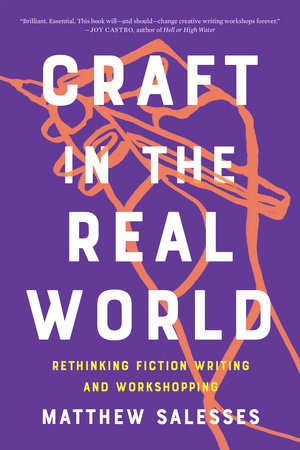
I raise this idea today in light of the current book I’m reading, Matthew Salesses’s wonderful Craft in the Real World. We talked a little about it yesterday, about how creative writing “workshops” unwittingly reinforce some patterns and prohibit others. He discusses the ways in which the fiction of different genres and different cultures represent insurmountable challenges for readers trained to workshop (yes, it’s a verb, too…<sigh>) in the traditional way. It’s an important book that I think will help a vast community of writing teachers reconsider their choices.

But, as is often the case with books about complex social issues, I’m compelled by his diagnosis while being less compelled by his prescriptions. He lays out a variety of alternative modes for presenting, reviewing, commenting upon and accepting the comments of others; individual readers may find some of those useful, others alien. But in his own example syllabus, which I find generous and hope-filled, there’s still a reversion to seemingly neutral terms like agency and conflict and stakes and tone. But as Salesses himself argued in the first half of the book, those things aren’t universally received, aren’t even universally necessary to fictions of different genres and cultures. These are all patterns that are only legible once we’ve named them and used them.

I think maybe all we have is the ability to seek out people who share our patterns; to learn other patterns as a matter of choice and breadth; and to be able to explain our own patterns to anyone else who seems curious. And we need to understand that when our work doesn’t excite someone else, it’s as likely to be a simple send/receive error as a matter of craft and talent. The writer and reader have different patterns, different rules, different expectations.


This raises an opportunity and a problem for creative writing as an academic discipline. The opportunity is for all of usโ€”faculty and students alikeโ€”to name the patterns we recognize and value, and to become more fluent in a broader array of patterns. The problem is that it leaves us susceptible to a radical relativism, a fallback to “it’s all good, man” that allows us to insist on the quality of our work and to blame the insufficiency of our readers to “get it.”

If reading and writing are modes of communication, then their quality resides in our mutual satisfaction with that communication. What one reader finds “clear” another finds “dull.” What one reader finds “challenging” another finds “bewildering.” What one reader finds “reassuring” another finds “rote.”

So maybe what creative writing programs should teach in class is the identification of patterns in fiction, and the self-identification of the patterns we most value as readers. And then the work of actually writing and judging and improving our own fiction comes when we’ve found our tribe; it happens away from classrooms, outside the curriculum, as acts of communication and friendship and love freely shared among friends.

Doing Nothing Is a Choice

If all you ever do is all you ever done, all you ever get is what you already got.

I’m in the midst of reading a terrific new book, Craft in the Real World, by Matthew Salesses (pictured above). In it, he questions the origins, functions and outcomes of our common beliefs about literary fiction, and then turns to the ways in which the “writing workshop” reinforce those beliefs, to the detriment of those whose identities or practices don’t fit that singular model.

Let’s back up. What exactly is a writing workshop? The term “workshop” implies a place where things get built, and a place where a master craftsman shows apprentices how to use tools, maintain materials, and learn the equipment and practices of a trade. But the writing workshop isn’t that. The master craftsman isn’t working on salable materials of her own in that space, and isn’t showing students how to move words around or select terms or introduce characters or deal with cultural difference. It’s not like a cabinetmaker’s workshop or an auto body workshop.

The writing workshop (which Salesses tracks back in origin to the University of Iowa in the 1930s and to a larger project in anti-communist cultural intervention) is a room with one instructor and eight or ten or twelve students. One of those students has sent her or his story to the rest of the group in advance, and the group comes in having read it, marked it up, and prepared to discuss it. During the discussion, the author is intended to be silent, so as to allow the other students to simply talk about what they found interesting or problematic, and to forestall writers’ defensiveness about “what they MEANT to do…”

Out of such good intentions comes a well-paved road to an often bad destination. And Salesses names a bunch of those bad destinations. Events in which people of color or LGBTQ+ people feel as though their powerlessness extends even to their own stories. Events in which the intentions of one genre are overwritten by the intentions of someone else’s genre. Events in which “the audience” is presumed to mean “people like me,” rather than people like the writer. Events in which words like conflict and stakes and story arc are tossed off as though they had a singular meaning.

The very best writing workshop I ever had was on the porch of the main house at Bread Loaf after the unproductive workshop of my story that had taken place in the reading group itself. That group of a dozen found themselves completely incapable of imagining Tim’s life and circumstances, wondered why he didn’t do X or why he thought Y. Applied their own concerns, argued about the character’s interpretation of events as though his interpretation wasn’t intended to be particular and specific to his circumstances. It was awful and unhelpful, as I imagine that it was for every writer over the course of those ten days. One story in particular, which I thought was just marvelous, was taken by the group and smashed to bits, each critic then reassembling the shards into her or his own mosaic. It’s really a pretty awful thing, which, to paraphrase Tolstoy, is awful for every participant in their own way.

But the next day, I sat on the porch with the workshop leader, Peter, and we had a true master-apprentice conversation about how I could literally speed up or slow down the pace of a scene to make it do even more of what I wanted it to do. It was the exact analogue to the cabinetmaker who says to the apprentice, “So if you want to make that kind of a curve, there’s a better tool to use to cut it.” And we talked for almost two hours not about interpretation or theme or mood, but about the actual work of creation, the materials available and their variety of uses. I learned more on the porch than I had from decades of writing instruction and a dozen traditional workshops.


We often repeat the things we know because we know them, and forget that the decision to do exactly the same thing again is a decision. It’s just gained momentum in such a way that we let it continue. We’re afraid of the decisions we could make, because we don’t know if they’ll work; but the decisions we’ve made for decades often don’t work, either. They’ve just become invisible.

There’s a lot of chatter, for instance, about electric vehicles. People are filling the conversation with chaffโ€”no fueling networks, precious metals for batteries coming from third-world political crises, the cost of disposalโ€”in an effort to distract and confuse. But listen. Henry Ford didn’t have fueling networks when he introduced the automobile; they arose to meet the demand. Oil comes from places with vast political crises, and plays into those crises. And rather than dispose of one thousand-pound battery every ten or twelve years, which is visible and easy to imagine, we currently dispose of seventy or eighty thousand pounds of gasoline or diesel fuel over that same period, which is invisible and goes into the sky rather than being visible and going into some repository. People pose problems with the possible, and never once consider the vast, unimaginable problems already present with the current.

Writing workshops are the same. We could go on forever with the cone of silence in which the writer sits helplessly off to the side while ten people misinterpret their work for an hour, but really, we don’t have to.

More tomorrow.

Works of Palliative Fiction

Let me prescribe a few of these.

Yesterday, we introduced the concept of palliative fiction, stories designed to ease suffering and renew strength. It can be hard, in our contemporary literary marketplace, to find the aisle where these over-the-counter aids are located. Just this morning, in fact, I saw a book praised for being “unsentimental,” a very sad and contemporary trait to celebrate. No, let’s look for some books that are, in fact, sentimental. Books that are motivated by generosity and hope.

Let’s start with an easy one: Walter Tevis’ The Queen’s Gambit. Yeah, the Netflix show was great, but you don’t know this story until you get into the weeds of this book. We meet Beth at age eight, when she arrives in the orphanage after her parents are killed in a car accident. Over the next couple of hundred pages, we watch Beth learn her powers at the board, occasionally falling to better players but using her anger at those losses to drive her to greater capability. We watch Beth become addicted to tranquilizers at the orphanage, watch her become more deeply held in their grip, watch her develop strength to resist. We watch her with her aimless adoptive mother, watch her learn some empathy for a woman she disdained. And none of her growth requires sudden superpowers. She has two superpowers right from her first moments at the orphanage: sheโ€™s fiercely intelligent, and she notices everything. Those two gifts underlie every action in the book, from sex to friendship to international chess tournaments. It is from front to back a novel with interest in agency, in Bethโ€™s ability to see and then to act.ย 

How about The Calligrapher’s Daughter, by Eugenia Kim. Just an amazing story, so rich, so careful. The Confucian culture of early 20th century Korea comes through in every sentence, every gesture, every refusal to speak. The complications are vast. Tradition and modernity. Confucian and Christian. Brother and sister. Husband and wife. Elite class and servant class. Good child and bad child. Occupier and occupied. Wife and mistress. Teacher and student. At every step, with every person she encounters, Najin has to make choices, and she agonizes over every single one, never certain upon which ground she stands.ย I increasingly value stories about people who always try to do the right thing, even when they have no idea what the right thing is. I’m tired of cynical, opportunistic, craven stories. Give me a story of someone generous, someone smart, someone intelligent enough to know that they don’t know.ย The Calligrapher’s Daughterย is exactly that.

Or maybe the best novel of the past twenty years that scarcely anyone’s heard of: Mayumi and the Sea of Happiness, by Jennifer Tseng. Mayumi, the narrator of this story, is a Japanese-British-American librarian who lets us completely, unguardedly, inside her mind as she navigates a web of relationshipsโ€”family, work, and (most especially) otherwise. She is disgusted and at peace with her husband, loving and exhausted with her daughter, at home and alienated from her work. And she is ashamed and impatient and delighted and brazen with her lover. Mayumi and the Sea of Happinessย is a treasure, a powerful and humbly honest story that defies summarization. I can’t recommend it highly enough.

I haven’t read his other books, but I stumbled across Kent Haruf’s final novel, Our Souls at Night, and I was immediately taken. Two small town neighbors, an older widowed man and and older widowed woman, turn to one another from simple loneliness and discover so much more. And together, they take on the project of reclaiming her grandson from his meager, uncaring family. A multidimensional book about the families we inherit and the ones we make.

YA literature is filled with books of hope and discovery. Two of my favorites are Sherman Alexie’s The Absolutely True Diary of a Part-Time Indian, and Rainbow Rowell’s Eleanor and Park. Any book where outsiders discover their capabilities, and discover people who can see and love those capabilities, is a win, and YA does that better than any other genre, because teenagers haven’t yet learned that being unsentimental is a good thing. Alexie tells the story of Arnold Spirit Jr., a delightfully profane young man who loves his family and friends but simultaneously wants something undefinably more, and struggles through his time away in a predominantly white high school to reconcile those two dreams. And Rowell puts two kids together who really don’t want to be, the Goth girl and the comic book boy, and lets them discover each other’s strengths.

There’s plenty more, but let’s start with these. I’ll write you another prescription later after you see how these go.

Palliative Fiction

Yeah, it’s tough, but we’ll make it. Maybe some of these books can help.

Palliative Care: an approach that improves the quality of life of patients and their families facing the problems associated with life-threatening illness, through the prevention and relief of suffering by means of early identification and impeccable assessment and treatment of pain and other problemsโ€”physical, psychosocial, and spiritual.

World Health Organization

Last night, Nora and I watched the first episode of the Lynn Novick / Ken Burns series on Ernest Hemingway, in which one of the chattering commentators praised him for fully capturing the “brutalizing era” that he saw around him. I’ve written before about the artistic valorization of suffering that supposedly makes literature serious. And Hemingway brought us fully into the violence of life: into war, into the bullring and the sport-hunting trip, and always into his toxic relationships with women. And I wonder, I really do, what we as readers gain from that. I’ve missed out on a vast amount of important literature because I’m just not interested. I finally three years ago read The Great Gatsby, which really isn’t anything more than an extended cut of The Real Housewives of Beverly Hills, in which every character has exchanged their last scraps of honor and decency for champagne and nicely wrapped shirts, covering the shambles of their misery with an expensive skim-coat of gaiety.

What do we gain? Can attending a dog fight do anything other than brutalize us just a little bit more?


A friend of ours wrote a few days ago that his obituary should include the line “and also penned what has been described as the two most profound books of poetry never to have been published.” Nora was deeply touched by that, and wrote back to him about the importance of doing work that may never be seen. And she wrote the following about my work: Herb talks about readers and wanting people who take pleasure in the characters he shapes, who identify with them, see themselves as better because of themโ€ฆbut then I have always said he is a pastor in writer\academic\municipal leaderโ€™s clothing. And that’s true. As a college teacher, I was less interested in teaching what I thought students “should know,” and far more interested in sharing my enthusiasms so that they might find their own.

Any career has three elements, and each of them requires a different role from its guides.

  • There’s technical or content knowledge, the things our tribe knows that others don’t. Our body of knowledge, our mode of discourse. College is really good at content knowledge, and the teacher’s job is to convey that.
  • There’s logistical knowledge, the tasks and tricks that we need to know in order to employ our content knowledge. We need to know how to schedule and how to budget, how to acquire good materials and how to quickly discern materials that won’t last. How to build and manage a team, how to find funding, how to keep a client happy. The training of that comes from the supervisor.
  • And finally, there’s emotional and strategic knowledge, the reasons why we do whatever it is that we do. We need to know what draws us, both in the proximal sense of interesting projects and in the distal sense of life mission. And that’s fostered by the mentor.

When I taught at Duke and at the Boston Architectural College, I was an adequate teacher and a decent supervisor, but I was attentive every day to being a mentor. That notion of “the life of the mind” really did speak profoundly to me, far more than any specific expression of it. My best students have gone on to be lawyers and doctors, writers and historians, urban planners and engineers. I’m agnostic about the mode of joy any individual chooses, favoring joy itself in whatever form it emerges.

I had a conversation once with the president of a college now loosely affiliated with a religious denomination. I asked whether there was any tension for him between the intellectual and religious roles he played. He said, “We can teach students what to think, or we can teach them how to think. It isn’t possible to do both.”


I’ve struggled for a long time to find a rapid descriptor of my “genre.” I’ve tried out men’s romance, which is kind of true but self-denigrating. I’ve tried out men’s fiction, as a mirror of women’s fiction ( the WFWA defines “the driving force of women’s fiction is the protagonist’s journey toward a more fulfilled self”), but men’s fiction just sounds like more of the Hemingway macho adventurism that got us into this mess in the first place.

But Nora’s comment last night clarified things for me. I want to ease suffering and encourage enthusiasm. I want to find a character I care about and write them toward safetyโ€”and by so doing, to write my readers toward safety as well. We have all suffered, and we’re all going to die. Our condition seems to be terminal. So a palliative fiction, borrowing from the WHO’s definition of palliative care, would be one that improves the quality of life of readers and those around them through prevention and relief of suffering, addressing pain that is physical, psychosocial, or spiritual. That feels like a worthy enterprise to me.

So, for the moment, palliative fiction will be the shelf tag. Tomorrow, I’ll recommend some.

Peer Review

Yeah, funny.

I think often about the differences between art forms: different expectations for who does them, how often, with what level of review or oversight or feedback. I have a friend who’s a brilliant wood turner, for instance. He treats each piece of wood as its own event, has almost never made the same thing twice. But he doesn’t take a bowl or a vase that’s drying after having been turned, and carry it to a colleague’s house and say “have a look, tell me what you think about that curve there.” No, he trusts his experience and his eye and he does what he wants. And when he’s accepted to a juried show, the jurors carry no expectation that they’ll be able to say “We’ll take it, but we have some recommendations…” No, they accept it or they don’t.

But writers are different from that. We belong to writers’ groups, send our work to be workshopped, sometimes more than once, while we’re working on it. If we’re lucky enough to have an agent take it on, that agent feels entirely warranted in making substantial recommendations about the book they see hiding inside the book we wrote. And then if that agent is lucky enough to sell it, the author goes through it all over again with an editor. I’m not complaining about thatโ€”I’ve had really wonderful relationships with a couple of different editors who’ve helped me make stories betterโ€”but I’m just noting it as a fundamental difference between craft practices.

That wood turner has made about five or six hundred beautiful things in a dozen years of work; that works out to maybe one a week. Each one might be two years in the making, but he’ll be working on a bunch of them at once, turning some and drying others and finishing yet more. I’ve made a dozen things in seven years, not quite two a year. And in the writing world, that’s suspect, the notion that someone might be able to write a novel in four or six months. It must be rote, formulaic. Hack work. (And working fast certainly CAN produce hack work. I read a novella today as one of my free downloads on my new iPhone, by a writer who’s written almost three dozen books in the same period since 2013 that I’ve been writing fiction. And good lord, it’s awful.)

So we have different expectations by pace, different expectations by nature of review and editorial input. It’s fun, as a counterfactual exercise, to imagine taking on another way of working. To say, as a writer, that I’m going to work rapidly, trust my training and my instincts about stories, and the people who’ll like it will like it. Everybody else can go on to the next booth.


I’ve been doing some academic coaching lately. And without putting a precise dollar amount on it, I can say that I’ve made about the same in the past five months of that work than I’ll have made from everything I’ve ever published in thirty years. (You can make your own case as to whether one is underpaid or the other overpaid.) And that coaching is only possible because I’ve had twenty years of practice at doing what I do around assessment. I’m able to work rapidly, trust my training and my instincts about how colleges work, and get good products onto the table reliably and fast. The novelist William Saroyan once wrote that “I can write better than anyone who can write faster, and I can write faster than anyone who can write better.”

I watch my friend Aimee make jiseung. She’s been doing it for decades, works incredibly fast and without oversight, and produces beauty. Now she’s in Korea, watching the “intangible cultural resource holder” Bak Seong-chun make bamboo screens. He’s been doing it for seventy years, works incredibly fast and without oversight, and produces beauty. Jazz players improvise every night. Decades of practice makes them reliable. But in the twenty-five years since he became a professional golfer, Tiger Woods has had a daily swing coach in all but six of those years, seeing the things that Tiger himself could not, tinkering and tweaking every day toward incremental perfection. So the role of collaboration and oversight varies even at the highest possible levels of different art forms.

I’m self-taught in almost everything I do, though that doesn’t mean that I haven’t had feedback. And we all are, aren’t we. We all taught ourselves how to cook and how to be parents or friends. We all taught ourselves how to drive, really, and how to read, really, with only the lightest forms of coaching along the way. No state licensing board requires a masters degree in parenting before one’s first child, and THERE’s a high-stakes practice, isn’t it? And with only a few guides along the way, I’ve taught myself how to write.

As Marge Piercy wrote in her brilliant poem “For the Young Who Want To,” every artist lacks a license to hang on the wall. We just do the work, over and over, and occasionally we ask someone to look over our shoulder.

Forego the Crocodiles!!

Don’t even think about it.

Letโ€™s ply some strands together today, shall we?

Strand 1. Back when I was in grad school, I discovered a faculty hobby: writing themselves extra salary. All these people had โ€œnine-month contracts,โ€ which meant that their salary was intended to represent nine months of service to the university (though their health care continued unabated over the summer). Those three summer months were free to do with as they pleased. And what they pleased was to write small research grants that included a summer stipend for two or three months of work at their pro-rated monthly faculty salary. They werenโ€™t embarrassed about saying that they were looking for summer support. Better than selling ice cream at the beach, I suppose.

Strand 2. A friend of mine, a deep and devoted student of Italian language and culture, wrote to me about the Italian guild system for protected crafts. โ€œThose inside it are well off and self-congratulatory as they ensure that the moat around them is filled with crocodiles. It is the reason why they stay inside its confines well past retirement and the young are left to rot outside the walls.โ€ Huh. I seem to remember a book about that a couple of years ago…

Strand 3. I picked up a copy ofย Poets & Writersย magazine on Saturday, because I clearly donโ€™t have enough opportunities already to torment myself. I was browsing their section on summer workshops and retreats, and I kept coming across one name over and over as a workshop leader. And no, I wonโ€™t tell you their name, but it’s ubiquitous. One major conference in April, another major conference in July, a third major conference in August. And by โ€œmajor,โ€ I mean a conference that even the most casual writers would have heard of.ย 

This person is a faculty member at an elite institution, teaching two courses per semester. An adjunct faculty member teaching two courses per semester would make about twelve grand per year, with no benefits. This faculty member, based on Chronicle of Higher Ed data for their institution and rank, makes about $125K plus substantial health care and contributions to retirement. On, you guessed it, a nine-month contract. Leaving plenty of time for socializing around the country, making a few grand per week for a) being a star, and b) occasionally commenting on the work of the desperate climbers.

Strand 4. I forget the writer who said this, but he claimed that the fundamental distinction between commercial and literary fiction is that writers of commercial fiction make their living from writing, and writers of literary fiction make their living from university patronage. They neednโ€™t actually sell much of anything, merely get the right publishers to put their work before the right awards committees. The author I mentioned in strand 3 published a novel twenty years ago, a second one five years ago, and a book of essays three years ago. Their total income from the royalties of all three of those books was likely at or slightly less than a yearโ€™s faculty salary. Perhaps quite a lot less.

The mystery writer Nevada Barr wrote 19 novels in her series about National Parks Ranger Anna Pigeon, between 1993 and 2016. Nineteen very good books in 23 years, not three books in twenty. And the first half dozen written while she was still working as a park ranger herself, not teaching elite undergrads in groups of a dozen.ย Her novels have been her primary job for a quarter of a century.

She’s not featured at three different writing conferences this summer. Because she writes commercial fiction. She’s not a member of the guild.


So what yarn shall we spin from these singles?

Well, the easy one is resentment, but letโ€™s try to avoid that one for a minute.

Another easy one is the unpredictability of the universe. But thatโ€™s kind of nihilistic, liable to become a sweater with one arm, or with five.

No, I want to re-create the yarn plied together a few years ago by Robert Frank, in his bookย Success and Luck: Good Fortune and the Myth of Meritocracy. Frank, an economist by trade, argued thatย of courseย talent and hard work matter in attaining success. But he demonstrated over and over that millions of people have talent and work hard and donโ€™t succeed, and that the last secret sauce is just having stood in the right place at the right time. Malcolm Gladwell also notes this, showing that all of the microcomputing billionaires were born between 1953 and 1956, so as to be at the right age when IBMโ€™s first personal computer became widely available in 1975. All of the social media billionaires were born in the late 1970s and early 80s, so as to be at the right age when free college server space and vast internet bandwidth were becoming normal.

Frank further demonstrates that those who recognize how lucky they were are more likely to try to manufacture that luck for others, whereas those who believe they did it all on their own are more likely to hoard it all, like self-congratulatory Italian guild members.

So letโ€™s take that as our lesson for the day. Those of us who got lucky (and yes, we were talented and worked hard, too, hereโ€™s a cookie) have a responsibility to build the conditions in which luck can fall more broadly. We have to introduce people around, make connections, get the work we like in front of the right readers. We have to make opportunities for our new colleagues, at every chance we get, knowing that weโ€™re already doing just fine.

Forego the moat and the crocodiles. Build the bridge instead.

Mysteries of Faith

We’ll get back to you, probably…

So I’m 62 years old, yay me. And that means that, as of 8:15 this morning, I was eligible to register for my first COVID vaccine. So I did. Sort of.

I logged onto the Health Vermont portal, using the account that I’d created last week. It didn’t like my password. It came straight from my Apple keychain, I didn’t mistype it or misremember it, but who knows. So I created a new password. Fine. Then I logged in, went to my account page, and there was no button for making a vaccination appointment. A testing appointment, yes, but no vaccination appointment. I opened a new browser window and looked at the video for how to apply online, and THAT showed a vaccination appointment button… but mine didn’t.

I logged out, and logged back in. No button. I refreshed my browser. No button. The phone system was, of course, jammed, and you couldn’t hold, just “call back later.” Logged out, logged back in again. Nothing.

Finally, a little after 8:30, I logged back in (for literally the twentieth or more time) and NOW there’s a vaccination button. So I went through the appointment sequence, verified that I didn’t currently have COVID and wasn’t allergic and wasn’t pregnant, and set an appointment for Saturday 3/27. Great, only two days away. I confirmed, logged out, and a confirmation email had already come into my inbox.

Done, right?

Oh, honey, NO! This is the internet! You’re never done.

Two hours later, I got another email saying that my appointment had been cancelled. Well, what the hell, at least I know how to do it now. So I log back in, go through the sequence again, and make another appointment, again this coming Saturday. No harm no foul.

Confirmation email comes in. Followed ten minutes later by another email saying that my appointment had been cancelled. I go back online, and now nothing’s available any time in the next two weeks!

So I bucked up and called the phone line, intended only for those elderly hermits who’ve never seen a phone that didn’t have a plastic dial on it. (Vermont’s got a lot of those folks.) It rang through, put me on hold… and disconnected me.

I called back, it rang through, and to my amazement, immediately connected me with an employee, a pleasant young man used to dealing with elderly hermits. “Let’s go ahead and get you started,” he said, in that tone used to get Grandpa to come down to the sunroom and work on a jigsaw puzzle.

I explained to him that I was young enough to use a computer, and that I’d already made two appointments that had subsequently been auto-cancelled. “Yeah, we’ve had a lot of technical problems this morning,” he said, “everybody who was making vaccination appointments got routed into testing appointments instead.” But at least I’d verified my online bona fides (bolstered further by my not having a hotmail or AOL email address), and he stopped coddling me and we got on with the job, laughing together a few times at the randomness of the world.


As frustrating as all of this was, it was at least possible, with great persistence, to get an answer, and ultimately to get through the door. There are innumerable things that we apply for that are completely opaque, for which neither answers nor rationale will ever be available.

Apply to a college, for instance, and the answer months later will be either yes or no, in either case with no elaboration. Apply for a job. Apply for a faculty position. Apply for a fellowship or a residency. Yes/No, usually long enough later that we’d forgotten we’d ever applied in the first place. No other options, no further knowledge. No one will laugh with you about the system failures. No one will even talk to you in their grandpa-voice about what’s going on at the call center.

And writers have it even worse. Slightly more than half of the queries I’ve ever sent to literary agents have simply evaporated. The other half: Yes/No. (Actually: No. In three cases, Yes, followed a few weeks later by No.)


I was listening last week to an interview with a writer I like, and she said that before her current big-deal magazine gig and book contract, she’d been writing for an online magazine, and was responsible for writing two or three pieces a week that would get a hundred thousand views each. She meant it as an illustration of the pressures of making one’s private life public, but I heard it a little differently. She, on her own, would never have been able to muster a hundred thousand views. Her magazine’s renown (and its subscription mechanisms and its daily e-mail blast) was responsible for at least ninety thousand of that, and she was responsible, more or less, for not damaging the brand, not squandering the platform she’d been given, adding her marginal gains onto the established endowment.

If you write for the Atlantic Monthly, let’s say, you’re guaranteed to have a couple of million views. As Elizabeth Warren is fond of saying, “You didn’t build that on your own.” You’re borrowing the king’s cloak. But we see that workโ€”just the quality of the work itself, not all the supportive infrastructureโ€”and we think to ourselves, “I can do that.”

That’s the bait we talked about yesterday. That logical sequence from I’ve been well trained and put in the training time to I’ve done a smaller version of this thing and had it highly praised to therefore, I ought to be able to get this thing, right? That sequence of thought is what makes us click on the submittal button and open the portal. But that last stepโ€”that word therefore that spans from empirical past to deductive prospectโ€”is where the bridge of logic collapses, where we’ve simply entered into matters of prayer that will or will not be answered. We will enter a world of silence, a limbo in which we are neither guilty nor innocent, merely set aside with all the uncountable others.

I’ve risen to that bait once again. It just looks so good. And the pursuit has given me the excuse to go back to a novel that I’d completed in draft but always knew had some weak areas, so that if I AM welcomed to paradiseโ€”by whatever miracle that I can’t invoke myselfโ€”I have something to offer St. Peter. But just the clicking of the button was traumatic, reawakened all of the fear of that invisible world. The world in which all the other kids are laughing at me, I just know it. All those other kids who know where the good parties are at, who call one another by nicknames, who’ve hung around each other every summer since they were in MFA together. As the founders of one notable literary journal said, “We didn’t even set out to do this, but we just knew so many people.” As is true for the afterlife, others must intercede on our behalf to get us through the gates.

That’s the difference, isn’t it, between the edible little fish that will nourish you and the balsawood minnow with the barbed treble-hooks that will pierce you and drag you along. If a patron knows you and asks for your work, it’s a fish. If you don’t know your potential benefactor, and you have to ask them to read your work, it’s a lure. But magical thinking comes true every rarely so often, which is enough to keep us imagining causality rather than grand cosmic accident.

It really does look like a fish, though, doesn’t it…

Rising to the Bait

Pretty, isn’t it…

One of the reasons I’m a vegetarian is that I have a low tolerance for violence. I understand: cycle of nature, food chain, blah blah blah… but one of the things that makes us human is that we get to choose how to participate, not merely play out some supposedly inevitable role as predator or prey.

I’m particularly annoyed by catch-and-release fishing, which is supposedly the humane, “sporting” alternative to eating what you bring home. But really, the only reasons to hunt and fish are a) to sit in the woods or on the boat and meditate, and b) to eat.

Let’s think about it from the fish’s point of view. The fish, I think, has a vocabulary of four words:

  • Whateverโ€”nothing special going on here, just chillax
  • Huhโ€”I wonder what that thing is over there
  • Yumโ€”I’m going to eat that thing!
  • FUCK!!!!โ€”That thing’s going to eat me!

I think that pretty much covers the gamut of fish inner monologue. (Some people, too.)

So here’s the short story of the catch-and-release experience from the fish’s POV.

Whatever.

Huh.

Yum!

FUCKFUCKFUCKFUCKFUCK!!!!!!!!!!!!!!!!

Whatever.

Excerpted from “What I Did Last Summer,” by pretty much every bass in third grade

The trauma may not be lasting, the fish may not have an enduring sense of self into which this momentary assault will be permanently fit, but it’s trauma nonetheless, and I don’t need to participate in it.


A lot of our lives is catch-and-release, though, isn’t it. Being an adjunct faculty member can be like this: just doin’ our scholarly thing, seeing an interesting opportunity over there, swimming over to be told that “you’re just the right person to teach this, we’ve had a need in this area for so long…” And we hit the bait, only then to discover the barbed hook and the lack of nutrients.

Being a writer is much the same: just doin’ our fiction thing, seeing an interesting agent or magazine, swimming over to deliver the pitch, and biting down hard just to be strung along and eventually tossed back.

But damn, that bait looks good.

Really, the ideal life of the writer is only the first couplet of this abbreviated poem of experience: whatever and huh. That is, happily writing, and being interested in something new to write about. It’s the second pair, the external forces, that introduce the danger. The glittering lure that draws us; the unseen barb that snares us, thrashing for our lives.

More tomorrow.

Systemic, Dude

So the last couple of days, we’ve talked about tribes, and alliances, and alienation. But let’s think about it not just in terms of individual bonds with our own communities; let’s go broader, and take an ecological look at why so many of us seem to be at odds with ourselves.

About 125 years ago, ร‰mile Durkheim proposed the idea of anomie, or the breakdown of values and norms. Although the term is often used to describe an individual’s state of mind, the real import of anomie is that it’s a collective condition; that our old rules don’t make sense any more. And certainly, in our year of COVID, it’s no surprise that we’re experiencing some anomie. We don’t get to be social, don’t get to hang out or date or go to class. But I think that there are a lot of forces of anomie right now: a confluence of absences.

  • More and more jobs becoming gigs, with everybody scrambling to stay one step ahead of the infinite crowd of replacements.
  • Tens of millions of college graduates, grad school graduates, med school graduatesโ€”well prepared and highly skilled, who played by the rules and excelled, now in numbers far too great to be employed.
  • A cultural cesspool of drive-by insults, of ill-will dropped into every online community from anywhere in the world. Maybe not even by humans.
  • A world of social rebalancing, in which mediocrity isn’t enough to protect white males any more, but excellence for women and people of color hasn’t yet brought about assured rewards (or safety).
  • The looming end of setting fire to fossil fuels, and the resistance of those still in the industry (and those for whom the artifact of a big-ass truck is a crucial validation).
  • The changing climate that reconfigures seasons and shorelines, that brings new weather and new crops and new pests.
  • The clinging decline of the Boomers, who sucked up all the air in the room and never made opportunities for anyone younger.
  • The crushing burden of wealth inequality, and the protection of its own power against the needs of hundreds of millions of hard workers.

I mean, just look around at any mode of human relations, and you’ll see the remnants of what had seemed stable, inevitable. To quote Marx, “all that is solid melts into air.” We’ve mastered a game that no one plays any more, and every time we try to learn the new one, we discover that’s already obsolete, too. I’ve gone through vinyl records and eight-tracks and cassettes and CDs and MP3s and MP4s. I’ve gone through MS-DOS and Windows 3.1 and Mac OS six through eleven. I was a star of my undergrad program and a star of my grad program and never had a chance on the academic market. All of us, doing everything we know how to do, within the context of events that cannot be predicted.

We’re asked to blame ourselves, to try harder, to do more. Our individualism sets us into perpetual competition, and so we look for scapegoats, people we can defeat, interlopers we should repel. As the old joke has it, three guys are sitting at a table with a dozen cookies. The capitalist has ten, the worker has one, and the consumer has one. And the capitalist says to the consumer, “watch out, that union guy’s going to steal your cookie.” We’re turned against each other, crabs clawing one another back down into the pot.


One of the most common conversations I’ve had since The Adjunct Underclass came out two years ago is some variant of “Yeah, it was like that for me, too.” So many people have just been relieved to learn that they are not uniquely defective, that their talents weren’t imaginary. That there are a vast body of others who’ve done well, done good, and done right, and not experienced any payoff from it.

Just as was true for the book, I offer no simple mechanism by which our anomie can be repaired. We are in an ecosystem, not a machine in which a lever drives a gear turns a shaft all in knowable proportion. But just that knowledge seems to be helpful: learning the fundamental wrongness of that all the cause-and-effect we’ve been taught gives us a chance to stop harming ourselves even further with a bad story. As Anaรฏs Nin wrote, “shame is the lie someone told you about yourself.” And those liesโ€”that you’re insufficient, that you haven’t worked hard enough, that the next round will for sure be the winnerโ€”have vast power if we believe them.

We won’t be able to imagine what’s next if we hang onto what isn’t.

Where Is Your Tribe?

Won’t you be… my neighbor?

The title question of today’s postโ€”where is your tribe?โ€”will be nonsensical to those over a certain age, and irrelevant to those under. The notion that community and physical place are interwoven was once taken for granted and is now bewildering.

Geographers talk about relationship “friction,” as in a force resisting movement. For a long time, physical distance offered huge amounts of friction. When it took four months to get from New Hampshire to the frontier in mid-Ohio, very few people did it, and hardly anybody did it more than once. Now I could drive that in one long day. in 1907, the British ocean liner HMS Mauretania set a record from London to New York, making the trip in just under six days. Now it’s closer to six hours, on any air carrier you like.

Private couriers became public mail. Physical mail became telegraphs, telegraphs became telephones, telephones became email and text. Each of those innovations reduced the friction of communication, allowed distance to be overcome more easily.

Economists also talk about friction, in similar ways. That ticket on the Mauritania to get you to New York in 1907 was a luxury item: a second-class one-way ticket, adjusted for inflation, was about five times more expensive than a coach-fare flight today. So the cost of travel is also a diminished frictional force. Superfast internet connection enables everybody with a phone plan to be in contact with anybody anywhere, and the idea of worrying about “long-distance charges” is long past. (My mom was a telephone operator, and “long distance” was a big freakin’ deal when I was a kid. Calling my aunt Martha, from our home in Michigan to hers in Ohio, was a twice-a-year event. Now my writing group meets every month by video, from Vermont to North Carolina to Sweden, at no per-conversation cost.)

So the friction of distance is almost gone… or is it?


Where are you? Right now, as you’re reading this, where are you? Open Google Maps and figure out how far away you are from Middletown Springs, Vermont. If you’re Tom, you’re about 2,100 miles away. If you’re Jenn, you’re about 1,850 miles away. If you’re Diana, you’re about 185 miles away. If you’re Hugh, you’re about two miles from our porch; if you’re Sudeshna, it’s 7,100 miles. Aimee’s usually 550 miles away, but now 6,800 for a few months. All good friends, all over the map.

I have lots of friends here in town, but when I think about their networks, the geographic circles are different sizes. One of the fundamental divisions in our town are the old Vermonters and those who’ve come from away (even if they might have come from away forty-five years ago). If you don’t have generations in the cemetery, you’re more or less a newcomer.

For the old Vermonters, geographical friction is stronger. Sure, they’ve got Facebook friends here and there, but the circle of conversations for lots of families is concentrated between the poles of Granville NY and Rutland VT, an hour’s diameter. They get their news from the Rutland Herald and the Lakes Region Free Press, and more fundamentally from friends at the store and through the car window.

I received eleven personal emails today. Five were local within five miles, the other six ranging from 320 miles to 3,100 miles away. I read articles in the New York Times, the New Yorker, New York Magazine, the Washington Post, the San Francisco Chronicle, the Atlantic Monthly, Inside Higher Ed

Where is my tribe?

I bought a cauliflower this afternoon, some blackberries, some turbinado sugar. I bought some onions, some cherry tomatoes, some lemons. I’m betting that those six produce items collectively traveled well over fifteen thousand miles to get here.

I would not do very well to be local. I would have less of interest to read, a different community of friends with a more enclosed body of interests and experiences. I would eat more seasonally, and less interestingly.

But I would know my local environment far more deeply. I would understand seasons in a completely different, full-bodied way. I would eat berries for three weeks every summer, and treasure them. I’d eat venison from the freezer for six months every winter, and remember where I’d shot it. I would know the same body of people from grade school to senior-citizen day at that same school eighty years later.

Where is my tribe?


I’ve learned to be multilingual over my life, to be an ambassador traveling between communities. I’ve learned ways to make my academic and professional skills beneficial to my small rural town, just as I had earlier learned to make my working-class upbringing a powerful tool for my scholarly and professional life.

But I think that’s left me globally alien, never quite at home anywhere. I read things like yesterday’s academic abstract and I roll my eyes, scarcely able to believe that anyone anywhere actually uses that heightened language. But I can tire quickly of local gossip at the general store, the unmediated conversations about I was gonna go into Rutland but then my sister called and she needed me to tell her how many eggs go into Aunt Sally’s squash bread, and I said, well, it depends on whether you’re using store eggs or fresh eggs… Honest to God, I’ve heard people fill twenty minutes without a single idea.

I don’t know who my tribe is, exactly, nor where. My very closest friends are from my life in higher education, spread across the United States… and from my life in Middletown Springs, within five minutes’ drive and in the same houses for twenty and thirty and forty years.

This blog is bilingual. It carries large ideas in small words, big concepts demonstrated through small examples. It shuttles back and forth between communities.

Let’s think about that word “alien,” and its paired idea of alienation. The Stanford Encyclopedia of Philosophy describes alienation as “the problematic separation of a subject and object that properly belong together.” It is a psychic state of disassociation between things that ought to be associated. We can be alienated from our family, or from our work. The hobbies that had once brought us pleasure can now feel remote and cold. In the most troubling sense, we can become alienated from ourselvesโ€”that we no longer recognize who we’ve become, can no longer make sense of ourselves. Every life crisis is a mode of self-alienation, that the story we’ve told about ourselves no longer hangs together but a new story hasn’t yet made itself evident.

Am I even part of my tribe?

More tomorrow.