
(Image by Allan Wadsworth, via Unsplash)
Many years ago, I had an older friend who’d been a government bookkeeper during WWII. One senior accountant on a raised platform faced the room, with thirty or forty workers down on the floor in row and column desks. Every so often, one of Tom’s co-workers would light a cigarette and lean back in his chair, seemingly pondering some difficult calculation but really just taking a five-minute eye-and-brain break from the endless stream of numbers flowing across the desk. When Tom did the same thing without the cigarette, the bossman would holler “Hawley! Get back to work!” So he did what any reasonable worker would do, and took up smoking.
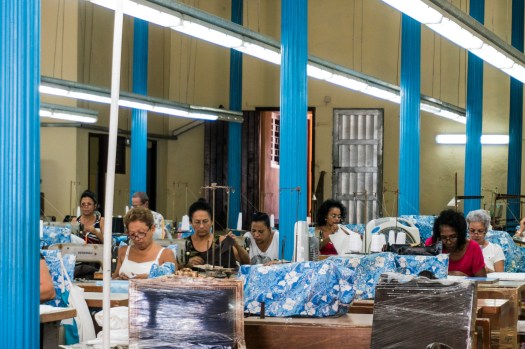
Etymonline.com shows the phrase “rat race” scarcely in existence at all prior to the war, and rising to its peak of usage in 1969. That growth paralleled the rise of bureaucratic culture, in which Taylorism, standardization, and the division of labor emerged from the factory floor and entered the office. (The male office, anyway. Taylorism and close observation had already been the main structure of women’s corporate working lives, from the Lowell mills to telephone operators to steno and typing pools.)
When each workday feels like the last, when someone’s job is to provide standardized outputs at a steady pace, that person has no attentional autonomy. That doesn’t mean they’re not skilled; Barbara Ehrenreich spent a year doing housecleaning and diner waitressing and hotel housekeeping, and said at the end, “There is no such thing as unskilled labor.” The skills and judgments one develops, though, are only focused on the immediate task provided. The miner may exercise a lot of judgment about the most productive and safest way to attack a wall, but the wall and extraction of coal therefrom is the only thing to pay attention to.
Years ago, when I was doing my dissertation in a rural high school, I started to see significant differences between students, but not only across the dimensions one would expect: intelligence, athletic ability, popularity and such. What I saw was four clusters of students that I framed my own X-Y quadrant diagram around.

High school is an attentional-deficit environment. Every fifty minutes, a new person insists on students’ full attention to yet another irrelevancy. They get yanked through six or seven attentional demands every day. The teacher John Taylor Gatto, in his 1991 acceptance speech for New York State Teacher of the Year (a speech he used to resign from the profession, saying “I can’t hurt children any more”), said that one of the hidden lessons of high school is that nothing really matters. We start and stop our engagement with any particular idea on someone else’s whim, rather than on our own progress or satisfaction with the work we’re doing. English-History-Religion-Algebra-Lunch-PE-Spanish, the screwing-on of knowledge-nuggets as we roll down the line. And in the end, we’re screwed.
It turns out that different groups of kids responded differently to the factory. Kids from middle-class families who were aimed at college and white-collar life did pretty well in school, but for different reasons. The ones who made themselves attentionally compliant, who did what they were told, were the “good kids.” I called them Believers—they endured the difficulties of the world in order to obtain the rewards sure to come. Others, though… they struggled against their bonds every day. They believed so strongly in the value of thinking that they hated being told what to think about, or when they should stop thinking about one thing and go on to another. They were the Theologians, who relied not on received wisdom but on self-determination. That girl in the back of Spanish II who’s secretly reading Cervantes… that’s a theologian.
Working-class kids who were moving toward blue-collar life right after high school also fell into the same two camps, but they looked different. The ones who were willing to comply—”whatever, dude“—were Agnostic to what was being presented, all of which was merely something to endure before lunch, before soccer, before graduation day. But the ones who pushed back had no aims to move toward, they just didn’t want to be herded. These were the “fuck you!” kids, the Infidels in detention or shifted off campus into the “continuation school” of post-expulsion and pre-emancipation.
High school, in principle, names its function as moving kids upward on that graph; giving them the tools they need to have a better shot in adult life. But what I saw, every day, was that the hidden function of high school is moving kids leftward, toward compliance. Compliance makes the machine run, whether you believe in the machine or not.
More soon.





 Herb Childress