Nora and I went to a show tonight. I won’t tell you who. This performer has endless talent, and a fifty-year career fully deserved. But… it felt like what you’d hear at a really sophisticated nursing home. Smooth liked mashed potatoes and gravy, comfort food.
All the greatest hits came out. And was good, this performer absolutely hasn’t lost any chops at all, gave us two full hours. But the crowd was restless, lots of meandering back and forth to the restrooms.
This puts me in mind of my own writing. It’s good, and I can totally give you a great reading experience. But—is it the SAME experience? Is it the nursing home, simultaneously excellent and familiar?
I’m putting together a collection of short stories from the last year or two, all having to do with people who are socially isolated for some reason or another. How alike are they? They range across fifty years, rural and metropolitan, poverty and wealth. But they have that common theme—how do people find themselves with no peers, no friends, no family? As I’m pulling them together, they feel… I don’t know, they feel glossy. Perfectly polished, perfectly accomplished. I know how that machine works, and I’ve got it tuned.
One of my favorite bands of the 90’s, the Crash Test Dummies, had three really great albums back to back at the start of their career. Their fourth album, Give Yourself a Hand, came with a sticker on the CD case warning that this one wasn’t much like the ones before. I didn’t much care for the new one, but they needed to make the change, and I respect that.
I’m left wondering what will come next. And I kind of like that feeling, even as it makes me unsettled. Will my fans follow me, or will I betray their expectations? (How many folk music fans does it take to change a light bulb? Five. One to turn the bulb, and four to complain that it’s electric.) I guess the next one might need a sticker.
A lot of work for a moment (Image by Towfiqu Barbhuiya, via Unsplash)
Our local theater company does an annual Ten Minute Play festival as a fundraiser for their educational programs. Mine was one of the four performed last night, and will be again tonight (come on by if you’re in the neighborhood).
It was a wonderful presentation. The director and actors found material there that they could inhabit, and the play became far more than my script. But because my brain just works this way, I was thinking earlier in the day about how much went into that ten public minutes.
There were eight plays presented over the two weekends. It took me about four hours to write mine, so we’ll say that’s thirty hours of donated time.
Each play was rehearsed three times, at two hours each. That’s six hours per play, times an average of three performers plus director plus playwright, so 6*5 is 30 hours; at 8 plays that’s 240 donated hours.
Dinner was included in the ticket price, so that’s ten people at two hours apiece making crockpots of soups or trays of desserts, times four nights: another 80 hours. Plus a crew of ten feeding people and washing up and taking admission, times four nights: another 120 hours.
The company’s leader herself probably put in at least another hundred on her own, laying out the website and managing ticket sales and scheduling the venue and the lights & sound.
So all of that—and there’s undoubtedly more—adds up to 500 to 600 hours. That’s how the world of volunteer communities works. Six hundred donated hours, compressed to what the public sees in the two hours of soup and salad and theater.
None of us know what it takes to create the things we consume so easily. Our life of gratitude would be full if we thought about all of the unseen behind the illusions of ease and convenience.
I grew up attending Bethlehem Lutheran Church, in western Michigan. Although I didn’t know it at the time, it was affiliated with the American Lutheran Church (ALC). All I knew was that it felt like home, and that its messages were about forgiveness, duty to others, humility, and mutual support.
I only came to recognize the uniqueness of my home culture when I entered another. For 7th and 8th grades, my folks sent me across town to Our Redeemer Lutheran School, which was affiliated with the Lutheran Church – Missouri Synod. The core messages there were pretty different, all focused on our need to accept Christ as our personal savior or face the eternal lake of fire. Forgiveness was focused on ourselves rather than others; our duty was to share the Good Word; our humility was rooted in Original Sin; and our mutual support was near to nonexistent.
Both of these communities relied not merely upon the same Bible, but upon the same man’s 16th Century commentary on the Bible. And they ended up in wildly different places: one gentle and hopeful, one self-centered and angry.
(When I then went to Catholic high school, with its extra books in the Bible and its extra sacraments and the elevation of Mary and the other saints… well, my conversion to anthropology was inevitable.)
I’m put in mind of all of that today as I sit quietly with my grief. We have started out with the same guiding documents, the same body of laws, and we have come to different places.
I will try to choose forgiveness, duty, humility, and mutual support. And because I’m fallible, I will fail, repeatedly. But for today, those principles sustain me. There’s work to be done, and only us fallible to do it.
I always imagine there’s a meter in your head, and this is positive and this is negative. And you’re just very lightly going through it and what you’re doing is reading that prose and watching that needle. And you’re not attributing cause, you’re not defending, you’re just watching. If the needle stays up in the positive, you’re good. And when you train yourself in this approach, you’ll see once in a while it’ll just drop. At that point, don’t say “Oh, no! I’ve failed. I have to go back to law school.” You just say very gently to the story, “What’s going on? I noticed that your needle dropped there, what do you think?” And if you approach it this way, eventually the story will say, “I don’t know, I’m just boring right here.” Once you get your defensiveness down, the story will very frankly tell you what’s wrong with it. And the fix is often quite simple. So my process is to read along in the story, hopefully keeping the needle up high. When it drops, don’t panic. You just keep going through the thing again and again, and eventually (you might be deluding yourself) you get to a point where it feels like the needle is up in the positive for the whole story. And then you’re done. — George Saunders
The story I started in August 2023 has a lot of good stuff in it. To paraphrase Saunders, quite a lot of it’s in the positive zone. But there are places where the story is clear in its negative self-assessment, by which I mean I’m bored when I re-read it. The problem is that I haven’t done the work to figure out exactly where that is, and exactly what’s boring about it (and what I mean by boring in the first place). To use Saunders’ analogy, I haven’t had a meter; I’ve just had an idiot light, a big red bulb that just says “This whole story sucks. Stop now!”
So for the past couple of days, I’ve much more patient and detailed diagnostic work. I’ve gone back into the manuscript and laid out each scene within each chapter, as preparation for putting the meter onto each one individually. Using the opening chapter as an example, it looks like this:
Chapter 1, which establishes Martha and George and the fact of well-to-do young adults in 1940
Scene 1—the friends at Antioch College in their last semester of senior year. Martha proposes to George, in a way (1,482 words)
Scene 2—They decide to tell their two families (476 words)
Scene 3—They visit Martha’s family in Toledo (793 words)
Scene 4—They visit George’s family in Detroit (3,327 words)
Scene 5—They commit to their future on their way back to school (317 words)
At this point, I’ve done this for the first seven chapters, about forty scenes total. Just through the work of naming the subsections, I’ve discovered (for instance) that Chapter 6 Scene 10 isn’t accomplishing anything worthwhile for the story as a whole, and I’ll probably dump the whole 1,188 words in favor of a sentence or two somewhere else.
All of this work does a few things. First, it forces me to slow down and take what I’ve done in small segments, thinking closely about each one. Second, it allows me to celebrate the ones that really are working; more than I thought, perhaps. Third, it makes me more careful in defining “works” and “doesn’t work.” What exactly do I mean by those judgments? Is the language fun? Is the dialogue real? Is the scene advancing the plot, or developing one or more themes? Is it introducing uncertainties that will have to come to fruition later on? I spent much of the day today on Chapter 3 Scene 6, helping it do three pieces of work simultaneously instead of just one.
If it’s done right, the reader won’t notice any of that; she’ll just be carried forward. But the writer is working from a sounder foundation.
This is what the inside of my head has been doing. (Image by Topsphere Media, via Unsplash)
It’s time.
2024 has been a productive and busy year, but it’s also been a creative lost cause. What exactly have I been doing?
The Town. Being chair of the Selectboard means that everything comes my way. When the Health Officer resigned, the board chair got that job by default. Three days later, a homeless drug user burned down the abandoned house she was living in after she was released from jail, and then the next day got bitten by all three of her dogs. We’ve had wildly contentious meetings about muddy roads and preserving trees and the quality of gravel from the local pit. When our transfer station attendant got a new job last December, one of the other board members and I have split the duties of running the place ourselves until we finally hired someone early last month. This is the year of renewal for our Hazard Mitigation Plan, and we’ve received a major grant for the renovation of a discarded Catholic church to become our new library (though we’re having trouble buying the building, with a new bishop coming in and the Diocese declaring bankruptcy… we should finally close a week from today).
The Election. Not merely the national scene, about which I’m optimistically terrified. Our local candidate for Vermont House needed Nora and I to step up and take over lots of campaign tasks. (There’s a whole story there—as Jack Webb used to say, names have been changed to protect the innocent.) Plus I’m a poll worker and an elections officer. The VT Secretary of State has issued guidance on what to do in the face of an active threat, and I’m seeing ads for junior-spaceman scam devices that supposedly detect wireless signals from voting machines to some secret web server where the Chinese-Venezuelan Jews can steal the election… there’s just a lot of lunacy out there. I’d say I’m looking forward to next Wednesday when it’s over, but in the Orange Era, elections are never over; they just turn into baseless, endless lawsuits. Or armed gangs.
Coaching. I led a writers’ group from September to May, which came to a trickling close when the specified end date arrived. I never knew how to be helpful. Maybe I was.
Work. I’ve taken on an external-evaluation job for a Federal grantee, which includes everything from questionnaire development and data analysis to buying 200 coffee gift cards for individual participants, all at a distance of 2,550 miles.
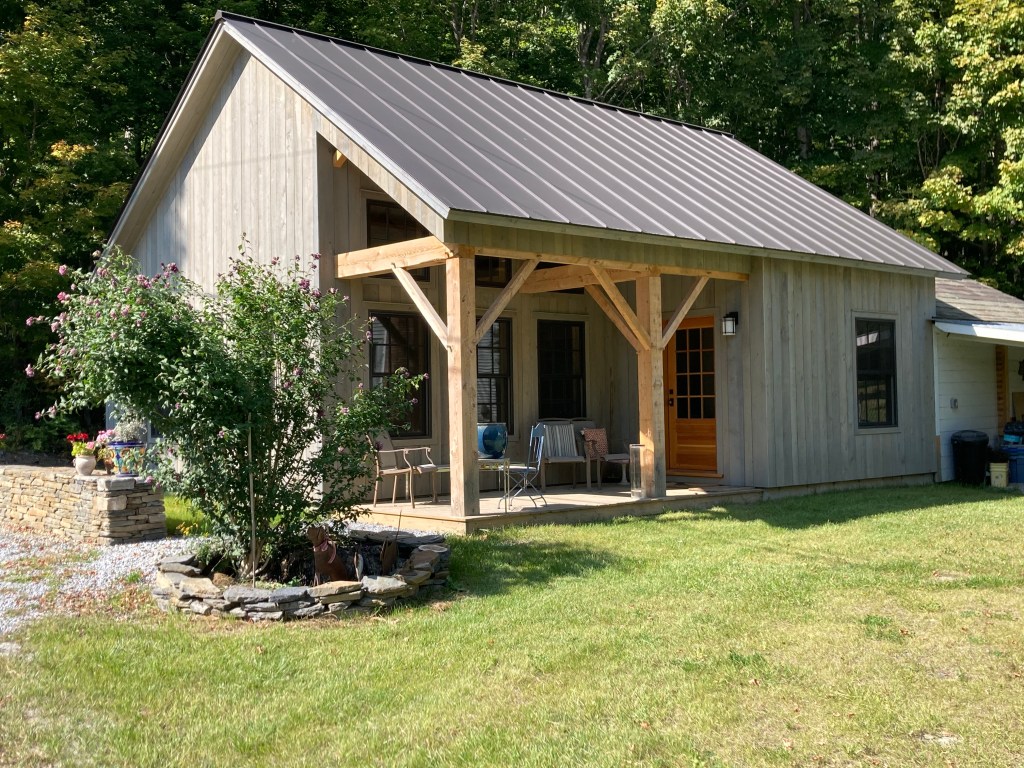
Home Life. It seems like we’ve had people over for dinner or potlucks, or staying with us for a few days, on every square of the calendar. It’s been a super-social year. And that’s before we get to the big project, which was the construction of our studio. It’s a treat (one of our neighbors called it “a public good”), but it occupied most of a year, from September to September.
Project by Glenn Tarbell, Tarbell Carpentry, Middletown Springs VT
With all of that going on, I haven’t made any space to just write. I’ve sat at the keyboard plenty, to no avail. I keep knowing that something’s going to come up, looking over my shoulder at all of my real and imaginary tasks, and so I don’t have the confidence to just go away for hours at a time and live in another world.
Writing isn’t about typing. It’s not about proofreading, or editing. Those things are all true, but they aren’t what writing is. Writing is fully inhabiting another life, as emotionally filled as my own. And that takes not merely time, but also permission. Permission I haven’t granted myself for a year.
I started this blog back in 2019, when The Adjunct Underclass was coming out. Since then, I’ve written three novels I’m really proud of; the blog was part of the discipline that let them emerge. But since last fall, I’ve had two really good ideas for a novel. And as the writer and teacher Robert Owen Butler says, if you have a good idea for a novel, you’re going to write a bad book. Stories don’t come from good ideas. They come from the spirit world, from what he calls “the place where you dream.” So I’ve driven those two books sixty or eighty pages into the swamp, with no hope of retrieval. That becomes its own cycle, work that doesn’t work that convinces me that I can’t do the work. Easier and safer to just lose myself to internet head.
So it’s time to be back, to clear the culvert and let the flow come free. Glad to see you.







 Herb Childress